HCPCS Code J1560: Gamma globulin IM injection billing guide
HCPCS Code J1560: Official descriptor and covered services HCPCS Code J1560 carr...

Last Updated: Nov 11, 2026
J1640 is the HCPCS Level II code for injection, hemin, 1 mg. It reports Panhematin, the intravenous hemin given for acute porphyria attacks, and one unit equals 1 mg administered.
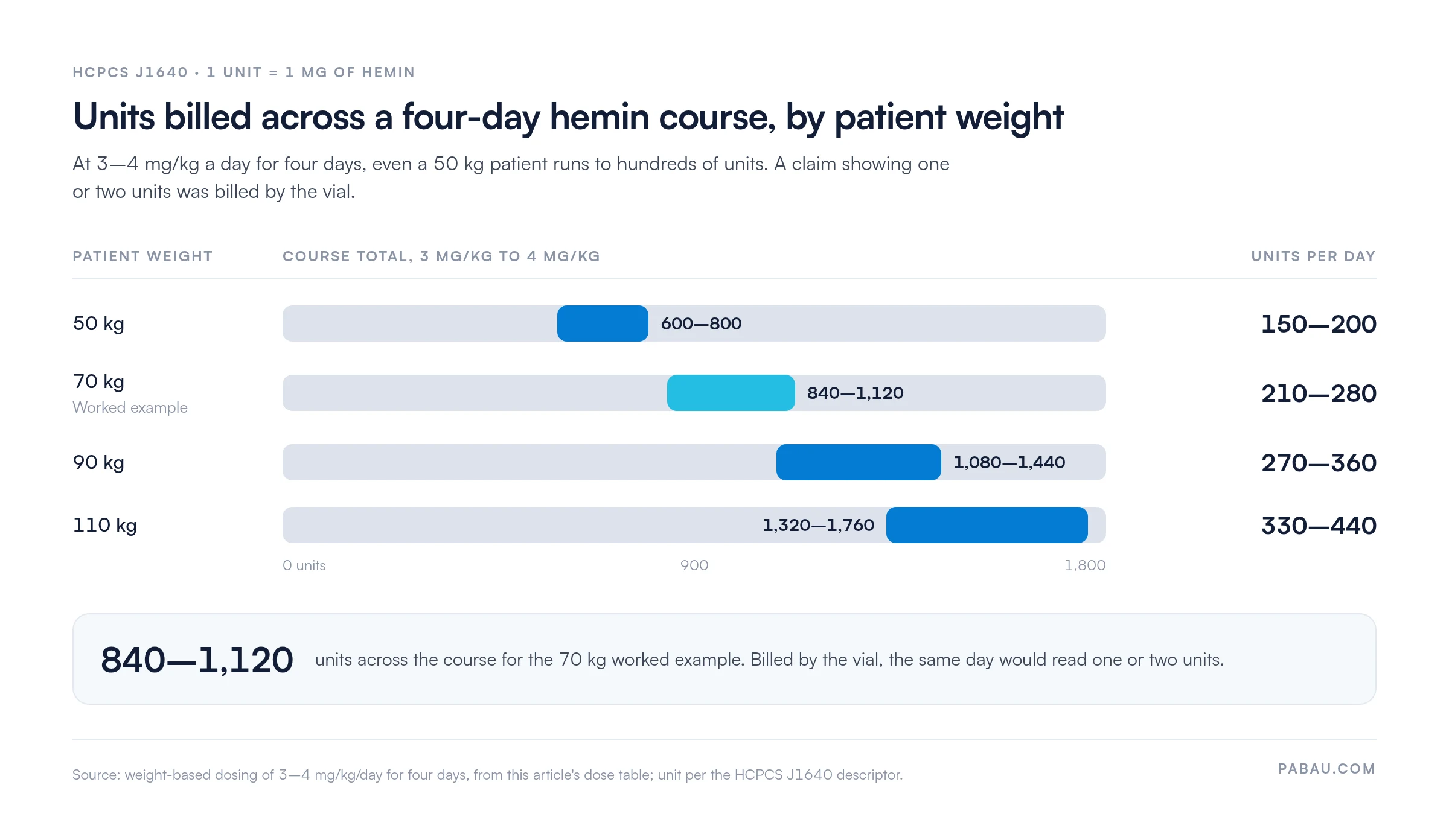
The drug is billed by the milligram, never by the vial. A typical course of 3–4 mg/kg a day for four days gives a 70 kg patient 840–1,120 units in total. The infusion itself is billed separately with a CPT administration code.
Let Pabau's smart automation suggest the right codes, reduce claim denials, and keep your practice compliant—effortlessly.
Automate repetitive tasks and focus on what matters most—your patients.
Reduce coding errors and ensure compliance with the latest regulations.
Clean claims, fewer denials, and faster reimbursements.
Powerful insights and reporting to help your practice thrive.
HIPAA compliant SOC 2 certified GDPR-compliant Trusted by 4,000+ clinics worldwide

HCPCS Code J1640 bills hemin injection per 1 mg, not per vial, so the milligrams given set the unit count on the claim.
A typical course of 3–4 mg/kg a day for four days gives a 70 kg patient 840–1,120 units in total.
E80.21 is the most specific diagnosis code for acute intermittent porphyria, and a nonspecific porphyria code is a common denial trigger.
The FDA label covers recurrent, menstrual-cycle-related attacks of acute intermittent porphyria, so wider hepatic porphyria use is off-label and payer policies vary.
Medicare pays J1640 at ASP plus 6% in a physician office, and the rate changes every quarter.
Pabau’s claims management software sends claims through the Claim.MD clearinghouse and tracks the prior authorization on the patient’s case.
HCPCS Code J1640 is assigned the official descriptor Injection, hemin, 1 mg. Hemin is a naturally derived iron-containing porphyrin that suppresses the hepatic ALA-synthase enzyme driving porphyrin overproduction during an acute attack.
The brand name is Panhematin, manufactured by Recordati Rare Diseases, and it is the only FDA-approved intravenous hemin product available in the United States.
The code sits within the HCPCS Level II J-code range, which CMS maintains for drugs administered by injection or infusion and not typically self-administered. J1640 is active and valid for the 2026 code year with no descriptor change from prior years.
J1640 is used to treat acute attacks of the hepatic porphyrias. These inherited disorders disrupt heme synthesis, so toxic porphyrin precursors build up. The FDA label is narrower than that use.
It covers recurrent attacks of acute intermittent porphyria (AIP) tied to the menstrual cycle, once carbohydrate loading has proved inadequate. Wider use, including porphyria variegata and hereditary coproporphyria, is off-label.
Payers expect documentation to show an acute attack is underway, not a stable or latent phase. The chart should capture neurological or abdominal symptom onset and elevated urinary porphyrin precursors (ALA and PBG). It should also record why the treating physician chose hemin over supportive care alone.
Treatment guidelines support hemin for acute attacks of any acute hepatic porphyria. Payers differ on how closely they follow the label, though. Check the plan’s drug policy before an off-label course, because some plans deny it whatever ICD-10 code is billed.
Every J1640 claim requires a valid porphyria diagnosis code. A missing code, or a nonspecific one where a more specific code exists, is the most common reason J1640 claims come back. Check the payer’s local coverage determination (LCD) for the accepted code set, as some plans restrict coverage to E80.21 alone.
Code to the highest specificity the record supports: E80.21 for confirmed AIP, and E80.29 for variegata or hereditary coproporphyria. Expect E80.20 to draw extra scrutiny, and check the payer’s coverage criteria before submission.
Run a diagnosis code audit before the first infusion visit rather than at claim submission. If the chart documents only a family history of porphyria and elevated lab values without an acute attack, the claim will deny. Confirm E80.21 (or the applicable subcode) is in the problem list and tied to an acute episode note before billing J1640.
J1640 is billed per 1 mg of hemin, not per vial. A Panhematin vial contains 350 mg of lyophilized hemin, reconstituted to about 336 mg of hematin in 48 mL.
The typical regimen is 3–4 mg/kg a day for four consecutive days. For a 70 kg patient at 4 mg/kg, each daily dose is 280 mg. That is 280 units of J1640 a day and 1,120 units across the course.
Over a full four-day course the totals climb into four figures, so a claim showing one or two units stands out at once.
Most payers expect the National Drug Code (NDC) alongside J1640 on a drug claim. Place the 11-digit NDC in the drug identification loop of the 837P, or in the shaded area of the CMS-1500 paper form.
Enter the N4 qualifier, then the NDC, then the NDC quantity. For a powder vial like Panhematin, that quantity is usually the number of vials, with the unit of measure UN. Confirm the format with your clearinghouse.
Record the NDC and the vial’s lot number at the infusion, so neither has to be hunted down at submission. A claims management workflow that flags a blank NDC field before the claim leaves catches the rest.
The place of service (POS) codes most often used with J1640 are 22 (on-campus outpatient hospital), 19 (off-campus outpatient hospital), and 11 (office). The setting also decides the payment system. Hospital outpatient claims are paid under OPPS, and office claims under the physician fee schedule.
In a physician office, Medicare pays HCPCS Code J1640 at the Average Sales Price (ASP) plus 6%, the standard method for Part B drugs. In a hospital outpatient department, payment falls under the OPPS Addendum B rate.
Both rates update quarterly, in January, April, July and October. The allowed amount for J1640 in Q1 2026 may therefore differ from Q3 2026.
Hemin is a high-cost orphan drug with limited market volume, so its ASP can move noticeably between quarters. Find the current quarter’s payment limit for J1640 in the CMS ASP pricing files before each billing cycle. Never rely on a rate pulled more than one quarter ago for a drug this expensive.
Commercial payers and Medicare Advantage plans set their own allowable amounts, which may be above, at, or below the Medicare ASP+6% benchmark. Some commercial payers reference average wholesale price (AWP) instead of ASP.
Check each plan’s formulary and fee schedule separately. Tracking these across payers is where a systematic revenue cycle management workflow makes a material difference on a drug this expensive.
Prior authorization (PA) is required by most commercial payers and many Medicare Advantage plans for J1640. Traditional Medicare (Parts A and B) does not require PA for outpatient drug claims, but Medicare Advantage plans may set their own. Medicaid programs vary by state. Some require PA for every course, others only for repeat courses.
Obtaining PA before the first infusion matters. Hemin infusions often start in a hospital during an acute attack, which leaves little time. Many plans offer a concurrent or retrospective pathway for emergencies.
Those pathways need documentation that the situation was urgent and the team could not wait for prospective review. Good medical billing compliance practice means setting up the PA workflow before the patient is in crisis, not after.
J1640 denials cluster around five root causes. Understanding which error produced the denial determines whether the corrective action is a resubmission, a corrected claim, or an appeal. Good denial management strategies start with tracking denial reason codes, so patterns surface before they compound.
J1640 covers only the drug itself. The intravenous administration is billed separately with a CPT code, and the infusion’s length decides which one. CPT treats an infusion of 15 minutes or less as an IV push, so record the start and stop times.
National Correct Coding Initiative (NCCI) edits govern bundling between administration and drug codes. They update quarterly, so check the current edits before submission. Building a clean claim means confirming that no other service billed that day bundles the administration code.
Hospital outpatient departments bill on the UB-04 instead, with J1640 under revenue code 0636 and the administration code under 0260. Confirm with the facility billing team which claim form applies.
This checklist covers what a billing team needs before submitting a J1640 claim. Work through it at the point of care, not at the billing workstation, and the common denial triggers never reach the claim. The medical billing workflows that suit rare-disease drugs treat documentation as a clinical step.
For practices billing J1640 regularly, build a dedicated drug billing checklist into your intake workflow rather than relying on the standard encounter form. Capture patient weight, lot number, actual mg administered, and PA number at the point of infusion. Those four details head off three of the five denial reasons in the table above before the claim is built.
On many infusion teams the dose lives in the chart, the vial in a stock sheet and the authorization in an email. The biller then rebuilds the claim from all three, which is where unit and authorization errors creep in.
In Pabau, the practice management platform we build, those details sit on one patient record. Stock carries its lot and expiry, and the lot is recorded against the patient and the appointment. The prior authorization code, dates and sessions are tracked on the case, with a warning when one is missing.
US claims go out as 837P claims through the Claim.MD clearinghouse, with eligibility checks before the visit and ERA remittances posted back. A short-paid J1640 line then shows up against the patient it belongs to, not at month-end reconciliation.

Pabau sends claims through the Claim.MD clearinghouse, checks eligibility, and tracks prior authorizations on the patient’s case. See how it handles a weight-based drug claim like J1640.

J1640 is easy to look up and easy to get wrong, because every figure on the claim comes from a weight and a dose. Put the weight, the milligrams and the authorization into the record at the infusion, and the claim follows from them.
Leave them for the billing desk, and a course worth more than a thousand units can come back denied for a single field. A few minutes at the bedside cost far less than weeks of appeals. Book a demo to see how Pabau carries the infusion record onto the claim for high-cost drugs like hemin.

Looking to improve claim accuracy before submission? Building a clean claim outlines the data elements payers check on first pass and how to get them right.
HCPCS Code J1640 covers injection of hemin, billed per 1 mg administered. The FDA label for hemin (brand name Panhematin) covers recurrent attacks of acute intermittent porphyria related to the menstrual cycle, after carbohydrate loading proves inadequate. Guidelines also support it for other acute hepatic porphyria attacks, but that use is off-label. The infusion itself is billed separately with a CPT administration code.
Bill one unit of J1640 per milligram of hemin administered. At 3–4 mg/kg a day, a 70 kg patient receives 210–280 mg a day, so the claim shows 210–280 units for that date of service. Billing by vial (1–2 units) instead of by milligram is the most common unit error on J1640 claims.
Yes, Medicare Part B covers J1640 when it is billed with an accepted porphyria diagnosis code, most commonly E80.21 for acute intermittent porphyria. The drug must be given in a covered setting, such as a physician office or hospital outpatient department. Medicare Advantage plans may add prior authorization requirements that traditional Medicare does not have.
Prior authorization is required by most commercial payers and many Medicare Advantage plans. Traditional Medicare Part B does not require it for J1640 in the outpatient setting. Medicaid rules vary by state, and some programs require PA for every treatment course. Always verify with the payer before the first infusion.
Medicare pays J1640 at the Average Sales Price plus 6%, and the rate updates every quarter. Take the current figure from the CMS ASP pricing files for the quarter in which the drug is given. A rate from a prior quarter, or from a coding tool that is not updated quarterly, risks billing at the wrong allowable.
The five most common denial reasons for J1640 are incorrect units, a weak diagnosis code, missing prior authorization, a missing NDC, and a place-of-service mismatch. Tracking denials by CARC code shows billing teams which error costs the most.