

HCPCS code J2690: Procainamide units and billing guide
What HCPCS code J2690 covers, and what it does not HCPCS code J2690 reports R...

Last Updated: Oct 30, 2026
J1071 is the HCPCS Level II code for injection, testosterone cypionate, 1 mg. Each billing unit equals 1 mg, so a 100 mg dose is 100 units and a 200 mg dose is 200 units. The code replaced J1070 and J1080 on 1 January 2015.
Use J1071 when your practice buys the drug and a clinician injects it. Most denials come from three errors. Teams bill with the old 100 mg unit logic, confuse cypionate with enanthate (J3121), or leave the NDC off Medicaid claims. Check those three before you submit.
Let Pabau's smart automation suggest the right codes, reduce claim denials, and keep your practice compliant—effortlessly.
Automate repetitive tasks and focus on what matters most—your patients.
Reduce coding errors and ensure compliance with the latest regulations.
Clean claims, fewer denials, and faster reimbursements.
Powerful insights and reporting to help your practice thrive.
HIPAA compliant SOC 2 certified GDPR-compliant Trusted by 4,000+ clinics worldwide

HCPCS code J1071 bills testosterone cypionate injection at 1 mg per unit, so a 200 mg dose is 200 units.
J1071 replaced J1070 and J1080 on 1 January 2015, and J3000 is streptomycin, not testosterone.
Testosterone enanthate bills under J3121, and Azmiro, a branded testosterone cypionate, bills under J1072.
Medicaid requires the NDC, with the quantity in milliliters, while the HCPCS units stay in milligrams.
On Medicare claims, add JZ or JW only when the dose comes from a single-dose vial.
HCPCS code J1071 is the Level II code for testosterone cypionate given by injection, billed at 1 mg per unit. You report it when your practice buys the drug and a clinician injects it. The CMS HCPCS system added the code on 1 January 2015.
Before then, practices billed this drug under J1070 (up to 100 mg) or J1080 (1 cc, 200 mg). CMS retired both codes and moved testosterone cypionate to a single 1 mg unit. As a result, the unit count on your claim now matches the milligrams in the chart.
J1071 covers one drug, given by a clinician. The products below each have their own code, or they sit outside a drug claim entirely. Matching the vial to its entry in the HCPCS Level II library is the first check on any injectable claim.
Cypionate and enanthate are different testosterone esters, and CMS codes them separately. Both now bill at 1 mg per unit, so the unit math is identical. Only the drug name tells you which code to use.
Check the vial label or the purchase invoice first, then the administration note. If the two disagree, fix the record before the claim goes out. And never bill a code just because it is the default charge in your system.
Count one unit for every milligram injected. A 100 mg dose is 100 units, and a 200 mg dose is 200 units. Because doses come in whole milligrams, there is no rounding.
The classic error is billing 1 or 2 units, which follows the retired 100 mg codes. That claim pays for 2 mg instead of 200. Also make sure the units match the milligrams in the note, because auditors compare the two.
Under the Deficit Reduction Act of 2005, state Medicaid programs must collect NDCs on physician-administered drugs, and most states require them on all such claims.
Many Medicare Advantage and commercial plans ask for them too. Original Medicare doesn’t generally require an NDC on a professional claim, yet strong medical billing compliance captures it every time.
Watch the units, because the NDC quantity uses a different measure. HCPCS units count milligrams, while the NDC quantity usually counts milliliters. So a 200 mg dose from a 200 mg/mL vial is 200 HCPCS units and ML1 on the NDC line.
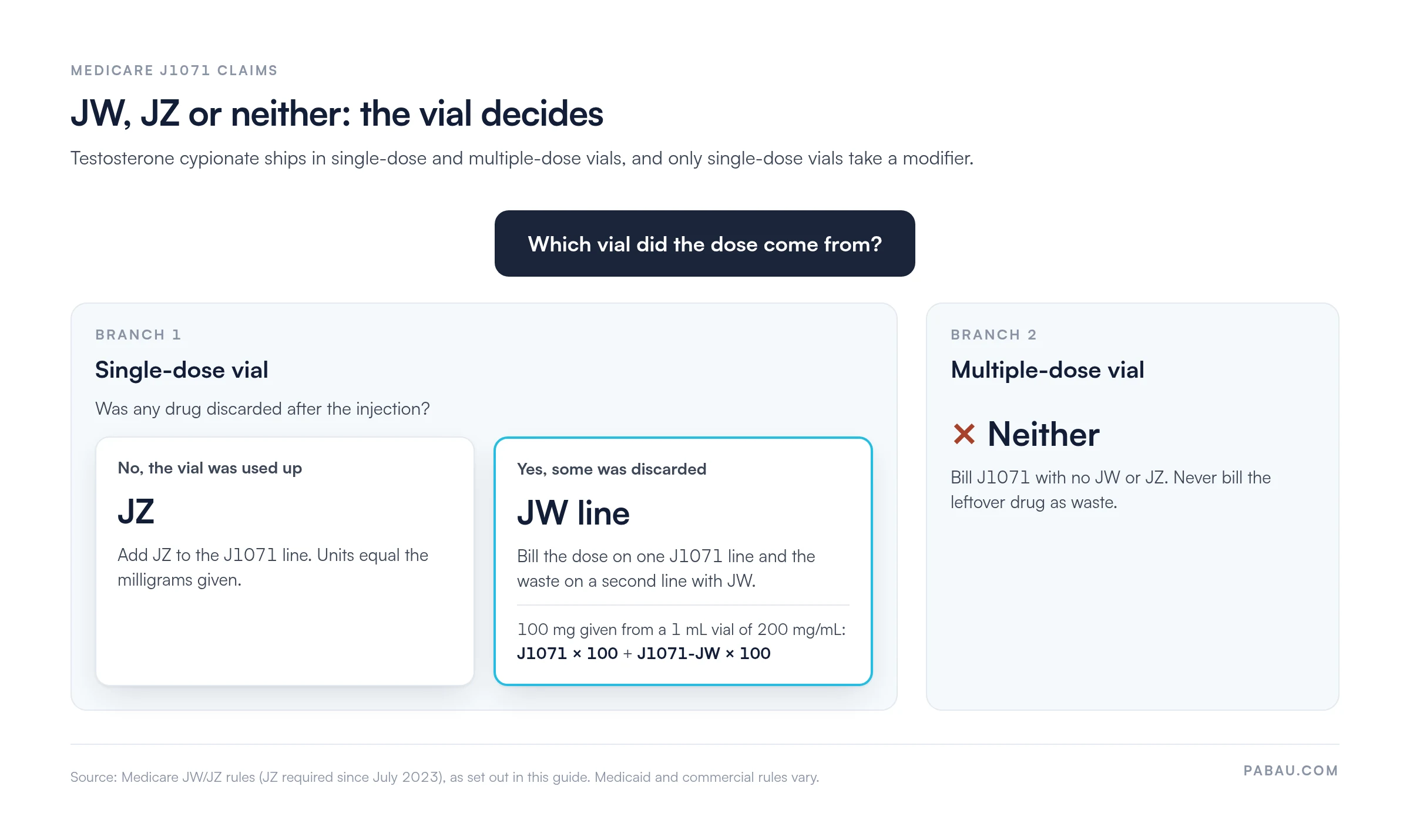
Medicare’s JW and JZ modifiers apply only to drugs from single-dose containers. Testosterone cypionate comes in both single-dose and multiple-dose vials, so check which one you opened.
Here is an example. You give 100 mg from a 1 mL single-dose vial of 200 mg/mL. Bill J1071 × 100 units, then J1071-JW × 100 units. The note should show the vial size, lot number, dose given and amount discarded. The diagram below maps each vial type to its modifier.
J1071 pays for the drug, while CPT 96372 pays for giving it. 96372 covers a therapeutic, prophylactic or diagnostic injection, given subcutaneously or intramuscularly. In the office, bill both lines on the same claim.
Two pairings cause most trouble. First, Medicare does not allow 99211 alongside 96372, so a nurse-only visit is never billed with the injection. Second, a separate E/M visit on the same day needs modifier 25 and its own documented work.
Setting matters too. In a hospital outpatient department, the hospital usually buys the drug and bills it on the facility claim. Your practice then bills neither J1071 nor 96372 for that visit.
Every J1071 claim needs a diagnosis that shows why testosterone is medically necessary. Most payers want documented hypogonadism, backed by low morning testosterone results. The lab test behind those results bills separately under CPT 84403.
Coverage lists differ by payer, so check the plan’s testosterone policy before you rely on a code. A diagnosis one plan accepts may fail at another.
Record the total testosterone level, the reference range and the collection time before the first claim. Many plans want two low morning results before they approve therapy.
Original Medicare pays J1071 under Part B at average sales price (ASP) plus 6%. CMS updates the ASP pricing files every quarter, so use the file for the date of service. The per-unit rate looks tiny because the unit is 1 mg, so multiply before you judge a payment.
Part B covers J1071 only when a clinician gives the injection during the visit. Each Medicare contractor also keeps a self-administered drug exclusion list. If your contractor lists testosterone cypionate, Part B won’t pay for it, even in the office.
Original Medicare has no national prior authorization program for J1071. Medicare Advantage and commercial plans often require one, and Medicaid rules vary by state. Check the plan’s rules before the first injection, not after the denial.
A typical request includes the following:
Run this list on every testosterone injection claim. Each line matches a common denial reason. Keeping the order and the dose on one record makes the check faster.
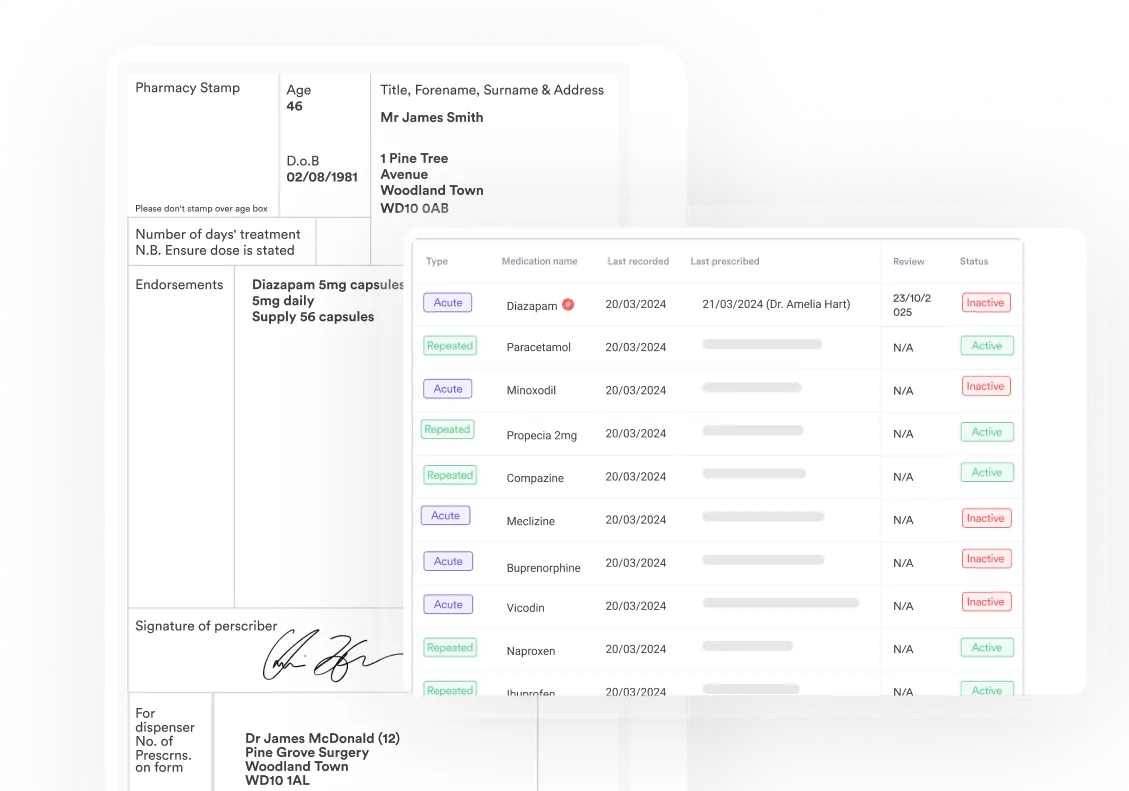
A complete superbill captures most of these fields before the claim is batched. That way, the billing team never has to guess.
J1071 denials follow a short, predictable list. Good denial management tracks which one hits most often. Then you fix that step in the workflow, instead of correcting each claim by hand.
Testosterone billing usually breaks at the handoff between the treatment room and the billing desk. The dose, vial and lot sit in one place, while the claim gets keyed somewhere else. Each retyped field is a chance for a 2-unit error.
Pabau, the practice management platform we build for medical and aesthetic practices, keeps both halves on one patient record. Its error-checking claims software pre-fills the CMS-1500 from the patient’s invoice. It also flags missing or invalid details, such as authorization codes, before you send.
In the US, claims go out through Claim.MD, with eligibility checks before the visit, claim-status tracking and settlement from ERA files. So your team spends less time chasing testosterone claims and more time with patients.

Pabau pre-fills claims from the patient’s invoice and flags missing details before you send. See how it fits your testosterone therapy workflow.

J1071 rewards precision more than effort. Get the code, the milligram units and the vial type right, and most testosterone claims pay on the first pass. Get one wrong, and the error repeats on every injection until someone audits it.
So start with last month’s testosterone claims and run them against the checklist above. Fix the default charge in your billing system first, since one wrong setting spreads to every claim. Book a demo to see how Pabau turns the injection record into a clean J1071 claim.

Billing injectable drugs across multiple practice locations? What is revenue cycle management covers how end-to-end RCM strategy reduces drug-code denials at scale.
Need a reference for your full claims process? Clean claim checklist walks through every element a payer needs to process a claim without a request for additional information.
Filling in NDC details by hand? CMS-1500 form guide walks through each box, including the shaded drug lines in Box 24.
Waiting on a testosterone approval? The prior authorization process sets out a step-by-step workflow for getting payer approval before the first dose.
Yes. Testosterone is a Schedule III controlled substance under federal law. Your practice needs a DEA registration to order and store it. Keep a dispensing log that matches the lot numbers in your J1071 notes.
Payers often want compounded drugs billed under J7999, compounded drug, not otherwise classified, rather than J1071. They may also ask for the invoice or NDC details. Check the payer policy before you bill a compounded vial.
Yes, if the visit covers a separate problem or decision. Add modifier 25 to the E/M code and document that work apart from the injection. Never pair 99211 with 96372, because Medicare bundles the nurse visit into the injection.
No. Xyosted is a testosterone enanthate autoinjector that patients use at home, so it runs through the pharmacy benefit. Aveed is testosterone undecanoate, and it bills under J3145 when a clinician gives it.


