

HCPCS Code G0163: Skilled nursing observation and assessment
What is HCPCS Code G0163? HCPCS Code G0163 is a deleted Level II code for skille...

Last Updated: Oct 15, 2026
J0791 is the HCPCS Level II code for injection, crizanlizumab-tmca, 5 mg. It bills Adakveo, an infusion that reduces vaso-occlusive crises in sickle cell disease patients aged 16 and older. The code has been active since July 1, 2020.
One unit equals 5 mg, so a 70 kg patient at 5 mg/kg bills 70 units. Most J0791 denials trace to unit errors, missing prior authorization or an unsupported diagnosis code.
Let Pabau's smart automation suggest the right codes, reduce claim denials, and keep your practice compliant—effortlessly.
Automate repetitive tasks and focus on what matters most—your patients.
Reduce coding errors and ensure compliance with the latest regulations.
Clean claims, fewer denials, and faster reimbursements.
Powerful insights and reporting to help your practice thrive.
HIPAA compliant SOC 2 certified GDPR-compliant Trusted by 4,000+ clinics worldwide

HCPCS code J0791 bills crizanlizumab-tmca (Adakveo) at 5 mg per unit. The FDA approved the drug in November 2019, and the code took effect on July 1, 2020.
Units are weight-based: Divide the prescribed mg dose by 5, then round up to the next whole unit. A 70 kg patient at 5 mg/kg = 350 mg = 70 units.
Most Medicare Advantage, Medicaid managed care and commercial plans require prior authorization, and a missing one is the top denial driver for J0791.
Report the infusion with CPT 96365, and put NDC 00078-0883-61 in the shaded area of line 24A. Every single-dose vial claim needs JW or JZ.
Pabau’s claims management software runs validation checks before submission, so a missing authorization code or membership number is caught before the payer sees it.
HCPCS code J0791 is the Level II HCPCS code for crizanlizumab-tmca injection, maintained by the Centers for Medicare and Medicaid Services (CMS). Its official long descriptor reads: Injection, crizanlizumab-tmca, 5 mg. The short descriptor is Inj crizanlizumab-tmca 5mg. The code has been effective since July 1, 2020.
Crizanlizumab-tmca is a humanized anti-P-selectin monoclonal antibody manufactured by Novartis and marketed as Adakveo. P-selectin is a cell adhesion molecule that plays a central role in vaso-occlusive crises (VOCs). By blocking it, crizanlizumab reduces the frequency of pain crises in sickle cell disease (SCD).
J0791 is reported in increments of 5 mg. Dosing is weight-based at 5 mg/kg per the FDA-approved label. To calculate the number of units to bill, divide the total milligrams administered by 5.
The Adakveo prescribing information sets the schedule at 5 mg/kg IV at week 0 and week 2, then every 4 weeks. The drug comes in 100 mg/10 mL (10 mg/mL) single-dose vials, so one full vial equals 20 billing units.
Bill only the units administered. When a partial vial is opened and the remainder is discarded, report the wasted portion on a separate J0791 line with the JW modifier. If the entire vial content is administered with zero waste, append the JZ modifier to confirm no drug was discarded. The modifier section below covers both in detail.
Put together, a 70 kg patient’s visit produces the five claim entries shown below.
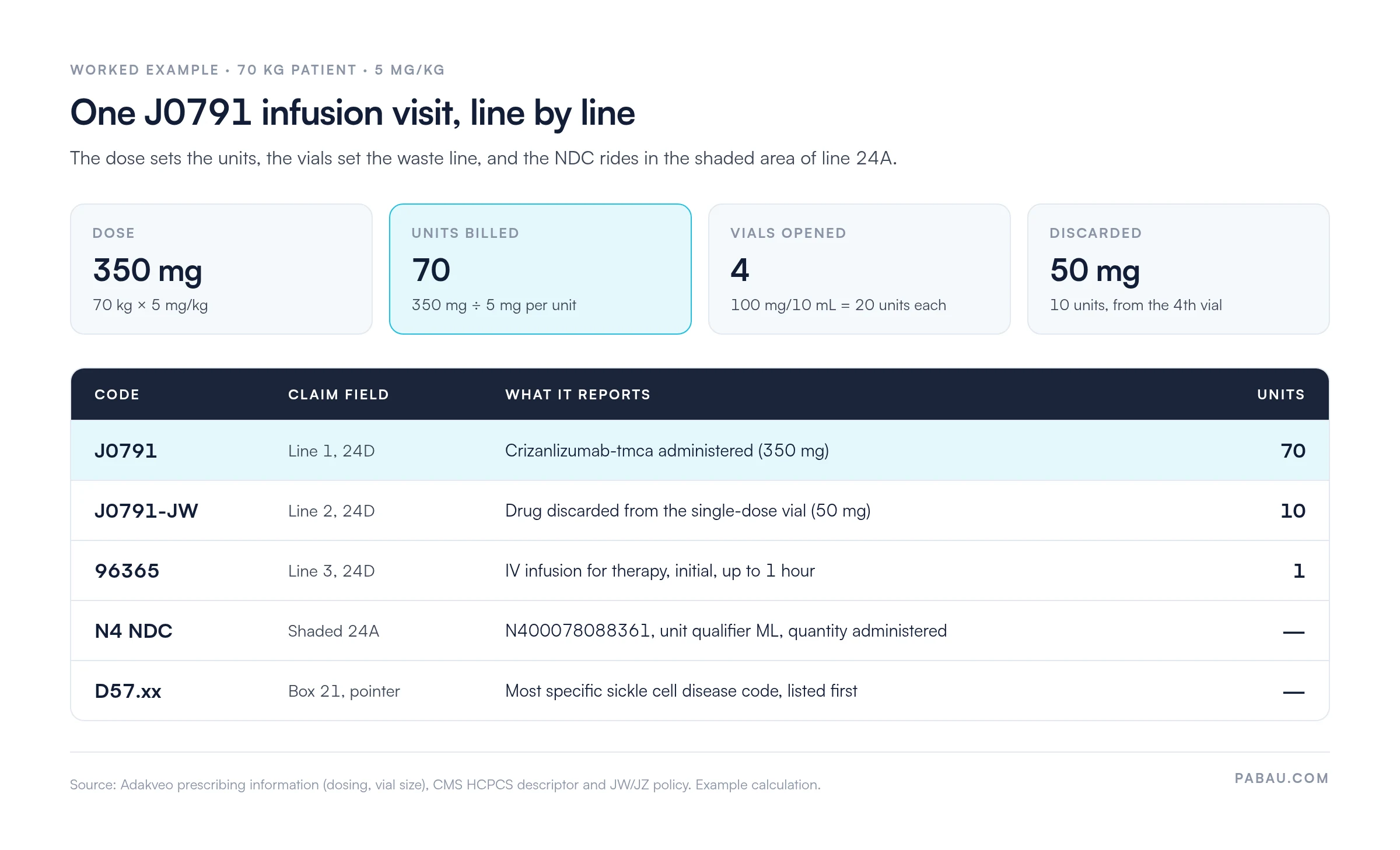
J0791 is a drug code only, so it does not capture the infusion service. Report the administration separately with the appropriate CPT code, per AMA CPT guidelines. Crizanlizumab is a non-chemotherapy therapeutic infusion given IV over 30 minutes, so the initial service is 96365. A second drug infused afterward on the same visit adds 96367.
Place of service (POS) changes what Medicare pays for the administration service, not for the drug. The facility rate applies at POS 22 (hospital outpatient) and POS 23 (emergency department). The non-facility rate applies at POS 11 (office) and POS 49 (independent clinic). The J0791 drug payment is ASP-based and does not vary by POS.
Always confirm the correct POS with the treating facility before submitting. Building a superbill documentation template that locks in the J0791 and CPT pairing prevents the most common coding inconsistencies at this step.
Every J0791 claim requires at least one ICD-10 diagnosis code from the D57 sickle cell disease category. The code must reflect the SCD type documented in the medical record. Submitting an unspecified code when a more specific one is available is a common cause of medical necessity denials.
D57 codes build specificity in layers. The 4th character names the genotype and crisis status, such as D57.0 for Hb-SS disease with crisis. The 5th character, and the 6th where one exists, names the crisis complication. D57.0 itself is a non-billable parent category, so a claim needs D57.00 through D57.09 instead.
Payers typically require a documented history of vaso-occlusive crises as a coverage criterion. Code the primary SCD diagnosis first, then add any complication or symptom codes as secondary. Standalone pain codes (G89.x, M54.x) without a D57 primary code will almost certainly trigger a medical necessity denial.
NDC (National Drug Code) reporting is required by Medicaid fee-for-service in all states and by most commercial payers. Many Medicare Advantage plans also require it. A J0791 claim missing a required NDC is rejected automatically. Pabau, the practice management platform we build, includes claims software for practices that runs validation checks before each claim is sent.
Always source the current Adakveo NDC from the FDA NDC directory or the current package insert. An outdated NDC on a claim is a rejection trigger. These requirements are part of broader medical billing workflows for specialty drugs.
Most Medicare Advantage plans, Medicaid managed care organizations and commercial health plans require prior authorization (PA) for J0791. Traditional Medicare fee-for-service does not require PA for J0791 under current policy. Still, verify with the patient’s Medicare Administrative Contractor (MAC). Submitting without PA when a plan requires it is the most common reason J0791 claims are denied.
eviCore healthcare manages utilization review for J0791 on behalf of many commercial and Medicare Advantage plans. Criteria vary, so verify them with each payer before submitting. Payers, including eviCore, typically apply these clinical criteria:
PA documentation should include the full medical record supporting each criterion above. A complete, organized PA submission cuts the back-and-forth with the plan and speeds up approval. Clean claim submission discipline starts at the PA stage, not at claim filing.
Under Medicare Part B, J0791 is reimbursed using the Average Sales Price (ASP) methodology, at ASP+6% for the drug component. CMS updates ASP every quarter, so the payment rate changes four times a year. Look up the current quarter’s rate in the CMS ASP pricing files before estimating reimbursement.
Commercial and Medicaid managed care plans may require the drug to come through a specialty pharmacy rather than buy-and-bill. In that scenario, the pharmacy bills for the drug, not the infusing practice. Confirm the dispensing channel during the PA process.
Two modifiers govern drug waste reporting on J0791 claims. CMS requires every claim for a single-dose vial drug to carry either JW or JZ, showing how any leftover drug was handled. Omitting both is a compliance risk and can trigger post-payment audits.
Verify current JW/JZ guidance with your MAC before applying, because CMS updates modifier policy details. Commercial and Medicaid modifier requirements vary, so review each payer’s billing guidelines separately.
Document the exact number of units administered and the number of units wasted in a separate notation in the patient’s infusion record. This documentation must match what appears on the claim line for J0791 with JW. Auditors look for this pairing.
Two kinds of code get mixed up with J0791 most often. One is the set of codes billed before J0791 existed, and the other is injectable drugs given to the same patients. Billing the wrong one causes denials and potential compliance issues.
J0791 denial patterns are consistent across payer types. Most trace to missing documentation or administrative errors that billing staff can correct before submission. Understanding the denial codes that accompany each rejection narrows down the root cause quickly.
Appeal clinically appropriate denials with the original PA approval, the complete infusion record, and a letter of medical necessity from the treating hematologist. A structured denial management strategy that tracks J0791 denials by reason code shows which fix removes the most volume.
Check the AAPC HCPCS code lookup to confirm the current descriptor and any payer-specific edits before resubmission. For a broader lookup, the PGM Billing HCPCS lookup tool pulls current CMS data and is a quick reference for coders.
Infusion teams often build a J0791 claim by hand from the infusion note, the PA letter and the vial log. One mismatched unit count or missing authorization number can send the claim back weeks later.
In Pabau, each patient is linked to their insurer, and the claim is built from the invoice with those details already filled in. Validation checks run in the background, so a missing membership number or authorization code is flagged before submission.
US practices send claims through the Claim.MD clearinghouse, check eligibility in real time, and post electronic remittance advice (ERA) against the right invoice. Every claim’s status sits in one view, from pending to paid, so a stalled J0791 claim gets spotted early.

Pabau’s claims management tools help infusion practices track HCPCS drug codes, unit quantities, modifier requirements, and prior authorization status to reduce denials and accelerate reimbursement.

J0791 claims rarely fail because of the drug itself. They fail on the details around it, such as a unit count that doesn’t match the documented weight or a PA that lapsed between cycles.
Treat each infusion visit as a checklist. Confirm the PA and the D57 code before the patient arrives. Then reconcile the vial log against the JW or JZ line before the claim goes out. Those few minutes cost far less than a denied claim billed at dozens of units.
Book a demo to see how Pabau checks each J0791 claim before it reaches the payer.

Looking for a step-by-step denial resolution guide? Denial management in healthcare covers how to categorize, appeal, and prevent common payer denials by claim type.
Need to understand the full claims submission process? How a medical claims clearinghouse works explains how claims move from practice to payer and where errors surface.
Want to tighten up your superbill for specialty drug visits? Building an accurate superbill walks through how to include drug codes, CPT pairings, and diagnosis linkage on a single billing document.
Billing another injectable for the same patients? HCPCS code J0895 covers deferoxamine mesylate units, documentation, and the claim errors to watch for.
HCPCS code J0791 is used to bill for crizanlizumab-tmca (Adakveo), a biologic infusion for sickle cell disease. It reduces vaso-occlusive crises in patients aged 16 and older. Each unit represents 5 mg of the drug, and the code has been effective since July 1, 2020.
Bill the total milligrams administered divided by 5. For example, a 60 kg patient receiving 5 mg/kg = 300 mg administered = 60 units billed. Report wasted drug on a separate J0791 line with the JW modifier.
Yes, for most payers. Medicare Advantage, Medicaid managed care, and commercial plans typically require prior authorization before administering crizanlizumab. Traditional Medicare fee-for-service generally does not require PA, but verify with the patient’s MAC. Always confirm PA requirements with the specific plan before each administration cycle.
Yes. J0791 is covered under Medicare Part B as a provider-administered drug under the buy-and-bill model. Reimbursement is based on ASP+6%, with rates updated quarterly. Check the current CMS ASP drug payment file for the applicable quarter’s rate before estimating revenue.
Yes, for Medicaid fee-for-service claims and most commercial payer claims. Report the current Adakveo NDC (00078-0883-61) in 11-digit 5-4-2 format. It goes in the shaded area of line 24A on the CMS-1500 with the N4 qualifier and the unit of measure in ML.
CPT 96365 (IV infusion for therapy, initial, up to 1 hour) is the standard companion code for J0791, since the infusion runs about 30 minutes. CPT 96366 is added for each additional hour, which is rare with standard crizanlizumab dosing.




