CCSD code H4430: Examination of rectum under anaesthetic
CCSD code H4430 pays for the examination alone CCSD code H4430 is the UK private...

Last Updated: Oct 20, 2026
J0743 is the HCPCS Level II code for injection, cilastatin sodium; imipenem, per 250 mg.
Imipenem-cilastatin is reserved for serious gram-negative, gram-positive, and polymicrobial infections that narrower agents cannot cover. Accordingly, this reference covers the descriptor, unit calculation, the Medicare payment basis, the NDC crosswalk, documentation requirements, and the errors behind most J0743 denials.
Let Pabau's smart automation suggest the right codes, reduce claim denials, and keep your practice compliant—effortlessly.
Automate repetitive tasks and focus on what matters most—your patients.
Reduce coding errors and ensure compliance with the latest regulations.
Clean claims, fewer denials, and faster reimbursements.
Powerful insights and reporting to help your practice thrive.
HIPAA compliant SOC 2 certified GDPR-compliant Trusted by 4,000+ clinics worldwide

HCPCS Code J0743 describes injection, cilastatin sodium; imipenem, per 250 mg.
Each billing unit equals 250 mg, so a 500 mg dose is 2 units and a 1,000 mg dose is 4 units.
In addition, most payers require an NDC alongside J0743 on the CMS-1500 or the 837P claim file.
However, J0742 covers Recarbrio, a different drug that must never be billed as J0743.
In turn, practice management software like Pabau keeps the dose, the units, and the NDC on one record.
HCPCS Code J0743 is a Level II HCPCS code maintained by the Centers for Medicare and Medicaid Services (CMS). In practice, it describes a specific drug, route, and quantity that must match the administered dose on every claim.
The semicolon in the official descriptor separates cilastatin sodium from imipenem. Indeed, the two agents are co-formulated. Specifically, cilastatin inhibits the renal enzyme dehydropeptidase-I, which stops the kidney from breaking imipenem down. Both components are present in every vial, and the code covers Primaxin or any FDA-approved generic imipenem-cilastatin product.
Incorrect unit calculation is the single most common source of J0743 claim errors. To do this, divide the total milligrams administered by 250 to get the number of units to bill. Then round to the nearest whole unit under your payer’s rounding policy.
Rounding policy: CMS instructs providers to round to the nearest whole unit. In practice, most payers follow the standard half-unit convention for a dose that falls between exact multiples of 250 mg.
Bill the next full unit up when half a unit or more is used, and the lower unit when less is used. Confirm your MAC’s local policy, because some commercial payers round differently.
Bill only the dose actually administered, not the dose drawn from the vial. For example, if 750 mg is drawn and 50 mg is discarded due to clinical factors, document the amount administered (700 mg) and bill 3 units. Never bill for wasted drug unless your payer explicitly reimburses wastage and your documentation supports it.
Medicare Part B reimburses provider-administered drugs under the Average Sales Price (ASP) methodology. Specifically, for HCPCS Code J0743, the payment rate equals ASP + 6% per unit, updated quarterly by CMS. Because ASP changes each quarter, no static dollar figure in this article will remain accurate for long. Therefore, always verify the current rate against the quarterly CMS ASP drug pricing files. The Physician Fee Schedule lookup tool carries physician services, not drug ASP pricing, so it is the wrong source for this code.
After a claim processes, the electronic remittance advice (ERA) shows the allowed amount per unit billed. In turn, reconciling that against your expected ASP rate catches underpayments early, before they turn into write-offs.
MAC jurisdiction affects whether the claim is covered at all. For instance, different Medicare Administrative Contractors administer Part B claims across US regions. The ASP + 6% formula is national, but a MAC’s local coverage determination can decide whether imipenem-cilastatin is payable for a given indication. Check your own jurisdiction’s policy before the drug is administered.
Check the CMS ASP drug pricing file each quarter (January, April, July, October) and update your practice management system’s expected reimbursement rate for J0743. Over time, a 10-cent-per-unit discrepancy on a patient receiving 1,000 mg four times daily adds up to significant underpayment across a month of infusion visits.
Most payers require the National Drug Code (NDC) alongside HCPCS Code J0743 on the claim. In fact, CMS requires NDC reporting on Part B drug claims submitted on the CMS-1500 and 837P electronic claim file. Specifically, the NDC identifies the specific product administered: manufacturer, formulation, and package size. Imipenem-cilastatin is available from multiple manufacturers, each carrying a different NDC.
The table below lists representative NDC codes. Verify each one against the current AAPC HCPCS code reference and the CMS NDC-to-HCPCS crosswalk file before submission. In particular, manufacturer NDCs change when a product is reformulated, discontinued, or relabeled.
NDC billing format: CMS requires the 11-digit NDC in a 5-4-2 format on paper claims (CMS-1500, Box 24A). By contrast, on 837P electronic claims, the NDC goes in Loop 2410. In addition, include the unit of measure qualifier (UN for units, ML for milliliters, GR for grams) and the NDC quantity dispensed. As a result, a missing or misformatted NDC is among the most common denial reasons for J-code drug claims.
Every J0743 claim needs documentation that proves medical necessity, confirms the dose administered, and supports the units billed. Payers audit drug claims at higher rates than office visit claims, so a thin record turns into a denial or a post-payment recoupment.
In total, four decisions sit between the infusion and a payable line item, and each one fixes a different field on the claim.
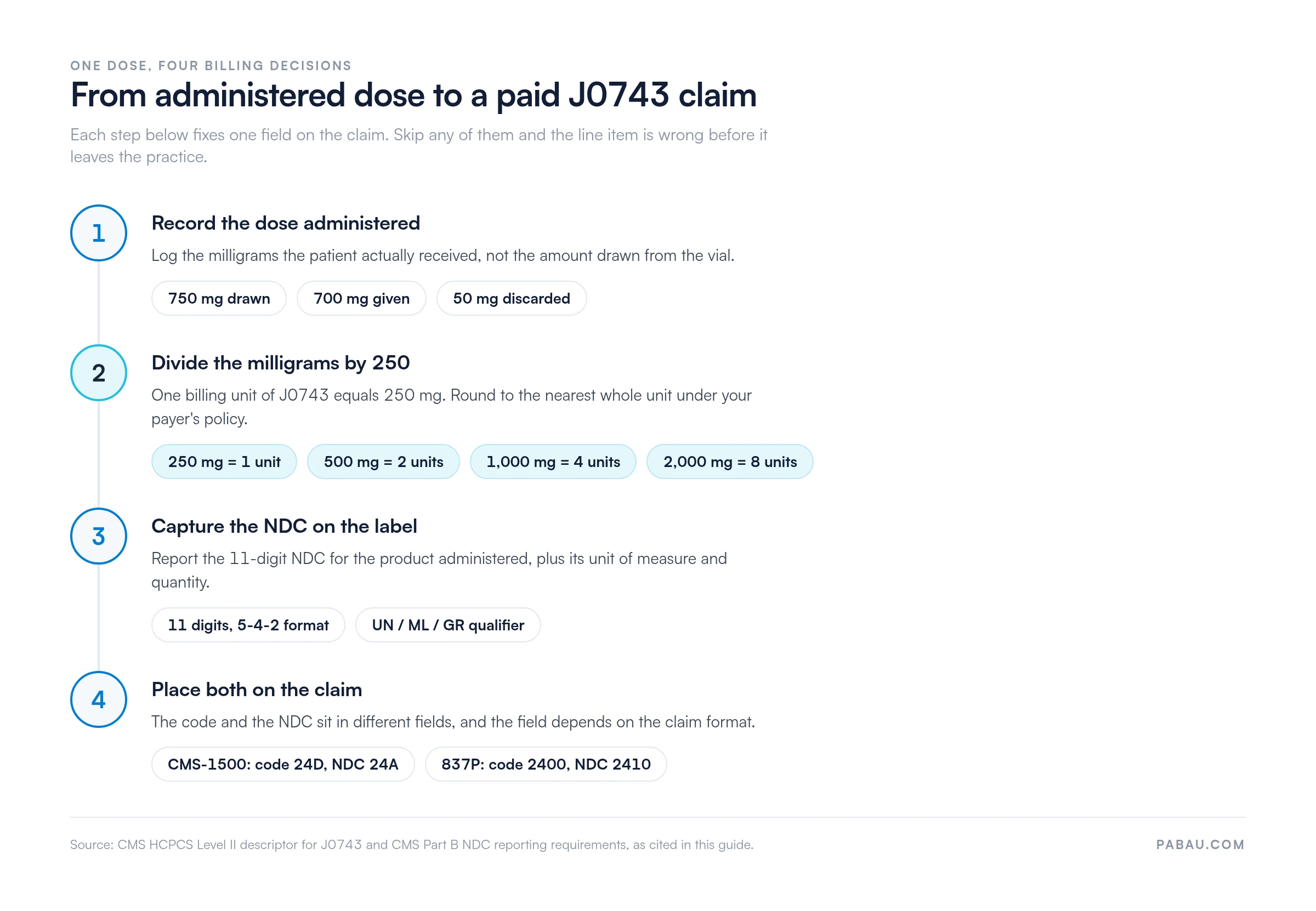
Practice management software like Pabau stores the administration record against the visit it belongs to. The order, the note, and the billed units then sit in one place. From there, Pabau’s claims management software submits the claim from that record and tracks its status. As a result, a charge slip carrying the dose in mg, the calculated units, and the NDC makes the handoff to billing almost error-free.
Most outpatient imipenem-cilastatin claims follow the buy-and-bill model. First, the practice or infusion center purchases the drug from a wholesaler or specialty pharmacy. It then administers the drug and bills the payer for both the drug cost and the administration service.
Medicare Part B covers imipenem-cilastatin when administered incident-to a physician’s service in an office or outpatient infusion setting. Specifically, coverage turns on three factors. Namely, those are the clinical indication, the place of service, and whether the drug is reasonable and necessary for the patient’s condition.
HCPCS Code J0743 has been active and valid for billing purposes across recent code years. Still, the table below reflects available information as of the date of publication. Always verify current status against the CMS HCPCS Level II alpha-numeric code file for the applicable benefit year before submitting claims.
Imipenem-cilastatin is one of several carbapenem and broad-spectrum antibiotic J-codes. Notably, the code most often confused with J0743 is J0742, which covers a different three-drug product. The table below lists the codes most likely to appear alongside J0743 on a claim.
J0743 vs. J0742: This is the comparison that matters most. In particular, Recarbrio (imipenem-cilastatin-relebactam) is a newer product approved for carbapenem-resistant organisms, and it bills under J0742. The two drugs share the imipenem-cilastatin backbone but differ by the addition of relebactam.
J0741 is not part of that pair. Instead, it covers cabotegravir and rilpivirine, an injectable HIV therapy with no relationship to either carbapenem. Billing J0743 for Recarbrio, or the reverse, is a coding error regardless of clinical intent.
The NDC on the vial settles which of the two codes applies, so check the label rather than the order. For a wider view, the full HCPCS code library covers drug and supply codes outside the antibiotic range.
In practice, six mistakes account for most J0743 denials and audit findings. Each one is cheap to prevent at the point of documentation and expensive to unwind after the claim has been paid.
Practices with a disciplined denial process review J-code denials weekly rather than monthly. A weekly sweep catches unit errors, missing NDCs, and POS mismatches while the claim is still inside the appeal window.
A log of denial reasons by code also reveals patterns. One payer may reject J0743 without an authorization number every time, and that stays invisible until the revenue loss is large.
Audit a sample of J0743 claims internally each quarter. Specifically, three checks cover most of the exposure.
In fact, Medicare RAC and commercial auditors run the same exercise. Running it first removes the common vulnerabilities before they attract outside scrutiny.
Build a J0743 checklist into your infusion documentation workflow. Specifically, it needs seven fields. Namely, those are drug name, NDC in 5-4-2 format, dose in mg, units calculated, route, POS code, and ICD-10-CM diagnosis. Running the checklist at the point of documentation catches errors before the claim reaches your clearinghouse.
In most practices the dose lives in the infusion record and the NDC lives on a vial label in the treatment room. The unit count is then typed into the billing system from whatever the biller can find. As a result, every handoff between those three is a chance to lose a digit.
Pabau holds the administration record, the invoice, and the claim against the same appointment. The clinician documents the dose once, and the billing team works from that record instead of re-entering it. From there, claims go out through the built-in clearinghouse connection, and their status comes back onto the same visit.
As a result, that shortens the audit trail. When a payer asks why four units of J0743 were billed, the answer is a lookup rather than a search through paper infusion logs.

Pabau stores the infusion record, the invoice, and the claim against the same appointment. Your billing team works from the dose that was documented, rather than re-entering it.

J0743 is not a difficult code to bill. Instead, the denials come from four small facts that live in four different places. Namely, those are the dose given, the divisor of 250, the NDC on the label, and the field the claim format expects.
Practices that capture those four at the point of care rarely appeal a J0743 claim. By contrast, practices that reconstruct them at billing time appeal often, and win late. The accuracy is decided in the treatment room, not in the billing queue.
One quarterly habit is worth keeping. For example, pull ten J0743 claims and trace each billed unit back to a documented milligram. Book a demo to see how Pabau links the infusion record to the claim so that trace takes minutes.

Need to understand the broader billing submission process? What is medical billing covers the end-to-end revenue cycle from charge capture to payment posting.
Want to reduce claim denials across your practice? Denial management in healthcare explains how to build a systematic appeals and prevention workflow.
Looking to verify coverage before you administer? Insurance eligibility verification walks through real-time benefit checks for drug coverage and prior authorization.
HCPCS Code J0743 is the Level II J-code for injection, cilastatin sodium; imipenem, per 250 mg. It bills the drug cost when a provider administers imipenem-cilastatin in an office or outpatient setting. For example, typical indications include complicated intra-abdominal infection, nosocomial pneumonia, and infections caused by multi-drug-resistant gram-negative organisms.
To calculate this, divide the total milligrams administered by 250 to get the units to bill: 500 mg = 2 units, 1,000 mg = 4 units, 1,500 mg = 6 units. Bill only the dose actually administered, not the dose drawn from the vial, and round to the nearest whole unit per your payer’s rounding policy.
Medicare Part B pays ASP + 6% per unit for J0743, updated quarterly. The dollar amount changes each quarter when CMS publishes the new ASP drug pricing file. Therefore, check the current CMS ASP Drug Pricing Files rather than a fixed rate in any reference guide. The Physician Fee Schedule lookup tool does not carry drug ASP pricing.
Several NDCs map to J0743, one per manufacturer. For instance, Merck (Primaxin brand), Fresenius Kabi, Hikma, and Sandoz each carry distinct NDCs for their imipenem-cilastatin products. Verify the correct NDC against the current CMS NDC-to-HCPCS crosswalk file. Then report it in 11-digit, 5-4-2 format on the CMS-1500 or the 837P claim.
J0743 covers standard imipenem-cilastatin (Primaxin or generic). By contrast, J0742 covers imipenem-cilastatin-relebactam (Recarbrio), a three-drug product that adds a beta-lactamase inhibitor for carbapenem-resistant organisms. The two share the imipenem-cilastatin backbone but carry different NDCs, indications, and codes. J0741 is unrelated to both, since it covers cabotegravir and rilpivirine for HIV.
J0743 is reported as active for both 2025 and 2026 based on available HCPCS reference data. Still, confirm current status against the CMS HCPCS Level II alpha-numeric file for the applicable benefit year. Code status can change with the annual January update cycle.