

CCSD code G5100: Bypass of duodenum billing guide
CCSD code G5100 bills a bypass that leaves the duodenum in place CCSD code G5100...

Last Updated: Oct 16, 2026
J0714 is the HCPCS Level II code for injection, ceftazidime and avibactam, 0.5 g/0.125 g, the code used to bill Avycaz. Each unit covers 0.5 g of ceftazidime, so the standard adult dose of one 2 g/0.5 g vial bills as 4 units.
Report it with the 11-digit NDC under the UN qualifier and modifier JW or JZ for drug waste. Pair it with an infusion administration code such as CPT 96365. Medicare Part B pays it in the physician office and hospital outpatient settings, while inpatient use is bundled into the DRG.
Let Pabau's smart automation suggest the right codes, reduce claim denials, and keep your practice compliant—effortlessly.
Automate repetitive tasks and focus on what matters most—your patients.
Reduce coding errors and ensure compliance with the latest regulations.
Clean claims, fewer denials, and faster reimbursements.
Powerful insights and reporting to help your practice thrive.
HIPAA compliant SOC 2 certified GDPR-compliant Trusted by 4,000+ clinics worldwide

HCPCS code J0714 covers ceftazidime-avibactam (Avycaz) injection, and one billing unit equals 0.5 g ceftazidime plus 0.125 g avibactam. The standard adult dose is one 2 g/0.5 g vial, which bills as 4 units per infusion.
Medicare Part B pays J0714 at ASP+6% in the physician office, while hospital outpatient departments are paid under OPPS. Inpatient use is bundled into the Part A DRG.
Medicaid and most commercial payers require the 11-digit NDC alongside J0714, reported with the UN qualifier and a quantity of 1 per vial.
Report modifier JW on a separate line for discarded drug, or modifier JZ when no drug was discarded.
Always bill J0714 with an infusion administration code, such as CPT 96365 for the first hour.
HCPCS code J0714 is the Level II code that CMS assigns to “Injection, ceftazidime and avibactam, 0.5 g/0.125 g.” It is the specific, permanently assigned code for Avycaz and is active for 2026. Each unit covers 0.5 g of ceftazidime, so the standard 2 g adult dose bills as 4 units.
Ceftazidime-avibactam is a combination beta-lactam/beta-lactamase inhibitor antibiotic. Ceftazidime targets gram-negative bacteria, and avibactam protects it from breakdown by extended-spectrum beta-lactamases. The combination is given intravenously. There is no oral formulation, and J0714 does not apply to any non-injectable route.
J0714 covers Avycaz given for its FDA-approved indications. Off-label use is a compliance risk and draws heightened payer scrutiny, so confirm the diagnosis supports an approved indication before billing.
The FDA-approved indications for ceftazidime-avibactam (Avycaz) are:
J0714 does not apply to oral ceftazidime-avibactam (none is FDA-approved), non-injectable routes, or ceftazidime given alone without avibactam. Payers expect a diagnosis code that maps directly to one of these indications on every claim.
One billing unit of J0714 equals 0.5 g ceftazidime plus 0.125 g avibactam. Each Avycaz vial contains 2 g ceftazidime and 0.5 g avibactam. Most infusion protocols dose at 2 g/0.5 g (2.5 g combined) every 8 hours, which equals 4 units per infusion.
Report the units that match the dose administered, rather than the number of vials opened. When part of a vial is discarded, report the discarded units on a separate line with modifier JW. The documentation section below lists what the record needs to support that line.
Formula: Divide the ceftazidime grams administered by 0.5 to get the unit count. A 2 g ceftazidime dose divided by 0.5 = 4 units of J0714.
The unit count is the first of five entries on a J0714 claim line, and the diagram below shows the other four.
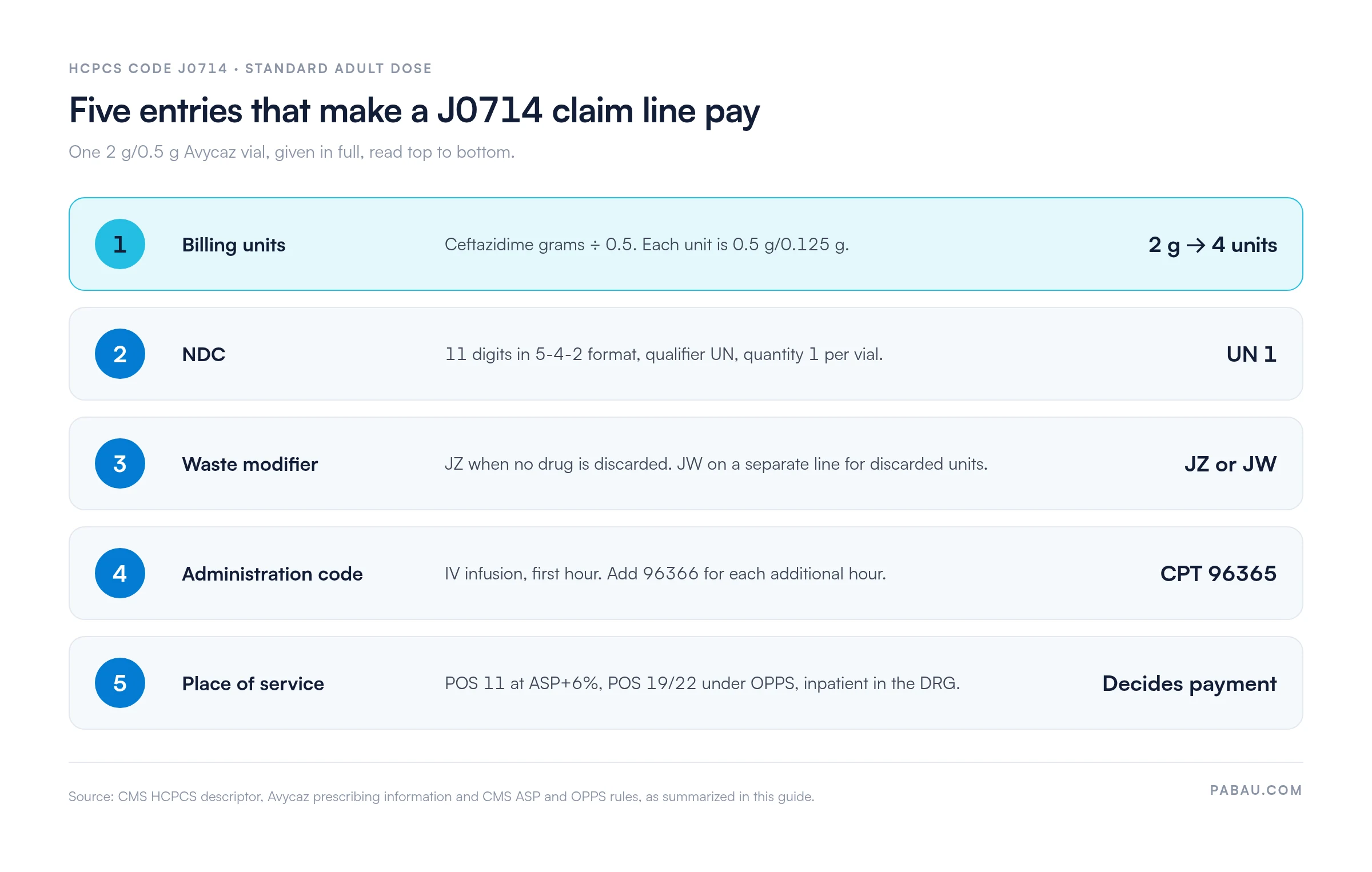
Medicare Part B pays HCPCS code J0714 at ASP+6% (average sales price plus 6%) in the physician office (POS 11). Hospital outpatient departments (POS 19/22) are paid under OPPS (Addendum B). The ASP-based payment limit changes each quarter when CMS releases updated pricing files.
Because ASP rates shift quarterly, a hard-coded dollar figure here would be outdated by the time claims are filed. Check the current payment limit in the CMS ASP Drug Pricing Files. Filter by HCPCS code J0714 and select the applicable quarter.
Avycaz is not on the self-administered drug exclusion lists published by Medicare Administrative Contractors (for example Palmetto GBA’s Article A53066). It therefore qualifies for Part B coverage when a provider administers it in an eligible setting.
Run a unit-cost check before each claim. Multiply the current payment limit per unit by the number of units billed. If the total looks out of range for the dose administered, recount the units before submitting. Overcounting J0714 units is one of the fastest ways to trigger a pre-payment review.
J0714 is separately billable only when the patient is in an outpatient or non-facility setting. For an inpatient, the drug cost is bundled into the Medicare Part A DRG payment. Billing J0714 separately for an inpatient encounter will result in denial.
Medicaid and most commercial payers require the 11-digit National Drug Code (NDC) reported alongside HCPCS code J0714 on the claim. A missing or mismatched NDC is one of the most common denial triggers for this code.
Report the NDC in the 5-4-2 format (labeler-product-package), for example 00456-2700-10, the Avycaz carton of 10 vials (4 billing units per vial). The NDC unit qualifier for J0714 is UN (unit), with a quantity of 1 per vial. Verify the current Avycaz NDC against the vial label before billing. Packaging changes can create a new NDC that differs from the one the system has on file.
Cross-reference the NDC on the vial against the AAPC HCPCS code reference and the manufacturer’s current labeling before each billing cycle. That check confirms the code-to-NDC pairing is still valid.
J0714 is the drug code only. It does not cover the provider’s work in administering the infusion. Providers bill a companion infusion administration code on the same claim, most often CPT 96365 for the first hour.
Modifiers JW and JZ (drug wastage): When part of a vial is discarded, report the wasted units on a separate J0714 line with modifier JW. Report modifier JZ on the J0714 line when no drug was discarded. Medicare has required one of the two on single-dose container drug claims since July 1, 2023. Document the lot number, the amount discarded, and the reason for waste in the medical record.
Medicare Part B generally does not require prior authorization (PA) for HCPCS code J0714 in outpatient settings. Most Medicaid managed care plans and commercial payers do. Billing without an approved PA when one is required is a top denial reason.
The typical prior authorization workflow for J0714 includes:
PA requirements vary by payer, plan, and state. Never assume Medicare’s no-PA default applies to commercial or Medicaid claims. Check each payer’s policy for J0714 specifically, as some plans have added PA requirements for high-cost antibiotics in recent years.
J0714 is the permanently assigned, specific HCPCS code for ceftazidime-avibactam. J3490 is the unclassified fallback for drugs that have no specific J code. Using J3490 when J0714 is available is a billing error that routinely triggers denial or audit.
Before defaulting to J3490, verify that the payer’s system recognizes J0714. Medicare and most major payers have loaded this code. If a payer rejects J0714 with an “invalid code” error, call the payer to confirm. That rejection usually points to a lag in the payer’s system rather than a missing code.
Most J0714 denials fall into six categories, and each one has a clear corrective path. For the reason codes payers attach to these rejections, see our guide to denial codes.
Systematic denial management workflows and pre-submission audits clear most of these issues before the claim reaches the payer. Pabau, the practice management platform we build, includes claims management software that flags missing companion codes and NDCs when the claim is created.
Every J0714 claim needs medical record documentation that survives a payer audit and supports any PA appeal. Complete records are also a core element of medical billing compliance for high-cost injectable drugs.
Under the HCPCS Level II coding framework, three items resolve most J0714 documentation problems before they reach the payer. They are an accurate NDC, the correct unit count, and a diagnosis code that maps to an FDA-approved indication.
Create a J0714 charge capture checklist for your infusion team. It should cover the diagnosis code, the culture result on file, the dose in grams and the units calculated. Add the NDC from the physical vial, the JW or JZ modifier, the administration CPT code, and the PA number if applicable. A two-minute pre-submission check prevents most first-pass denials for this code.
A J0714 claim draws on three separate records. The nursing note holds the dose, the vial label holds the NDC, and the payer portal holds the PA number. Each hand-off between them is a point where a unit count or a modifier can drop off the claim.
Pabau keeps the drug code, the administration code, the NDC and the PA number on a single claim screen. Your billing team sees the whole J0714 line, units and JW or JZ modifier included, before the claim leaves the practice.
The result is fewer first-pass denials on a high-cost drug, where one rejected claim can hold up payment for weeks.

Pabau’s claims management software keeps drug codes, NDCs, administration codes and PA numbers in one claim workflow. Your team can check every J0714 line before submission.

The quickest win on J0714 is to treat the standard dose as a fixed pattern. One 2 g/0.5 g vial is 4 units, one NDC unit under the UN qualifier, a JZ modifier, and an administration code such as 96365. Any claim that departs from that pattern deserves a second look before it goes out.
Check the place of service before the units, because it decides whether the units are paid at all. The same infusion earns ASP+6% in the physician office and the OPPS rate in a hospital outpatient department. As an inpatient line, it is not paid separately.
For the wider workflow these steps belong to, see our overview of medical billing. Book a demo to see how Pabau puts the dose, NDC and modifiers for J0714 on one claim screen before it reaches the payer.

Need to understand how clearinghouse submissions work for drug codes? Medical claims clearinghouse overview explains how drug J codes move from the practice to the payer electronically.
Wondering how to handle a J0714 claim that came back with a denial code? Denial management in healthcare covers the appeal process and denial tracking workflows.
Looking for a billing compliance checklist to use alongside this guide? Medical billing compliance outlines the documentation and audit-readiness standards that apply to Part B drug claims.
HCPCS code J0714 covers injection of ceftazidime and avibactam, 0.5 g/0.125 g per billing unit, given intravenously as Avycaz. It applies in outpatient and non-facility settings when the drug is given for an FDA-approved indication. It does not cover inpatient administration, oral routes, or unapproved uses.
Divide the ceftazidime grams administered by 0.5 to get the unit count. A standard 2 g ceftazidime (2.5 g combined) dose equals 4 units, one vial. Bill for the amount administered, and report any discarded drug on a separate JW line.
Medicare Part B pays J0714 at ASP+6% per unit in the physician office, and CMS updates the dollar amount every quarter. Check the current payment limit in the CMS ASP Drug Pricing Files before submitting claims. Hospital outpatient departments are paid under OPPS instead.
Medicare Part B generally does not require prior authorization for J0714, but most Medicaid managed care plans and commercial payers do. Verify with the specific payer before the first infusion. Proceeding without a required PA is the most common appeal scenario for this code.
Use J3490 only if the payer’s claims system does not recognize J0714, which is rare. J0714 is the permanently assigned, specific code for ceftazidime-avibactam. Using J3490 when J0714 is available triggers denial or manual review, so verify with the payer first.
Under Medicare, J0714 may not be separately payable in an ASC, because ASC payment rules bundle many drugs into the facility fee. Other payers set their own rules. Verify with the specific payer and check the current CMS ASC Covered Procedures List before billing.



