HCPCS Code J1110: Dihydroergotamine mesylate injection billing guide
HCPCS Code J1110: Official descriptor and drug overview HCPCS Code J1110 is the ...

Last Updated: Oct 29, 2026
J0595 is the HCPCS Level II code for injection, butorphanol tartrate, 1 mg. Butorphanol is an opioid agonist-antagonist given by intramuscular or intravenous injection for pain, before surgery, during anesthesia and in labor.
One unit equals 1 mg, so a 2 mg dose bills as 2 units. Pair the drug line with the injection's administration code, and report the NDC where the payer asks for it.
Let Pabau's smart automation suggest the right codes, reduce claim denials, and keep your practice compliant—effortlessly.
Automate repetitive tasks and focus on what matters most—your patients.
Reduce coding errors and ensure compliance with the latest regulations.
Clean claims, fewer denials, and faster reimbursements.
Powerful insights and reporting to help your practice thrive.
HIPAA compliant SOC 2 certified GDPR-compliant Trusted by 4,000+ clinics worldwide

HCPCS code J0595 reports butorphanol tartrate injection, and one billing unit equals 1 mg, so a 2 mg dose bills as 2 units.
J0595 is not a buprenorphine code. Sublocade bills under Q9991 or Q9992, and buprenorphine hydrochloride injection bills under J0592.
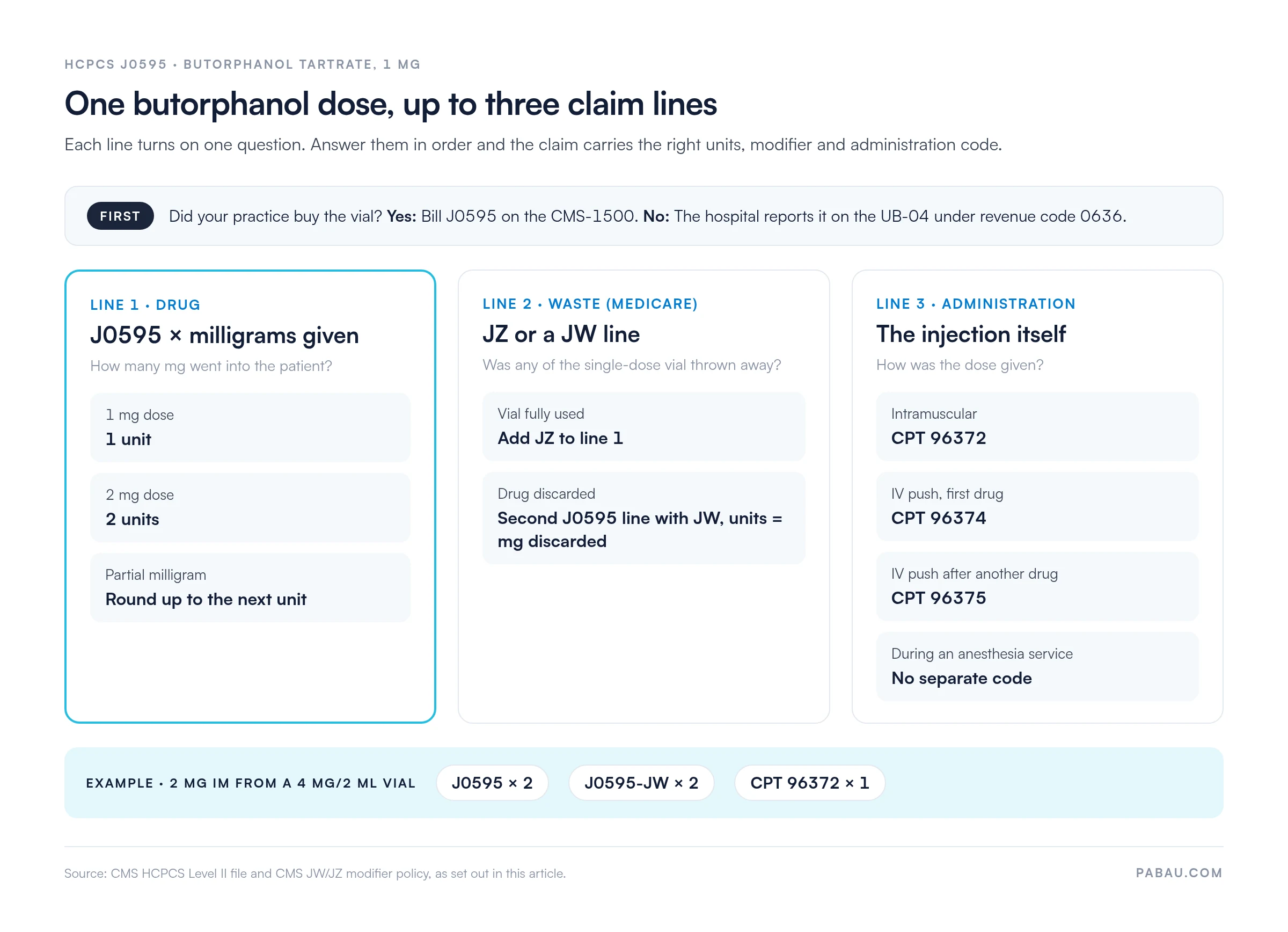
Pair J0595 with CPT 96372 for an intramuscular dose or CPT 96374 for an IV push, unless the dose is part of an anesthesia service.
On Medicare claims, add the JZ modifier when the single-dose vial is fully used, or bill the discarded milligrams on a separate JW line.
Link the claim to the cause of the pain, the planned surgery or the labor encounter, never to an opioid use disorder code.
HCPCS code J0595 is the Healthcare Common Procedure Coding System Level II code for injection, butorphanol tartrate, 1 mg. It reports the drug supplied when a clinician gives butorphanol by intramuscular or intravenous injection. One billing unit equals 1 mg of drug.
Butorphanol is an opioid agonist-antagonist analgesic and a Schedule IV controlled substance. It is used for pain, as a preoperative medication, as a supplement to balanced anesthesia, and for pain during labor. The code has been in the CMS HCPCS code set since January 1, 2004, and it is still active.
Butorphanol is a partial agonist at the mu opioid receptor and a full agonist at the kappa opioid receptor. The original brand, Stadol, has been discontinued. Practices and hospitals now stock generic vials from manufacturers such as Hospira and Hikma.
The FDA label sets the doses that drive your unit count. Know them before you code the claim.
The label tells clinicians to use another analgesic if delivery is expected within four hours. Butorphanol also comes as a nasal spray, but J0595 describes an injection. A nasal spray dispensed to the patient does not fit the code. Full dosing and safety details sit in the DailyMed label for butorphanol tartrate injection.
Bill one unit of J0595 for each 1 mg given. A 2 mg dose is 2 units, and a 4 mg dose is 4 units. When a dose falls between whole units, round up to the next unit.
Butorphanol comes in single-dose vials, so Medicare also wants to know what was thrown away. The table shows how common doses map to units and to the JW or JZ modifier.
On the CMS-1500, enter J0595 in item 24D and the units in item 24G. The NDC goes in the shaded area of item 24. On the UB-04, hospitals report J0595 under revenue code 0636 with units in the service units field.
State Medicaid programs require the National Drug Code (NDC) on claims for physician-administered drugs, and many commercial payers do too. Add it on every J0595 claim unless the payer tells you otherwise.
Medicare requires the JW or JZ modifier on separately payable Part B drugs from single-dose containers. Use JZ when no drug was discarded. Use JW on a second J0595 line for the milligrams discarded, and record the discarded amount in the chart.
J0595 pays for the drug only. The injection itself goes on its own line, and the route decides the code.
Butorphanol and buprenorphine sound alike, and so do their codes in a quick lookup. Mixing them up bills the wrong drug at the wrong unit size. The CMS HCPCS file separates them clearly, and you can find related HCPCS codes in our code library.
Sublocade, the monthly buprenorphine injection for opioid use disorder, never bills under J0595. Brixadi, the weekly and monthly buprenorphine injection, has its own codes as well. Check the descriptor in the AAPC HCPCS code lookup before you post a charge from memory.
In a physician office, Medicare Part B pays J0595 at average sales price (ASP) plus 6%, per unit. CMS updates the payment limit every quarter, and J0595 appears in the 2026 files. Pull the current figure from the CMS ASP pricing files rather than quoting an old rate.
CMS gives J0595 coverage code C, carrier judgment. That means your Medicare Administrative Contractor decides coverage, so read its local policies and articles. Medicaid sets its own rates by state, and commercial payers follow their contracts.
Most butorphanol doses are given in hospitals, so the setting often decides who reports the drug at all. Only the party that bought the vial bills J0595.
When the hospital supplied the drug, the physician bills only their professional service. A J0595 line on the physician claim then duplicates the facility charge and draws a denial.
Link J0595 to the reason the dose was given. For pain, that is usually the condition causing the pain. ICD-10-CM guidelines say not to use G89 pain codes when the underlying diagnosis is known, unless the encounter is for pain control.
For a preoperative dose, link the diagnosis for the surgery the patient is having. For labor, the obstetric codes for that encounter carry the claim. Opioid use disorder codes such as F11.20 belong to buprenorphine claims, not butorphanol.
Commercial plans and Medicare Advantage plans set their own authorization rules for drugs like butorphanol. Check the plan’s medical-benefit drug policy before you give the dose. Then make sure the chart supports every unit, modifier and route the claim reports.
J0595 denials follow a short, predictable list. Fixing the pattern once in your denial management workflow stops the same error from coming back.
Before you post a J0595 charge, read the vial label aloud against the order. Butorphanol and buprenorphine look alike on a shelf and in a code search, and one check catches both errors.
Run this list before you send a J0595 claim. Each step maps to a field on the CMS-1500 or the superbill that feeds it.
Put together, one butorphanol dose produces up to three claim lines. Each line turns on a single question, as the diagram shows.
Most J0595 errors start when someone retypes the dose, the units and the NDC from the chart into a claim. Each handoff is a chance to bill a vial instead of milligrams.
In Pabau, the practice and billing platform we build, each claim opens pre-filled from the invoice, so the dose, units and NDC are entered once. Its claim validation helps you catch claim errors early, scrubbing each claim for missing or invalid details before it goes to the clearinghouse. In the US, that clearinghouse is Claim.MD, which also checks eligibility before the visit.
Rejected claims come back flagged as needing action, with a link to the field that needs fixing. Payments settle from ERA files, so your team can see which drug lines were paid and which need an appeal.

Pabau builds claims from the invoice and scrubs them for missing or invalid details before submission. Your team spends less time reworking drug denials.

J0595 is a small code with one big trap. It reports butorphanol, not buprenorphine, and it counts every milligram as a unit. Get those two facts right and most denials on this code disappear.
The rest is setting and paperwork. Bill the drug only if your practice bought the vial. Add JW or JZ for Medicare, and link the dose to the reason it was given.
Book a demo to see how Pabau helps your billing team send drug claims that pay on the first submission.

Managing denials across multiple payer types? Denial management in healthcare covers the end-to-end workflow for tracking, appealing, and preventing common denial patterns.
Need to verify your eligibility workflow before submitting drug claims? Revenue cycle management in healthcare explains how eligibility verification fits into the pre-submission billing process.
Billing the IV push that goes with the drug? CPT code 96374 explains when the initial IV push code applies and how to report it.
Giving the dose intramuscularly? CPT code 96372 covers the IM injection line that sits beside the drug code.
HCPCS code J0595 is the Level II code for injection, butorphanol tartrate, 1 mg. It reports the drug when a clinician gives butorphanol by IM or IV injection for pain, before surgery, during anesthesia or in labor.
Bill one unit for each 1 mg given. A 2 mg dose is 2 units and a 4 mg dose is 4 units. Round a partial milligram up to the next whole unit.
No. J0595 is butorphanol tartrate. Sublocade bills under Q9991 for doses up to 100 mg and Q9992 for doses over 100 mg. Buprenorphine hydrochloride injection bills under J0592.
State Medicaid programs require it, and many commercial payers do too. Report the 11-digit NDC in 5-4-2 format after the N4 qualifier, then ML and the volume given.
Bill CPT 96372 for an intramuscular dose or CPT 96374 for a single IV push. Do not bill a separate administration code when the dose is part of an anesthesia service.
Yes, when the drug is separately payable under Part B. Add JZ when the single-dose vial was fully used. Bill the discarded milligrams on a second line with JW.
Link the drug to the reason it was given. That is the condition causing the pain, the surgery the dose prepares for, or the labor encounter. Opioid use disorder codes do not apply.