CPT code 86481: TB IGRA billing guide
CPT code 86481: Official descriptor and procedure description CPT code 86481 des...

Last Updated: Nov 2, 2026
J0330 is the HCPCS Level II code for injection, succinylcholine chloride, up to 20 mg. It bills the depolarizing neuromuscular blocker used for rapid sequence intubation, at one unit for each 20 mg or part of it.
Coders sometimes confuse J0330 with J9330 (temsirolimus), a single-digit mix-up that produces an incorrect-code denial. Units are the other common error. A 100 mg dose is five units, not one, and a 30 mg dose rounds up to two.
Let Pabau's smart automation suggest the right codes, reduce claim denials, and keep your practice compliant—effortlessly.
Automate repetitive tasks and focus on what matters most—your patients.
Reduce coding errors and ensure compliance with the latest regulations.
Clean claims, fewer denials, and faster reimbursements.
Powerful insights and reporting to help your practice thrive.
HIPAA compliant SOC 2 certified GDPR-compliant Trusted by 4,000+ clinics worldwide

HCPCS code J0330 bills succinylcholine chloride injection at one unit per 20 mg administered, and any partial 20 mg increment counts as a full unit.
NDC reporting is mandatory for Medicaid and required by most commercial payers, with qualifier LN and an ML unit of measure for liquid vials.
JW and JZ apply to Medicare Part B claims for single-dose containers. Confirm J0330’s status on the CMS JW/JZ list, and note that other payers set their own rules.
Pabau’s claims management software submits CMS-1500 claims through Claim.MD in the US.
HCPCS code J0330 is the Level II code the Centers for Medicare and Medicaid Services (CMS) maintains for injection, succinylcholine chloride, up to 20 mg. It sits in the J0000-J9999 range (J codes, drugs administered other than oral method). Each billing unit covers up to 20 mg of drug given to the patient, not the amount dispensed or drawn.
Succinylcholine chloride is a depolarizing neuromuscular blocking agent (NMBA). It binds to nicotinic acetylcholine receptors at the neuromuscular junction, causing brief muscle fasciculations followed by paralysis.
The label puts onset within about 1 minute of an IV dose. Paralysis typically lasts about 4 to 6 minutes, and up to about 10 minutes, which makes it a common choice for rapid sequence intubation (RSI).
The FDA-approved indications are as an adjunct to general anesthesia, to facilitate tracheal intubation, and to relax skeletal muscle during surgery or mechanical ventilation. Laryngospasm management and muscle relaxation during electroconvulsive therapy (ECT) are off-label but common uses.
Common vial concentrations are 20 mg/mL (200 mg/10 mL) and 50 mg/mL, though higher concentrations are available. Most formulations need refrigeration. Record storage conditions and the lot number in the medical record to support wastage documentation.
J0330 covers physician-administered succinylcholine chloride injection in the non-facility physician office setting, billed in 20 mg increments given to the patient. The scope is narrow. It covers only the drug charge, and only for succinylcholine chloride. It also applies only when the physician practice bills the drug separately, outside a bundled facility payment.
Each billing unit of J0330 covers up to 20 mg of succinylcholine chloride. Divide the dose in milligrams by 20, then round up to the next whole unit. Any partial 20 mg increment counts as another unit, so a 30 mg dose is 2 units.
The main claim line bills the dose given to the patient, not the whole vial. When part of a single-dose vial is discarded and the JW modifier applies, the discarded amount goes on its own JW line.
The medical record must show the dose given in milligrams, not just the vial size drawn. A chart note stating “succinylcholine administered per protocol” without a milligram dose does not support the billed units and will fail audit. For how the drug line and the administration line fit into one claim, start with medical billing fundamentals.
The National Drug Code (NDC) is an FDA-assigned identifier for every drug product, reported on claims in an 11-digit form. Reporting the NDC alongside J0330 is mandatory for Medicaid and required by most commercial payers.
Medicare Part B does not mandate it for physician-administered drugs at the federal level. Many Medicare Advantage plans and supplemental payers do, so including it on every claim line is best practice.
JW and JZ are Medicare Part B (fee-for-service) modifiers for drugs supplied in single-dose containers. JW reports an amount discarded, and it was already required for any discarded amount before 2023. JZ is the newer modifier that attests no drug was wasted. JW/JZ refund reporting began January 1, 2023, and CMS required JZ no later than July 1, 2023.
Neither modifier applies to multi-dose vials. One third-party billing reference notes that J0330 is not on the CMS list of single-dose-container drugs. Confirm its status on the current CMS JW/JZ list before adding either. Other payers set their own rules. The three questions below settle which line, if any, a J0330 claim takes.
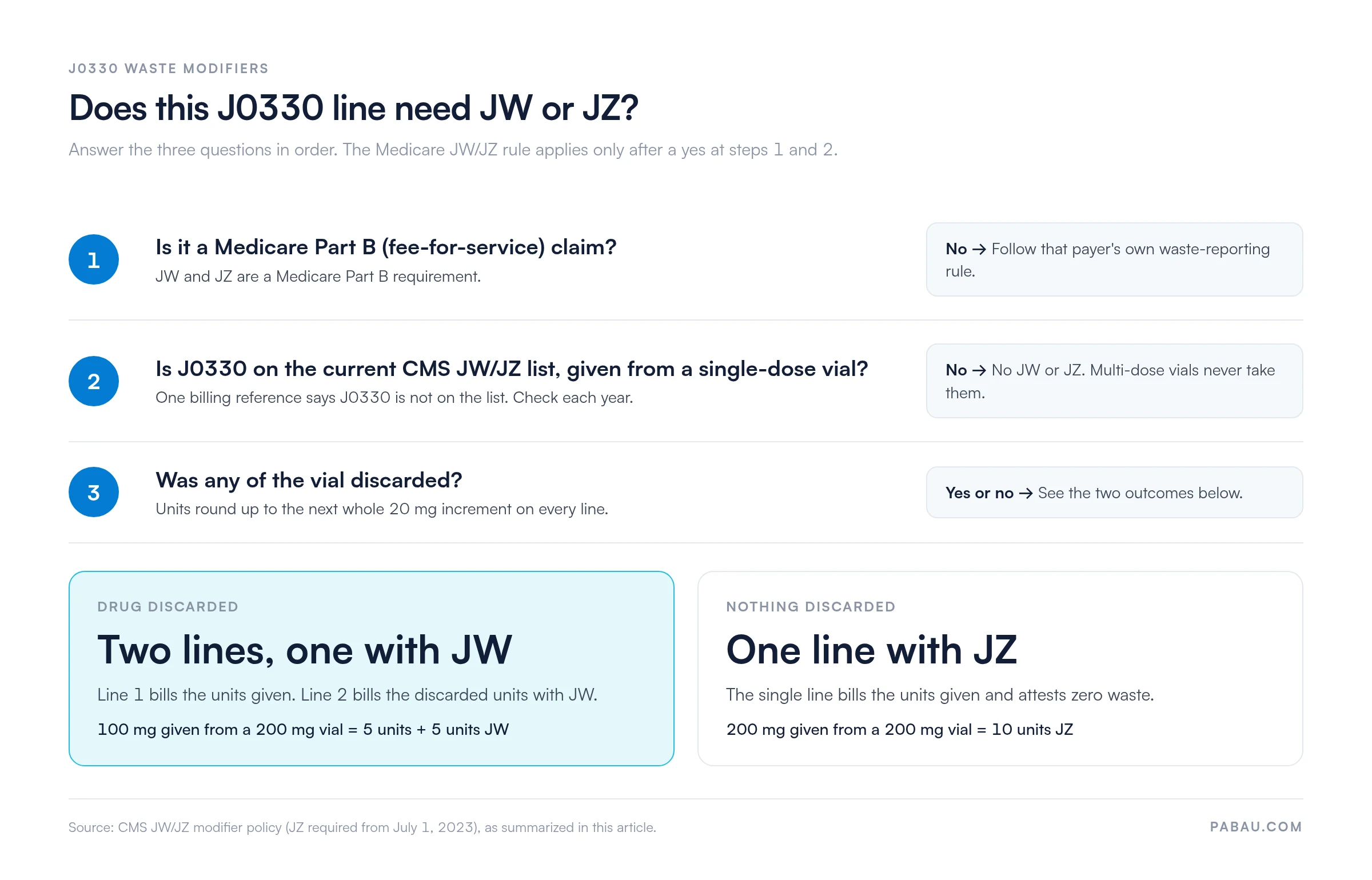
Where JW/JZ applies, CMS expects JZ on every single-dose-container line with zero waste from July 1, 2023. A line that carries neither modifier can be returned or denied. If J0330 appears on the current CMS list, audit Medicare Part B claims since that date that lack both modifiers and resubmit them correctly.
Medicare Part B covers physician-administered injectable drugs, including succinylcholine under J0330, when given incident to a physician’s service in a non-facility setting. Reimbursement follows the Average Sales Price (ASP) plus 6% method. CMS publishes the payment limits each quarter in the CMS ASP drug pricing files.
Verify the current ASP payment limit for J0330 in the CMS quarterly ASP drug pricing file before quoting patients or planning revenue projections. Rates change four times a year, so any printed figure goes stale within months.
Where succinylcholine is given decides whether J0330 can be billed separately or is bundled into the facility’s payment. Getting this wrong is a frequent billing error for anesthesia-related drug codes.
J0330 covers the drug charge only. When the physician practice bills both the drug and the injection service, a separate CPT administration code goes on the same claim. That is most often CPT 96374 for an IV push. These are two distinct line items, billed together.
96374 and 96375 are not reported when the drug is given as part of an anesthesia service. In facility settings (outpatient hospital, ASC), the facility typically bills the administration code. The physician practice bills the professional service, such as the anesthesia CPT code, but generally not the drug administration code.
Two kinds of confusion show up in J0330 coding audits. One is a single-digit mix-up with J9330. The other is clinical, where a different neuromuscular blocker is coded as succinylcholine.
Rocuronium is often used in place of succinylcholine for RSI, and vecuronium and cisatracurium appear on the same anesthesia records. None of them bills under J0330.
Check the drug name and unit dose for any HCPCS drug in the AAPC Codify HCPCS lookup or the annual CMS HCPCS file. Don’t rely on memory or auto-populated EHR fields without confirming the code still matches the current year’s descriptor.
Every billed unit of J0330 must trace to a medical record entry. Medicare, Medicaid and commercial auditors look for each of these elements when reviewing J0330 claims. Missing even one creates a recoupment exposure.
Mapping each of these elements to a claim field is the core of clean claim submission. A superbill can capture drug name, dose, lot number and route at the point of care. Billing staff then complete the J0330 line without returning to the clinical record.
Medicare Part B does not require prior authorization for succinylcholine in most clinical settings. Succinylcholine is used mainly in emergency and urgent contexts (RSI, laryngospasm, ECT), so payers generally accept that advance approval isn’t clinically feasible.
Commercial managed care plans and Medicaid managed care organizations may require prior authorization (PA) for scheduled, non-emergency uses. Practices using succinylcholine for elective procedures such as ECT should check PA requirements plan by plan before the date of service. A typical PA request includes these details:
Keeping medical billing compliance documentation for each encounter supports both the PA submission and any later audit defense.
Most J0330 denials fall into five categories. Each carries a claim adjustment reason code (CARC) on the remittance advice, and the guide to medical billing denial codes explains the wider set. Spotting the pattern on the first denial stops the same error repeating on later claims.
For Medicare denials, file the redetermination request within 120 days of receiving the initial determination. Receipt is presumed 5 days after the notice date. Gather the physician order, administration record, NDC vial label, and any documentation supporting the modifier used.
Submit through the contractor’s portal with a cover letter citing the specific denial reason and the documentation that refutes it. Denial management workflows that log each denial by reason code show patterns across the whole billing cycle, beyond the single claim in front of you.
Most J0330 errors start in the handoff from the anesthesia record to the claim. Someone has to turn a milligram dose into units, copy the NDC and quantity, and decide whether a waste modifier applies.
Pabau, the practice management platform we build, handles the claim side of that handoff. Its claims management software submits CMS-1500 claims through Claim.MD in the US and checks insurance eligibility before the visit. Claim validation scrubs each claim for missing or invalid details before it leaves Pabau.
If a claim still comes back rejected, Pabau flags it as Needs action and links straight to the field to correct. Prior authorizations are stored as cases that follow the appointment through to the claim, which helps when a plan requires PA for scheduled ECT.

Pabau submits CMS-1500 claims through Claim.MD and scrubs each one for missing or invalid details first. Your billing team fixes flagged J0330 claims before they turn into resubmissions.

J0330 rewards precision at the bedside more than effort in the billing office. Chart the dose in milligrams, round partial 20 mg increments up, and report the NDC in milliliters. Do that and most J0330 denials never reach your remittance advice.
Settle the JW/JZ question once a year by checking J0330 on the current CMS list, then apply each commercial payer’s own rule. Medicare Part B single-dose rules don’t carry over to multi-dose vials or other payers.
The trade-off is a few seconds of charting now against a resubmission weeks later. Book a demo to see how Pabau submits CMS-1500 claims and checks eligibility for your drug administration billing.

Need a framework for cleaner drug billing claims? Medical billing fundamentals walks through the end-to-end process of turning a drug administration encounter into a paid claim.
Struggling with repeated J-code rejections? Denial management in healthcare covers systematic approaches to tracking, appealing, and preventing recurring claim denials.
Want to reduce first-pass claim errors? Clean claim submission outlines the documentation and coding checks that prevent common billing errors before the claim leaves your practice.
Billing the IV push that delivered the dose? CPT code 96374 covers the administration code that most often pairs with J0330.
Filling in the claim form by hand? CMS-1500 form template shows where the J-code, units and NDC supplemental data go on a paper claim.
HCPCS code J0330 is the billing code for succinylcholine chloride injection, up to 20 mg. Succinylcholine is a depolarizing neuromuscular blocking agent used mainly for rapid sequence intubation, surgical muscle relaxation, and electroconvulsive therapy. Brand names billed under J0330 include Anectine and Quelicin.
Bill one unit of J0330 for each 20 mg of succinylcholine chloride given, rounding any partial increment up. A 30 mg dose is 2 units, a 100 mg dose is 5 units, and a 200 mg dose is 10 units. National policy sets no fixed per-encounter cap, but payers may apply claim-level edits. Document the milligram dose in the chart to support the units billed.
Yes, for Medicaid claims, where NDC reporting is mandatory under federal requirements. Most commercial payers also require it. Medicare Part B does not mandate it federally, but many Medicare Advantage plans do. Include the 11-digit NDC with qualifier LN and an ML quantity on every J0330 claim line to avoid payer-specific denials.
J0330 covers succinylcholine chloride injection (up to 20 mg, a neuromuscular blocker), while J9330 covers temsirolimus (1 mg, an oncology mTOR inhibitor). The two are confused through a single-digit mix-up. Billing J9330 for succinylcholine produces an incorrect-code denial and may trigger a compliance review.
JW and JZ are required only on Medicare Part B claims for drugs from single-dose containers, and never on multi-dose vials. Confirm J0330’s status on the current CMS JW/JZ list first. Where the rule applies, use JZ when no drug was discarded, or add a separate JW line for the discarded amount. Other payers set their own rules.
Medicare Part B generally does not require prior authorization for succinylcholine, because it is most often used in emergency contexts where advance approval isn’t feasible. Commercial managed care plans and Medicaid managed care organizations may require PA for scheduled uses such as elective ECT. Check requirements with each plan before the date of service.
The top J0330 denial reasons are a wrong unit count and a missing or invalid NDC. A missing JW or JZ modifier, where Medicare requires one, is another. Billing the code in a facility setting where the drug is bundled into the APC payment also triggers denials. So does a single-digit mix-up that submits J9330 instead of J0330.