HCPCS code G0248: Home INR monitoring demonstration
HCPCS code G0248: Official descriptor and code category HCPCS code G0248 is a Me...

Last Updated: Oct 26, 2026
J0133 is the HCPCS Level II code for injection, acyclovir, 5 mg. It reports the drug supplied when a patient receives acyclovir by IV infusion or injection, at one billing unit per 5 mg administered.
The code sits in the J0000-J9999 range for drugs administered other than oral method, so oral acyclovir is never billed with it. The infusion itself takes a separate CPT administration code, such as 96365, on the same claim.
Let Pabau's smart automation suggest the right codes, reduce claim denials, and keep your practice compliant—effortlessly.
Automate repetitive tasks and focus on what matters most—your patients.
Reduce coding errors and ensure compliance with the latest regulations.
Clean claims, fewer denials, and faster reimbursements.
Powerful insights and reporting to help your practice thrive.
HIPAA compliant SOC 2 certified GDPR-compliant Trusted by 4,000+ clinics worldwide

HCPCS Code J0133 reports acyclovir injection at one billing unit per 5 mg administered, not per vial dispensed.
J0133 covers the drug only, so every J0133 claim also needs a separate CPT administration code, such as 96365.
Medicare Part B covers J0133 when IV acyclovir is medically necessary. Medicare Advantage and commercial plans may require prior authorization.
A single-dose vial line needs JW for the discarded amount, or JZ when no drug is discarded. Multi-dose containers take neither modifier.
HCPCS Code J0133 is a Level II Healthcare Common Procedure Coding System code with the official descriptor: Injection, acyclovir, 5 mg. One billing unit equals 5 mg of acyclovir administered.
The code sits within the J0000-J9999 HCPCS range, drugs administered other than oral method, and CMS updates the code set quarterly. You can look up the other J codes in our HCPCS code library.
J0133 covers the drug acquisition cost for injectable acyclovir only. It does not cover the clinical service of administering the drug, which requires a separate CPT administration code billed on the same claim.
Covered uses: IV acyclovir for herpes simplex virus (HSV) infections, herpes zoster (VZV/varicella-zoster), HSV encephalitis, and neonatal herpes. It also covers acyclovir therapy in immunocompromised patients where the prescriber has documented medical necessity for the parenteral route.
Not covered under J0133:
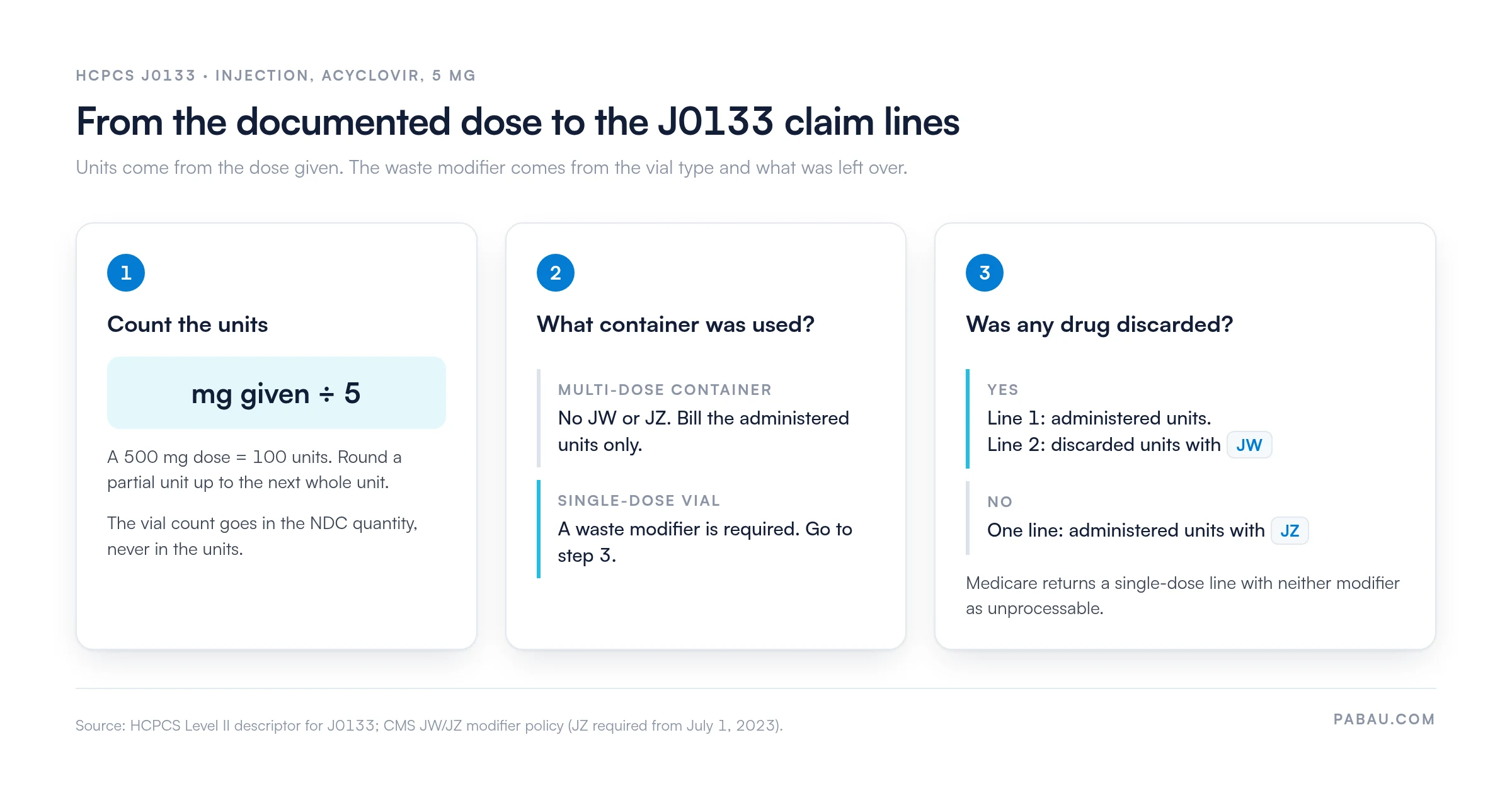
Each billing unit of J0133 equals 5 mg of acyclovir administered. Divide the documented administered dose in milligrams by 5 to get the number of units to bill. Bill units based on the dose administered, not the vial size drawn up. The dispensed vial belongs in the NDC quantity on the same line, never in the J0133 unit count.
Rounding: Bill whole units only. If the administered dose does not divide evenly by 5, round up to the next whole unit. Document the exact dose in mg in the infusion nursing note and the drug administration record. That lets the billed units be audited against the chart.
Waste reporting: When a single-dose vial holds more drug than the administered dose, the discarded remainder must be reported. Bill it on a separate J0133 line with modifier JW. When no drug is discarded, add modifier JZ to the administered line instead. Neither modifier applies to multi-dose containers.
JW has applied since January 1, 2017. JZ was optional from January 1, 2023 and required from July 1, 2023, under the CMS JW/JZ policy (MLN Matters SE22020). From October 1, 2023, claims missing both modifiers are returned as unprocessable. The flow below shows how one documented dose becomes claim lines.
The claim must carry an ICD-10-CM diagnosis code that establishes medical necessity for IV acyclovir. Payers review the diagnosis-to-drug pairing: A diagnosis that does not clinically indicate parenteral antiviral therapy is a common denial trigger.
The medical record must document why parenteral therapy is necessary. A diagnosis of uncomplicated oral herpes (B00.1) paired with J0133 will likely deny because the clinical indication does not support IV administration over oral alternatives.
J0133 covers the drug cost only. The clinical service of infusing or injecting the drug is billed separately using a CPT administration code. Choose the administration code based on route and session structure. A timed infusion usually takes 96365 for the first hour, while an IV push takes 96374.
Documentation must include infusion start and stop times to support the administration code billed. Without start/stop times, 96366 (each additional hour) will deny.
Bill the administration code (96365 or 96374) and the drug code (J0133) on the same claim date. Submit them as separate line items. Bundling both onto one line or omitting the administration code leaves revenue on the table. It may also trigger an edit that flags the drug code as unbillable without a service code.
J0133 is the only HCPCS J code for acyclovir, and it covers the injectable form only. HCPCS Level II J codes report drugs administered other than orally, so no J code exists for oral acyclovir. Oral acyclovir is a pharmacy-benefit drug billed by its NDC, not on the medical claim with J0133.
The second decision is the unit. J0133 counts 5 mg of acyclovir administered, while the NDC on the same line describes the vial dispensed. A fully used 500 mg vial is therefore 100 units of J0133, not 1 unit. Billing the vial count as J0133 units is a common reason payers reject this code.
Medicare Part B reimburses J0133 under two distinct methodologies depending on where the drug is administered. Check the setting first, because it decides whether J0133 is paid as its own line or packaged into the service it supports.
Non-facility settings (physician office, freestanding infusion center): Medicare pays based on Average Sales Price (ASP) plus 6%. CMS updates these payment limits quarterly in its ASP drug pricing files. Always verify the current quarter’s limit in the CMS ASP pricing file lookup, because prior-quarter figures go stale.
Hospital outpatient settings: J0133 is subject to OPPS (Outpatient Prospective Payment System) packaging rules. Under OPPS, low-cost drugs may be packaged into the Ambulatory Payment Classification (APC) payment for the associated service rather than paid separately. Hospitals should verify the current OPPS Addendum B to confirm whether J0133 is separately payable or packaged in a given payment year.
Medicaid and commercial plans: Medicaid reimbursement varies by state. Commercial payers set their own allowables, which may be above or below Medicare ASP rates. Always verify plan-specific drug fee schedules.
Medicare fee-for-service generally does not require prior authorization for J0133. Medicare Advantage and commercial plans set their own rules and may require it, particularly for high-dose or prolonged courses of IV acyclovir. Build that plan check into the pre-infusion checklist, so any request goes in before the first dose.
When prior authorization is required, submit the following documentation:
Every J0133 claim must be backed by a complete, date-matched medical record. A claim that cannot be supported by the chart on audit is treated as an overpayment. Solid medical billing workflows integrate documentation capture into the infusion workflow before the claim is submitted.
Required documentation elements for J0133:
Medicaid requires an 11-digit NDC on every J0133 claim line. Many commercial plans have adopted the same requirement. Report the NDC in 5-4-2 format (e.g., 12345-6789-01) in claim loop 2410 on an 837P electronic claim.
Report the NDC unit qualifier that matches the drug form. Use UN (units) for vials billed per vial count, or ML (milliliters) when the payer requires volume-based reporting. Verify the payer’s NDC unit qualifier preference in the provider manual. Cross-walk the dispensed NDC to J0133 using the CMS HCPCS reference to confirm the NDC maps to this code.
CMS requires either JW or JZ on every single-dose vial line for drugs furnished on or after July 1, 2023 (optional from January 1, 2023). JW and JZ do not apply to multi-dose containers. Omitting both on a single-dose vial claim is an audit flag and may result in payment reduction or recoupment.
J0133 denials cluster around four root causes. They are unit calculation errors, units that do not match the NDC or dose, unsupported diagnoses, and missing NDC or modifiers. Practices using error-checking claims software catch most of these before the claim leaves the system.
Run a monthly denial audit on J0133 claims grouped by denial code. When more than two denials share the same CARC (Claim Adjustment Reason Code), the cause sits in one workflow step. Fix that step, and the next claims go out clean.
J0133 rework usually starts after the infusion, when a biller pieces the dose, the vial and the waste back together from nursing notes. A unit count built from the vial size, or a single-dose line without JW or JZ, only surfaces when the payer rejects it.
Pabau, the practice management platform we build, keeps the treatment note, the invoice and the claim in one patient record. Pabau’s claim validation scrubs each claim for missing or invalid details before it leaves Pabau, so fixes happen before submission. US practices then send claims through the Claim.MD integration.
The result is fewer returned J0133 lines and less time spent reconciling vials against charts at the end of the week.

Pabau keeps the treatment note, invoice and claim in one patient record. Its claim validation scrubs each claim for missing or invalid details before submission, so fewer J0133 lines come back.

Bill J0133 from the dose in the chart, never from the vial on the tray. Fix that habit first, because a unit error follows every line it touches, from the NDC quantity to the JW waste line.
The trade-off is documentation time at the bedside. Nurses record the exact mg given, the start and stop times, and any discarded amount. Those few minutes of charting are what let a J0133 claim survive a payer audit.
Oral acyclovir stays off this claim entirely, so keep it on the pharmacy side. Book a demo to see how Pabau checks each J0133 claim for missing details before it goes out.

Need to understand the broader HCPCS billing framework? What is medical billing covers how J-codes fit into the US claims workflow from service delivery to payment posting.
Giving acyclovir by push alongside another drug? CPT code 96375 covers each additional sequential IV push of a new drug.
Want to reduce claim denials across your billing operation? Denial management in healthcare walks through systematic approaches to identifying and correcting recurring denial patterns.
Infusing acyclovir after another drug in the same visit? CPT code 96367 explains how to bill a sequential infusion of a new drug.
HCPCS Code J0133 is the Level II drug code for injection, acyclovir, 5 mg. It bills the drug cost when injectable or IV acyclovir is administered in an outpatient or physician office setting. One unit equals 5 mg administered.
Bill 1 unit of J0133 per 5 mg of acyclovir administered. Divide the documented administered dose in mg by 5: A 500 mg dose equals 100 units; a 250 mg dose equals 50 units. Always base units on the administered dose, not the vial size.
Commonly paired codes include B00.3 (herpesviral meningitis), B00.4 (herpesviral encephalitis), and B00.7 (disseminated herpesviral disease). Zoster and neonatal codes include B02.0 (zoster encephalitis), B02.9 (zoster without complications), and P35.2 (congenital herpesviral infection). The diagnosis must establish medical necessity for the IV route.
Medicare fee-for-service generally does not require prior authorization for J0133. Medicare Advantage and commercial plans set their own rules, so check the patient’s plan before the first infusion. When a plan requires it, submit the prescriber order and the diagnosis with clinical notes. Add documentation explaining why IV therapy is needed instead of oral therapy.
JZ is required when the entire vial was administered with no waste. JW is required for any drug amount discarded from a single-dose vial, billed on a separate line. KD applies when the drug is infused through DME. CMS requires JW or JZ on single-dose vial lines for drugs furnished on or after July 1, 2023 (optional from January 1, 2023). Neither applies to multi-dose containers.
No. HCPCS Level II J codes report drugs administered other than orally, and J0133 (injection, acyclovir, 5 mg) is the only acyclovir J code. Oral acyclovir is a pharmacy-benefit drug billed by its NDC. J0131 is an unrelated code for acetaminophen injection, so it never applies to acyclovir.
Yes, Medicaid requires an 11-digit NDC on all J0133 claims, reported in 5-4-2 format in claim loop 2410. Many commercial payers have adopted the same requirement. Include the correct NDC unit qualifier (UN, ML, or GR) as specified in the payer’s provider manual.