

HCPCS code E0198: Water pressure pad billing guide
HCPCS code E0198 is a water pad for a standard mattress HCPCS code E0198 is the ...

Last Updated: Oct 13, 2026
H1011 is the HCPCS Level II code for family assessment by licensed behavioral health professional for state defined purposes.
Other mental health and community support services sit in a separate range, H2000 to H2041. The two are often merged into one mental health block, which sends coders to the wrong code. It also covers current fee schedule considerations, documentation requirements, and the CPT alternatives.
Let Pabau's smart automation suggest the right codes, reduce claim denials, and keep your practice compliant—effortlessly.
Automate repetitive tasks and focus on what matters most—your patients.
Reduce coding errors and ensure compliance with the latest regulations.
Clean claims, fewer denials, and faster reimbursements.
Powerful insights and reporting to help your practice thrive.
HIPAA compliant SOC 2 certified GDPR-compliant Trusted by 4,000+ clinics worldwide

HCPCS Code H1011 covers a family assessment by a licensed behavioral health professional for state-defined purposes.
H1011 is not covered by Medicare, so it is billed to state Medicaid programs, and acceptance varies by state.
Rates are set by each state Medicaid program, so no single national reimbursement rate applies to H1011.
Audit-proof records tie the assessment to provider credentials, a diagnosis, and the enrollee’s treatment plan.
Practice management software like Pabau supports HCPCS H-code claims, denial tracking, and state-specific Medicaid billing.
HCPCS Code H1011 has one official descriptor: “Family assessment by licensed behavioral health professional for state-defined purposes.” The last four words do the work. Your state Medicaid manual, not the code book, decides which assessments qualify.
CPT codes carry a nationally standardized descriptor maintained by the American Medical Association (AMA). H codes are administered at the state level instead. A billable family assessment in California may not match what another state’s Medicaid program recognizes. Read your state Medicaid provider manual before you submit.
The descriptor specifies a “licensed behavioral health professional.” Each state decides which credentials qualify, and the list varies. These provider types are commonly recognized across state Medicaid programs, though you still need to confirm with your own state agency.
Some states also allow billing under a supervising licensed professional. That covers assessments performed by a provisionally licensed or pre-licensed clinician under documented supervision. Scope of practice rules differ from state to state, so check the provider manual rather than assuming.
Group practices should switch on credential tracking at the individual clinician level in their behavioral health EHR. Billing H1011 under an ineligible provider type is a common denial trigger. Practices running psychology practice software can map each license type to the codes it is allowed to bill.
H codes are Medicaid-specific. Medicare does not cover H1011 or any other H-series behavioral health code. For comparable services. An H1011 claim sent to Medicare will deny.
California’s Medi-Cal program is a confirmed user of H1011, particularly in dyadic and family behavioral health services. Other states may use it under a different program name, or bill equivalent services with state-specific codes. The CMS HCPCS overview confirms that H codes sit outside the national Medicare fee schedule.
Before submitting H1011 claims, download your state Medicaid agency’s current behavioral health fee schedule and provider manual. State Medicaid websites update these documents annually, often with changes to covered codes and billing requirements that take effect at the fiscal year start.
The best medical practice management tools let you standardize how unlisted and miscellaneous codes get documented.
No single national reimbursement rate exists for HCPCS Code H1011. Each state Medicaid program sets its own rate. Managed care organization (MCO) contracts can vary it again within the same state. The table below shows representative state ranges from public Medicaid fee schedule data, so verify each figure with the state agency before billing.
Use the CMS Physician Fee Schedule lookup tool to check whether an entry exists for H1011 in your jurisdiction. For state Medicaid rates, go straight to the agency’s provider portal. Third-party aggregators are a starting point at best, so confirm against the official source first.
H1011 claims follow several rules that differ from standard CPT-based workflows. Denials most often come from an incorrect place of service code, missing modifier information, or a payer that does not cover the code at all. Denial codes in medical billing follow a similar pattern across specialties, so the same three causes turn up on most claims.
Confirm your practice management system can transmit 837P claims and attach modifiers at the service line. Pabau’s claims management software handles HCPCS submission and denial tracking, so nobody on the billing team is tracking state Medicaid rule changes by hand.
State Medicaid auditors reviewing H1011 claims look for three things. They want evidence of medical necessity, proof of provider qualifications, and a direct link between the family assessment and the enrollee’s treatment plan. Miss one and the claim is open to recoupment.
Structured clinical assessment forms beat free-text notes here, because they capture every required element the same way each time.
A family genogram records relationships in a form an auditor can read at a glance. A DAP note template gives the session narrative a fixed shape, which makes the treatment plan link easy to find.
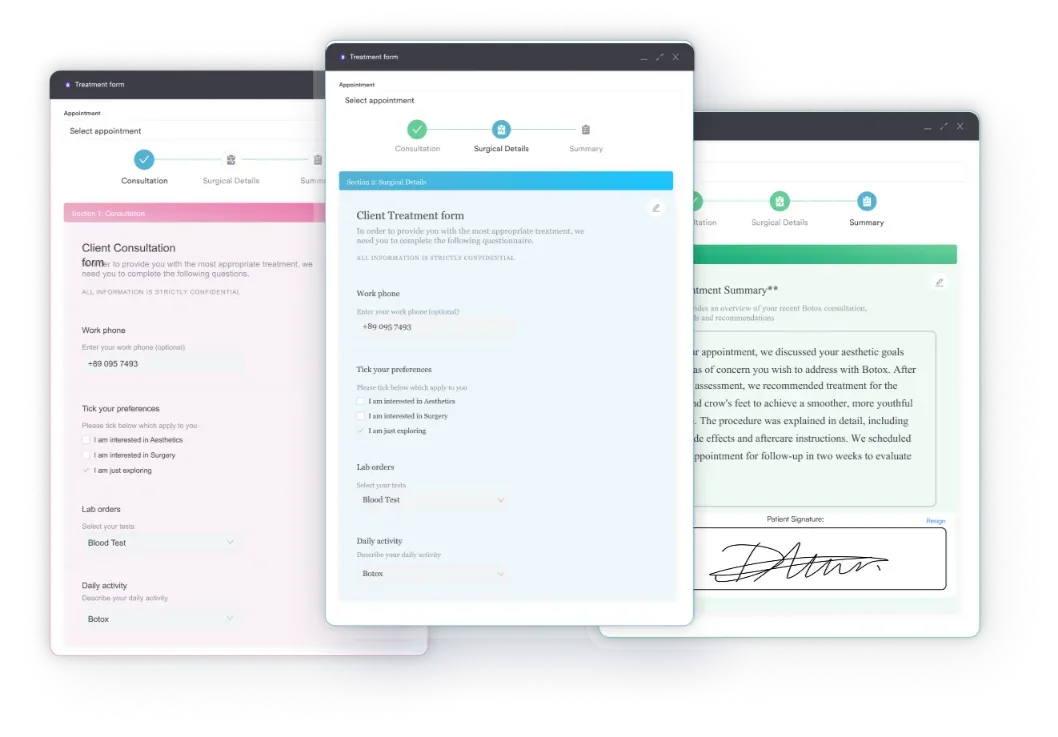
Electronic records must also meet HIPAA-compliant documentation standards for storage, access controls, and transmission of electronic protected health information (ePHI).
H1011 is the last code in the H1000 to H1011 range for prenatal care and family planning assessment. Knowing the codes around it helps you pick the right one instead of undercoding or upcoding the service. The table below lists the codes clinicians reference most often, per the AAPC HCPCS code range.
A broader evaluation code such as H2000 is not a substitute for a family-specific assessment. Claim substitution between them is the kind of error your documentation will not support under audit.
Child and adolescent programs lean on family assessment more than most. Practices running ADHD clinic software often pair H1011 with a diagnosis such as F43.20 when family dynamics are part of the presentation.
Clinicians who bill both Medicaid and commercial insurance have to choose between H1011 and a CPT equivalent. The payer decides, not the clinician. Using the wrong code system for the payer is one of the fastest routes to a denial. Confirming insurance eligibility before the visit also tells you which code system that particular payer expects.
For a Medicaid enrollee whose assessment qualifies under H1011, billing 90791 may deny if the state expects H-code billing for that service category. Billing H1011 to a commercial payer will almost always deny. Build payer-specific rules into your automated billing workflows so claims route to the right code system on their own.
Run a payer-segmented claim audit quarterly. Pull all H1011 claims by payer type and confirm that no commercial insurance or Medicare claims appear in the H1011 billing data. Even a small number of miscoded claims can trigger a Medicaid audit if the pattern looks like systematic upcoding.
Most practices billing H1011 keep the rules outside the system. Someone maintains a spreadsheet of state modifiers, opens a PDF fee schedule before each claim, and remembers which clinicians are credentialed for the code. When that person is on leave, the denials start.
Pabau, our practice management platform, holds those rules where the claim is created. Payer rules send H1011 to Medicaid and CPT codes to everyone else. Modifiers attach at the service line based on credential and delivery method. Credential tracking keeps ineligible providers off the code entirely.
Session note templates capture provider credentials, the family members present, the diagnosis, and the treatment plan link. The client record keeps all of it against the enrollee, so answering an audit request takes minutes instead of a week of digging.
Denial tracking maps each rejection back to its cause, whether that is thin documentation or a failed authorization. Your billing team fixes the pattern once instead of reworking claims one by one. That is the practical argument for keeping Medicaid rules inside your practice management software.

Pabau’s claims management software supports HCPCS H-code submission, denial tracking, and state-specific Medicaid workflows. Your billing team spends less time chasing claims and more time on patient care.

H1011 rewards precision about one thing above all, and that is your own state’s rules. The descriptor is national, but the definition governing your claim lives in your state Medicaid manual. Read it before you bill rather than after a denial lands.
The trade-off worth remembering is reach against fit. CPT 90791 travels across every payer, while H1011 pays only where a state has activated it, and only for what that state defines. Pick by payer, document to the state’s standard, and the code stops being a problem.
Book a demo to see how Pabau handles Medicaid claim routing and audit-ready documentation for behavioral health teams.

Billing case management alongside the assessment? T1017 covers targeted case management, the code many states pair with a family assessment.
Coding an unclear adjustment disorder? Unspecified adjustment disorder code explains when F43.20 applies if the response does not fit a specific subtype.
Comparing the Medicare-side evaluation code? 90791 explains psychiatric diagnostic evaluation billing for the payers that reject H codes.
Coding a primary insomnia diagnosis? Primary insomnia ICD-10 code explains when F51.01 applies to sleep difficulty unrelated to other conditions.
Coding insomnia tied to depression? Insomnia due to depression code explains when F51.05 applies if insomnia is not an independent diagnosis.
HCPCS Code H1011 is used to bill a family assessment by a licensed behavioral health professional for state-defined purposes under a state Medicaid program. It covers structured assessment of family dynamics, behavioral health risk factors, and protective factors within the enrollee’s care plan.
Licensed behavioral health professionals can bill H1011. That includes Licensed Clinical Social Workers (LCSW), Licensed Marriage and Family Therapists (LMFT), Licensed Professional Counselors (LPC), and Licensed Psychologists. Each state Medicaid program sets its own credential requirements, so verify eligibility with your state before billing.
H1011 is covered by Medicaid only, in the states that have activated the code. Medicare does not cover H1011 or any other HCPCS H-series behavioral health code. An H1011 claim sent to Medicare denies automatically, so use CPT 90791 or 90792 for Medicare-covered psychiatric evaluations.
No single national reimbursement rate exists for H1011. Each state Medicaid program sets its own rate, and managed care organization contracts can vary it further within a state. Check your state Medicaid agency’s behavioral health fee schedule or provider portal for the current year’s rates.
Not every state has activated H1011 in its Medicaid program. California’s Medi-Cal program is a confirmed user. Other states may use H1011 within specific behavioral health programs, or bill equivalent services with state-specific codes. Verify acceptance with your state Medicaid agency before submitting claims.
H1011 is a HCPCS Level II state-assigned code billed only to Medicaid for family assessments under state-defined programs. CPT codes such as 90791 are nationally standardized and accepted by Medicare, commercial payers, and Medicaid. Use H1011 for Medicaid claims in states that accept it, and CPT codes elsewhere.



