HCPCS code P9058: Red blood cells, leukocytes reduced, CMV-negative, irradiated
HCPCS code P9058: Official descriptor and key attributes HCPCS code P9058 report...

Last Updated: Oct 26, 2026
G0276 is the HCPCS Level II code for a blinded lumbar stenosis procedure in an approved coverage with evidence development (CED) clinical trial. The patient receives either percutaneous image-guided lumbar decompression (PILD) or a placebo control.
It is not the routine code for the MILD procedure. Medicare pays G0276 only inside a CMS-approved trial that is randomized, blinded and placebo-controlled, under NCD 150.13. Other CED studies report CPT 62330, which replaced 0275T on January 1, 2026.
Let Pabau's smart automation suggest the right codes, reduce claim denials, and keep your practice compliant—effortlessly.
Automate repetitive tasks and focus on what matters most—your patients.
Reduce coding errors and ensure compliance with the latest regulations.
Clean claims, fewer denials, and faster reimbursements.
Powerful insights and reporting to help your practice thrive.
HIPAA compliant SOC 2 certified GDPR-compliant Trusted by 4,000+ clinics worldwide

HCPCS Code G0276 reports a blinded PILD procedure or its placebo control, performed inside a CMS-approved coverage with evidence development (CED) trial.
G0276 is not the routine code for the MILD procedure, and Medicare does not cover PILD for lumbar stenosis outside an approved study.
Non-blinded CED studies report CPT 62330, which replaced Category III code 0275T on January 1, 2026, and a claim never carries both codes.
A payable G0276 claim needs modifier Q0, Z00.6, a stenosis code such as M48.062, the 8-digit trial number, and POS 19, 22 or 24.
Pabau, the practice software we build, scrubs each claim for missing or invalid details before it leaves the system, which catches a missing field early.
HCPCS Code G0276 is the HCPCS Level II code for a blinded lumbar stenosis procedure in an approved coverage with evidence development (CED) clinical trial. The official CMS descriptor appears in full in the code details table below.
The code exists because of how the trial is designed. In a blinded, placebo-controlled study, some patients receive PILD and others receive a placebo procedure. G0276 covers both arms, so the claim does not reveal which treatment the patient received.
Medicare has covered PILD billed with G0276 since January 1, 2015. Coverage applies only when the procedure is part of a CMS-approved clinical trial. CMS Transmittal 13709, issued April 2, 2026, restates that rule in the Medicare Claims Processing Manual.
PILD is a percutaneous decompression for lumbar spinal stenosis (LSS). Under imaging guidance, the physician removes part of the thickened ligamentum flavum that narrows the spinal canal. The commercial MILD procedure is one PILD technique.
G0276 reports that service only in one setting: a blinded, placebo-controlled CED trial. The same code applies whether the patient received the decompression or the placebo control. Routine MILD cases outside a trial are not reported with G0276.
The study’s design decides which code goes on the claim, as the decision path below shows. CMS instructs that G0276 is reported only in a randomized, blinded trial with a placebo control arm. PILD performed in any other CED-approved study was reported with 0275T.
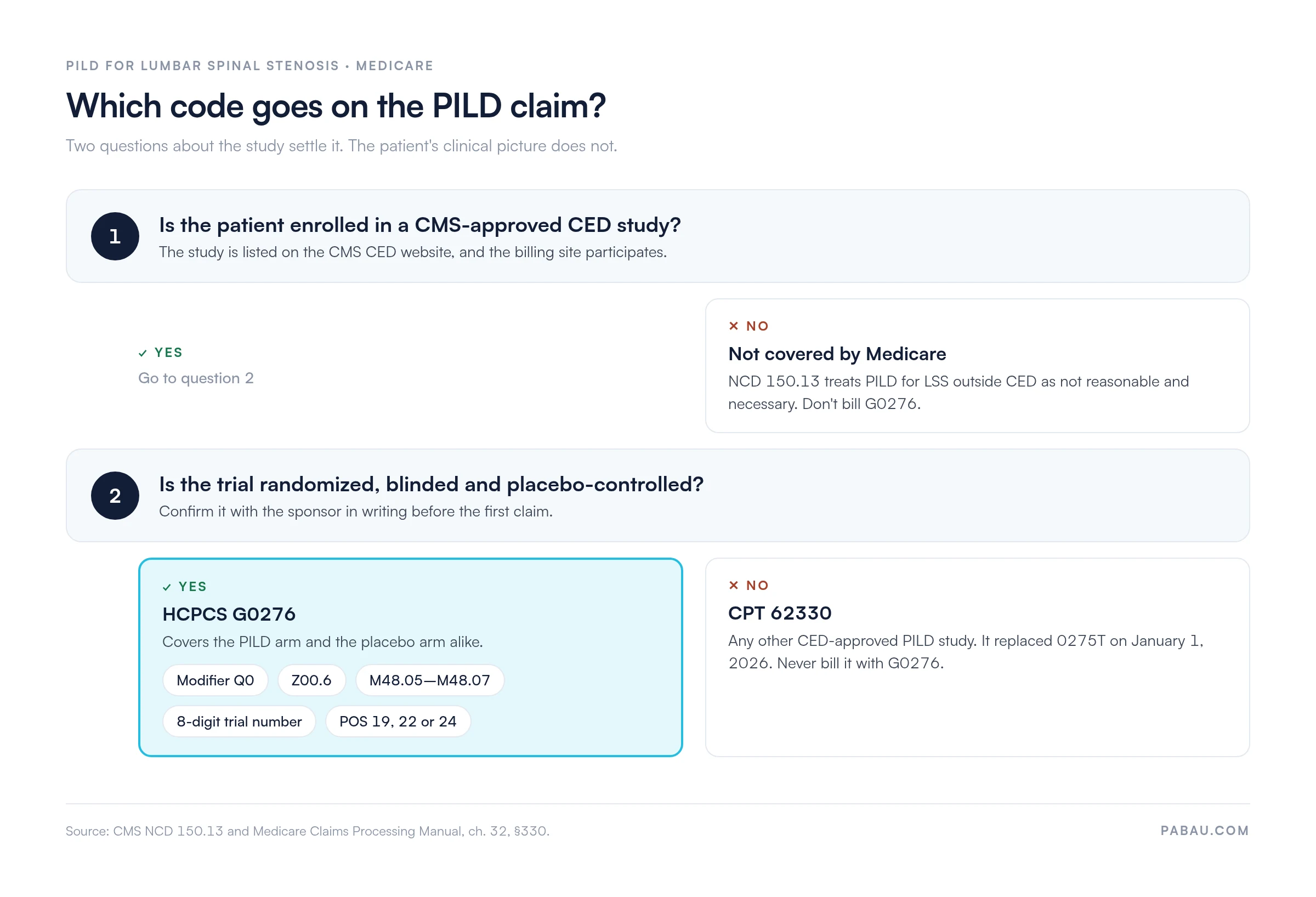
Category III code 0275T was end-dated December 31, 2025. From January 1, 2026, CPT 62330 replaces it, and CMS added 62330 to NCD 150.13 in the same update. A PILD claim may carry G0276 or the CPT code, never both.
Before the first claim, ask the trial sponsor in writing whether the study is blinded and placebo-controlled. That answer settles G0276 vs. 62330, and the sponsor should also supply the 8-digit trial number.
Medicare covers PILD for lumbar spinal stenosis only through coverage with evidence development. NCD 150.13 took effect on January 9, 2014. Outside an approved study, CMS treats PILD for LSS as not reasonable and necessary.
A second route opened on December 7, 2016. Medicare also covers PILD for beneficiaries enrolled in a CMS-approved prospective longitudinal study. That study must use an FDA-approved or cleared device that completed a CMS-approved randomized controlled trial.
Because the NCD sets national coverage, there is no local LCD checklist to satisfy for G0276. Three tests apply instead. The study must be approved, the patient must be enrolled, and the claim must carry the trial identifiers. A claim from a hospital that isn’t a participating trial site is denied, whatever the patient’s clinical picture.
Payment rates and status indicators change each year. Check the current status of G0276 in the CMS Physician Fee Schedule lookup and the OPPS and ASC files before you quote a rate.
Every G0276 claim carries two kinds of diagnosis. One is the clinical-trial code Z00.6, in the primary or secondary position. The other is a lumbar spinal stenosis code within the range CMS lists, M48.05 to M48.07.
M48.06 itself is a category header and cannot be billed. It needs a sixth character, and the two billable codes differ by neurogenic claudication, not by laterality.
CMS lists the covered range as M48.05 to M48.07, so thoracolumbar (M48.05) and lumbosacral (M48.07) stenosis also fall inside it. Code the level the imaging and the physician’s notes document.
Professional claims for G0276 are returned as unprocessable when any trial identifier is missing. The modifier rules below come from the Medicare Claims Processing Manual, chapter 32, section 330. Q0 and Q1 also apply on other clinical trial claims, such as those billed with G0293.
Hospital outpatient claims follow section 330.2. Bill G0276 on a 13X or 85X type of bill with Z00.6, condition code 30 and modifier Q0. Add the 8-digit trial number listed on the CMS CED website.
Image guidance is part of the G0276 descriptor. Check the current NCCI edits before you report any separate imaging guidance code on the same date of service.
The documentation for G0276 centers on trial participation. The record has to show that this patient was enrolled in this approved study when the procedure was done. Strong medical billing compliance starts with the elements below.
Run insurance eligibility verification before the procedure date as well. Commercial plans set their own rules for trial services. Medicare Advantage claims for qualifying trials may route differently, so confirm the payer’s position with the plan and the sponsor in writing.
Most G0276 rejections come from a missing trial element rather than a clinical dispute. The codes below are the ones CMS tells contractors to use. Working them systematically is the core of denial management in healthcare.
Remark code N704 means the decision cannot be appealed but the claim can be resubmitted with corrected information. Fix the claim rather than drafting an appeal letter. For a CARC this table doesn’t list, our guide to denial codes explains what each one means.
A G0276 claim usually fails on a clerical detail. A missing Q0, a blank trial number field or the wrong place of service sends it back unprocessed, often weeks after the procedure.
Pabau’s claims management software builds each claim from the patient’s invoice. Each claim is scrubbed for missing or invalid details before it leaves Pabau. A rejected claim is flagged “Needs action”, and the fix shows what went wrong with a link to the field.
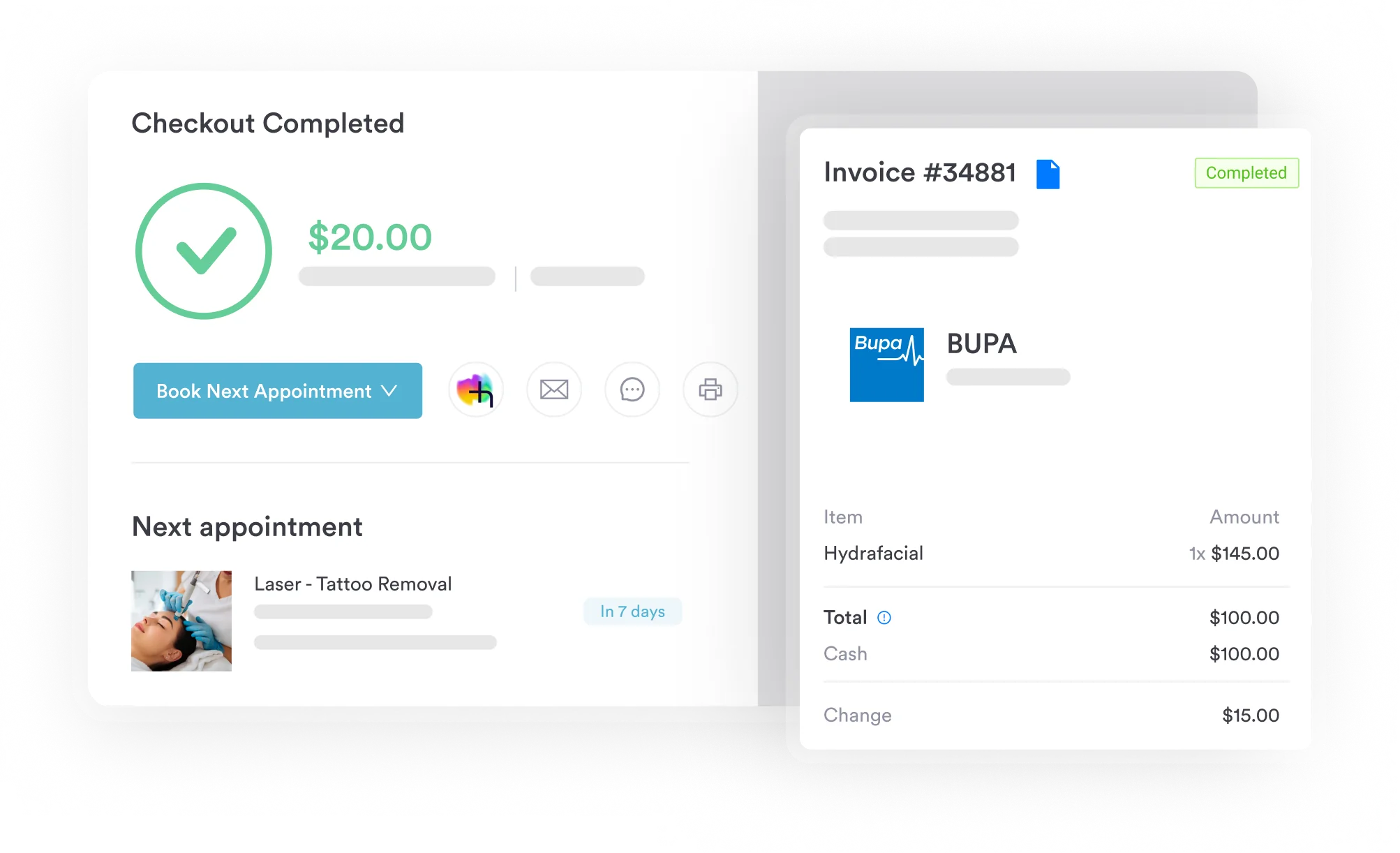
Authorizations sit on the patient record as cases, and the reference follows the appointment to the claim. US practices can check eligibility through Claim.MD before the visit and settle payments from ERA files once the remittance arrives.

Pabau scrubs every claim for missing or invalid details before it leaves the system and flags rejected claims with what went wrong. Your team fixes trial claims faster.

G0276 belongs on a claim only when the patient is enrolled in a CMS-approved, blinded, placebo-controlled PILD trial. Treating it as the everyday MILD code produces claims Medicare will not pay. Confirm the trial design with the sponsor first, because that decides whether the claim carries G0276 or 62330.
The trade-off worth remembering is that trial billing is less flexible than LCD billing. No appeal argument rescues a claim from a non-participating site. Build Q0, Z00.6, condition code 30 and the trial number into the charge template before the first patient. Book a demo to see how Pabau catches missing claim details before a trial claim goes out.

Need a framework for tracking procedure-code rejections? Denial management in healthcare covers the systematic approaches billing teams use to reduce repeat denial patterns.
Want fewer claims returned as unprocessable? Submitting a clean claim walks through the elements that prevent first-pass rejections on procedure codes.
Reviewing billing workflows for a spine or pain practice? Revenue cycle management explained covers how integrated billing workflows reduce coding errors across complex code sets.
Looking up another Level II code? HCPCS codes collects billing guides for each HCPCS code, with modifiers and claim rules.
HCPCS Code G0276 is the CMS code for a blinded lumbar stenosis procedure in an approved CED clinical trial. It reports either percutaneous image-guided lumbar decompression (PILD) or a placebo control.
Not for routine cases. G0276 applies only when PILD or its placebo is performed inside a CMS-approved, randomized, blinded, placebo-controlled trial. Medicare does not cover PILD for lumbar stenosis outside an approved study.
The trial design separates them. G0276 is for blinded, placebo-controlled CED trials, while 0275T covered PILD in other CED-approved studies. CPT 62330 replaced 0275T on January 1, 2026, and a claim carries only one code.
No. Under NCD 150.13, Medicare covers PILD for lumbar spinal stenosis only within a CMS-approved CED study. Outside that setting, CMS treats the procedure as not reasonable and necessary.
Modifier Q0 is required on the G0276 line. Contractors return a PILD claim without Q0 as unprocessable. Routine services in the same study take modifier Q1 instead.
Two are needed. Z00.6 goes in the primary or secondary position, alongside a stenosis code from M48.05 to M48.07. For the lumbar region, use M48.061 without neurogenic claudication or M48.062 with it.
G0276 is payable only in place of service 19, 22 or 24. Those are the off-campus outpatient hospital, the outpatient hospital and the ambulatory surgical center. Hospital outpatient claims also need condition code 30.