HCPCS Code E0272: Foam rubber mattress billing guide
HCPCS Code E0272: official descriptor and code overview HCPCS Code E0272 is the ...

Last Updated: Nov 6, 2026
G0294 is the HCPCS code for noncovered procedure(s) using either no anesthesia or local anesthesia only, in a Medicare qualifying clinical trial, per day.
The physician fee schedule does not pay it, and the hospital OPPS packages it or pays it under APC 5732. It flags trial-only work so Medicare can pay the routine costs around it under NCD 310.1. Use G0293 instead when the procedure involves conscious sedation or regional, general or spinal anesthesia.
Let Pabau's smart automation suggest the right codes, reduce claim denials, and keep your practice compliant—effortlessly.
Automate repetitive tasks and focus on what matters most—your patients.
Reduce coding errors and ensure compliance with the latest regulations.
Clean claims, fewer denials, and faster reimbursements.
Powerful insights and reporting to help your practice thrive.
HIPAA compliant SOC 2 certified GDPR-compliant Trusted by 4,000+ clinics worldwide

HCPCS code G0294 reports a noncovered procedure done with no anesthesia or local anesthesia only in a Medicare qualifying clinical trial, once per day.
Use G0293 instead when the noncovered procedure involves conscious sedation or regional, general or spinal anesthesia.
G0294 is not payable under the physician fee schedule. Under the hospital OPPS it carries status indicator Q1, so it is packaged or paid under APC 5732.
Trial claims need the 8-digit NCT number and ICD-10-CM code Z00.6, plus condition code 30 on institutional claims.
Most problems trace back to a missing NCT number, the retired QV modifier, or a G0294 line sent to the physician fee schedule.
HCPCS code G0294 is the Level II code for a noncovered procedure using no anesthesia or local anesthesia only in a Medicare qualifying clinical trial. It is reported once per day. CMS added it on January 1, 2003, together with its companion code G0293, and both are still active in the October 2026 HCPCS file.
The code tells Medicare that a trial procedure falls outside coverage. That lets the payer separate it from the routine care it does pay for under its clinical trial policy. G0294 has no connection to preventive, counseling or behavioral services.
These values come from the CMS quarterly HCPCS file for October 2026. The OPPS status comes from Addendum B. Neighboring G codes sit in our index of HCPCS codes.
G0293 and G0294 describe the same situation and differ only in the anesthesia used. Both report a noncovered procedure in a Medicare qualifying clinical trial, and both are billed per day.
A study-only biopsy under local anesthesia goes to G0294. The same biopsy under moderate sedation moves to G0293. Record the anesthesia type in the procedure note, because it is the only detail that decides between the two codes.
National Coverage Determination 310.1, Routine Costs in Clinical Trials, sets what Medicare pays for when a beneficiary takes part in a qualifying trial. It splits trial care into routine costs, which Medicare covers, and items it excludes.
Medicare covers these routine costs:
Medicare excludes these:
G0294 sits on the excluded side. A typical example is an extra biopsy taken only for study data, under local anesthesia or none.
The NCD also defines which trials qualify. A trial must study an item in a Medicare benefit category and have therapeutic intent. Trials funded by NIH, CDC, AHRQ, CMS, the Department of Defense or the VA are deemed to qualify. So are trials run under an FDA investigational new drug application, and drug trials exempt from one.
Medicare recognizes a trial claim by its identifiers. Each one has a fixed place on the claim, and the place differs between institutional and professional claims.
CMS made the trial number mandatory for dates of service from January 1, 2014. A claim without it is returned as unprocessable, per CMS Transmittal 2955.
Modifiers mark each covered line on a trial claim as investigational or routine. Q1 replaced the older QV modifier on January 1, 2008.
G0294 reports a noncovered procedure, so a routine-care modifier does not describe it. CMS’s original instructions barred QV from noncovered items, and Q1 took over that role. Put Q1 on the covered routine lines, and confirm line-level rules for G0294 with your Medicare Administrative Contractor (MAC).
Medicare does not pay G0294 under the physician fee schedule. The code carries pricing indicator 00, which CMS defines as a service that Part B does not price separately. Processing note 0109 adds that payment is for hospital outpatient only.
On a hospital outpatient claim, the OPPS Addendum B lists G0294 with status indicator Q1 in APC 5732. Q1 means STV-packaged. The line is packaged when the claim carries a status S, T or V service, and otherwise paid at the APC rate of $38.16.
Two cautions apply. Appearing in Addendum B does not itself mean the service is covered. And status indicator Q1 has no connection to the Q1 modifier that marks routine trial lines.
Routine trial costs are paid through the lines that carry modifier Q1 under NCD 310.1, or Q0 for a covered investigational item. The trial’s clinical trial agreement usually decides who pays for the noncovered procedure. Read the agreement and the informed consent before you bill the patient for any part of it.
The map below shows where each kind of protocol procedure lands on the claim, with G0294 as one of five outcomes.
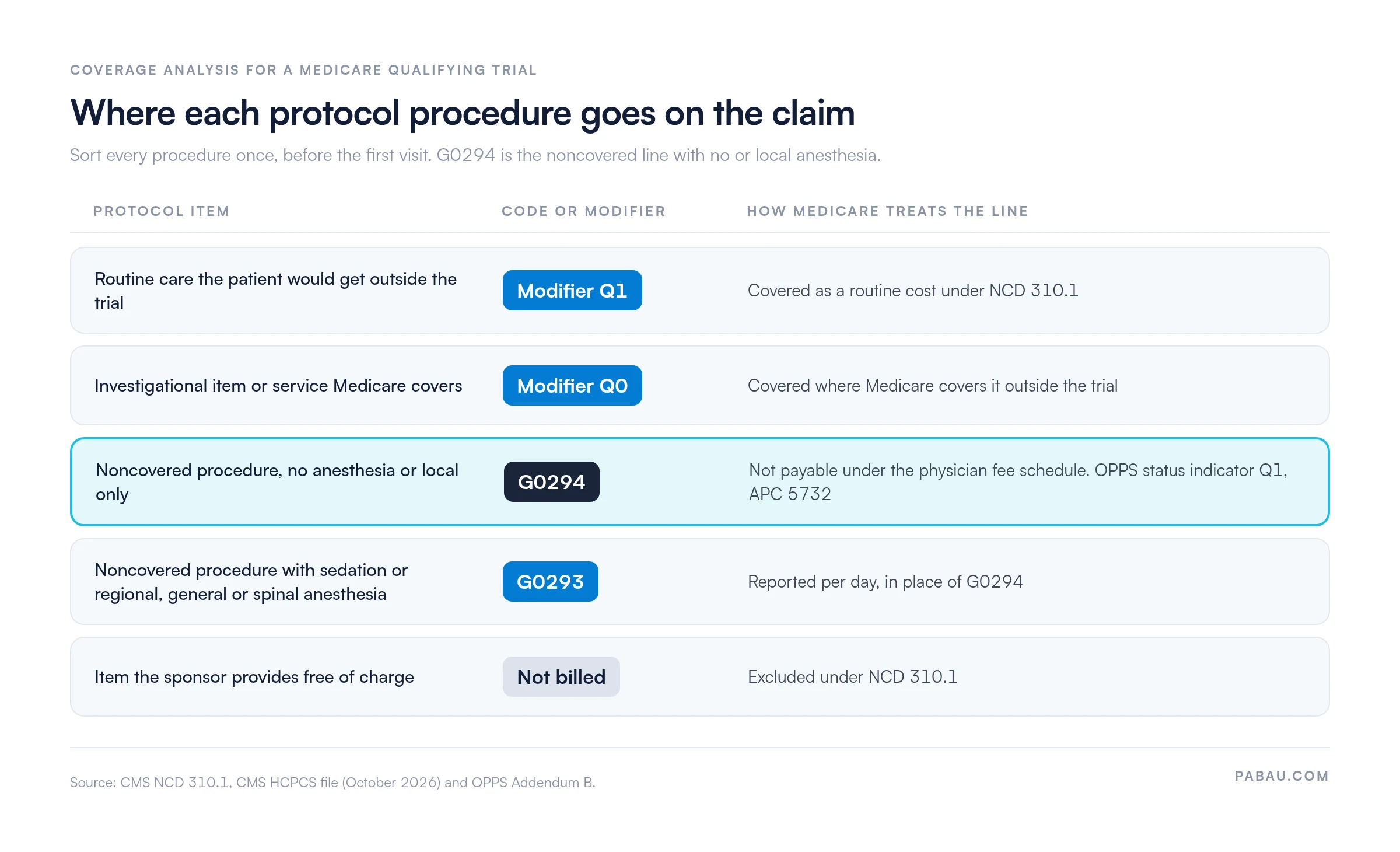
Build a coverage analysis for each trial before the first patient visit. Map every protocol procedure to routine (Q1), investigational (Q0), sponsor-paid, or noncovered (G0293 or G0294). Your billers then code each visit from that map.
G0294 claims usually fail on the trial identifiers around the code. Each pattern below has a fix you can apply before submission, which keeps denial management work to a minimum.
Good medical billing compliance practice treats the coverage analysis as the source document for every one of these checks. A clean claim for a trial patient starts there.
Research billing breaks down when the trial details sit in a binder and the claim sits in a billing system. A biller who cannot see the NCT number or the coverage analysis has to guess, and the payer returns the claim.
Pabau, the practice management and billing platform we build, keeps the patient record and the claim in one place. Its claims management software scrubs each claim for missing or invalid details before it leaves your practice. CMS-1500 claims go out through Claim.MD, and rejected claims come back flagged with the reason.
For a practice that sees trial patients, that gives your team one place to confirm the Q1 lines, Z00.6 and the trial number before submission. A missing identifier gets fixed before the claim goes out, so you avoid waiting on a return to find it.

Pabau scrubs every claim for missing details before it leaves your practice and shows the reason behind each rejection. See how it fits your billing workflow.

Treat G0294 as a coverage flag first and a payment line second. The physician fee schedule pays nothing for it, and on a hospital claim OPPS packages it or pays it under APC 5732. Either way, its job is to keep a study-only procedure off the covered lines.
When a trial claim fails, check the NCT number, Z00.6 and condition code 30 before you question the code itself.
Build the coverage analysis once per trial and code every visit from it. To see how Pabau keeps the patient record and the claim together, book a demo.

Billing the same procedure under sedation? HCPCS code G0293 covers noncovered trial procedures with conscious sedation or regional, general or spinal anesthesia.
Need to understand denial patterns across your HCPCS claims? Denial management in healthcare walks through the root-cause analysis process for common remittance denial codes.
Want to streamline your full Medicare billing workflow? What is revenue cycle management covers the end-to-end process from eligibility verification to payment posting.
Billing research visits and need a compliance framework? Medical billing compliance outlines the documentation and audit standards behind compliant claims.
Working a returned or denied trial claim? Denial codes in medical billing explains the CARC and RARC codes on your remittance.
G0294 reports a noncovered procedure performed with no anesthesia or local anesthesia only in a Medicare qualifying clinical trial, once per day. It shows Medicare which trial work falls outside coverage, so the routine costs on the claim can be paid under NCD 310.1.
The anesthesia used. G0293 covers noncovered surgical procedures using conscious sedation or regional, general or spinal anesthesia. G0294 covers noncovered procedures using no anesthesia or local anesthesia only. Both apply in a Medicare qualifying clinical trial and are reported per day.
Not under the physician fee schedule, where G0294 carries pricing indicator 00 and is not payable. On a hospital outpatient claim, OPPS gives it status indicator Q1 in APC 5732. It is packaged with a status S, T or V service, and otherwise paid at the APC rate. That listing does not itself make the procedure covered. Routine trial costs are paid on the lines billed with modifier Q1 under NCD 310.1.
Clinical trial claims use Q0 for covered investigational services and Q1 for covered routine services. Q1 replaced the QV modifier on January 1, 2008. Because G0294 reports a noncovered procedure, the routine-care modifier belongs on the covered lines. Confirm line-level rules with your MAC.
On a CMS-1500, enter the 8-digit NCT number in Item 19 with a CT prefix, such as CT12345678. On an 837P, report it in loop 2300 REF with qualifier P4 and no prefix. Institutional claims report it on the 837I in loop 2300 REF with qualifier P4, or with value code D4 on a paper CMS-1450. Claims from January 1, 2014 that lack it are returned as unprocessable.
No. G0294 is a clinical trial code for noncovered procedures. Medicare’s intensive behavioral therapy for cardiovascular disease is billed with G0446, under its own national coverage determination.