

CPT Code 52352: Ureteroscopic stone removal billing guide
CPT Code 52352: Official descriptor and procedure overview CPT Code 52352 descri...

Last Updated: Oct 30, 2026
G0182 is the HCPCS Level II code for physician supervision of a Medicare hospice patient's care plan while the patient is not present. It requires 30 minutes or more of oversight in a calendar month, billed once under Medicare Part B with modifier GV or GW. The patient's designated attending physician or nurse practitioner bills it, provided the hospice does not employ or pay them.
Most denials trace to a missing or wrong GV/GW modifier, under-documented time, or an ineligible billing physician. Coders also confuse it with G0181, the home health version, and with CPT 99377 and 99378, which Medicare does not accept.
Let Pabau's smart automation suggest the right codes, reduce claim denials, and keep your practice compliant—effortlessly.
Automate repetitive tasks and focus on what matters most—your patients.
Reduce coding errors and ensure compliance with the latest regulations.
Clean claims, fewer denials, and faster reimbursements.
Powerful insights and reporting to help your practice thrive.
HIPAA compliant SOC 2 certified GDPR-compliant Trusted by 4,000+ clinics worldwide

HCPCS code G0182 pays for at least 30 minutes of hospice care plan oversight in a calendar month, billed once per patient under Part B.
Only the patient’s designated attending physician or nurse practitioner may bill it, and the hospice must not employ or pay them. The biller must also sign the plan of care and have seen the patient face to face in the prior 6 months.
Modifier GV marks an attending the hospice does not employ or pay, for terminal-condition care, while GW marks a service unrelated to the terminal condition. A missing or wrong modifier is a leading denial cause.
Pabau’s claims management, part of the practice management platform we build, helps teams prepare and submit CMS-1500 claims and track their status.
HCPCS Code G0182 is a Medicare G-code that pays the attending physician or nurse practitioner for supervising a hospice patient’s care plan. The oversight must total at least 30 minutes in a calendar month, and none of it involves a face-to-face visit with the patient.
It belongs to the temporary G-code range of the HCPCS Level II code set. CMS uses these codes for services that CPT does not describe the way Medicare pays them.
G0182 covers non-face-to-face oversight performed outside a direct patient encounter. Every activity must be clinically necessary, documented with the time spent, and tied to managing the hospice patient’s care plan.
The CMS long descriptor names the activities that count, in this wording:
In practice, that means reviewing hospice nurse notes and lab results, revising medications, and talking with the hospice team. The CMS manual counts communication with professionals not employed in the same practice as the physician, such as hospice nurses, social workers and chaplains.
Several activities do not count toward the 30-minute threshold and cannot appear in a G0182 time log. CMS lists the first four in its Claims Processing Manual, chapter 12, section 180.
G0182 requires a minimum of 30 minutes of qualifying care plan oversight within a single calendar month, per CMS billing instructions. The 30 minutes are cumulative across the month and do not need to happen in one session.
Time must be documented as start and stop times per activity, or as total minutes per activity. Medicare Administrative Contractors (MACs) such as Novitas, CGS and Palmetto GBA expect the date, the nature of the activity and the time spent.
A note that says “reviewed chart and updated care plan” with no time recorded will not survive a post-payment audit.
The 29-minute problem: if a physician logs 29 minutes across the month, the claim is unbillable. Medicare has no lower-threshold G-code for shorter oversight, so that month produces no payment. A mid-month documentation check catches shortfalls while there is still time to act.
G0182 may only be billed by the patient’s designated attending physician, or a nurse practitioner designated as the attending. The hospice must not employ or pay them, and they must be the clinician who signs the plan of care.
Under 42 CFR 414.39, the biller must also have seen the patient face to face within the 6 months before the first billed month. Medicare pays only one physician per patient per month for this oversight.
The claim carries no other services and is billed only after the month ends, per the CMS Claims Processing Manual, chapter 12, section 180.1.
Verify attending status in writing before you submit a G0182 claim. Keep a copy of the hospice election statement or Notice of Election that names the attending physician, plus the signed plan of care. File both with a record confirming the attending has no employment or payment tie to the hospice.
Every G0182 claim requires either modifier GV or modifier GW. Submitting G0182 without one of these modifiers results in a denial, and the wrong modifier can draw an audit.
Decision guide: ask whether the oversight is clinically driven by the condition that established hospice eligibility. If yes, use GV. If it manages a separate, unrelated condition, use GW.
G0182 is one unit per month on a claim with no other services, so choose the single modifier that matches the month’s oversight. Consult your compliance officer when the link to the terminal condition is unclear. CMS covers the hospice modifiers in its Claims Processing Manual, chapter 11, sections 40.2 and 50.
G0181 covers physician care plan oversight for patients under a home health agency, while G0182 covers the same oversight for patients enrolled in hospice. The patient setting decides the code, not the clinical content of the oversight.
Home health certification is a separate service again. A physician who certifies a patient for Medicare home health bills G0180, not either oversight code.
CPT codes 99377 and 99378 are the AMA’s care plan oversight codes for hospice patients. Medicare does not accept them for hospice physician oversight claims and requires G0182 instead. Non-Medicare payers may accept either the CPT codes or G0182, depending on their contracts.
Every G0182 claim must be supported by a contemporaneous time log and clinical narrative. Reconstructing documentation after the fact is an audit risk. The following elements are required, per CMS and MAC guidance.
Store this documentation in the patient record alongside the monthly superbill and the claim copy. MACs auditing G0182 claims pull the full record, not only the claim form.
G0182 is submitted on a CMS-1500 paper claim or its electronic equivalent, the 837P. The five checks below decide whether a month is billable, and the field guidance after them covers the errors behind most first-pass rejections.
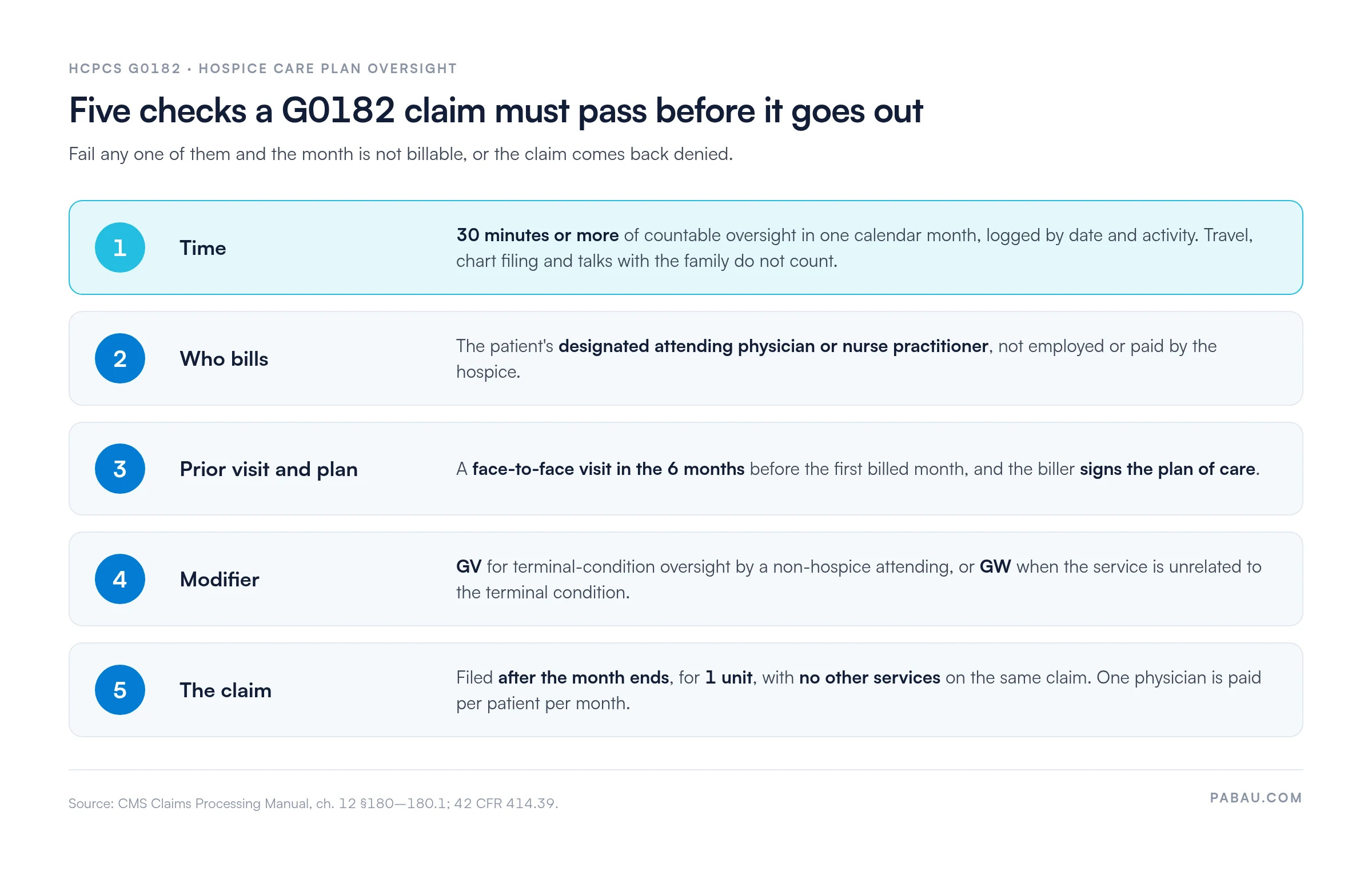
A clean claim submission on first pass depends on every one of these fields being right at once. A missing modifier alone is enough for a denial from most MACs.
Medicare pays G0182 under the Medicare Physician Fee Schedule (MPFS). Payment is adjusted each year and varies by location through the Geographic Practice Cost Index (GPCI). The national rate typically falls between $100 and $130, depending on the calendar year.
For 2026, G0182 carries 3.25 total RVUs in both settings, or about $108.55 nationally at the $33.4009 conversion factor. The facility and non-facility national payments are identical.
Look up the current-year rate using the CMS Physician Fee Schedule lookup tool. Enter G0182 in the HCPCS code field and select your locality. The tool returns the national non-facility rate, the national facility rate, and the relative value units (Work RVU, Practice Expense RVU, and Malpractice RVU). Do not use a prior-year rate or a community forum figure as your billing benchmark; MPFS rates are updated each January 1.
Most G0182 denials fall into five categories. Effective denial management for this code means addressing root causes before submission, not only after rejection.
Set a pre-submission edit rule for G0182 in your billing system that checks three fields together. It should confirm a GV or GW modifier, at least 30 logged minutes, and a single unit for the patient and month. Route any claim that fails a check to a human reviewer before it goes to the MAC.
Hospice oversight claims arrive one unit at a time, once a month, for each patient. Many practices still track them in a spreadsheet beside the billing system, which makes it easy to lose sight of a claim after it leaves.
Pabau’s claims management helps teams prepare and submit CMS-1500 claims and track their status. The time log, the modifier choice and the attending checks stay with your clinicians and coders. Pabau keeps each submitted claim’s status visible.
The result is a monthly list your billing lead can work from. Practices comparing tools can see how claims management software fits a monthly billing cycle.

Pabau’s claims management helps teams prepare and submit CMS-1500 claims and track their status, so a monthly G0182 claim never drops out of sight.

G0182 pays for a month of remote oversight for a patient near the end of life. That work is easy to do and easy to lose. The month is billable only when eligibility, time and the modifier all hold up.
Settle eligibility first, because it cannot be fixed later. Confirm the attending designation, the signed plan of care and the face-to-face visit before the month starts, then log minutes as you go.
Modifier errors can be corrected and resubmitted, but a 29-minute month or an ineligible biller cannot. Book a demo to see how Pabau helps your team submit each monthly claim and follow it through to payment.

Need to understand how denials get resolved after submission? Denial management in healthcare explains the appeals workflow and how to reduce write-offs on time-sensitive codes.
Want to see how clearinghouse submission works end to end? Clean claim submission covers what it takes for a claim to pass all edits on the first pass.
Looking for broader context on the billing cycle? Revenue cycle management explains how coding, submission, and payment posting connect across the practice.
Billing home health oversight instead? HCPCS code G0180 covers the physician certification that starts a Medicare home health episode.
HCPCS Code G0182 covers care plan oversight for a patient enrolled in the Medicare Hospice Benefit. It requires at least 30 minutes of non-face-to-face oversight within a calendar month. Covered work includes reviewing test results, communicating with the hospice team, revising the care plan and adjusting medical therapy.
30 minutes of qualifying oversight within a single calendar month is the minimum. Time accumulates across the month, but every minute must be documented with the date, the activity and the time spent. A month with only 29 documented minutes is not billable.
Yes, when the nurse practitioner is the patient’s designated attending and is not employed or paid by the hospice. CMS Claims Processing Manual chapter 12, section 180(B), and chapter 11, section 40.1.3.1, allow it.
A CPO claim must contain no other services, so bill any E/M visit on a separate claim. Face-to-face time from that visit never counts toward the G0182 30-minute threshold.
The five common reasons are a missing modifier, a wrong modifier, fewer than 30 documented minutes, an ineligible biller, and a duplicate monthly claim. Only the modifier errors are correctable by resubmission or appeal. Time, eligibility and duplicate denials are not.



