

CCSD code G5100: Bypass of duodenum billing guide
CCSD code G5100 bills a bypass that leaves the duodenum in place CCSD code G5100...

Last Updated: Oct 16, 2026
G0102 is the HCPCS Level II code for prostate cancer screening by digital rectal examination (DRE). Medicare pays for one every 12 months for men over 50. Unlike the PSA test billed as G0103, the DRE leaves the patient owing the Part B deductible and 20% coinsurance.
Two rules decide whether the claim pays. G0102 is bundled into any covered E/M visit on the same day, and the next screening must wait 11 full months. Below, we follow the claim from the eligibility check to payment.
Let Pabau's smart automation suggest the right codes, reduce claim denials, and keep your practice compliant—effortlessly.
Automate repetitive tasks and focus on what matters most—your patients.
Reduce coding errors and ensure compliance with the latest regulations.
Clean claims, fewer denials, and faster reimbursements.
Powerful insights and reporting to help your practice thrive.
HIPAA compliant SOC 2 certified GDPR-compliant Trusted by 4,000+ clinics worldwide

G0102 is the HCPCS Level II code for a screening digital rectal exam (DRE) on male Medicare patients over 50.
Medicare pays for one screening DRE every 12 months, counted as 11 full months after the month of the last screening.
The patient owes the Part B deductible and 20% coinsurance on G0102, while the PSA test billed as G0103 costs them nothing.
List Z12.5 first on every claim, because a symptomatic first-listed code risks a diagnostic reclassification or a denial.
G0102 is bundled into a covered E/M visit on the same day, so it pays only alone or with a noncovered preventive visit.
HCPCS code G0102 is the Medicare code for a prostate cancer screening digital rectal examination. The official CMS HCPCS descriptor reads “Prostate cancer screening; digital rectal examination.” CMS created it as a Level II G-code, so you won’t find it in the AMA CPT codebook.
Medicare covers it once every 12 months for men over 50. The patient shares the cost, and a covered E/M visit on the same day absorbs it. The table below holds the quick reference.
G0102 covers the manual exam itself. The clinician inserts a gloved, lubricated finger into the rectum and feels the back of the prostate. They check its size, contour and consistency, plus any nodules or tenderness.
The code stops at the exam. The PSA test, a biopsy, and any follow-up procedure are billed on their own. A DRE done because of symptoms, such as urinary retention or blood in the urine, is diagnostic. It doesn’t belong under G0102.
CMS NCD 210.1 sets the coverage rules for prostate cancer screening, G0102 included. Three facts decide eligibility. The patient must be male, over 50, and enrolled in Medicare Part B.
Medicare doesn’t count 365 days, and it doesn’t reset on January 1. Instead, it waits for 11 full months to pass after the month of the last screening. So a patient screened on March 15 is eligible again from March 1 the following year.
That two-week head start matters if you book annual screenings on a fixed date. Some MACs also add documentation rules through Local Coverage Determinations, so check your MAC’s LCD portal. The timeline below maps one patient’s year, next to what he pays for each part of the screening.
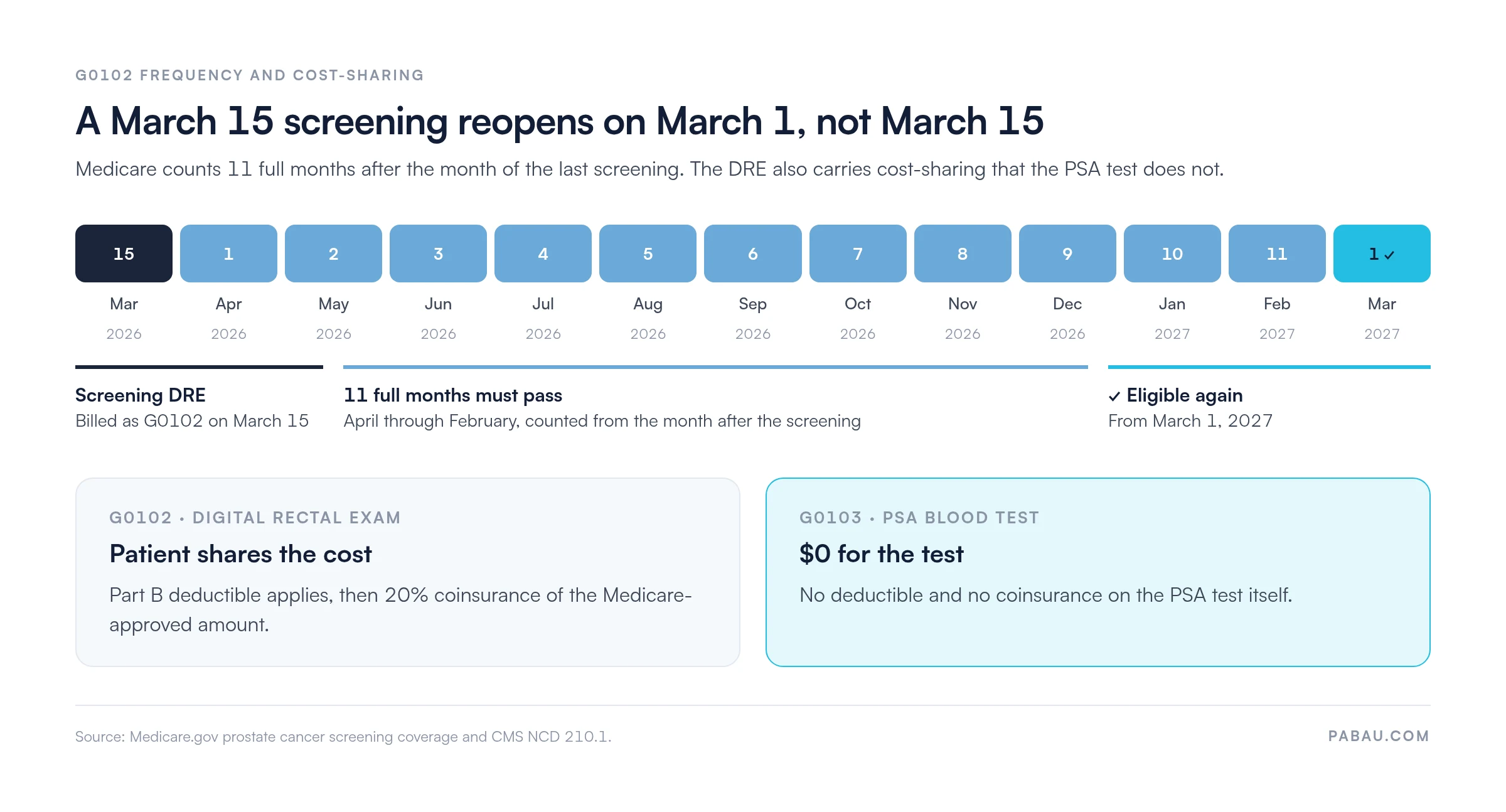
The Part B deductible and 20% coinsurance apply to G0102, whether the DRE is coded as screening or diagnostic. Only the PSA test billed as G0103 is free to the patient. In a hospital outpatient department, the patient may also owe a hospital copayment, according to Medicare.gov.
Tell patients this at booking, since many assume the whole screening is free. Front desk staff who understand medical billing workflows can explain the bill before the statement arrives.
List Z12.5 first on every G0102 claim. It stands for “encounter for screening for malignant neoplasm of prostate.” That tells the payer the DRE was a screening, not a workup.
Risk codes from the ICD-10-CM code set can follow in later positions. The table shows which ones help and which ones hurt.
A symptom code such as N40.1 (BPH with lower urinary tract symptoms) in first position changes how the payer reads the visit. The claim may be reclassified as diagnostic, sent for medical necessity review, or denied.
What if the screening turns up a nodule? Keep Z12.5 first and add the finding code after it. Any workup that follows is then billed as diagnostic.
G0102 covers the physical exam, and G0103 covers the PSA blood test. They’re two parts of the same screening, and each carries its own Medicare payment.
Both codes can go out for the same date of service, each with Z12.5 first. The physician’s office usually bills G0102. The lab bills G0103, or the office does if it runs PSA tests in-house.
No. G0102 is a CMS-created code for the Medicare preventive DRE, and the AAPC HCPCS code range places it outside CPT.
Commercial payers and Medicaid usually expect the DRE inside an E/M visit (99202-99215) or a preventive medicine visit (99381-99397). Check each payer contract, because bundling rules vary by plan.
A clean G0102 claim depends on four calls: eligibility, documentation, diagnosis order, and what else you bill that day. Work through them in this order.
Medicare bundles G0102 into a covered E/M visit on the same day, and modifier 25 doesn’t unbundle it. G0102 pays separately only when the DRE is the only service. It also pays when done during a noncovered preventive visit, such as 99397.
So when a patient raises a new problem during a screening visit, decide which service the note supports before you bill. Medicare won’t pay for both.
G0102 is paid under the Medicare Physician Fee Schedule (MPFS). Rates update each January with the final rule, so check the current-year figure in the CMS lookup tool.
After the Part B deductible, Medicare pays its share of the allowed amount and the patient owes 20% coinsurance. The same split applies whether the DRE is coded as screening or diagnostic.
Each January, look up G0102 in the CMS MPFS tool once the final rule takes effect. Export the facility and non-facility rates for your MAC. Then update your fee schedule before the first G0102 claim of the year. A stale rate won’t trigger a denial, but it skews your expected payments.
Most G0102 denials trace back to frequency, diagnosis order, eligibility, or a same-day E/M visit. Each one has a clear fix. Good denial management strategies start with knowing which one costs your practice the most.
Frequency denials are the easiest to prevent. Before you confirm the booking, check the month of the patient’s last paid G0102. If you can’t confirm it, have the patient sign an Advance Beneficiary Notice (ABN).
An auditor wants proof that the visit was a screening and that a DRE took place. A note reading “prostate exam performed, normal” shows neither. Solid medical billing compliance starts with a note template that captures each element below.
A structured template turns these into required fields. That way, nothing depends on memory at the end of a long session.
Build a G0102 note template that prompts for the screening reason, age, DRE technique, and each finding. An auditor should confirm every claim element within 30 seconds of opening the note. A note that needs interpreting will cause trouble on audit.
Many practices still key screening claims by hand. Staff retype codes and diagnoses from the visit note into the claim form, and each retyped field invites a wrong code or a missing NPI.
In Pabau, the practice management and billing platform we build, the claim form pre-fills from the patient record. The HCPCS code on the service lands on the charge line. ICD-10-CM and HCPCS lookup libraries make Z12.5 quick to find, and required claim fields are validated before the claim can be sent.
For US practices, Pabau’s claims management software submits through Claim.MD and runs eligibility checks before the visit. Your team spends less time fixing rejected claims and more time with patients.
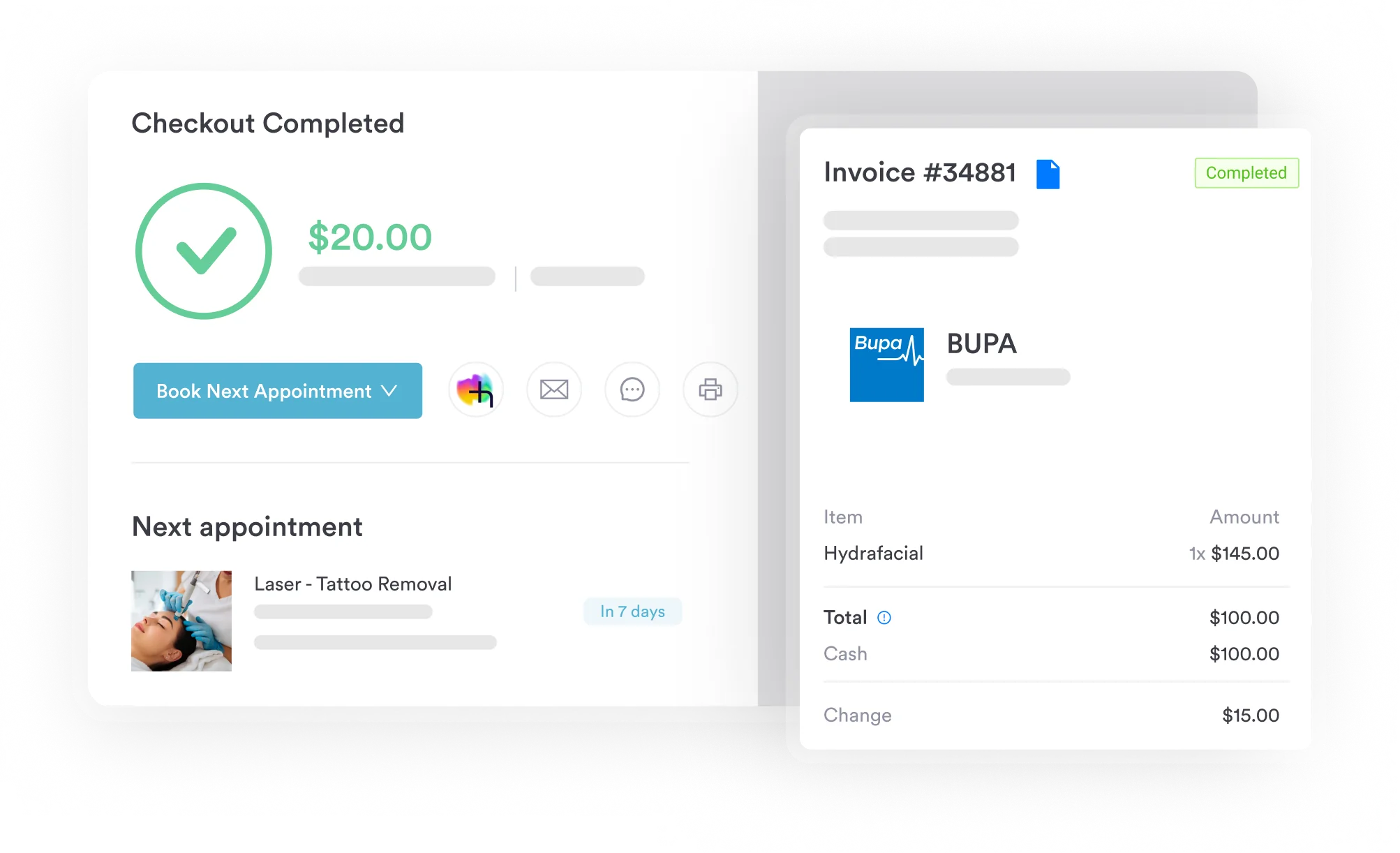

Pabau pre-fills claims from the patient record and checks required fields before submission. US practices submit through Claim.MD, with eligibility checks built in.

G0102 rewards practices that check before they bill. Confirm the 11-month window, list Z12.5 first, and keep the DRE off any day with a covered E/M visit. Those three checks stop the denials that cost the most time.
Set patient expectations too. The DRE carries cost-sharing that the PSA test doesn’t, and a patient told at booking won’t dispute the statement later.
If retyped claims are slowing your team down, book a demo to see how Pabau sends preventive screening claims from the record to the payer.

Need guidance on managing billing denials at scale? Denial management in healthcare walks through root-cause analysis and corrective workflows for common CARC codes.
Want to understand how preventive HCPCS claims fit into broader billing operations? What is revenue cycle management explains the claims lifecycle from eligibility through payment posting.
Looking for a superbill template that includes HCPCS codes? Superbill generation covers what goes on a compliant superbill and how to set one up in your practice management system.
Billing other Medicare preventive services? Medicare billing explains how Part B claims are submitted, paid, and appealed.
Coding the diagnosis side of the screening? ICD-10 code Z12.5 covers the prostate screening encounter code that must lead every G0102 claim.
Yes. The USPSTF doesn’t recommend the DRE as a screening test, but Medicare coverage comes from statute and NCD 210.1. Eligible patients can still have one screening DRE every 12 months.
No. Medicare covers the screening DRE for men over 50 with no upper age limit. Whether to screen an older patient is a clinical decision, not a coverage one.
The Part B deductible and 20% coinsurance still apply. The patient may also owe a hospital copayment. Bill with POS 22 so the facility rate applies.
Yes, if the visit was planned as a screening. Keep Z12.5 first and add the code for the finding after it. Any follow-up workup is billed as diagnostic.
Use an Advance Beneficiary Notice when you can’t confirm that 11 full months have passed. Append modifier GA so the patient can be billed if Medicare denies for frequency. Without a signed ABN, the practice absorbs the loss.



