CPT Code 52352: Ureteroscopic stone removal billing guide
CPT Code 52352: Official descriptor and procedure overview CPT Code 52352 descri...

Last Updated: Oct 30, 2026
E0325 is the HCPCS Level II code for urinal; male, jug-type, any material. It covers a reusable male urinal billed as durable medical equipment, whether it's made of plastic or metal.
A frequent denial cause is billing this male-specific code for a female patient, who takes E0326 instead. Medicare also expects a signed order, a supporting ICD-10 diagnosis, and documentation that bed or room confinement keeps the patient from standard toilet facilities.
Let Pabau's smart automation suggest the right codes, reduce claim denials, and keep your practice compliant—effortlessly.
Automate repetitive tasks and focus on what matters most—your patients.
Reduce coding errors and ensure compliance with the latest regulations.
Clean claims, fewer denials, and faster reimbursements.
Powerful insights and reporting to help your practice thrive.
HIPAA compliant SOC 2 certified GDPR-compliant Trusted by 4,000+ clinics worldwide

HCPCS code E0325 covers a male jug-type urinal of any material, and E0326 covers the female version.
Medicare Part B covers E0325 as durable medical equipment when medical necessity is documented and the supplier is DMEPOS-enrolled.
The KX modifier is required only where the applicable DME MAC LCD or policy article calls for it, so check the LCD for your jurisdiction.
Billing E0325 for a female patient is a frequent denial cause, and it’s easy to prevent at order entry.
Claims management software such as Pabau scrubs each claim for missing details and tracks it from pending to paid.
HCPCS code E0325 is the Level II code for “Urinal; male, jug-type, any material.” Plastic and metal versions both bill under it, so the supplier never picks a separate code based on what the product is made of. Medicare Part B covers it as durable medical equipment (DME) when the order and the medical record support it.
The claim goes to a DME Medicare Administrative Contractor (DME MAC), not the physician’s contractor. The supplier must be enrolled for durable medical equipment, prosthetics, orthotics and supplies, known as DMEPOS. The table sets out the code’s key attributes.
Not sure a product belongs under E0325? The Pricing, Data Analysis and Coding (PDAC) contractor issues formal coding decisions for DME products. CGS Medicare’s coding verification lookup tool helps you check a product’s HCPCS code before you bill it.
E0325 is broad on material and narrow on the item itself. Plastic, polyethylene and metal male urinals all bill under the same code. Knowing what falls outside it matters just as much for clean billing.
Covered under E0325: Male jug-type urinals made of plastic, polyethylene or metal, in any configuration designed for bed-based male urination.
Not covered under E0325:
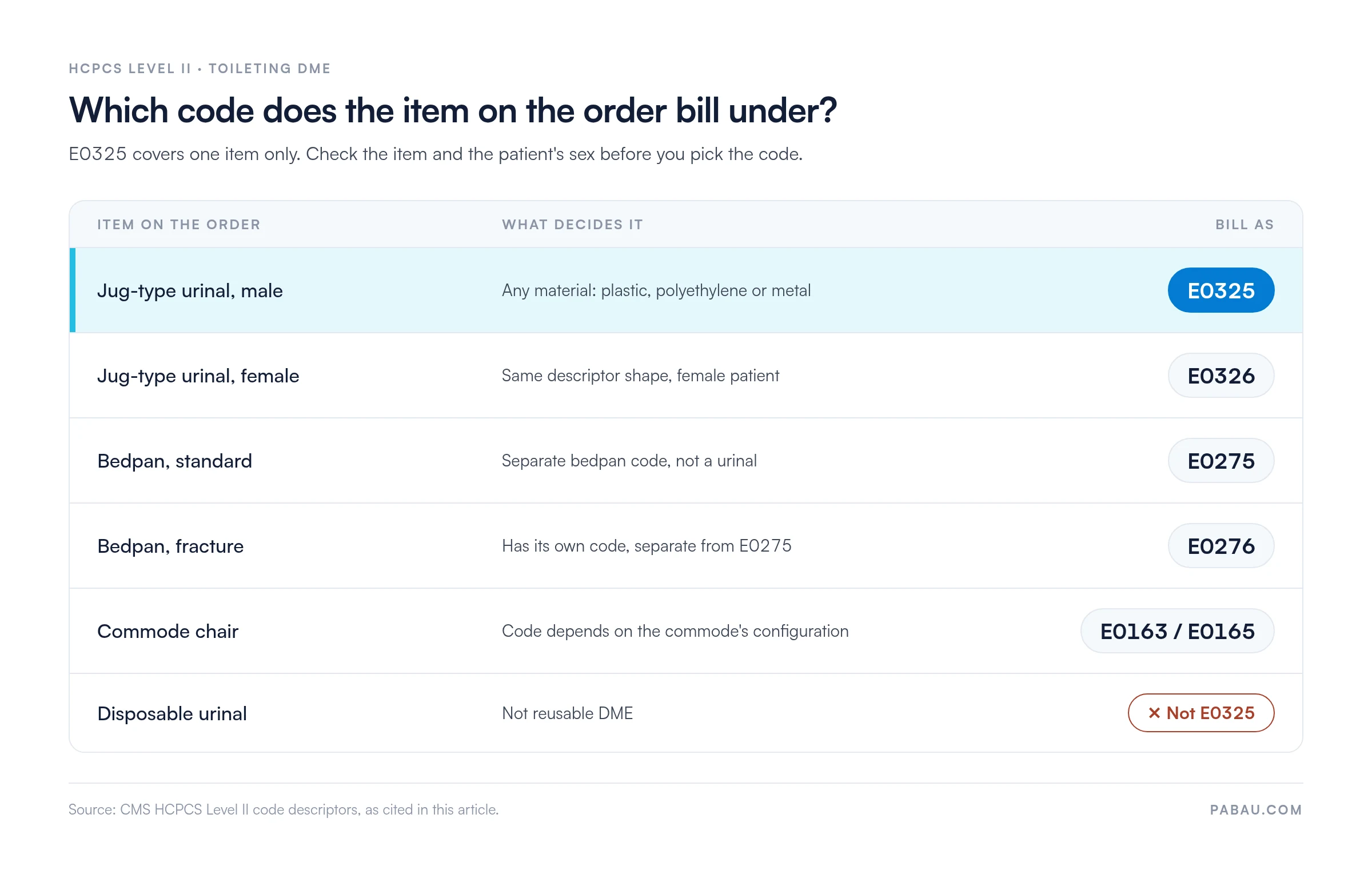
Orders often name the item loosely, so it helps to map each toileting item to its code before you bill.
Suppliers sometimes receive orders for a “urinal” that don’t state the patient’s sex. A sex-verification step at intake saves you the cost of a denied claim and a refund request later.
E0325 is for male patients, and E0326 is for female patients. The two descriptors are otherwise identical, which makes them easy to mix up. A frequent denial cause is billing this male-specific code for a female patient.
Payers check the billed code against the patient’s sex on file. A mismatch is usually caught by a claim edit before anyone reviews the record. Fixing it takes a corrected claim or an appeal with proof of the patient’s sex, which adds weeks to payment.
Medicare Part B covers E0325 under the DME benefit when three conditions hold. The supplier is DMEPOS-enrolled, medical necessity is documented, and the item is for use in the beneficiary’s home. The applicable DME MAC’s Local Coverage Determination (LCD) governs coverage, and the payment amount comes from the CMS DMEPOS fee schedule.
Key Medicare coverage rules for E0325:
The CMS HCPCS overview explains how the Level II code set is maintained and updated each year. Check it to confirm that E0325 is still an active code for the current year.
Medical necessity for E0325 rests on documentation that the patient can’t use standard toilet facilities because of bed or room confinement. That’s how the DME MAC policy frames it, so check the applicable LCD for the current wording in your jurisdiction. The order must tie that need to a specific condition, and “patient requested urinal” won’t hold up at audit.
The medical record should show:
Good medical billing compliance means keeping the order, the supporting clinical note and the ICD-10 linkage in the patient record before you submit the claim. An auditor who can’t find the order in the file will treat it as if it never existed.
Document the specific functional limitation in the physician order, alongside the diagnosis. A note that says ‘patient confined to bed, unable to reach toilet due to left hemiplegia following CVA’ is far stronger than ‘mobility impaired.’ Specificity protects the claim at audit.
The ICD-10 codes below are commonly linked to E0325 claims because they describe conditions that can keep a patient from reaching a standard toilet. Every claim needs a linked diagnosis to establish medical necessity. You can check each descriptor in our searchable ICD-10-CM library.
The diagnosis alone doesn’t guarantee coverage. The clinical note must connect it to the functional limitation, the patient’s inability to reach a toilet, to satisfy the LCD. A payer reviewing M54.50 for low back pain will expect detailed clinical justification, while G82.20 for paraplegia speaks for itself.
Modifiers on an E0325 claim tell the payer three facts. They show whether the item is purchased or rented and whether medical necessity criteria are met. They also flag whether the patient knows the item may not be covered. Each one carries its own legal and reimbursement implication.
KX needs the most care. It is required only where the applicable DME MAC LCD or policy article calls for it, so check the LCD for your jurisdiction. Appending KX is a legal attestation that the supplier holds documentation supporting medical necessity. Billing it without that documentation is a compliance risk that reaches well beyond an audit finding.
DME claims for E0325 go to the DME MAC for the beneficiary’s home state, not the physician’s Medicare Administrative Contractor. Getting the claim path right before submission avoids routing errors that delay payment. The medical billing process for DME follows its own workflow, separate from professional or facility claims.
Urinals (E0325, E0326) are generally not on the CMS list of DME items that need prior authorization before Medicare will pay. Most E0325 claims can therefore go out without pre-approval from the DME MAC. The documentation requirements still apply in full.
Three situations where prior authorization may still apply:
Most E0325 denials are preventable. The patterns below come up repeatedly in DME claim audits and coder discussions, and each has a simple fix when it’s caught before submission. Effective denial management workflows deal with them upstream, well before the appeals stage.
Run a pre-submission checklist before every E0325 claim. Verify the patient’s sex matches the code, and confirm the order is signed and dated before the dispense date. Check whether your LCD requires KX, and confirm the supplier NPI is DMEPOS-enrolled. These four checks take minutes and head off the most common errors on this list.
Without a pre-submission check, an E0325 error usually surfaces with the denial. Someone reads the remittance, works out that the patient was female or the order was unsigned, and files a corrected claim weeks later.
Pabau, the practice management platform we build, moves that check to before submission. Its claims management tools pre-fill each claim from the invoice and scrub it for missing or invalid details before it goes to your clearinghouse. The signed order and clinical note sit in the same patient record, so the documentation an auditor asks for is already filed.
Every claim is then tracked from pending to paid. A rejected claim is flagged as needing action with the reason attached, so your team fixes the field and resubmits. You spend less time on corrected claims and get paid for urinals and other DME sooner.

Pabau checks each claim for missing or invalid details before it reaches your clearinghouse, then tracks it from pending to paid. Rejected claims arrive flagged with the reason, so your team can fix and resubmit them quickly.

E0325 rewards suppliers who check before they bill. Confirm the patient’s sex, the signed order and the documented confinement at intake, and the denials in this guide rarely happen.
The trade-off is a few minutes of up-front work on a low-cost item. That’s still cheaper than a corrected claim, an appeal and weeks of waiting on a small payment. Treat the LCD for your jurisdiction as the final word on KX and confinement wording, since it can change.
Book a demo to see how Pabau checks each DME claim before it reaches your clearinghouse.

Need to understand DME denial patterns before they hit your claims? Denial management in healthcare covers the systematic approach to reducing claim rejections across payer types.
Want a broader foundation for medical billing compliance? What is medical billing explains the end-to-end revenue cycle process that DME billing plugs into.
Looking for resources on billing compliance requirements? Medical billing compliance outlines documentation standards and audit readiness practices for healthcare billers.
Keeping a DME catalog with its codes? Durable medical equipment list gives you a free DME template with HCPCS codes.
Filing DME claims on paper? CMS-1500 form walks through every box of the claim form, with a free template.
HCPCS code E0325 covers a male jug-type urinal made of any material, billed as durable medical equipment for patients who can’t use standard toilet facilities. Plastic, polyethylene and metal versions all bill under the same code, so the material never changes the code.
E0325 is the HCPCS code for a male jug-type urinal, and E0326 is the code for a female jug-type urinal. The only difference is the patient sex the item is designed for. Billing E0325 for a female patient is a frequent denial cause, so verify the patient’s sex before you select the code.
Yes, Medicare Part B covers E0325 as durable medical equipment when its coverage criteria are met. Per the DME MAC policy, the patient must be unable to use standard toilet facilities because of bed or room confinement. Check the applicable LCD for your jurisdiction. The item must be for home use, and the supplier must be DMEPOS-enrolled. The claim also needs a signed order and a supporting ICD-10 code. The beneficiary pays 20% coinsurance after the Part B deductible.
The common modifiers are NU (new equipment purchase), RR (rental), KX (medical necessity requirements met), GA (ABN on file) and GY (item statutorily excluded). KX is required only where the applicable DME MAC LCD or policy article calls for it, so check the LCD for your jurisdiction. Apply only one transaction modifier, NU or RR, never both.
Frequent denial reasons are a patient sex mismatch, a missing or unsigned physician order, and no documentation linking the ICD-10 diagnosis to a functional limitation. A missing KX modifier where the LCD requires it also causes denials, as does billing from a supplier that isn’t DMEPOS-enrolled. Each one is preventable with a pre-submission checklist.
Medicare generally doesn’t require prior authorization for E0325, because urinals aren’t on the current CMS DME prior authorization list. State Medicaid programs and commercial payers may set their own requirements, so verify with the payer before dispensing to any non-Medicare beneficiary.
Commonly linked ICD-10 codes include G82.20 (paraplegia, unspecified), G82.50 (quadriplegia, unspecified), M62.81 (muscle weakness, generalized) and Z99.3 (dependence on wheelchair). G35.D (multiple sclerosis, unspecified) and I69.354 (hemiplegia and hemiparesis following cerebral infarction affecting left non-dominant side) are also used. The clinical note must connect the diagnosis to the functional limitation, because the code alone doesn’t establish medical necessity.