

HCPCS Code G0163: Skilled nursing observation and assessment
What is HCPCS Code G0163? HCPCS Code G0163 is a deleted Level II code for skille...

Last Updated: Oct 15, 2026
HCPCS code E0301 is a heavy duty, extra wide hospital bed supplied without a mattress, for patients over 350 and up to 600 pounds. Side rails of any type are part of the code.
The weight band is the deciding fact. Above 600 pounds the bed becomes E0302, and the same frame delivered with its mattress is E0303. Medicare covers E0301 under LCD L33820, and since August 12, 2024, it also needs a face-to-face visit and a written order before delivery. Miss either step and the claim is denied. Below, you'll find who qualifies, the paperwork, the modifiers and a checklist to run before you submit.
Let Pabau's smart automation suggest the right codes, reduce claim denials, and keep your practice compliant—effortlessly.
Automate repetitive tasks and focus on what matters most—your patients.
Reduce coding errors and ensure compliance with the latest regulations.
Clean claims, fewer denials, and faster reimbursements.
Powerful insights and reporting to help your practice thrive.
HIPAA compliant SOC 2 certified GDPR-compliant Trusted by 4,000+ clinics worldwide

HCPCS code E0301 is a heavy duty, extra wide hospital bed frame for patients over 350 and up to 600 pounds, billed without a mattress.
Medicare covers it under LCD L33820 when the patient meets one fixed-height bed criterion and falls inside that weight band.
Since August 12, 2024, E0301 needs a face-to-face encounter and a written order before delivery, but no certificate of medical necessity.
A frame delivered with its mattress is billed as E0303, and patients over 600 pounds move to E0302 or E0304.
Each monthly rental claim carries RR, a rental-month modifier, and KX, GA or GZ.
HCPCS code E0301 is the Level II code for a heavy duty, extra wide hospital bed supplied without a mattress. The official descriptor sets its weight capacity at greater than 350 pounds, but less than or equal to 600 pounds. It ends with “with any type side rails, without mattress.”
Notice what the descriptor leaves out. It says nothing about how the bed adjusts. Three facts decide the code: the weight band, the extra wide frame and the missing mattress. Side rails of any type are built into the code, so they never go on a separate line.
E0301 sits in the E0250-E0373 hospital bed range of the HCPCS Level II codes. The CMS HCPCS system publishes the official descriptor and updates the code set every year, so check the current file before billing.
Medicare covers E0301 when two conditions are met together. First, the patient meets at least one fixed-height hospital bed criterion in LCD L33820. Second, the patient weighs more than 350 pounds but no more than 600 pounds.
The fixed-height criteria are met when the patient has at least one of these needs:
Elevating the upper body alone doesn’t meet the first criterion. For head-of-bed elevation, the LCD expects pillows or wedges to have been considered first.
The weight test is just as strict. The grid below shows how the weight band and the mattress pick the code together.
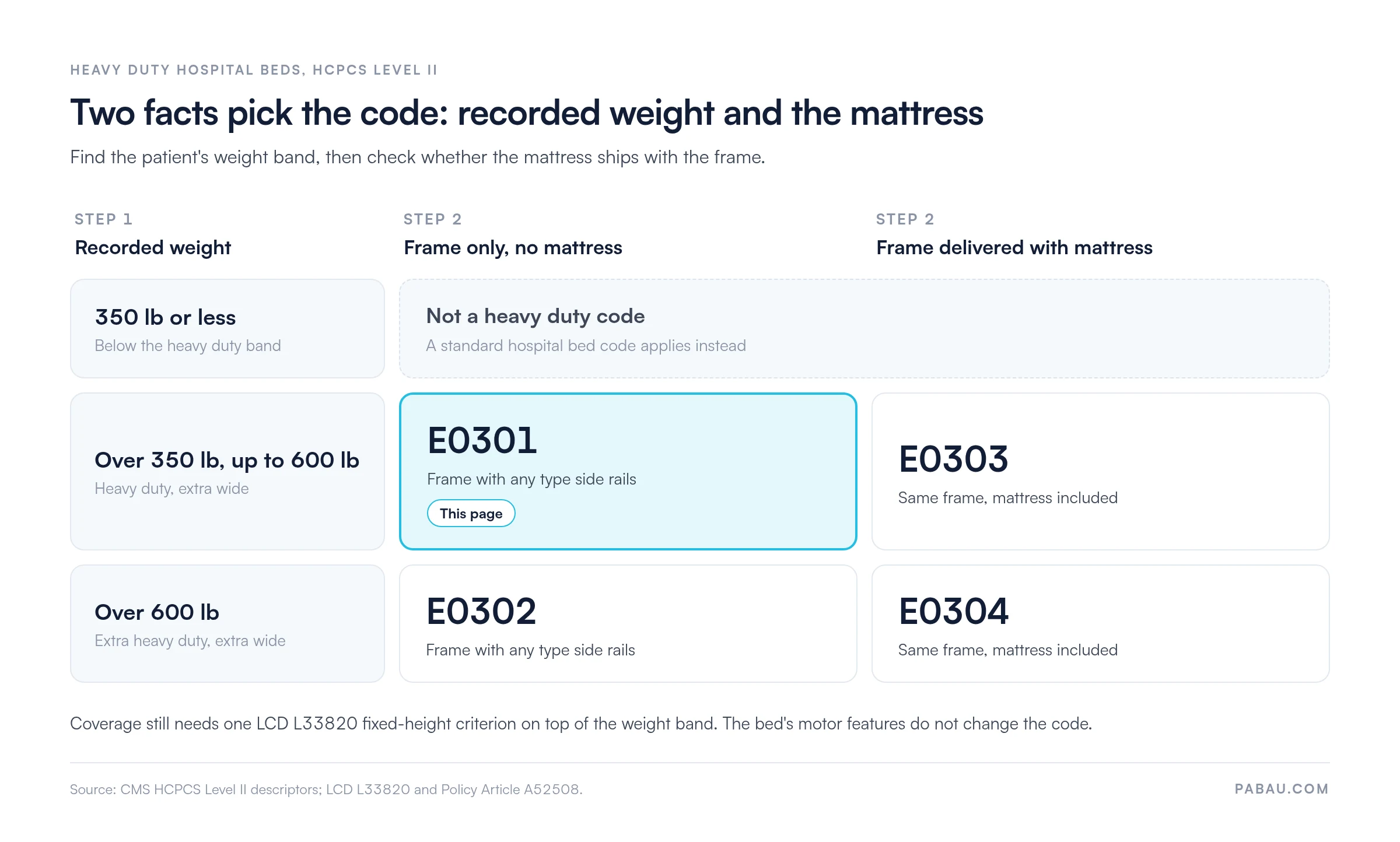
A weight above 600 pounds moves the patient to E0302 or E0304. At 350 pounds or less, the E0301 weight criterion isn’t met, so a standard hospital bed code applies instead.
Record the patient’s current weight in the treating practitioner’s notes before the order goes out. The 350 and 600 pound limits decide the code, so a missing weight leaves the bed choice unsupported at review.
E0301 belongs to a family of four heavy duty codes that split on two questions. Is the patient above or below 600 pounds, and does the mattress come with the bed? E0260 answers a different question altogether, which is how the bed adjusts.
That’s why E0260 and E0301 aren’t interchangeable. E0260 describes a semi-electric bed with its mattress, and L33820 covers it when the patient also needs frequent or immediate changes in body position. E0301 describes a weight-rated frame without a mattress, covered on the fixed-height criteria plus the weight band.
Heavier patients need a different frame. Above 600 pounds, the frame-only code is E0302.
Policy Article A52508 covers a mattress or side rails provided at the same time as the bed. In that case, suppliers bill the single code that combines the items. A heavy duty frame delivered with its mattress is therefore billed as E0303, not as E0301 plus a separate mattress line.
E0301 fits when the frame is supplied alone, for example when the patient already has a suitable mattress. Check the delivery record against the code before the claim goes out.
Since August 12, 2024, CMS has required a face-to-face encounter and a written order before delivery for E0301. That makes the order of the first three steps matter. Here is how a typical rental moves from the first visit to payment.
Steps one to three are where most of the risk sits. A claim built on an order dated after delivery fails, however strong the medical record is.
An E0301 claim needs no certificate of medical necessity. It does need a face-to-face note, a standard written order received before delivery, and records that support the criterion and the weight. Here’s who owns each document.
Policy Article A52508 requires a KX, GA or GZ modifier on hospital bed claims, and claims without one are rejected. KX goes on when every L33820 criterion is met and documented. Getting this right is a big part of submitting a clean claim.
Your DME MAC’s current guidance can add detail to the policy article, so check it before relying on any modifier combination.
Medicare pays for E0301 under the DMEPOS fee schedule, and the amount varies by state. Hospital beds are capped rental items, so the supplier bills the bed month by month with the RR modifier. Look up the current allowed amount on the CMS DMEPOS fee schedule page.
Medicare pays 80% of the approved amount once the Part B deductible is met. The beneficiary, or a secondary payer, owes the remaining 20%. Allowed amounts change by state and by year, so we don’t quote a dollar figure here.
Medicare doesn’t currently require prior authorization for E0301. CMS can add items to its Required Prior Authorization List, though, so check the list before each new rental begins.
Commercial and Medicare Advantage plans set their own rules, and many require authorization for DME. Confirm the requirement with each payer before delivery, and keep the reference number with the order.
A few minutes with this list saves a resubmission later. Check each item against the file, not from memory.
Good denial management in healthcare starts with knowing where an E0301 claim fails. Each mistake below maps to a requirement in L33820, its policy article or the CMS order rules.
L33820 doesn’t publish a list of covered diagnosis codes for hospital beds. The diagnosis supports the criterion, while coverage depends on the documented need and the weight band. The codes below show conditions that can support a fixed-height criterion or the weight record.
Use the diagnosis the treating practitioner documented, and check it against the current ICD-10-CM code set before the claim goes out.
Most E0301 problems start before the claim is built. The weight sits in one note, the order in another file, and the claim form gets typed up from memory.
Pabau, the practice management platform we build, keeps the record and the claim in one system. Its claims management software pre-fills the claim from the patient record. It then checks that required claim fields are complete before the claim can be sent.
In the US, Pabau submits claims through Claim.MD, with eligibility checks, claim-status tracking and remittance posting. Your team spends less time retyping and more time on the documents the payer reviews.
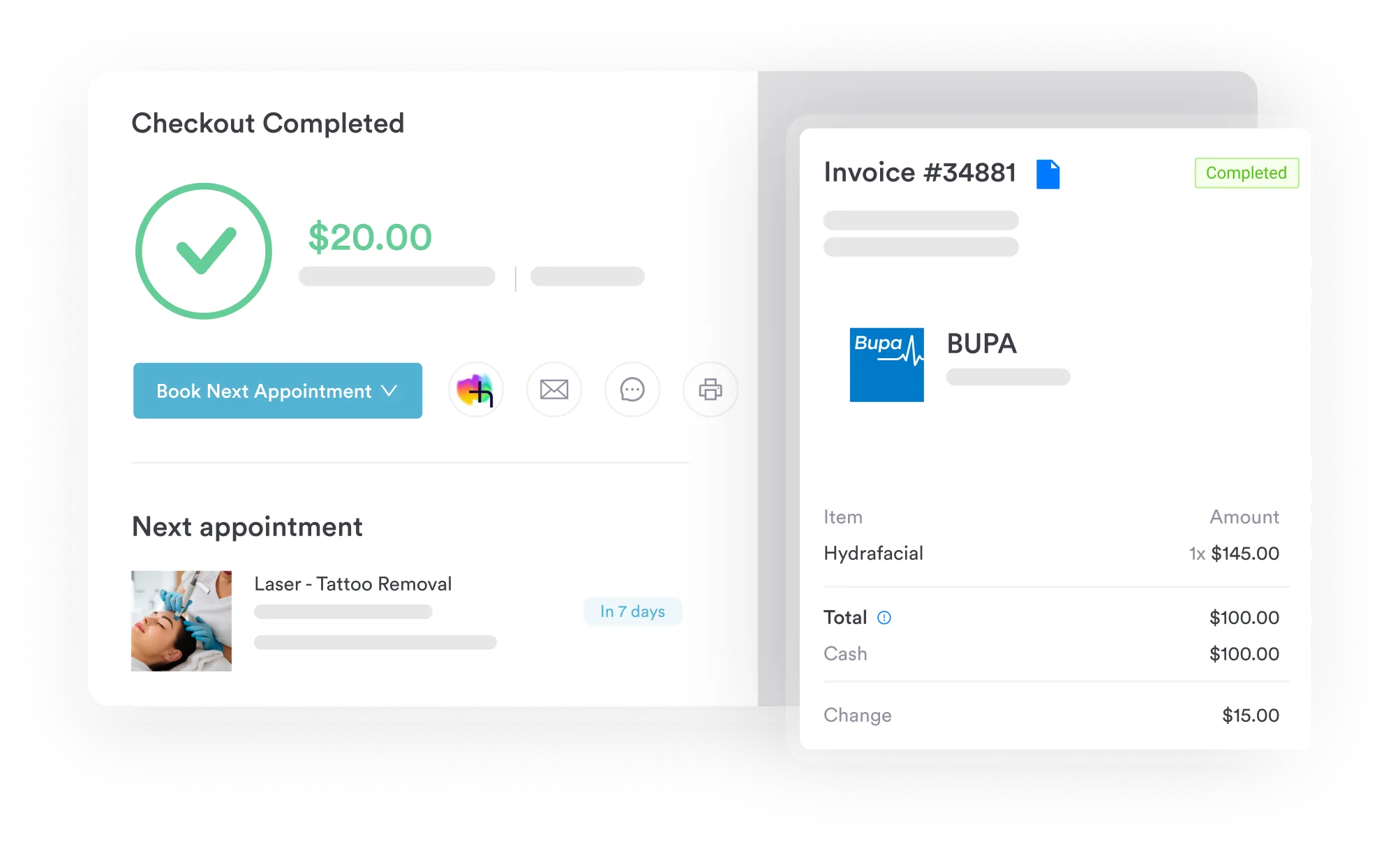

Pabau pre-fills claims from the patient record, checks required fields before sending, and submits US claims through Claim.MD. Your team spends less time retyping claims.

E0301 is a weight-band code, and the weight band is where most coding errors start. Pick the code from the recorded weight and whether the mattress ships with the frame. The bed’s motor features don’t decide it.
The bigger risk now is timing. Since August 2024, the face-to-face note and the written order have to exist before the bed arrives. Get those in place first, and the KX modifier has a record to stand on.
Book a demo to see how Pabau builds DME claims from the patient record and sends them through Claim.MD.

Need to understand how clearinghouses handle DME claims? Medical claims clearinghouse guide covers how claims route from DME supplier to payer and where edits occur.
Want to reduce claim rejections before submission? What is revenue cycle management walks through the end-to-end workflow from order to payment posting.
Looking for guidance on medical billing compliance requirements? Medical billing compliance covers documentation standards, audit risk, and payer policy alignment.
Billing a patient over 600 pounds with the mattress included? HCPCS code E0304 covers the extra heavy duty bed and its coverage rules.
It depends on the patient’s weight and the mattress. E0301 covers a bariatric bed frame for patients over 350 and up to 600 pounds, and E0303 is the same bed with its mattress. Above 600 pounds, use E0302 or E0304.
Yes. Since August 12, 2024, CMS has required a face-to-face encounter and a written order prior to delivery for E0301. The visit must fall within the six months before the order date.
Usually, yes. Hospital beds are capped rental items under Medicare. After 13 months of continuous rental, ownership of the bed passes to the beneficiary.
No. E0301 coverage needs a recorded weight above 350 pounds. At 350 pounds or less, bill the standard hospital bed code that matches the bed’s features.
Medicare Advantage plans cover what Original Medicare covers, but they can set their own authorization rules and supplier networks. Check the plan’s DME policy before delivery.




