CPT code 92511: Nasopharyngoscopy with endoscope
CPT code 92511: official descriptor and procedure overview CPT code 92511 descri...

Last Updated: Oct 13, 2026
E0203 is the HCPCS Level II code for a therapeutic lightbox, minimum 10,000 lux, table top model. It covers the bright light therapy box a physician orders for home use, most often for seasonal depression.
Medicare lists E0203 as non-covered, so traditional Medicare does not pay for it. Most denials trace to a missing spec sheet or an unsupported diagnosis. Others come from claims sent to fee-for-service Medicare, which does not cover it. Payment comes from commercial plans, VA Community Care, some Medicaid programs, or Medicare Advantage supplemental benefits.
Let Pabau's smart automation suggest the right codes, reduce claim denials, and keep your practice compliant—effortlessly.
Automate repetitive tasks and focus on what matters most—your patients.
Reduce coding errors and ensure compliance with the latest regulations.
Clean claims, fewer denials, and faster reimbursements.
Powerful insights and reporting to help your practice thrive.
HIPAA compliant SOC 2 certified GDPR-compliant Trusted by 4,000+ clinics worldwide

HCPCS code E0203 covers a tabletop therapeutic lightbox rated at 10,000 lux or more, and lower-output devices don’t qualify.
Medicare lists E0203 as non-covered (coverage code M), so fee-for-service Medicare denies the claim whatever the documentation shows.
Payment comes from commercial plans, VA Community Care, some state Medicaid programs, or a Medicare Advantage supplemental benefit.
On a Medicare claim, the GY modifier marks the item as statutorily excluded, so confirm the modifier each payer expects.
Pabau, the practice management platform we build, pre-fills claims from the patient record and checks required fields before they’re sent.
HCPCS code E0203 is the Level II code for a therapeutic lightbox, minimum 10,000 lux, table top model. It’s the bright light therapy box a physician orders for home use, most often for seasonal depression. The Centers for Medicare and Medicaid Services maintains the code set.
For billing teams, coverage is the fact that matters most. Medicare lists E0203 as non-covered, so traditional Medicare won’t pay for the device. Payment depends on the patient’s other coverage, and that check belongs before the box ships.
The 10,000-lux floor is part of the descriptor. A box rated at 2,500 or 5,000 lux doesn’t meet it, so it can’t be billed under E0203, whatever the order says.
E0203 sits in the HCPCS E-series (E0100-E9999), the durable medical equipment range that also holds canes, walkers, and hospital beds. It’s a DMEPOS item, so the supplier must be enrolled with each payer it bills.
The table below lists the billing identifiers for E0203. Medicare publishes no payment rate for it, because the item is non-covered.
Fee-for-service Medicare doesn’t pay E0203 claims, and no local coverage policy changes that. Commercial insurers, VA Community Care, and some state Medicaid programs set their own rates.
Some Medicare Advantage plans offer supplemental benefits, so confirm with the plan. Check the payer’s fee schedule before you quote a patient cost.
Two criteria in the descriptor decide it: an output of at least 10,000 lux and a tabletop form. A device has to meet both.
Keep the manufacturer’s spec sheet confirming 10,000 lux in the patient file. Payers ask for it on audit, and a missing sheet is treated as a non-compliant device.
Payers that cover E0203 want a documented diagnosis that supports light therapy. The ICD-10-CM codes below are the ones most often submitted. Acceptance varies by plan policy, so confirm with the payer before billing. To check a code’s full descriptor, browse our ICD-10-CM codes library.
The diagnosis must appear in the physician order and in the medical record. A code that shows up only on the claim form won’t survive a post-payment audit.
Medicare lists E0203 as non-covered, because a light box falls outside its durable medical equipment benefit. A correctly coded claim to fee-for-service Medicare is denied, and no contractor policy changes that.
So the work starts with routing. If your team is newer to payer routing, our guide to medical billing covers how a claim moves from order to payment. The chart below shows where an E0203 claim can land.
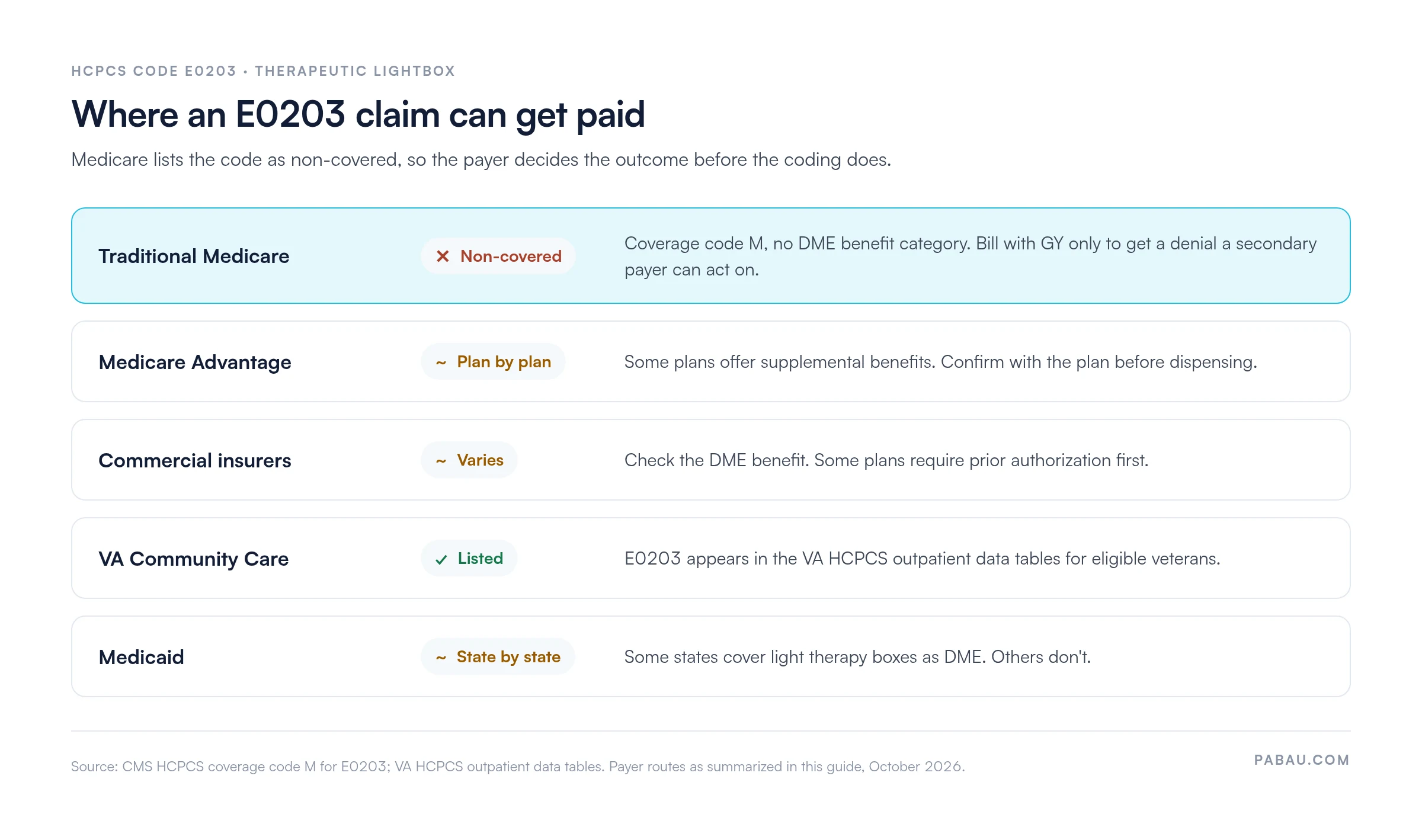
Where a payer covers it, medical necessity rests on a qualifying diagnosis, a physician order with the clinical rationale, and supporting records. Some commercial plans also ask for a letter of medical necessity with the prior authorization request.
Before dispensing a lightbox to a Medicare Advantage or commercial patient, call the plan’s DME line and confirm coverage and prior authorization. Verbal confirmation isn’t binding, so ask for a written authorization number and note the call. If you dispense before authorization, the supplier carries the full cost of a later denial.
Solid medical billing compliance for E0203 means every document is on file before the claim goes out. One missing item can lead to a denial, or to a recoupment on audit.
Billing E0203 means getting the payer, the modifier, and the place of service right together. One wrong element produces a denial, so work through the claim in order.
The modifiers below are the ones that come up on E0203 claims. Confirm what each payer expects, since commercial plans set their own rules.
Codes near E0203 look alike on a chargemaster, so mapping errors happen. The table shows how each one differs. Check descriptors in the AAPC HCPCS code lookup before you pick a code.
If your practice bills both light devices, our page on E0202 covers the newborn jaundice side. Audit chargemaster entries for these codes once a year to catch transposed numbers before they reach a claim.
Good denial management workflows for E0203 track these root causes:
Start with the denial reason. A Medicare denial for a statutory exclusion rarely changes on appeal, because the item has no benefit category to fall under. Appeals pay off when a covering payer denied the claim over missing documents.
Medicare’s process has five levels, and the later ones also apply to Medicare Advantage disputes.
For commercial denials, use the plan’s internal appeal first, then request an external review, which most states require plans to offer. Our medical appeal form template gives the letter a ready structure. A clean claim on first submission keeps most of this work off your desk.
Many DME billing teams track E0203 claims across a spreadsheet, a payer portal, and a folder of scanned spec sheets. Every handoff is a chance to lose an authorization number or a delivery receipt.
Pabau keeps that work inside the patient record. Its claims management software pre-fills the claim from the record. It also checks required fields, like authorization numbers, before the claim can be sent.
US claims go out through Claim.MD, with eligibility checks and remittance posting built in. Orders, spec sheets, and delivery receipts stay attached to the same patient file, so an audit request takes one search.
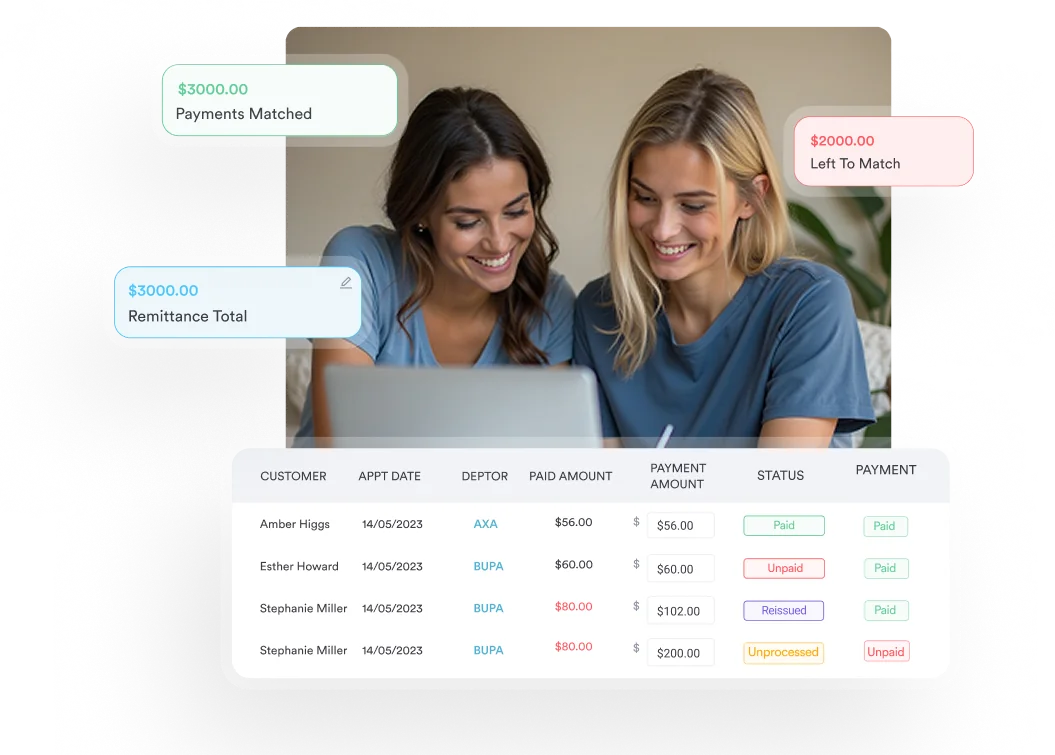

Pabau pre-fills claims from the patient record and checks required fields before submission. Orders, spec sheets, and delivery receipts stay in one patient file.

With E0203, the payer decides the outcome before the coding does. Check the patient’s coverage first. Then file the spec sheet, order, and authorization before the box ships.
If the patient has only traditional Medicare, say so early. A GY claim gets a quick denial for any secondary payer, and the patient knows they’ll likely pay out of pocket. That five-minute conversation saves an appeal with little chance of success.
Book a demo to see how Pabau keeps claim documents and payer details together for every device your practice dispenses.

Need a framework for reducing claim rejections across DME codes? Denial codes in medical billing covers the most common CARC reason codes and how to resolve each one.
Want to catch claim errors before they reach the payer? Medical claims clearinghouse guide explains how electronic claim scrubbing catches errors before submission.
Submitting a prior authorization for a light therapy box? Medical prior authorization form gives you a ready template for the request.
New to payer approvals? Prior authorization process walks through each step, from request to approval.
No. Medicare lists E0203 as non-covered (coverage code M), because a light box has no DME benefit category. Some Medicare Advantage plans offer supplemental benefits, so confirm with the plan.
No. Medicare publishes no payment rate, because the item is non-covered. Plans that cover it set their own allowed amount, so check the payer’s fee schedule.
Use GY, which marks the item as statutorily excluded. The resulting denial lets a secondary payer process the claim. GA and GZ apply to medical necessity denials instead.
No. The descriptor requires a tabletop model with at least 10,000 lux. Dawn simulators work differently, and lower-output lamps fall below the lux floor.
It depends on the payer. Some commercial plans require it before dispensing, and VA Community Care has its own authorization pathway. Record the authorization number in the patient file.
Yes. Light boxes are sold directly to consumers, and many patients pay out of pocket. If they plan to claim from other coverage, give them an itemized receipt showing E0203 and the diagnosis.