CPT code 49321: Laparoscopy with biopsy billing guide
What is CPT code 49321? CPT code 49321 is the surgical laparoscopy code for a bi...

Last Updated: Oct 7, 2026
E0135 is the HCPCS Level II code for walker, folding (pickup), adjustable or fixed height. It covers a walker with no wheels whose frame collapses for storage or transport, with legs that are fixed or adjust in height.
The folding frame is what separates E0135 from the rigid pickup walker, E0130. Front wheels move the claim to E0143, and a patient over 300 lbs needs a heavy-duty code. Medicare Part B pays for E0135 as durable medical equipment once the LCD L33791 coverage criteria are documented.
Let Pabau's smart automation suggest the right codes, reduce claim denials, and keep your practice compliant—effortlessly.
Automate repetitive tasks and focus on what matters most—your patients.
Reduce coding errors and ensure compliance with the latest regulations.
Clean claims, fewer denials, and faster reimbursements.
Powerful insights and reporting to help your practice thrive.
HIPAA compliant SOC 2 certified GDPR-compliant Trusted by 4,000+ clinics worldwide

HCPCS Code E0135 covers folding walkers, adjustable or fixed height, that have no wheels. That sets them apart from E0143 (folding wheeled walker) and E0141 (rigid wheeled walker).
Medicare Part B covers E0135 as DME when the patient has a documented mobility limitation. A standard written order must also be on file with a DMEPOS-accredited supplier.
A standard written order from the treating practitioner is enough for E0135, and it must be in place before the claim is submitted. No Certificate of Medical Necessity (CMN) is needed.
Claims management in Pabau, the practice management platform we build, lets practices that supply or coordinate walkers submit and track claims and follow denials.
HCPCS Code E0135 is the code for a folding walker with adjustable or fixed height and no wheels. It sits in HCPCS Level II, the code set the Centers for Medicare and Medicaid Services (CMS) maintains and updates each year. Medicare Part B covers it as durable medical equipment. The patient must meet the three criteria in LCD L33791, and a standard written order must be on file.
The CMS official descriptor reads: Walker, folding (pickup), adjustable or fixed height. Every element of that descriptor carries billing weight.
To bill E0135 correctly, the walker must meet all of the following physical and functional criteria. Missing even one moves the claim into a different code or triggers a denial for incorrect code selection.
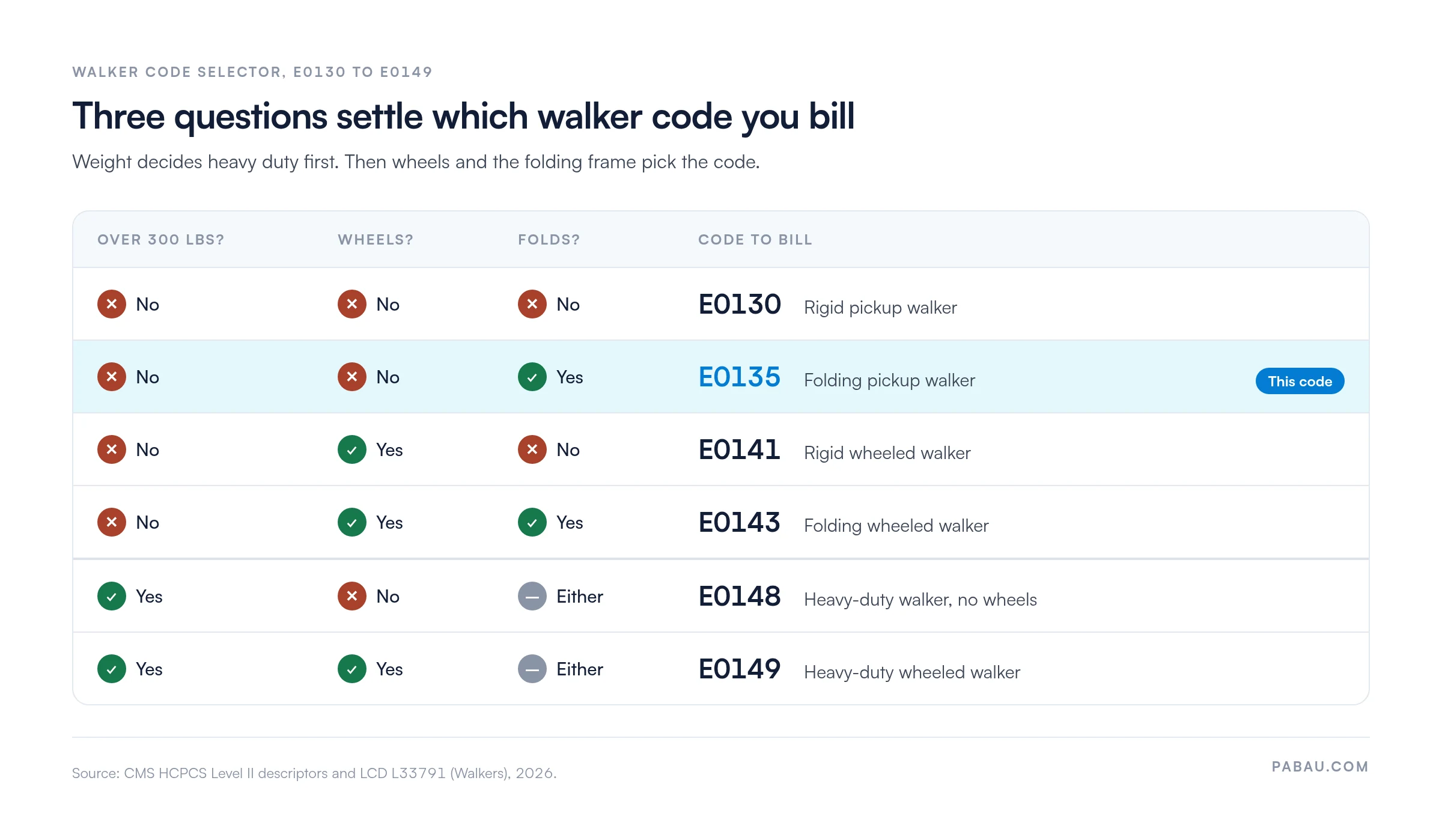
The walker code family runs from E0130 to E0159, and several codes share near-identical descriptors. A set of wheels, a built-in seat, or a frame that does not fold changes the correct code. Three questions about the patient and the device settle it, as the matrix below shows.
Accessories go on their own claim lines, so a seat dispensed with the walker is billed as E0156 alongside E0135.
E0130 and E0135 share every characteristic except one. The frame folds on E0135 and does not on E0130. Both are pickup walkers, both can be height-adjustable or fixed, and both have no wheels.
If the patient’s walker cannot be collapsed flat, bill E0130. If it folds for transport or storage, bill E0135. Auditors spot this mistake quickly because the fee schedule amounts differ and the device either folds or it doesn’t.
E0143 is the folding wheeled walker. The frame collapses like E0135, but front wheels let the patient push rather than lift. Clinically, E0143 fits patients who cannot reliably lift a walker with each step, often because of upper-extremity weakness or fatigue.
E0135 suits a patient with enough upper-body function for a pickup gait pattern. Check the physical device. If a folding frame has front wheels, E0143 is the correct code.
E0148 and E0149 are the heavy-duty walkers, and LCD L33791 covers them only for patients who weigh more than 300 lbs. E0148 has no wheels, and E0149 is wheeled. Either one can be rigid or folding.
So a bariatric patient who needs a non-wheeled walker is billed E0148, not E0149. Those two codes are also where the KX modifier applies, once the weight is documented. E0135 has neither wheels nor a heavy-duty frame, and it is billed without KX.
Medicare Part B covers folding walkers billed under HCPCS Code E0135 as durable medical equipment under the DME benefit. Coverage requires three things to align before the claim is submitted. The patient must be eligible, the clinical need must be documented, and the supplier must be DMEPOS-accredited.
Physical and occupational therapists are common referral sources for walkers, and their findings often form the core of the necessity documentation. LCD L33791 sets three coverage requirements, and the patient must meet all of them.
These criteria are national. Noridian and CGS (the DME MACs) apply the same LCD, so the coverage test does not change with the supplier’s jurisdiction. You can read the full policy in the Medicare Coverage Database entry for LCD L33791 (Walkers).
A Certificate of Medical Necessity (CMN) is required for certain DME categories, such as oxygen, power wheelchairs, and enteral nutrition. Standard folding walkers billed under E0135 do not require a CMN. A standard written order (SWO) from the treating practitioner is sufficient.
The LCD requires the SWO to be in place before the claim is submitted. It must include these elements.
Obtain the order before the claim is submitted, and ideally before delivery. Backdated orders are a recurring OIG audit finding in DME claims.
E0135 is not on CMS’s prior authorization list for standard Medicare claims in the current program cycle. Prior authorization requirements can change each year, so verify the current status with your MAC before assuming no PA is needed.
DMEPOS supplier accreditation is non-negotiable. The supplier billing E0135 must hold a valid DMEPOS accreditation through a CMS-approved organization and have a Medicare supplier number. Claims from non-accredited suppliers are denied regardless of the clinical documentation.
In competitive bidding areas (CBAs), reimbursement rates and supplier eligibility can differ from non-bid areas. The last round of contracts has lapsed and the next round has not started, so check CMS’s current competitive bidding program status. Walkers are paid at the fee schedule where no CBA contract applies.
A clean E0135 claim follows a four-step workflow. The patient is assessed, the treating practitioner signs the order, the documentation is assembled, and the claim is submitted. Incomplete documentation at any step creates a denial that is far harder to resolve after submission than before.
Run your documentation checklist before delivery, not after. Once a walker is delivered, the supplier has the equipment cost. Chasing a corrected order after the fact extends your reimbursement timeline by 30-90 days and often results in a partial or full denial.
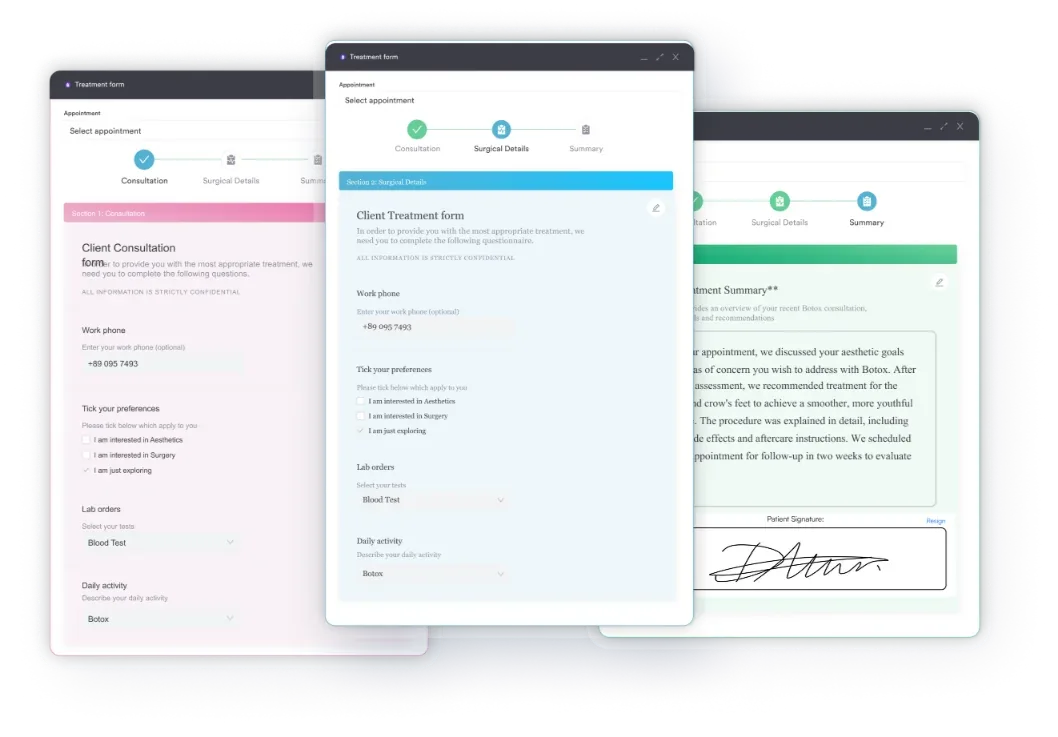
The supplier must retain the following documents in the patient’s file to hold up in a Medicare audit. Digital intake forms can capture and store this documentation electronically, which cuts retrieval time when an auditor asks.
HCPCS Code E0135 claims typically carry a modifier that tells the MAC how the equipment is being furnished. Incorrect modifier usage is one of the top denial triggers for DME claims.
Confirm current modifier guidance with your MAC before billing.
Medicare sets allowable amounts for E0135 through the DMEPOS fee schedule, which CMS updates annually. The payment rate for a folding walker depends on two factors. One is whether the supplier is in a competitive bidding area, and the other is whether the equipment is new or used.
For current amounts, download the CMS DMEPOS fee schedule files for the applicable year and check your state. Under Medicare Part B, the patient generally pays 20% of the approved amount. The annual Part B deductible applies first, and Medicare Advantage plans set their own cost-sharing.
Key billing facts for fee schedule purposes:
Fee schedule figures change each January. Always verify rates for the current year rather than relying on prior-year data. The PGM Billing HCPCS lookup tool provides a free reference for current and historical HCPCS rates using CMS data.
E0135 denials cluster around a handful of root causes, and most are preventable with a pre-submission documentation review. The table pairs each one with the claim adjustment reason code (CARC) it usually carries, where one applies.
Retain original signed orders, delivery receipts, and clinical notes for at least seven years so the file holds up during an OIG audit.
Medicare rules are a useful baseline, but Medicaid and commercial payers apply their own coverage policies for folding walkers. Assuming Medicare criteria translate directly to other payers is a common mistake that generates avoidable denials.
For Medicaid, no universal coverage claim can be made. Each state Medicaid program sets its own DME benefit rules, prior authorization thresholds, and approved supplier lists. Washington State’s Health Care Authority publishes a detailed medical equipment billing guide that shows the level of state-specific detail involved. Always check the applicable state Medicaid DME policy before billing.
Walker claims usually stall on paperwork. A supplier often keeps the order in one place, the delivery receipt in another, and the therapy notes in a shared drive. The file then gets rebuilt when an auditor calls.
Pabau keeps intake forms, signed consent, and clinical notes together in one patient record. Its claims management software lets your team submit and track claims and follow denials in the same system.
The result is a walker file you can hand over without a search, and one denial queue your billers work through instead of three.

Pabau keeps intake forms and clinical notes in the patient record. Its claims management lets DME suppliers and multi-specialty practices submit and track claims and follow denials.

Run two checks before an E0135 claim goes out. Confirm the walker folds and has no wheels, and confirm the signed standard written order is already in the file. Those two checks head off the wrong-code and missing-order denials before they start.
The trade-off is a few minutes per claim at intake against a 60-day appeals cycle later. For a supplier dispensing walkers every week, the up-front check is the cheaper habit.
Book a demo to see how Pabau keeps walker orders, delivery receipts, and claim status in one place for your billing team.

Billing a walker with a built-in seat? HCPCS code E0144 covers the enclosed walker with rear seat and how it differs from a standard frame.
Adding wheels to an existing walker? HCPCS code E0155 explains how the walker wheel attachment is billed as its own line.
Dispensing a platform attachment? HCPCS code E0154 walks through the forearm platform attachment and its documentation.
Ordering a brake attachment? HCPCS code E0159 covers the walker brake attachment and when Medicare pays for it.
Patient needs trunk support? HCPCS code E0140 details the walker with trunk support and its coverage criteria.
HCPCS Code E0135 covers a folding (pickup) walker with adjustable or fixed height and no wheels. It applies when the physical device collapses flat and the patient uses it for walking support. Accessories such as a seat attachment are billed separately under E0156.
E0130 is a rigid walker that does not fold, and E0135 is the folding version. Both are pickup walkers with no wheels and can be adjustable or fixed height. The only distinguishing criterion is whether the frame collapses. If the device does not fold, E0130 is correct. If it folds, use E0135.
Yes. Medicare Part B covers E0135 as durable medical equipment once medical necessity is established and a standard written order is on file. The supplier must also hold active DMEPOS accreditation. The patient typically pays 20% of the Medicare-approved amount after the Part B deductible.
The most common are CO-50 (medical necessity not established, usually from thin clinical documentation) and CO-4 (a modifier inconsistent with the code). CO-167 (diagnosis not covered) and CO-170 (supplier type not eligible) also recur. Billing E0130 for a folding device and a missing standard written order cause denials too. Each has a corrective step in the denials section above.
Yes. Accessories such as a seat attachment (E0156) and walker trays are billed separately alongside E0135 on the same claim. Each accessory code needs its own documentation of medical necessity. The treating practitioner’s written order should list every item dispensed, so no item is denied as missing from the order.