CCSD Code D0310: Microtia & anotia ear reconstruction billing guide
CCSD Code D0310: Definition and clinical scope CCSD Code D0310 is defined by the...

Last Updated: Oct 7, 2026
49321 is the CPT code for laparoscopy, surgical; with biopsy (single or multiple). It covers one or more tissue samples taken through laparoscopic ports from the peritoneum, omentum, mesentery, intra-abdominal lymph nodes, or a retroperitoneal mass.
The code sits in the 49320-49329 laparoscopy family and carries a 10-day global period under Medicare. A diagnostic laparoscopy with no tissue excised is 49320, which bundles into 49321 when both happen in one session.
Let Pabau's smart automation suggest the right codes, reduce claim denials, and keep your practice compliant—effortlessly.
Automate repetitive tasks and focus on what matters most—your patients.
Reduce coding errors and ensure compliance with the latest regulations.
Clean claims, fewer denials, and faster reimbursements.
Powerful insights and reporting to help your practice thrive.
HIPAA compliant SOC 2 certified GDPR-compliant Trusted by 4,000+ clinics worldwide

CPT code 49321 reports a surgical laparoscopy with single or multiple biopsies of the peritoneum, omentum, intra-abdominal lymph nodes, or a retroperitoneal mass.
Documentation must name the specific biopsy site, confirm specimen retrieval, and link to an ICD-10 diagnosis code that establishes medical necessity.
CPT 49320 (diagnostic laparoscopy, no biopsy) bundles into 49321 under NCCI edits. Billing both needs modifier 59 or an X modifier, plus distinct documentation.
CPT 49321 carries a 10-day global period, so routine postoperative visits in that window are bundled into the surgical payment.
Pabau’s claims management software works with the Claim.MD clearinghouse to flag 49321 claims with errors before submission and track their status.
CPT code 49321 is the surgical laparoscopy code for a biopsy, single or multiple, taken entirely through laparoscopic access. Typical targets are an intra-abdominal or retroperitoneal mass, a lymph node, or other peritoneal tissue.
The American Medical Association (AMA), which owns the CPT code set, places 49321 in the laparoscopy subsection covering the abdomen, peritoneum, and omentum (49320-49329).
The procedure involves trocar port placement, laparoscopic visualization of the target, and excision or needle-core sampling under direct vision. The specimen is then retrieved through a port. The biopsy must be the primary or a distinct procedure to justify the code. When it is incidental to a more definitive procedure, the parent code governs.
The operative note is the single most important document for a CPT code 49321 claim. Payer auditors check every op note for the five elements below. Missing any of them is the most common reason for a retrospective denial or a post-payment audit recovery.
Error-checking claims management software can flag an incomplete op note before the claim leaves the practice.
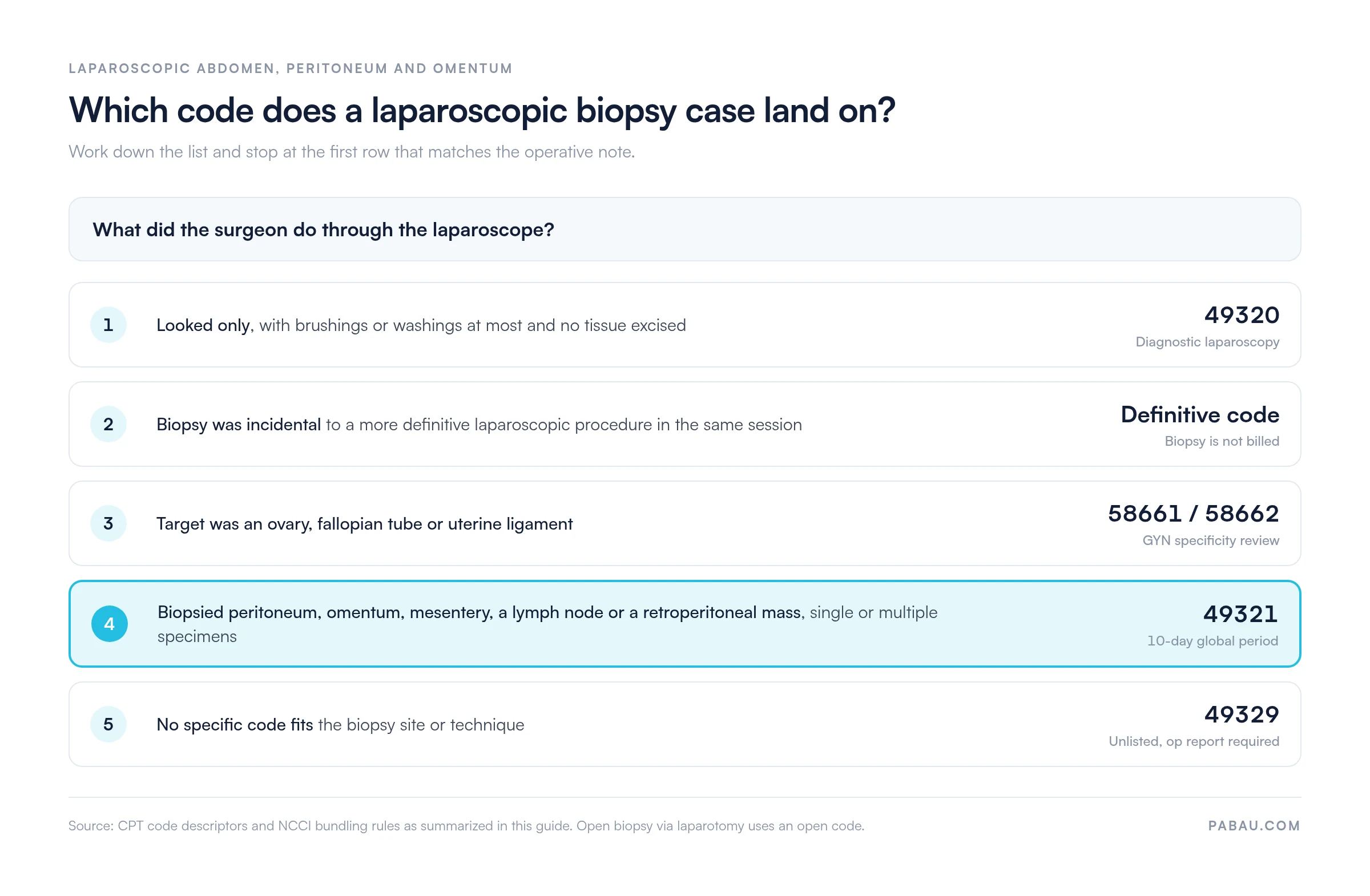
CPT 49320 covers diagnostic laparoscopy. The surgeon can view the abdomen and collect brushings or washings, but no tissue is excised. CPT code 49321 applies when the surgeon goes further and excises or cores a tissue specimen for pathology.
The distinction matters because 49320 is a column 2 code to 49321 under National Correct Coding Initiative (NCCI) edits. Billing both on the same claim without a modifier triggers an automatic denial.
When a surgeon begins a procedure as a diagnostic laparoscopy (49320) and then takes a biopsy specimen, only CPT code 49321 should be reported. The diagnostic service is subsumed into the more definitive surgical code.
Which code a case lands on depends on what the op note says the surgeon did, and the checklist below runs that decision in order.
Several codes interact with CPT code 49321 depending on what is biopsied and whether pathology or a concurrent GYN procedure is performed.
Pathology add-on (88305): when a 49321 specimen goes to pathology, the pathologist bills 88305 separately on a professional claim. The surgical practice does not report 88305 unless it owns the pathology laboratory under a global billing arrangement. Verify with the facility before including it on the surgeon’s claim.
GYN specificity rule: when the biopsy target is an ovary, fallopian tube, or uterine ligament, 58661 or 58662 may fit better than CPT code 49321. AAPC guidance recommends using the most specific code available. Billing 49321 for a clearly ovarian biopsy can trigger a payer denial for a code-to-specialty mismatch.
Flag any laparoscopic GYN biopsy for specificity review before submitting with CPT 49321. If the operative note names an ovarian or tubal structure as the primary biopsy target, route the case to a GYN coding specialist. They can confirm whether 58661 or 58662 better describes the service.
Modifier selection for CPT code 49321 depends on two questions. Is a second laparoscopic procedure billed on the same date, and was the biopsy unusually complex?
The Office of Inspector General (OIG) audits for modifier -59 overuse. It looks hardest at practices that use it routinely to bypass NCCI edits for procedures that aren’t distinct.
Since 2015, CMS has preferred the X modifier subset (XE, XS, XP, XU) because each specifies the exact reason for distinctness. If your billing system still defaults to -59 for all NCCI bypass situations, update the workflow to use XS or XE where appropriate.
Medical necessity for CPT code 49321 is established through the paired ICD-10-CM diagnosis code. The diagnosis must be specific enough to justify a laparoscopic biopsy rather than a less invasive alternative. Unspecified or observation-level diagnosis codes routinely trigger medical necessity denials on 49321 claims.
Confirm payer-specific Local Coverage Determinations (LCDs) before finalizing the diagnosis code. Several Medicare Administrative Contractors (MACs) have issued LCDs specifying which ICD-10-CM codes support coverage for laparoscopic abdominal biopsy procedures. A diagnosis that passes Medicare’s national coverage rules may still fail a MAC-specific LCD in your jurisdiction.
CPT code 49321 carries a 10-day global surgery period. Routine postoperative care is bundled into the procedure payment for the 10 days after the procedure date.
The CMS Physician Fee Schedule lookup tool gives current national average payments by place of service. The figures below are approximate 2026 national averages, so verify them against the current fee schedule before submitting claims.
Use the FastRVU lookup tool to pull current year wRVU and total RVU values with the applicable geographic practice cost index (GPCI) for your locality. Commercial payers typically reimburse at 110-150% of the Medicare fee schedule, though rates vary by payer contract and region.
Prior authorization: Medicare generally does not require prior authorization for CPT code 49321 when performed in a hospital or ASC setting with appropriate documentation. Commercial payers vary widely. Verify prior auth requirements with each payer plan before scheduling. For most commercial plans, a missing required authorization means a denial you can’t appeal.
The top denial reasons for CPT code 49321 follow a predictable pattern. Addressing each one before submission cuts rework far more than appealing denials after the fact. Strong denial management workflows catch these at the pre-authorization and charge-entry stages.
Submitting a clean claim the first time means validating all five elements above before the claim leaves your system. An 837 electronic claim file routed through a clearinghouse can catch code-level errors before the payer sees the claim.
Build a CPT 49321 pre-bill checklist in your EHR. Confirm the op note names the biopsy site and documents specimen count and hemostasis method. Then check that the ICD-10 code matches the MAC LCD and that commercial prior auth is on file. Running this before charge entry eliminates the most common denial triggers.
The National Correct Coding Initiative (NCCI), administered by CMS, governs which codes can be billed together with CPT code 49321. NCCI edit tables are updated quarterly; always verify the effective date of any specific edit before appealing a bundling denial.
The AAPC Codify CPT lookup shows current NCCI edit pairs alongside the 49321 descriptor. Checking it before submission helps most when 49321 is billed alongside a GYN laparoscopic code. Good medical billing compliance includes a quarterly NCCI table review to catch new column 1/column 2 pairs.
Many practices only find a missing modifier or a vague biopsy site when the denial comes back. By then, the fix means a corrected claim, a resubmission, and weeks of delayed payment.
Pabau, the practice management platform we build, connects to the Claim.MD clearinghouse. It submits 49321 claims electronically as 837P files to thousands of US payers. Real-time eligibility checks confirm coverage before the procedure date.
Pabau flags claims with errors before submission and tracks each claim’s status through to payment or denial. Your billing team works the exceptions instead of chasing every laparoscopic biopsy claim by phone.

Pabau works with Claim.MD to flag laparoscopic biopsy claims with errors before submission and track their status. Your billing team spends its time on exceptions, not resubmissions.

Treat CPT code 49321 as a documentation code first and a billing code second. When the op note names the site, counts the specimens, and ties to a specific diagnosis, the coding follows.
The trade-off is a few extra minutes at charge entry for every laparoscopic biopsy. That time costs far less than a corrected claim, a resubmission, and a payment that lands weeks late.
Book a demo to see how Pabau flags 49321 claim errors before submission and tracks every claim through to payment.

Need to understand clearinghouse claim checks? Medical claims clearinghouse explains how a clearinghouse checks surgical claims like 49321 before they reach the payer.
Dealing with recurring denial codes? Denial codes in medical billing maps the most common CARC reason codes to fixes for surgical and laparoscopic claims.
Want to streamline pre-claim eligibility checks? Insurance eligibility verification covers how real-time eligibility checks catch coverage and prior-authorization problems before a laparoscopic biopsy.
New to the billing cycle? What is medical billing walks through the claim lifecycle from charge capture to payment.
CPT code 49321 covers a laparoscopic surgical biopsy, single or multiple, of an intra-abdominal or retroperitoneal mass, lymph node, or other peritoneal tissue. The specimen is retrieved through a port for pathology. It does not cover open biopsy, or brushing and washing collection without tissue excision.
CPT 49320 is a diagnostic laparoscopy that allows visualization and brushing or washing only. CPT 49321 includes a tissue biopsy, by excision or core. When a surgeon moves from diagnostic visualization to biopsy in the same session, only 49321 is reportable. Billing both requires modifier XS and documentation of separate, distinct services.
Modifier -22 applies when the biopsy involved unusual complexity. Modifier -51 goes on the secondary laparoscopic code (not 49321) when multiple procedures are billed. Modifiers -59 or XS override the NCCI edit when 49320 is billed alongside 49321. Modifiers -LT or -RT apply when biopsying a paired structure such as bilateral retroperitoneal nodes.
Yes, in some scenarios, but GYN specificity rules apply. If the biopsy target is an ovary or fallopian tube, 58661 or 58662 may fit better than 49321. Check the NCCI edits between 49321 and the GYN codes for the specific operative combination. When in doubt, route GYN laparoscopic biopsy cases to a GYN coding specialist.
Medicare pays roughly $250-$330 for CPT code 49321 in a facility setting, as a 2026 national average estimate. The exact amount varies by locality and annual fee schedule updates. Use the CMS Physician Fee Schedule lookup tool to confirm the current rate for your Medicare Administrative Contractor (MAC) jurisdiction.
Yes. CPT 49320 (diagnostic laparoscopy) bundles into 49321 under NCCI column 1/column 2 edits and can’t be reported separately in the same session without a modifier. Further NCCI mutually exclusive edits apply when 49321 is billed with other laparoscopic abdominal codes on the same date. Review the NCCI tables quarterly for new edit pairs.
Medicare generally does not require prior authorization for CPT 49321. Commercial payer requirements vary by plan, so verify with each payer before scheduling the procedure. A missing required authorization from a commercial plan usually means a denial you can’t appeal. Build a pre-scheduling auth check into the workflow for every non-Medicare payer.