

CCSD code G5100: Bypass of duodenum billing guide
CCSD code G5100 bills a bypass that leaves the duodenum in place CCSD code G5100...

Last Updated: Oct 16, 2026
E0140 is the HCPCS Level II code for walker, with trunk support, adjustable or fixed height, any type.
What the treating physician documents doesn't always match what claims management software needs to submit a clean E0140 claim, and that mismatch is where most revenue leaks.
Let Pabau's smart automation suggest the right codes, reduce claim denials, and keep your practice compliant—effortlessly.
Automate repetitive tasks and focus on what matters most—your patients.
Reduce coding errors and ensure compliance with the latest regulations.
Clean claims, fewer denials, and faster reimbursements.
Powerful insights and reporting to help your practice thrive.
HIPAA compliant SOC 2 certified GDPR-compliant Trusted by 4,000+ clinics worldwide

HCPCS code E0140 describes a walker with trunk support, adjustable or fixed height, any type, billed under the Medicare Part B DME benefit
Medical necessity requires a documented mobility limitation, a physician written order, and evidence that a cane or crutch is insufficient
E0140 claims use the DMEPOS modifiers RR, NU, UE, and KE, and sit in a walker category with no active competitive bidding area today
Pabau’s claims management software supports HCPCS code entry, physician order storage, and DME billing workflows
HCPCS code E0140 is a Level II alphanumeric code maintained by the Centers for Medicare and Medicaid Services (CMS) for durable medical equipment not covered by CPT codes. It falls within the walking aids and attachments range (E0100 through E0159).
The trunk support component is the defining clinical feature of E0140. It distinguishes this code from standard walkers (E0141, E0143) by providing lateral and anterior trunk stabilization for patients whose upper body weakness or postural instability makes a basic walker unsafe.
The descriptor covers any type, adjustable or fixed height, so the same code applies regardless of the specific frame style.
Medicare Part B covers E0140 only when a specific set of medical necessity criteria is met. The applicable Local Coverage Determination, LCD – Walkers (L33791), governs walker coverage. Submitting a claim without meeting all criteria is the primary cause of E0140 denials.
Per CMS LCD guidance, three conditions must be satisfied simultaneously for E0140 coverage to apply:
The trunk support requirement adds an additional clinical layer. To justify E0140 over a standard walker code, documentation must establish that the patient has trunk weakness, instability, or postural impairment that makes a basic walker inadequate.
Physical therapists often support this with a documented balance assessment. Ordering physicians who record this distinction clearly see denial rates drop substantially.
Incomplete documentation is the most common reason E0140 claims are audited or denied. The physician written order is the foundation, but it cannot stand alone. CMS requires a comprehensive set of supporting records from the treating provider.
Suppliers dispensing E0140 at hospital discharge often work from a discharge planning checklist to confirm the order, delivery address, and caregiver instructions are in place before the device leaves the building.
Retention requirements generally call for seven years.
No ICD-10 code automatically guarantees E0140 coverage. However, the diagnoses below commonly pair with E0140 claims and align with the mobility limitation and trunk instability criteria defined in CMS LCDs. Coverage ultimately depends on the applicable LCD and the specific payer’s policy. Verify the current diagnosis list with your MAC before submitting.
Practices billing for physical therapy or occupational therapy services will recognize many of these diagnoses from their own documentation workflows. The crosswalk above is commonly accepted but not exhaustive. Payer LCDs differ, and some MAC jurisdictions maintain more restrictive diagnosis lists than others.
Post-surgical orthopedic patients may carry a complication code instead of a status code like Z96.641. A bone graft complication is reported with T86.838, but the notes still need to show the trunk instability that justifies E0140.
With software for managing patients, DME prescriptions stay linked to the assessments that justified them.
CMS publishes the DMEPOS fee schedule annually. Rates vary by Medicare Administrative Contractor (MAC) jurisdiction and locality. The CMS fee schedule tool provides current payment amounts by HCPCS code and locality.
For E0140, two distinct billing scenarios apply depending on whether the device is rented or purchased outright. The table below outlines the general framework. Always verify current rates against the CMS DMEPOS fee schedule for the applicable year before quoting or submitting claims.
National limiting charge applies to non-participating suppliers. If CMS reinstates a walker competitive bidding area in the future, only a contract supplier would be able to bill Medicare for E0140 there. No such restriction applies today.
Always pull the current DMEPOS fee schedule from CMS.gov before quoting reimbursement rates to patients or entering expected payment amounts in your billing system. Rates update annually on January 1, and locality adjustments can shift individual MAC rates by 10-15% from the national base.
Every E0140 claim submitted to Medicare requires at least one DMEPOS modifier. Submitting without a modifier, or pairing the wrong modifier with the billing scenario, triggers an automatic claim edit. The modifiers coders encounter most often with E0140 are RR, NU, UE, and KE.
RR and NU are mutually exclusive for the same claim line. During an active competitive bidding round, the supplier would append the round-specific modifier, such as KG or KK, to show the item was furnished under a bidding contract. No walker CBA is active today, so none of these round-specific modifiers currently apply to E0140.
Selecting the wrong walker code is one of the most common DMEPOS coding errors. Each code in the E0140-E0149 range describes a specific device configuration, and Medicare will not pay for a more specialized code unless the documentation supports that specific device. Use the table below to confirm E0140 is the correct code before submitting.
The most frequent coding error involves billing E0141 when the device actually has trunk support, or billing E0140 when the documentation describes a standard walker without trunk support. E0148 and E0149 get mixed up just as often, since only the presence of wheels tells them apart.
Coders working across the broader assistive-device range sometimes cross-walk walker documentation with crutch codes such as E0118, which follows a separate LCD entirely. The AAPC HCPCS code lookup provides current code descriptions and coding guidelines to verify the correct code selection for each device configuration.

Pabau helps DMEPOS suppliers and clinical practices manage HCPCS code entry, physician order documentation, and claim submission in one place. See how it works for your team.

Medicare traditionally has not required prior authorization for standard walkers, including E0140. However, CMS has expanded its prior authorization program for certain DME categories in recent years. Verify whether E0140 falls under the current CMS prior authorization program list for your MAC jurisdiction before assuming no PA is needed.
Medicaid programs vary significantly by state. Connecticut HUSKY Health and Virginia DMAS, for example, each publish their own walker policies with distinct prior authorization thresholds. State Medicaid programs may require prior authorization for E0140 regardless of whether Medicare does. Always verify with the specific payer before dispensing.
Walkers are historically a DMEPOS competitive bidding product category, but no walker CBA is active today. The last walker contracts, awarded under Round 2018, expired December 31, 2018, opening a gap period that began January 1, 2019. Round 2021 excluded walkers, and CMS’s most recently finalized round, covering national Remote Item Delivery categories, also left walkers out. Denial codes in medical billing group the reasons a payer refuses, and the group decides the fix.
None of this rules out a future round. Suppliers should still check current status at the CMS Competitive Bidding Implementation Contractor (CBIC) website before assuming no restrictions apply.
No walker CBA is active anywhere today, so this restriction is currently dormant for E0140. Still, confirm current status at the CBIC website before dispensing, since CMS periodically revises product categories between rounds. If a walker CBA returns to your area, only a contracted supplier could bill Medicare for E0140 there.
Practices billing durable medical equipment alongside clinical services face a workflow challenge that generic billing platforms rarely address well. DMEPOS claims require physician order storage, modifier selection, proof-of-delivery tracking, and fee schedule management alongside regular clinical billing.
Most practices cobble this together across separate systems, and that’s where records fall out of sync and audits get harder to defend.
Pabau’s claims management tools support HCPCS code entry and modifier assignment within the same workflow used for CPT billing. Physician orders and functional assessment notes get stored as digital forms attached to the patient record, creating an auditable chain of documentation from the initial order through delivery confirmation.
This matters for E0140 claims specifically because audit risk is tied directly to documentation completeness.
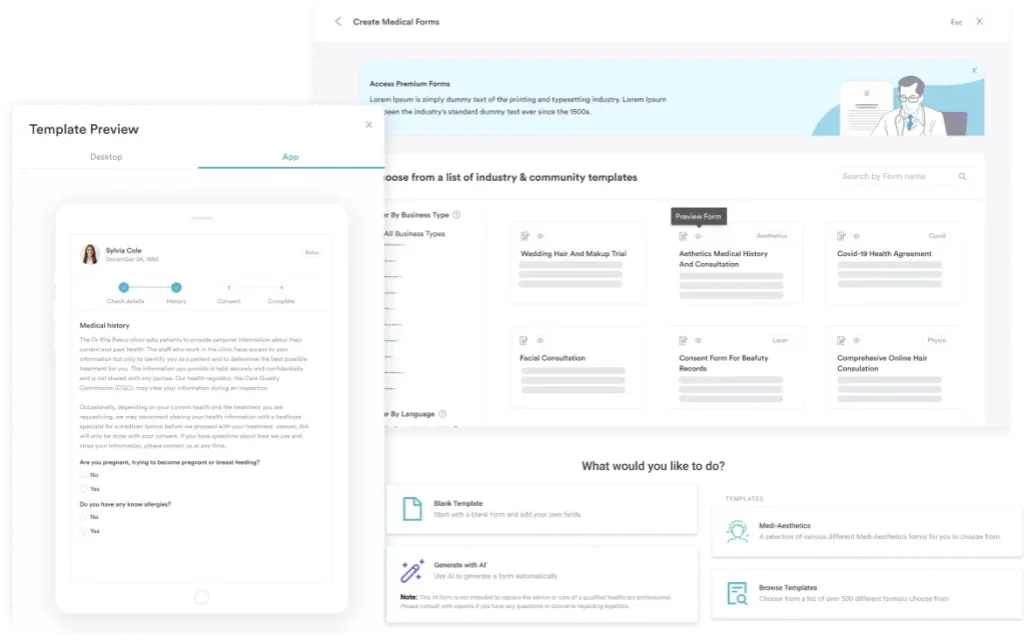
For practices running both therapy services and DME supply. When an auditor requests documentation for an E0140 claim, everything is in one place.
Practices managing compliance workflows find that centralized record-keeping cuts the time spent responding to post-payment reviews from hours to minutes.

HCPCS code E0140 is a straightforward code with specific documentation and modifier requirements that many DMEPOS billers underestimate. The trunk support distinction, the medical necessity criteria, and the modifier pairing each represent a separate point of failure for claims.
Getting E0140 right means having the physician order, the functional limitation narrative, and the correct modifier in place before the device is delivered, not after. Practices that manage this documentation within their practice management platform, rather than across separate spreadsheets and paper files, see fewer denials on DME claims.
To see how Pabau handles DME documentation and HCPCS billing workflows, book a demo with the team.

Billing a private endocrinology diagnostic test? CCSD code 0014B covers billing the acromegaly tolerance test under the UK private healthcare CCSD schedule.
Billing a private pathology antibody panel? CCSD code 0527C covers the pathology billing code for the Flavivirus IgG antibody serology panel.
Billing a urine test for nicotine exposure? CCSD code 0660U covers the cotinine urine test used to confirm recent tobacco or nicotine use.
HCPCS code E0140 is used to bill for a walker with trunk support, adjustable or fixed height, any type, under Medicare Part B as durable medical equipment. It covers the specific device category for patients who require lateral or anterior trunk stabilization in addition to standard walker support.
Medicare reimbursement rates for E0140 are published annually in the CMS DMEPOS fee schedule and vary by locality and MAC jurisdiction. Per the CMS fee schedule lookup tool, rates differ between purchase (NU), used purchase (UE), and rental (RR) billing scenarios. Always verify current rates from the CMS DMEPOS fee schedule for the applicable year and locality before submitting claims.
Medicare traditionally has not required prior authorization for E0140, but the CMS prior authorization expansion program may affect walker codes depending on your MAC jurisdiction. Medicaid programs vary by state and may require prior authorization regardless of Medicare policy. Verify with the specific payer before dispensing the device.
The modifiers used with E0140 are RR (rental), NU (new purchase), UE (used equipment), and KE (Round 1 competitive bidding, now historical). Every E0140 Medicare claim must include at least one of these. During an active competitive bidding round, a round-specific modifier such as KG or KK would also apply, but no walker CBA is active today. RR and NU are mutually exclusive on the same claim line.
E0140 describes a walker with trunk support, while E0141 describes a rigid, wheeled walker without trunk support. The trunk support component is the clinical and billing distinction between the two codes. Documentation must clearly establish that the patient requires trunk stabilization to justify E0140 versus the standard E0141 code.
Walkers are historically a DMEPOS competitive bidding product category, but no walker CBA is active today. The last walker contracts expired December 31, 2018, and both Round 2021 and CMS’s most recently finalized round excluded walkers. Confirm current status at the CBIC website before dispensing, since CMS can add categories back in future rounds.
Commonly paired ICD-10 codes include M62.81 (muscle weakness, generalized), G35 (multiple sclerosis), R26.89 (abnormalities of gait and mobility), Z96.641 (presence of right artificial hip joint), and I63.9 (cerebral infarction). Coverage depends on the applicable LCD and payer policy. Verify the specific ICD-10 list with your MAC before submitting.



