HCPCS code A4714: Treated water for peritoneal dialysis billing guide
HCPCS code A4714: Official descriptor, code type, and payment status HCPCS code ...

Last Updated: Oct 15, 2026
C1898 is the HCPCS Level II code for lead, pacemaker, other than transvenous VDD single pass. Hospital outpatient departments and ambulatory surgical centers report it on the UB-04 for each right atrial or right ventricular pacing lead implanted.
Three neighboring codes carve leads out of it. A VDD single-pass lead takes C1779, a left ventricular coronary venous lead takes C1900, and a defibrillator lead takes C1777, C1895 or C1896.
Let Pabau's smart automation suggest the right codes, reduce claim denials, and keep your practice compliant—effortlessly.
Automate repetitive tasks and focus on what matters most—your patients.
Reduce coding errors and ensure compliance with the latest regulations.
Clean claims, fewer denials, and faster reimbursements.
Powerful insights and reporting to help your practice thrive.
HIPAA compliant SOC 2 certified GDPR-compliant Trusted by 4,000+ clinics worldwide

HCPCS code C1898 covers pacemaker leads other than transvenous VDD single-pass leads, not defibrillator or ICD leads.
Left ventricular coronary venous leads used in CRT systems go to C1900, and defibrillator leads go to C1777, C1895 or C1896.
C1898 is a facility code for hospital outpatient departments and ASCs, and it never goes on a physician office claim.
Billing C1898 for a VDD single-pass lead is a frequent denial trigger, because that lead has its own code, C1779.
The operative report must specify the exact lead type, and the device label or UDI must be retained in the medical record.
Pabau’s claims management software lets billing teams submit, validate and track insurance claims from one dashboard.
The official CMS descriptor for HCPCS code C1898 is: Lead, pacemaker, other than transvenous VDD single pass. The descriptor does two jobs. It confirms the device category (pacemaker lead).
It also carves out the one sub-type with its own code: the transvenous VDD single-pass lead, C1779. If those two elements are not both true for the device implanted, C1898 is the wrong code.
Hospital outpatient departments and ASCs report C1898 on the UB-04, one unit per qualifying lead. It belongs to the device C-code range of HCPCS Level II. The table below summarizes the attributes billing staff check before submitting a claim.
C1898 covers the implantable lead component placed in the heart to deliver pacing stimuli from a permanent pacemaker generator. Right atrial and right ventricular pacing leads fall within scope, whether the system is single-chamber, dual-chamber, CRT or ICD. The lead must not be a transvenous VDD single-pass design.
Included under C1898:
Excluded from C1898:
A frequent point of confusion: a dual-chamber ICD or CRT-D implant often includes a right atrial pacing lead alongside the defibrillator lead. That atrial lead paces only, so it is reported with C1898.
The shocking lead takes C1777, C1895 or C1896, and any LV coronary venous lead takes C1900. Check your Medicare Administrative Contractor (MAC) device edits for the procedure code you are billing.
Most C1898 coding errors come from mixing it up with its neighbors in the cardiac lead family. Two facts decide the code: where the lead sits and whether it can deliver a shock.
Right atrial and right ventricular pacing leads go to C1898. Left ventricular leads placed through the coronary sinus go to C1900. Shock-capable leads go to C1777, C1895 or C1896.
C1900 covers a different lead, and it has no shocking function. Its official descriptor is “lead, left ventricular coronary venous system,” and CMS pairs it with CPT 33224 and 33225. The generator type does not decide the lead code either, so a CRT-P implant usually carries both C1898 and C1900.
The operative report is your source of truth. If it reads “dual-chamber pacing lead placed” without specifying VDD, query the physician to confirm lead type before coding. If it names a coronary sinus or LV lead, the code is C1900, not C1898. Guessing C1898 for a VDD or LV lead is a common audit finding in cardiac device billing.
Run that check one lead at a time, in the order shown below.
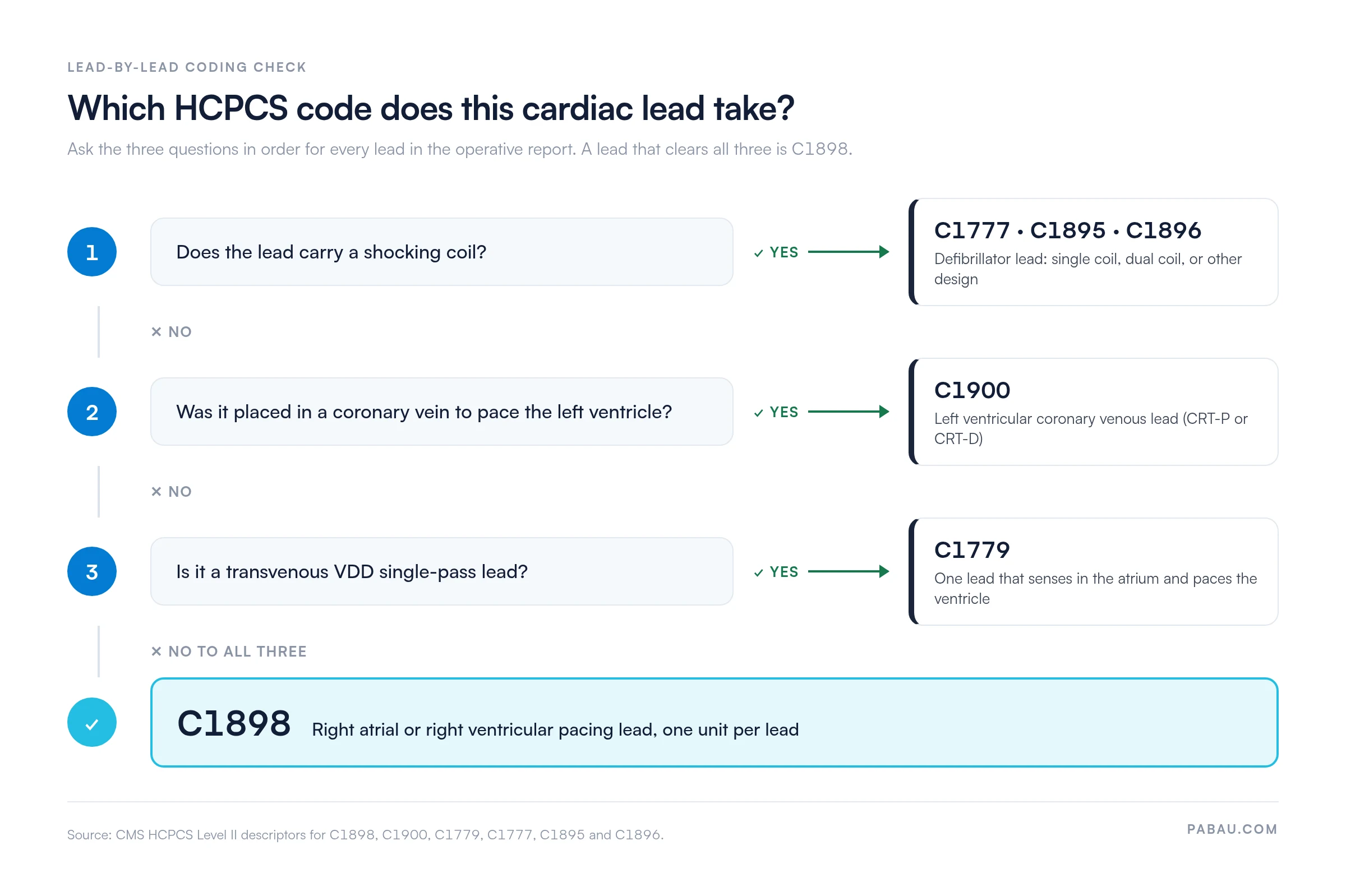
Build a three-question lead check into your cardiac charge capture process. Does the lead have a shocking coil? If yes, use C1777, C1895 or C1896. Was it placed in a coronary vein to pace the left ventricle? If yes, use C1900. If neither, confirm it is not a VDD single-pass lead, then use C1898.
C1898 is a facility code, not a physician code. It appears on the UB-04 institutional claim form, not on a CMS-1500 professional claim. The billing setting decides whether Medicare pays for the lead at all.
For commercial payers, coverage policies differ significantly. Medicare OPPS rules do not automatically transfer to Blue Cross, United, or Aetna contracts. Review each payer’s device billing policy before submitting C1898 on a commercial claim. Our overview of medical billing basics explains how facility and professional claims differ.
Under Medicare OPPS, C-codes like C1898 are paid as either pass-through or packaged device codes. Their status is set in the annual CMS OPPS final rule.
Pass-through status provides separate, cost-based reimbursement for a defined period (typically two to three years) while CMS collects utilization data. Once pass-through status expires, the device cost is typically packaged into the APC payment for the associated procedure.
Pass-through device payment means Medicare reimburses the device cost separately, on top of the APC payment for the procedure. The device is new enough that its cost is not yet reflected in OPPS payment rates.
C-codes were introduced specifically to identify devices in pass-through status. Once a C-code device’s pass-through period ends, CMS typically transitions it to a packaged status or assigns it to an existing APC.
Verify the exact 2026 Medicare reimbursement rate for C1898 directly from the CMS HCPCS code system and the current year’s OPPS addendum. Rates change with each annual rule.
The CMS Physician Fee Schedule does not apply to C-codes; use the OPPS rate files instead. Commercial reimbursement rates are set by contract and can differ substantially from Medicare.
Verify C1898’s payment indicator in the CMS OPPS Addendum B each January. The indicator tells you whether the device is packaged into an APC (status indicator N or Q) or receiving separate pass-through payment (status indicator H). Packaging status changes year to year and affects whether a separate C1898 line item generates payment or is ignored by the pricer.
Documentation is where many C1898 claims fail post-submission audit, even when the code itself is correct. The operative report, device records, and the claim must tell a consistent story about what was implanted.
Maintaining strong medical billing compliance standards across your cardiac procedure documentation directly reduces audit exposure on device codes.
The medical record must support four elements for C1898:
Follow this workflow each time a pacemaker lead implantation is coded in the hospital outpatient or ASC setting. Skipping any step increases the risk of denial or audit recoupment.
C1898 denials fall into predictable patterns. The table below shows the top denial reasons, what causes them, and the specific prevention step for each. Strong denial management strategies for cardiac device codes start with pre-submission documentation checks, not post-denial appeals.
Lead coding errors often surface weeks after the procedure, when a denial or an audit letter arrives. By then the device has been paid, recouped, or written off.
Pabau, the practice management platform we build, keeps the claim side of that work in one place. Its claims management tools submit insurance claims through connected clearinghouses and show every claim’s status in a single dashboard. Validation checks run in the background and flag a claim that is missing required details before it goes out.
Your coders still make the call between C1898, C1900 and C1779. Pabau makes sure the claim carrying that call is complete, submitted and followed to payment, so fewer device lines end up in appeals.
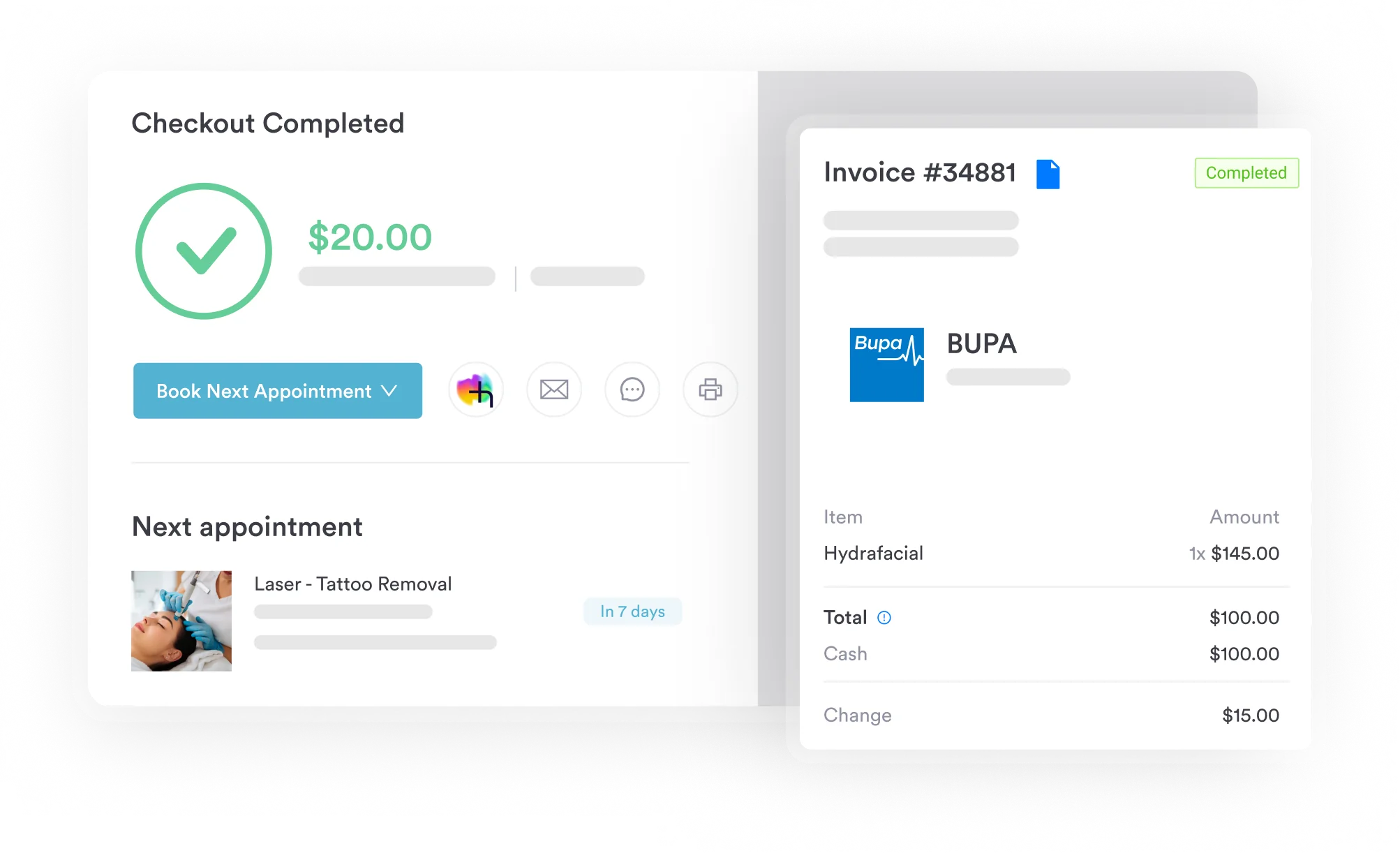

Pabau’s claims management lets billing teams submit, validate and track insurance claims from one dashboard. Claims missing required details get flagged before they reach the payer.

Most C1898 errors have little to do with C1898 itself. They come from treating every lead in a pacemaker, CRT or ICD implant as one code. Read the operative note lead by lead. RA and RV pacing leads take C1898, the LV coronary venous lead takes C1900, and shocking leads take C1777, C1895 or C1896.
Make that lead-by-lead check and the UDI check a fixed step before any claim leaves charge capture. It costs a few minutes per case, against recoupments that can arrive months after payment. Book a demo to see how Pabau validates and tracks every insurance claim from submission to payment.

Looking to improve documentation completeness before claims are submitted? Medical billing compliance outlines the documentation standards that support clean device code submissions and reduce audit risk.
Coding the shocking lead in the same implant? HCPCS code C1895 covers dual-coil endocardial defibrillator leads and how to bill them.
Working with a defibrillator lead that is neither single nor dual coil? HCPCS code C1896 explains when that catch-all lead code applies.
HCPCS code C1898 covers implantable pacemaker leads other than transvenous VDD single-pass leads, reported in the hospital outpatient or ASC setting under Medicare OPPS. It includes right atrial and right ventricular pacing leads, including those placed in CRT-P and dual-chamber ICD systems. It excludes left ventricular coronary venous leads (C1900), defibrillator leads (C1777, C1895, C1896) and VDD single-pass leads (C1779).
C1898 covers right atrial and right ventricular pacing leads, while C1900 covers left ventricular leads placed in the coronary venous system for cardiac resynchronization therapy. Neither is a defibrillator lead code; shock-capable leads go to C1777, C1895 or C1896. A CRT-P implant usually reports C1898 for the RA and RV leads and C1900 for the LV lead.
Yes, for the pacing-only lead. A dual-chamber ICD usually includes a right atrial pacing lead, which is reported with C1898. The defibrillator lead itself is reported with C1777, C1895 or C1896, and an LV lead in a CRT-D system with C1900. Check your MAC’s device edits for the procedure code before submitting.
The Medicare reimbursement rate for C1898 under OPPS changes annually and depends on the code’s current payment indicator (pass-through vs. packaged). Verify the current rate directly from the CMS OPPS Addendum B for the applicable calendar year. Pass-through status provides separate, cost-based payment. Packaged status bundles the device payment into the APC for the procedure, so a separate C1898 line generates no extra reimbursement.
Only hospital outpatient departments (HOPDs) and ambulatory surgical centers (ASCs) can bill C1898. Inpatient hospitals cannot report it because device costs are bundled into the MS-DRG payment. Physician offices cannot report it because C-codes are facility codes submitted on a UB-04 institutional claim form, not on a CMS-1500 professional claim.
The medical record must include an operative report naming the lead as a non-VDD pacing lead, plus the device label or UDI. It also needs a physician order for the device and a diagnosis code supporting medical necessity for pacemaker implantation. Missing UDI documentation is a frequent post-submission audit finding on HCPCS code C1898 claims.
Only if the current year’s OPPS Addendum B lists it that way. C-codes were created to identify pass-through devices, but pass-through payment lasts only two to three years. Once it expires, CMS packages the device cost into the procedure’s APC. Status indicator H means separate pass-through payment, while N or Q means the device is packaged. Confirm C1898’s indicator each January before expecting a separate payment line.
The top trigger is billing C1898 for a lead with its own code, such as a VDD lead (C1779) or an LV lead (C1900). Missing UDI or device label documentation is next. Claims also fail when C1898 goes on an inpatient or professional claim instead of a facility UB-04. A diagnosis code that does not establish medical necessity for pacemaker implantation causes denials too. Bundling edits deny separate payment once the device cost is packaged into the APC.