CPT code 63081: Vertebral corpectomy, cervical spine
CPT code 63081: official descriptor and procedure overview CPT code 63081 descri...

Last Updated: Oct 6, 2026
C1769 is the HCPCS Level II code for a guide wire, reported on hospital outpatient claims under the Outpatient Prospective Payment System (OPPS).
It sits in the C-code range for assorted devices, implants, and systems, C1760 through C2615. CMS created it as a transitional pass-through device code, and that status ran from August 1, 2000 to December 31, 2002. The code is still valid and billable, but its cost is now packaged into the payment for the procedure it supports.
Let Pabau's smart automation suggest the right codes, reduce claim denials, and keep your practice compliant—effortlessly.
Automate repetitive tasks and focus on what matters most—your patients.
Reduce coding errors and ensure compliance with the latest regulations.
Clean claims, fewer denials, and faster reimbursements.
Powerful insights and reporting to help your practice thrive.
HIPAA compliant SOC 2 certified GDPR-compliant Trusted by 4,000+ clinics worldwide

HCPCS Code C1769 is a Level II C-code for a guide wire, grouped with the OPPS devices in the C1760–C2615 range.
Its transitional pass-through status expired on December 31, 2002, so the guide wire’s cost is now packaged into the procedure’s APC payment.
Hospitals still report C1769 with its charge and units, because CMS sets future APC rates from that claims data.
Prior authorization attaches to the procedure the guide wire supports. Medicare Advantage and commercial plans each set their own rules.
Pabau’s claims management software connects procedure documentation to the claim at the point of care, so device lines such as C1769 are reviewed before submission.
HCPCS Code C1769 is the Level II code CMS assigns to a guide wire. It belongs to the C-code series, which CMS maintains for hospital outpatient items and services paid under the Outpatient Prospective Payment System (OPPS). Within that series, C1769 sits in the range for assorted devices, implants, and systems, C1760 through C2615. The CMS HCPCS code system publishes the annual code files that carry its descriptor and status.
CMS created C1769 as a transitional pass-through device code. Pass-through payment let hospitals bill new device costs separately while CMS gathered the claims data to price them. For C1769, that status began on August 1, 2000 and expired on December 31, 2002. The code has stayed valid and billable since then, but OPPS packages its payment into the procedure it supports.
Some reference sites label C1769 a parenteral supply, but no CMS source classifies it that way. In HCPCS, “parenteral” refers to the parenteral nutrition codes, B4164 through B5200. A guide wire has no connection to that series.
Report C1769 when a guide wire is used in a catheter-based or minimally invasive procedure in a hospital outpatient department. Interventional cardiology, interventional radiology, and urology account for most of these claims. The wire is advanced through a vessel or duct, so catheters, sheaths, balloons, or stents can follow it to the target site.
Confirm three conditions before the C1769 line goes on the claim. The medical billing process for device codes like C1769 depends on the record supporting each one.
Common procedures include percutaneous coronary intervention, peripheral angioplasty and stenting, nephrostomy tube placement, and ureteroscopy with stent placement. On a coronary angioplasty case, the procedure line carries CPT 92920, and the wire goes on its own C1769 line beside it.
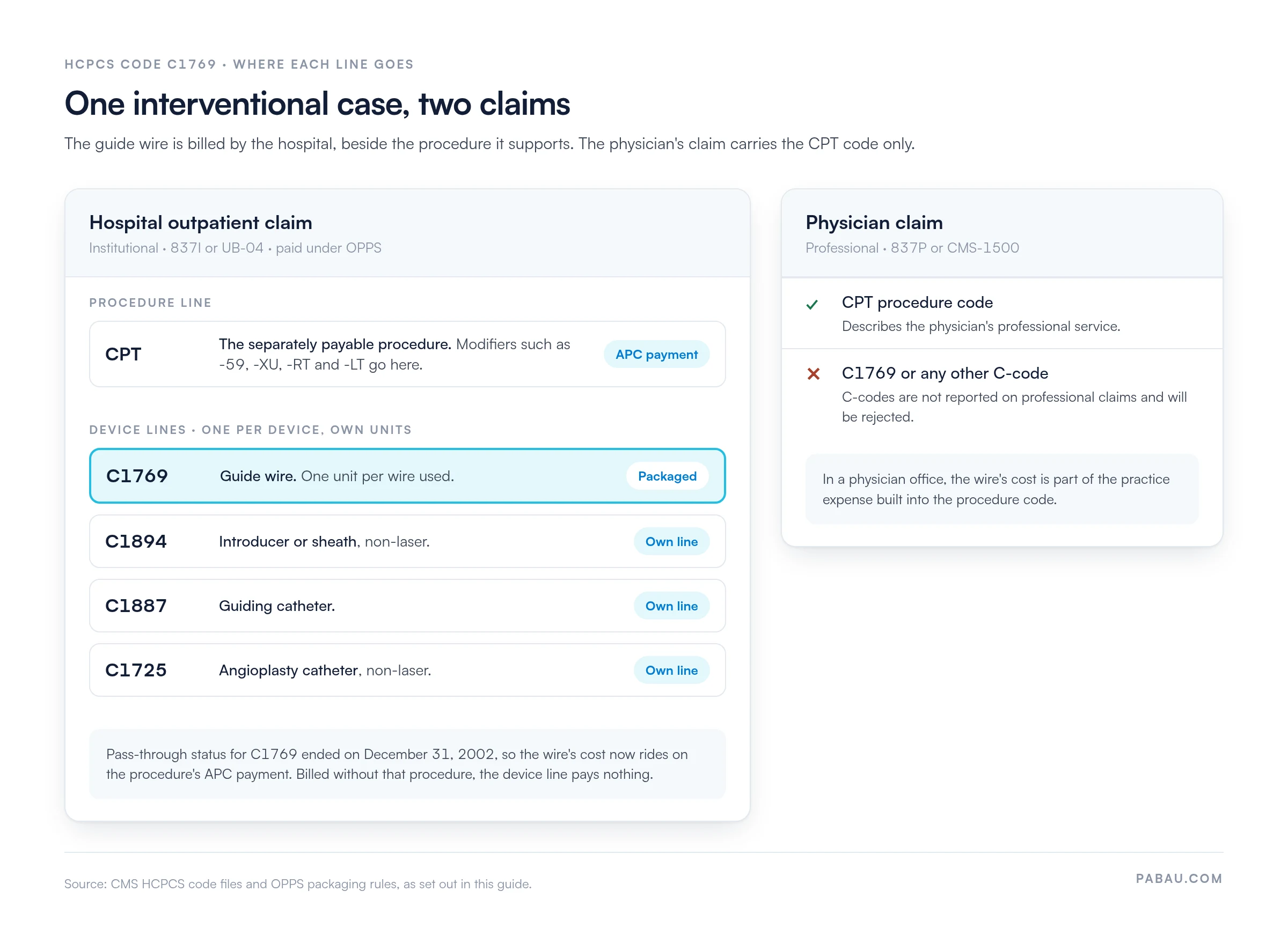
Report one unit per guide wire used, and record each wire in the note so the charge can be traced to the case. The diagram below maps which line belongs on the hospital’s claim and which on the physician’s.
The short descriptor “Guide wire” invites over-use. Its limits come from the OPPS payment system the code belongs to, and several common billing habits fall outside them.
Outside OPPS, follow the payer’s own rules. A freestanding imaging center or a commercial plan with a custom fee schedule may expect a different code, or no separate device line at all.
C1769 is one of several device codes that often appear on the same interventional claim. Each describes a different device, so a case that uses a sheath, a guiding catheter, and a wire can carry three device lines. The AAPC HCPCS code search provides descriptor text and code notes for each one.
Report each device on its own line with its own units. A sheath belongs on a separate C1894 line, and folding it or a catheter into the C1769 line understates the hospital’s device charges. Those charges feed the claims data CMS uses to set next year’s APC rates.
C1769 rarely needs a modifier of its own. Because it is packaged, no modifier makes it separately payable under OPPS. Most modifier decisions on these claims belong on the CPT procedure line. Verify current requirements against the Medicare Claims Processing Manual (Publication 100-04) and your MAC’s guidance before submitting.
Before adding -59 or -XU to a claim that carries C1769, check which line the modifier belongs on. These modifiers describe distinct procedures, so they go on the CPT line and leave the packaged wire’s payment unchanged.
Prior authorization for a C1769 claim attaches to the procedure, not to the guide wire. Payers authorize the intervention, and the packaged wire is covered under that approval. The rules still differ sharply by payer type, so check them when the procedure is scheduled.
When a required authorization is missing, the payer denies the procedure line, and the packaged wire goes with it. That denial is a coverage determination failure rather than a coding error. The appeal needs clinical documentation of medical necessity, not a corrected claim.
Documentation on a C1769 claim does two jobs. It supports medical necessity for the procedure, and it lets an auditor trace each device charge to the patient and the case. Meeting clean claim requirements on these claims means the record carries several specific elements.
Build those fields into the procedure note template, so staff capture them before the case closes. Reconstructing them weeks later during an appeal takes far longer. Embedding medical billing compliance standards in the clinical workflow keeps device charges accurate across interventional cases.
C1769 has no separate Medicare payment rate under OPPS in 2026. Its pass-through status expired at the end of 2002. The guide wire’s cost is now packaged into the Ambulatory Payment Classification (APC) payment for the procedure.
Packaging does not make the line optional. CMS sets future APC rates from hospital claims data, so a missing device line understates the cost of the procedure. Confirm the current status indicator and APC assignments in OPPS Addendum A and B, published with each OPPS final rule.
The PGM Billing HCPCS lookup tool and similar databases offer reference data. Treat any third-party figure as an estimate, and reconcile it against the CMS OPPS final rule before counting on a payment.
C1769 denials follow a few predictable patterns, and each one has a distinct fix. Because the code is packaged, most problems surface on the procedure line or the claim as a whole. The remittance names each one with standard denial codes. Systematic denial management workflows that track these by reason code catch a pattern before it repeats.
What happens: C1769 was submitted on a professional claim, or by a setting that does not bill under OPPS.
Fix: move the device line to the hospital’s institutional claim. Remove it from the physician’s claim, where the CPT code alone describes the professional service.
What happens: the C1769 line reaches the payer without the procedure it supported, often because that procedure was coded late or split onto another claim. Without a procedure to attach to, the packaged line generates no payment.
Fix: resubmit with the procedure and device lines on the same claim and date of service. Add a charge-capture check that flags any C-code without a matching procedure.
What happens: a Medicare Advantage or commercial payer required authorization for the procedure. The claim went out without it, and the denial cites a coverage determination failure.
Fix: request retroactive authorization where the plan allows it, or escalate to a peer-to-peer review with the plan’s medical director. Document any clinical urgency that made earlier authorization impossible. Then add a PA check to interventional scheduling.
What happens: the payer’s coverage policy or LCD does not support the diagnosis-procedure combination.
Fix: appeal with the full procedure note and clinical literature supporting medical necessity. For future Medicare cases, issue an Advance Beneficiary Notice (ABN) where the policy allows it.
Track C1769 adjustments by CARC (Claim Adjustment Reason Code) in your billing software. CARC 97 means the benefit is included in another service’s payment, which is expected for a packaged line. CARC 197 (authorization absent) and CARC 50 (not medically necessary) point to fixable problems on the procedure line.
Interventional billing teams often find device errors only after the remittance arrives. A guide wire missing from the procedure note, a C-code on the physician claim, or a device line without its procedure each costs a resubmission.
Pabau, the practice management platform we build, includes claims management software that links procedure documentation to the claim at the point of care. Billers can build denial-tracking workflows and flag missing authorizations before submission.
The result is less rework for the billing team, and device charges that reach the claims data CMS uses to set rates.

Pabau’s claims management software links procedure documentation to the claim at the point of care. Build denial-tracking workflows, flag missing authorizations before submission, and reduce rework across your interventional billing team.

C1769 pays nothing on its own, which is why it gets mishandled. Treat it as a device charge that travels with the procedure: one line per wire, on the hospital’s claim, beside the procedure it supported.
Get that pairing right, and the denials left over concern authorization and medical necessity, which procedure documentation can win on appeal. Packaging is a payment rule, so no appeal will turn the wire into a separate payment.
Book a demo to see how Pabau keeps device lines and procedure documentation together on interventional claims.

Need a framework for reducing claim rejections across your billing cycle? Revenue cycle management guide covers the end-to-end workflow from eligibility check through payment posting.
Building a documentation standard for interventional procedures? Medical billing compliance outlines the documentation principles that support clean claims across code types.
Adding a PA check to interventional scheduling? The prior authorization process sets out a step-by-step workflow for requesting and tracking approvals.
Billing a ureteroscopy with stent placement? CPT code 52332 covers the ureteral stent procedure that a guide wire often supports.
HCPCS Code C1769 reports a guide wire used in a hospital outpatient procedure paid under OPPS. Typical cases include percutaneous coronary intervention, peripheral vascular procedures, and ureteroscopy. It belongs on the hospital’s institutional claim, not on a physician’s professional claim.
No. C1769 is a Level II C-code for an OPPS transitional pass-through device, in the C1760–C2615 range for assorted devices, implants, and systems. In HCPCS, “parenteral” refers to the parenteral nutrition codes B4164 through B5200.
Traditional Medicare does not require prior authorization for most procedures that use C1769. Authorization, where required, attaches to the procedure rather than the guide wire. Medicare Advantage and commercial plans often impose their own PA rules, so check each plan before scheduling.
C1769 rarely takes a modifier of its own, because no modifier makes a packaged code separately payable. Modifiers such as -59, -XU, -RT and -LT belong on the CPT procedure line. Follow the payer’s policy if it also asks for them on device lines.
C1769 has no separate Medicare payment under OPPS in 2026. Its pass-through status expired on December 31, 2002, and its cost is packaged into the procedure’s APC payment. Confirm the status indicator in CMS OPPS Addendum B.
C1769 reports the guide wire itself. C1894 reports a non-laser introducer or sheath, the access device that the wire and catheters pass through. A case that uses both devices reports each one on its own line.
The most common cause is a C-code billed on a professional claim. Others include a device line without a payable procedure on the same claim, and missing prior authorization for the procedure. Medical necessity denials on the procedure also take the packaged wire with them.