

HCPCS code E0198: Water pressure pad billing guide
HCPCS code E0198 is a water pad for a standard mattress HCPCS code E0198 is the ...

Last Updated: Oct 13, 2026
C1787 is the HCPCS Level II code for patient programmer, neurostimulator. It covers the external handheld device a patient uses to adjust or check the output of an implanted neurostimulator.
The code is payable only in hospital outpatient and ambulatory surgery center settings under the Outpatient Prospective Payment System. Denials usually trace back to the wrong billing setting, a missing -KX modifier, or documentation that never ties the programmer to a specific implanted system.
Let Pabau's smart automation suggest the right codes, reduce claim denials, and keep your practice compliant—effortlessly.
Automate repetitive tasks and focus on what matters most—your patients.
Reduce coding errors and ensure compliance with the latest regulations.
Clean claims, fewer denials, and faster reimbursements.
Powerful insights and reporting to help your practice thrive.
HIPAA compliant SOC 2 certified GDPR-compliant Trusted by 4,000+ clinics worldwide

C1787 covers the external patient programmer only, not the implantable pulse generator or the leads.
The code is payable only in outpatient hospital and ASC settings under OPPS, so physician office and inpatient claims get denied.
Modifier -KX is required once LCD medical necessity criteria are met, and omitting it is the most common avoidable denial.
The implantable lead is C1778, not C1713, which is an orthopedic anchor or screw code.
Pabau’s claims management software tracks modifier requirements and prior authorization status, so C1787 claims go out complete.
HCPCS Code C1787 is the HCPCS Level II code for a patient programmer, neurostimulator.
That is the external handheld unit a patient uses to adjust or check an implanted stimulator at home. The code is payable only in outpatient hospital and ambulatory surgery center settings.
C1787 sits in the C-code range of HCPCS Level II. That is the code set the Centers for Medicare and Medicaid Services (CMS) maintains for supplies and devices outside CPT. C-codes are device-specific and apply under the Outpatient Prospective Payment System (OPPS).
Verify the current descriptor and status against the AAPC HCPCS code lookup or the CMS annual release files before you submit. C-code descriptors can change in the October OPPS addenda cycle.
The patient programmer is the external, handheld device a patient uses at home to adjust, pause, or check the stimulation output of an implanted neurostimulator. It is not the generator and not the lead, and that distinction drives most coding errors on neurostimulator claims.
The map below shows which code covers which part of the system, and which part never appears on a claim at all.
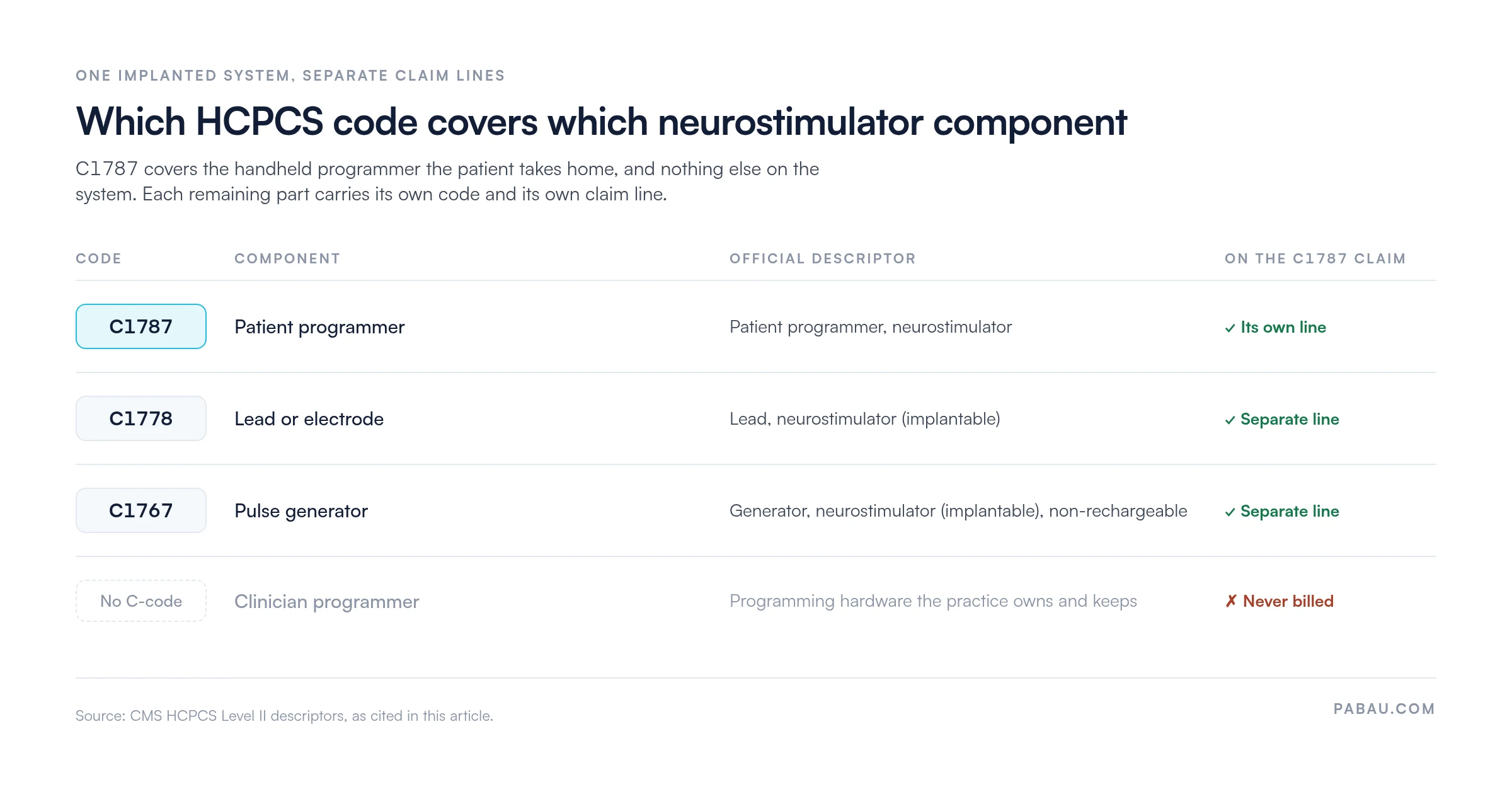
The generator, the leads, and the programmer are often implanted in one surgical session. Each still belongs on its own claim line with its own HCPCS code. Bundling them under a single code is incorrect and likely to trigger a bundling edit denial.
C-codes, including C1787, are OPPS-specific. They exist because inpatient DRG payments and physician fee schedule payments do not carve out device costs the same way. Billing C1787 in the wrong setting is one of the fastest paths to a denial.
If the implant procedure happens during an inpatient admission, C1787 cannot be unbundled and billed separately. The device cost is already inside the DRG payment.
Under OPPS, CMS assigns C1787 to an Ambulatory Payment Classification (APC) group. The facility is paid the APC’s packaged rate rather than a device-specific line-item amount. Rates change annually with the OPPS final rule, usually published in November for the following calendar year.
For current payment rates, use the CMS fee schedule search tool or download OPPS Addendum B and filter for C1787. Third-party rate aggregators often carry outdated figures. Verify against the CMS source for the current fiscal year before you quote a reimbursement amount.
Several factors move the payment a facility actually receives. Geographic wage index adjustments apply, so the same APC pays differently by region. A hospital outpatient department in San Francisco is paid more than one in rural Mississippi. Medicare Advantage plans may apply their own contracted rates instead.
CMS added certain neurostimulator procedures to its OPPS prior authorization program. Hospitals and ASCs must get approval before performing the service for Medicare fee-for-service patients. Whether C1787 itself triggers a PA requirement depends on the associated procedure code and the current CMS list.
PA requirements also vary by Medicare Administrative Contractor (MAC) jurisdiction and by commercial payer. A practice billing in the Noridian jurisdiction may face different documentation thresholds than one under CGS or Novitas. Run insurance eligibility verification before you schedule the implant, so payer-specific PA obligations surface early.
The most common confusion in neurostimulator billing is between C1787, the patient programmer, and C1778, the implantable lead. Each covers a physically distinct part of the same system. Getting them the wrong way round causes both under-billing and over-billing.
C1713 is a common wrong answer here. It is the code for an anchor or screw used in bone-to-bone or soft tissue-to-bone fixation. That is orthopedic hardware, not a neurostimulator component.
A complete SCS implant claim typically carries the procedure CPT code, the generator code, C1778 for the lead, and C1787 for the patient programmer. Each sits on its own claim line. Collapsing them into fewer codes reduces reimbursement and can trigger a medical review.
Run a claims audit on your neurostimulator procedure claims from the past 12 months. Filter for encounters where the implant CPT code was billed but C1787 was not included. Each missing programmer line is unreported revenue. Separately, filter for C1787 claims that went out without the accompanying IPG and lead codes to catch bundling errors before a MAC audit does.
Modifiers on C1787 claims signal medical necessity status, laterality, and other payer-required conditions. Missing the right one is the most common reason a technically correct C1787 claim is denied on first submission.
Modifier -KX carries the most weight. It attests that your documentation satisfies the LCD medical necessity criteria. Submitting C1787 without -KX where the LCD requires it produces a group-2 denial with remark code N432 or similar.
Neurostimulator LCDs vary by MAC, so confirm which one governs your jurisdiction before you build the claim template.
Payers auditing C1787 claims look for a specific set of records. Missing any one of them can produce a post-payment recovery request, not just a denial. Build the checklist into the pre-submission workflow rather than assembling it after an audit letter arrives.
The device label is the item most often missing. Pull the device sticker from the surgical package documentation and attach it to the claim record. Capturing lot numbers and model identifiers at the point of service means nobody has to reconstruct them weeks later during claim review.
Most C1787 denials are correctable. Identify the root cause from the remittance advice before resubmitting, and map each reason code to a specific workflow correction. Our guide to medical billing denial codes sets out how the common remark codes translate into next steps.
Electronic remittance advice data is the fastest way to categorize denial patterns across C1787 claims. Sorting denials by remark code lets a billing team fix the systemic cause instead of working claims one at a time.
Most C-code billing errors start in the workflow. A coder may know that -KX is required and still submit without it. The LCD checklist sits in a folder the claim screen never shows.
Practice management software like Pabau connects procedure documentation to device charge capture. Pabau’s claims management software flags the modifier requirements on a device line before the claim goes out. Prior authorization status sits on the same patient record, so nobody checks a second system for it.
That means a coder sees the LCD attestation, the device model, and the programmer line on one screen. Fewer C1787 claims leave the building incomplete, so fewer come back.
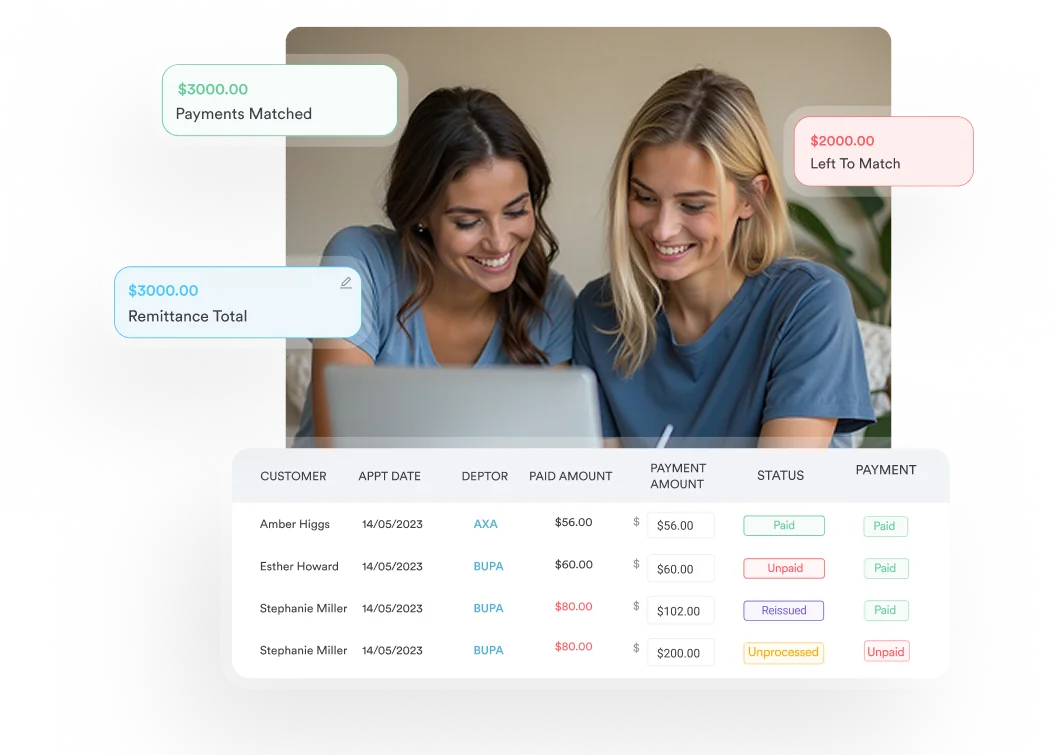

Pabau’s claims management software connects clinical documentation to device charge capture. Modifier requirements and prior authorization status are visible before the claim goes out.

C1787 has a narrow descriptor and a high denial rate. Payers rarely dispute the code. They dispute the setting it was billed from, the modifier attached to it, and the records behind it.
So treat C1787 as one line in a multi-code claim rather than a device charge on its own. Check the setting, attach -KX where the LCD is met, and file the device label with the claim. Those three habits fix most of what gets denied.
Pabau can catch those three before the claim leaves the building. Book a demo to see how device-code billing works in one record.

Need a primer on how medical billing works end to end? What is medical billing covers the full claims lifecycle from charge capture through payment posting.
Want to see how OPPS denial codes map to corrective actions? Denial codes in medical billing explains the most common remark codes and appeal strategies.
Looking to tighten your revenue cycle beyond device codes? What is revenue cycle management walks through the eight-stage RCM workflow and where practices lose the most revenue.
Want fewer device claims rejected on first pass? Clean claim sets out the fields a payer checks before a claim is accepted.
Need to read a remittance file faster? Electronic remittance advice explains how to sort denials by remark code and act on the pattern.
HCPCS Code C1787 covers the external patient programmer device provided to a patient as part of an implantable neurostimulator system. It does not cover the implantable pulse generator, the leads, or clinician programming hardware.
Yes. Medicare covers C1787 under OPPS when the claim comes from an eligible outpatient hospital or ASC. The applicable MAC LCD criteria must be met, and modifier -KX must be appended to attest that the documentation satisfies them.
C1787 covers the external patient programmer. C1778 covers the implantable lead or electrode. Both belong to the same neurostimulator system, but they go on separate claim lines because they are distinct devices with different costs.
Modifier -KX is required when LCD medical necessity criteria are documented and met. Modifier -GA is added when an Advance Beneficiary Notice is on file for uncertain coverage situations. Laterality modifiers -RT or -LT may be required by specific MACs for spinal cord stimulator claims.
C1787 is billable only in hospital outpatient departments and ambulatory surgery centers under OPPS. It cannot be billed in physician office settings (Part B fee schedule) or for inpatient admissions where device costs are bundled into the DRG payment.
Prior authorization requirements depend on the payer and MAC jurisdiction. CMS has added certain neurostimulator procedures to its OPPS PA program for Medicare fee-for-service, and commercial plans typically require PA for any implantable neurostimulator system. Verify PA requirements with the specific payer before the procedure date.



