HCPCS code A4714: Treated water for peritoneal dialysis billing guide
HCPCS code A4714: Official descriptor, code type, and payment status HCPCS code ...

Last Updated: Oct 15, 2026
C1849 was the HCPCS Level II code for skin substitute, synthetic, resorbable, per square centimeter. CMS terminated it on December 31, 2022, so it has not been billable for any date of service since January 1, 2023.
Claims carrying C1849 for a 2023 or later date of service deny as an invalid code. Bill the product-specific code for the skin substitute you applied instead, often a Q-code, confirmed in the current CMS HCPCS annual update file.
Let Pabau's smart automation suggest the right codes, reduce claim denials, and keep your practice compliant—effortlessly.
Automate repetitive tasks and focus on what matters most—your patients.
Reduce coding errors and ensure compliance with the latest regulations.
Clean claims, fewer denials, and faster reimbursements.
Powerful insights and reporting to help your practice thrive.
HIPAA compliant SOC 2 certified GDPR-compliant Trusted by 4,000+ clinics worldwide

HCPCS code C1849 described a skin substitute that is synthetic and resorbable, reported per square centimeter in hospital outpatient and ASC settings.
CMS added C1849 on July 1, 2020, and terminated it on December 31, 2022.
C1849 is a deleted code and has not been billable for any date of service since January 1, 2023. AAPC and CMS-derived HCPCS data agree on this.
Bill the product-specific code for the skin substitute you applied, often a Q-code, confirmed in the current CMS HCPCS annual update file.
Pabau’s claims management software tracks each skin substitute claim through its status stages, so a line carrying a deleted code gets caught early.
HCPCS code C1849 was defined by the Centers for Medicare and Medicaid Services (CMS) as: Skin substitute, synthetic, resorbable, per square centimeter. CMS terminated the code on December 31, 2022, so it now serves only as a historical reference.
Each word in the descriptor set a boundary. Synthetic meant the product contained no human or animal tissue. Resorbable meant the body absorbed the material over time, so it did not need surgical removal. Per square centimeter set how quantity was reported on the claim.
The code sat in the C-series of HCPCS Level II. CMS uses C-codes for reporting in hospital outpatient and ambulatory surgical center (ASC) settings under the outpatient prospective payment system. HCPCS Level II is the HIPAA-mandated code set for supplies, drugs and devices, maintained by CMS.
No, HCPCS code C1849 is no longer valid. CMS terminated it on December 31, 2022, so no claim with a 2023 or later date of service can carry it.
The code had a short life. CMS added it to HCPCS Level II on July 1, 2020, and it stayed reportable for two and a half years. Its CMS record now shows action code N, meaning no further maintenance, alongside the termination date. The timeline below shows which code applies on each side of that cutoff.
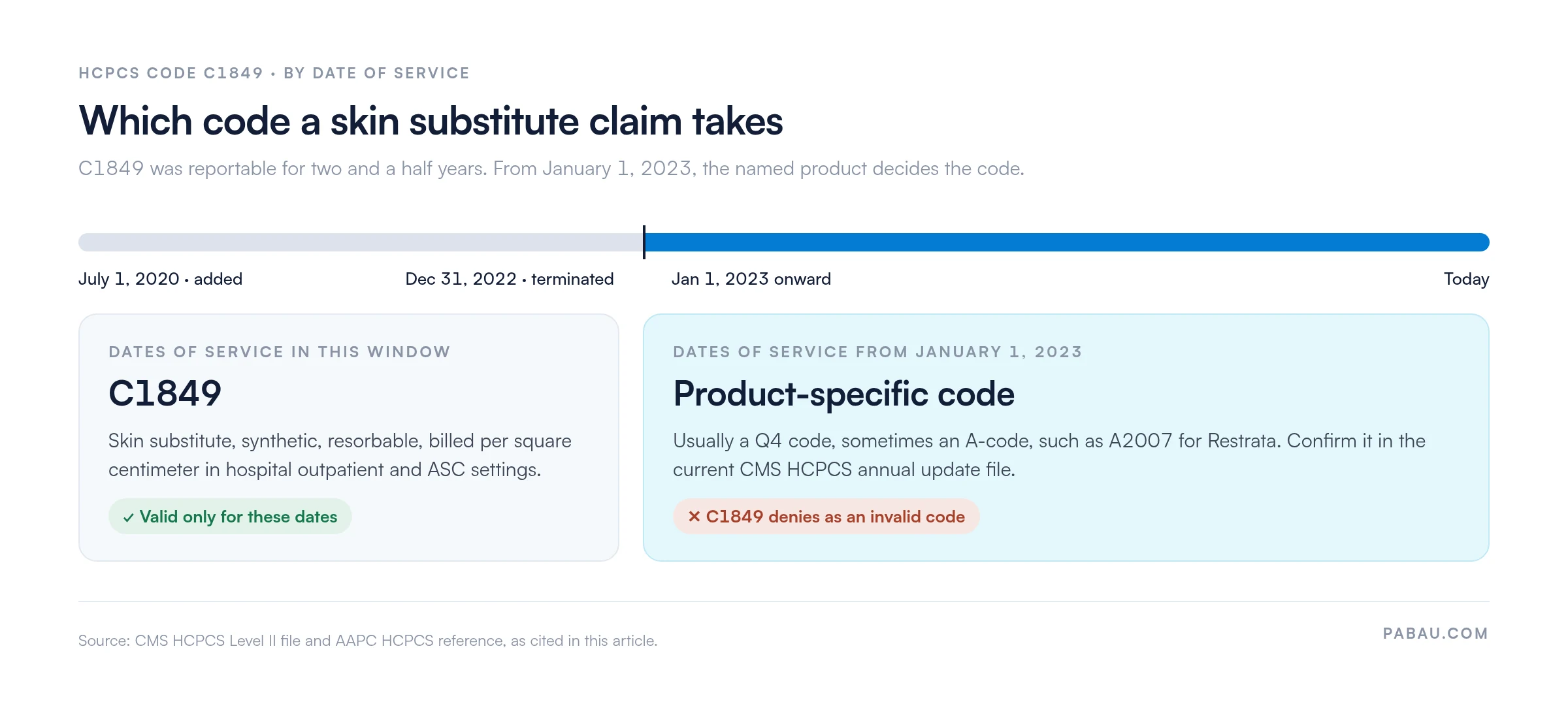
Coding references agree on the deletion. The AAPC HCPCS reference lists C1849 as a deleted code, effective January 1, 2023. Lookup sites that republish the CMS HCPCS file show the same December 31, 2022 termination date.
A lookup page headed “2026 HCPCS Code C1849” can look like an active listing. That year is only the site’s current data-year heading, and the record beneath it still reads as terminated. Check the termination date field, not the page title.
Search your charge master, superbills and fee schedules for C1849 now, and remove it wherever it still appears. Then repeat the check each quarter against the CMS HCPCS update file, so a deleted code never reaches a claim.
Bill the product-specific HCPCS code assigned to the skin substitute you applied. CMS named no single one-to-one replacement for C1849, so the right code depends on the product.
Most skin substitutes now carry their own Q-code in the Q4 series. Apligraf, for example, is billed under Q4101, and EpiFix under Q4186. Some synthetic products have A-codes instead. Restrata, for example, has been reported under A2007, per square centimeter, since January 1, 2022.
If you cannot find a product-specific code, ask the manufacturer which code CMS assigned and confirm it with your Medicare Administrative Contractor (MAC). Do not fall back on C1849, because a deleted code denies on submission.
While it was active, C1849 was billed per square centimeter, not per package, sheet or product unit. Most skin substitute codes that replaced it work the same way, so the measurement habits still matter.
To set the quantity, the coder took the square centimeters documented in the procedure note. A 4 cm x 3 cm application, for example, became 12 units on the claim. MACs compare documented measurements with submitted quantities during claim review.
The product line is only half of the claim. The application is reported separately with a CPT code such as 15271, which covers the first 25 sq cm on the trunk, arms or legs.
Before you bill any skin substitute, pull the measurement from the procedure note and compare it to the claim quantity. A 10 sq cm mismatch between chart and claim is enough for a MAC to deny or recoup payment.
Medicare coverage now attaches to the product-specific code, not to C1849. Coverage is governed by national guidance and by MAC-issued LCDs, which vary by jurisdiction. Verify the applicable LCD for your MAC region before billing.
Coverage criteria for skin substitutes typically require a qualifying wound type and documented failure of conservative treatment. The product itself must also meet CMS eligibility criteria.
The diagnosis codes that support medical necessity for a skin substitute application are wound-type specific. Common ICD-10-CM codes accepted under skin substitute LCDs include:
The covered diagnosis codes vary by MAC LCD. Cross-reference them against the LCD in effect for your jurisdiction, available through the CMS Medicare Coverage Database. A diabetic foot ulcer claim, for example, pairs E11.621 with an L97 code for the ulcer’s site and severity.
Prior authorization for a skin substitute depends on the payer and the product code. Medicare Advantage plans and commercial payers frequently require it. Check each payer’s policy and the applicable MAC LCD before the application.
Record the prior authorization number on the claim when you obtain one. An authorization issued against C1849 is not valid for a current date of service, so request it under the product-specific code.
Incomplete documentation is one of the most common reasons skin substitute claims deny. The medical record must support medical necessity and identify the exact product used. Wound care teams benefit from structured templates that capture each required element at the point of care.
Your MAC’s LCD may add requirements, such as a minimum period of prior wound care or a minimum wound area. Review it before each claim.
HCPCS code C1849 is often confused with the product-specific skin substitute codes that are billed today. Each category follows its own coverage rules and payment pathway. Our HCPCS code library covers many of the individual Q4 products.
The rule for current claims is simple. Find the code CMS assigned to the named product, and bill that code. C1849 is not a catch-all for synthetic products without their own code.
Any claim carrying C1849 for a date of service on or after January 1, 2023 denies because the code is invalid. Running submissions through status-tracking claims management shows whether that error is still reaching payers.
The other denial patterns below now apply to the product-specific codes that replaced C1849.
Before you build an appeal, confirm the code’s status in a lookup tool such as the PGM Billing HCPCS lookup tool. An appeal for a C1849 line on a 2023 or later date of service will not succeed, so correct the code instead.
Deleted codes like C1849 survive in charge masters, saved templates and staff habits long after CMS retires them. Each one that slips through costs a denial, a correction and a resubmission.
Pabau, the practice management and billing platform we build, keeps the clinical record and the claim in one place. Procedure notes capture the product name, lot number and wound measurements at the point of care. Coders then set the product code and quantity from that record.
Claims are tracked through every status stage, so a billing lead can see where a skin substitute claim stalls. That makes an outdated code visible in days rather than at month-end reconciliation.

Pabau’s claims management software gives billing teams a clear view of claim status, so outdated codes get caught before they cost you a resubmission.

C1849 is a closed chapter. The code has been invalid since January 1, 2023, and any lookup page that suggests otherwise is showing a data-year heading.
The work that remains is housekeeping with a payoff. Strip C1849 from every template, bill the code assigned to the named product, and keep measurements and lot numbers in the note. Practices that do this stop paying for avoidable resubmissions.
Book a demo to see how Pabau helps wound care billing teams catch outdated codes and keep skin substitute claims clean.

Billing a biologic skin substitute today? HCPCS code Q4162 is a skin substitute billing guide for one of the product-specific Q4 codes.
Applying a porcine bladder matrix? HCPCS code Q4166 covers how Cytal is coded and billed per square centimeter.
Want another product-specific example? HCPCS code Q4133 walks through billing for another skin substitute with its own code.
Grafting a larger wound? CPT code 15273 covers skin substitute application of 100 sq cm or more on the trunk, arms or legs.
Debriding the wound before the graft? CPT code 97597 explains how active wound care management is billed.
HCPCS code C1849 covered a skin substitute that was synthetic, with no human or animal tissue, and resorbable by the body. It was billed per square centimeter in hospital outpatient and ASC settings. CMS deleted it on January 1, 2023.
C1849 is deleted. CMS terminated it on December 31, 2022, and it has not been billable for any date of service since January 1, 2023. AAPC and CMS-derived HCPCS data both list it as deleted. A “2026” heading on a lookup site is only the site’s data year.
Bill the product-specific code for the skin substitute you applied. That is often a Q-code, and some synthetic products have A-codes, such as A2007 for Restrata. Confirm the code in the current CMS HCPCS annual update file.
C1849 was billed per square centimeter, not per package or per unit. Most current skin substitute codes use the same unit, so the quantity still comes from the measurements documented in the procedure note.
Q4XXX codes are product-specific and active, with each code mapped to a named skin substitute. C1849 was a descriptive code for synthetic resorbable products, and it was deleted on January 1, 2023.
A claim carrying C1849 for a date of service on or after January 1, 2023 denies because the code is invalid. Recode the line with the product-specific code for the skin substitute applied, then submit a corrected claim.