

HCPCS code E0198: Water pressure pad billing guide
HCPCS code E0198 is a water pad for a standard mattress HCPCS code E0198 is the ...

Last Updated: Oct 13, 2026
C1822 is the HCPCS Level II code for a high-frequency implantable neurostimulator generator with a rechargeable battery and charging system. Hospital outpatient departments report it for the pulse generator of a high-frequency spinal cord stimulator, billed with CPT 63685.
CMS created the code on January 1, 2016. Its pass-through payment ended on December 31, 2017, so OPPS now packages it into the implant procedure. Leads, trial kits and other generator types use separate C-codes.
Let Pabau's smart automation suggest the right codes, reduce claim denials, and keep your practice compliant—effortlessly.
Automate repetitive tasks and focus on what matters most—your patients.
Reduce coding errors and ensure compliance with the latest regulations.
Clean claims, fewer denials, and faster reimbursements.
Powerful insights and reporting to help your practice thrive.
HIPAA compliant SOC 2 certified GDPR-compliant Trusted by 4,000+ clinics worldwide

HCPCS code C1822 reports the generator of a high-frequency spinal cord stimulator with a rechargeable battery, never its leads and never a cardiac device.
Hospital outpatient departments report it on the UB-04 with CPT 63685 and an implant revenue code, usually 0278; inpatient stays use the MS-DRG.
C1822 lost pass-through status at the end of 2017, so a zero-paid C1822 line is packaged payment, not a denial.
Coverage rests on NCD 160.7 and your MAC’s policy, which require a documented trial with pain relief before the permanent implant.
Medicare outpatient prior authorization applies to CPT 63650. The trial’s tracking number carries to the permanent implant claim only when both stages happen at the same hospital and by the same physician.
HCPCS code C1822 is the CMS Level II code for Generator, neurostimulator (implantable), high frequency, with rechargeable battery and charging system.
It reports the pulse generator of a high-frequency spinal cord stimulator, such as a 10 kHz system. C1822 belongs to the C-code series that CMS keeps for hospital outpatient medical billing under the Outpatient Prospective Payment System (OPPS).
CMS created C1822 on January 1, 2016, as a new device category with transitional pass-through payment. Pass-through ended on December 31, 2017. Since then, Medicare has packaged the generator into the payment for the implant procedure.
CMS publishes HCPCS updates every quarter. Check the current descriptor against the CMS HCPCS overview before each annual OPPS update takes effect.
HCPCS code C1822 covers one component of a spinal cord stimulator system, the implanted pulse generator. The generator houses the rechargeable battery and the electronics, and the descriptor includes the charging system supplied with it. Leads, extensions, trial kits and other generator types each carry their own code.
C1822 has no link to cardiac devices. Implantable cardioverter-defibrillator generators use C1721 (dual chamber), C1722 (single chamber) or C1882 (other than single or dual chamber).
The neurostimulator generator codes split on two questions. Does the battery recharge, and is the device high frequency? When CMS created C1822, it revised HCPCS code C1820 to separate the two rechargeable types. C1820’s descriptor now reads “non high-frequency” to mark the split.
Manufacturers publish coding guides that name the C-code for each generator model. Map the model number, not the device family, to its code in the chargemaster.
Spinal cord stimulation is billed in two stages, and C1822 appears only in the second. NCD 160.7 requires a trial with a temporarily implanted electrode before the permanent implant. The map below shows which lines each claim carries.
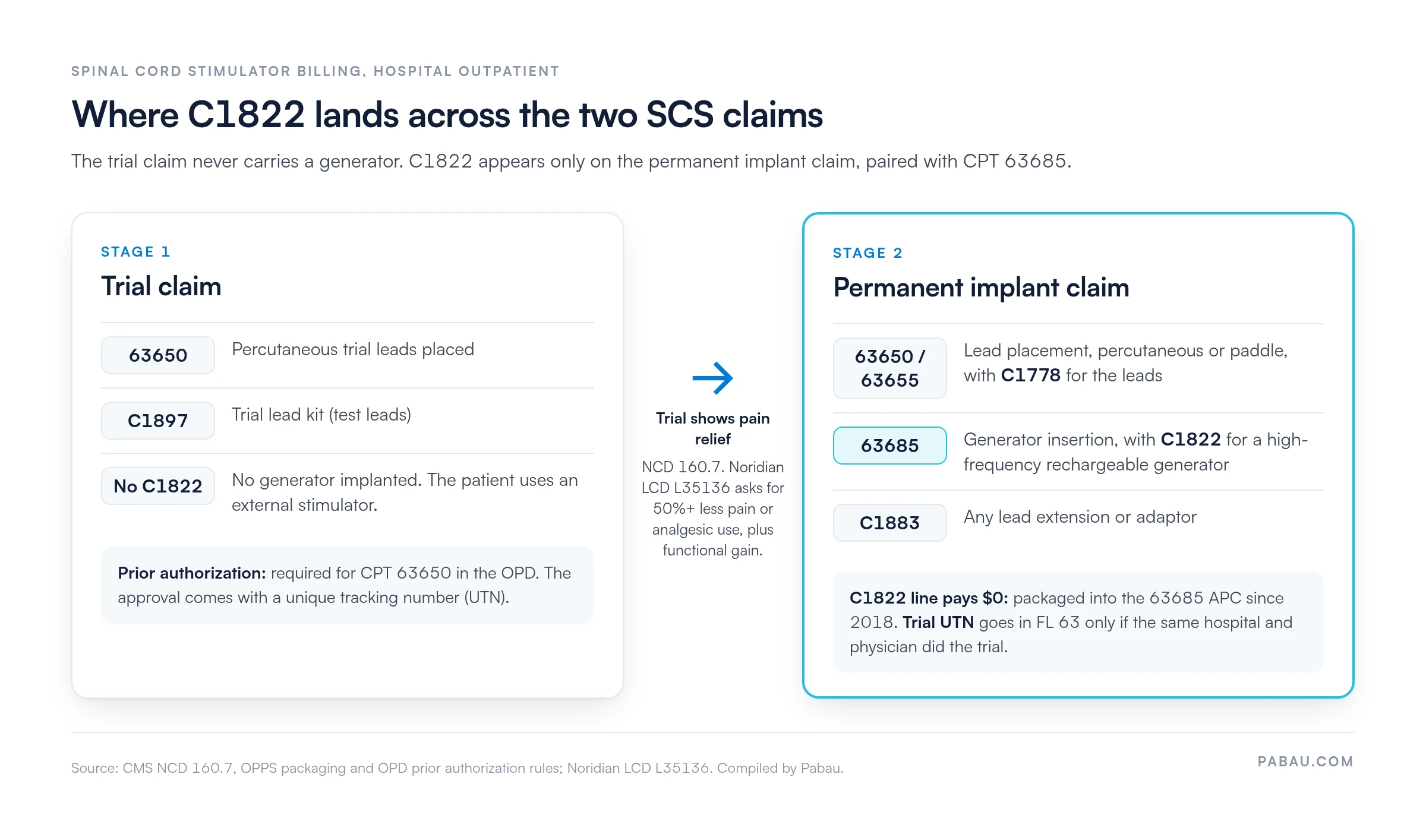
The trial usually places percutaneous leads with CPT 63650. In a hospital outpatient department, the test leads are reported with C1897. The patient goes home with an external stimulator and records their pain relief. No generator is implanted, so C1822 never appears on a trial claim.
After a successful trial, the surgeon places the permanent leads and the generator, often in the same session. The hospital claim then carries a procedure line for each step and a device line for each implanted component.
A generator-only replacement bills 63685 and C1822 with no lead lines, as long as the existing leads stay in place.
On the UB-04, C1822 goes in Form Locator 44 on its own line, with the revenue code in FL 42. Revenue code 0278 (other implants) is the usual pairing. CMS Program Memorandum A-03-035 lists the revenue codes hospitals may use for implantable devices: 0272, 0275, 0276, 0278, 0279, 0280, 0289 and 0624.
Map each generator model number in your chargemaster to its own C-code. Mapping by manufacturer or device family can let a high-frequency generator slip into C1820, or the other way around.
C1822 has no separate Medicare payment today. Its pass-through status ended on December 31, 2017, and CMS packages device codes without pass-through into the procedure they support. The generator cost is paid through the Ambulatory Payment Classification (APC) for CPT 63685.
A C1822 line paid at zero is therefore expected, and it is not a denial. The line still matters, because CMS sets future APC rates from the device charges hospitals report. Leaving it off can also send the claim back to you.
Medicare covers spinal cord stimulators under NCD 160.7, Electrical Nerve Stimulators. NCD 20.4 governs cardiac defibrillators and has no bearing on C1822. NCD 160.7 covers the implant only when all of these conditions are met.
Local coverage determinations (LCDs) add detail. Noridian’s LCD L35136, Spinal Cord Stimulators for Chronic Pain, sets the bar for a successful trial. It needs at least a 50% reduction in target pain or analgesic use, plus some functional improvement. The same LCD allows no more than two trials per spinal region in a patient’s lifetime.
Other MACs word their criteria differently, and some apply the NCD alone. Check the policy for your jurisdiction before the trial is booked.
Medicare also requires prior authorization in hospital outpatient departments for CPT 63650, for services on or after July 1, 2021. CMS has temporarily removed 63685 and 63688 from that list, so the generator procedure needs none. Each approval carries a unique tracking number (UTN).
When the OPD bills 63650 for both stages at the same hospital and by the same physician, the trial’s UTN goes on the permanent claim. If the trial took place elsewhere or with another physician, request prior authorization for 63650 with the permanent implant instead. Commercial payers set their own rules, so check each payer’s medical billing compliance policies before scheduling.
Most C1822 lines carry no modifier. The modifiers that matter sit on the procedure line, and CMS reports a device credit with a value code instead of a modifier.
These rules come from the Medicare Claims Processing Manual, Chapter 4, sections 61.2 and 61.3.
Most C1822 problems show up as a returned claim or a medical necessity denial on the procedure line. Hospitals with denial management workflows catch them before the claim leaves the facility. The remittance names each problem with a claim adjustment reason code, listed in our guide to medical billing denial codes.
Run a weekly worklist of spinal cord stimulator claims denied with CO-50. Missing trial records are far easier to supply while the appeal window is still open.
A C1822 claim is only as strong as the medical record behind it. Most of that record is built before the implant date, during the trial.
The hospital files the C1822 claim, but much of its evidence starts in the pain management practice. Trial pain diaries, the psychological evaluation and referral letters often sit in separate systems. The hospital billing team then chases them by email.
Pabau, our practice management and EHR platform, keeps that evidence on one patient record. Treatment notes, questionnaires and signed consent forms sit together, so the practice can send a complete file when the hospital or payer asks.
Pabau’s claims management software tracks the practice’s own claims by status, from pending to paid. Tying that work to a clean claim submission process cuts the time spent on avoidable appeals.
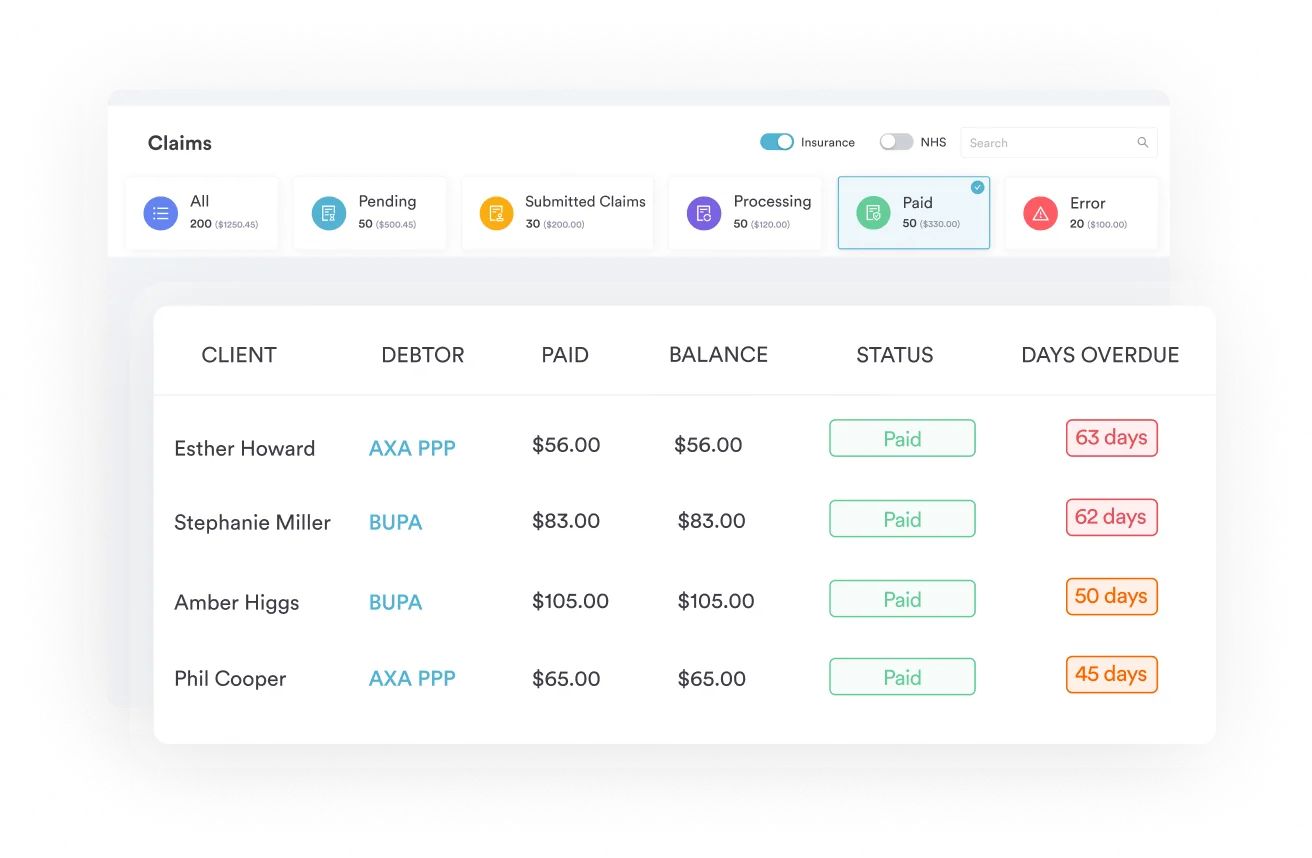

Pabau keeps trial notes, evaluations and consent forms on one patient record. Your practice can answer hospital and payer documentation requests for C1822 implants without digging through separate systems.

C1822 is a narrow code, covering one generator type, one partner procedure and one setting. Most C1822 errors come from treating it as a broader device code, or from expecting it to pay on its own line.
The coding fixes are quick on a resubmitted claim. Coverage takes longer, because the trial results, psychological evaluation and prior authorization all have to exist before the implant date. Start building that file on the day the trial is booked. Book a demo to see how Pabau keeps trial records, consent forms and follow-up visits on one patient record.

Billing a nonrechargeable generator instead? HCPCS code C1767 covers the generator code for primary-cell neurostimulators and how it pairs with CPT 63685.
Placing paddle leads for the permanent implant? CPT code 63655 explains the paddle lead placement code that often shares a claim with C1822.
Need a framework for managing outpatient billing compliance? Medical billing compliance covers the key requirements hospitals and outpatient facilities must meet to keep claims clean and auditable.
Want to understand how denial patterns affect revenue? Denial management in healthcare explains how to build a systematic denial prevention and recovery workflow.
Looking for guidance on what makes a claim pay on first submission? Clean claim submission breaks down the elements payers check before processing any hospital outpatient claim.
HCPCS code C1822 covers the implanted pulse generator of a high-frequency spinal cord stimulator with a rechargeable battery and charging system. Leads use C1778, trial lead kits use C1897, and other generator types use C1820 or C1767.
C1822 is a hospital outpatient code, reported under OPPS on the UB-04. Inpatient spinal cord stimulator implants are paid through the MS-DRG, and C-codes do not go on inpatient claims.
No. C1822 had pass-through payment from January 1, 2016, to December 31, 2017. It is now packaged, so its cost is paid within the APC for CPT 63685. Confirm the current APC and rate in CMS Addendum B.
Not for the generator procedure. In hospital outpatient departments, Medicare requires prior authorization only for CPT 63650, and it has temporarily removed 63685 and 63688. When 63650 is billed again at the same hospital and by the same physician, put the trial’s UTN on the permanent implant claim.
All three report spinal cord stimulator generators. C1822 is for high-frequency rechargeable generators, C1820 for rechargeable generators that are not high frequency, and C1767 for nonrechargeable ones. Check the model number against the manufacturer’s coding guide.
The usual causes are missing trial or NCD 160.7 documentation (CO-50) and a missing prior authorization UTN for CPT 63650. A wrong generator code or C1822 on an inpatient claim accounts for most of the rest. A zero-paid C1822 line is packaged, not denied.



