HCPCS code G0257: Unscheduled or emergency dialysis billing guide
HCPCS code G0257: Official descriptor and code overview HCPCS code G0257 is defi...

Last Updated: Oct 27, 2026
HCPCS code B5100 is the Level II code for the hepatic amino acid premix used in home parenteral nutrition. Its official descriptor reads: "Parenteral nutrition solution compounded amino acid and carbohydrates with electrolytes, trace elements, and vitamins, including preparation, any strength, hepatic, hepatamine-premix."
B5100 bills one unit per gram of amino acid. Formula mismatch is a common cause of denial. B5000 is the renal premix, B5200 is the stress premix, and standard premixes bill under B4189 to B4199.
Let Pabau's smart automation suggest the right codes, reduce claim denials, and keep your practice compliant—effortlessly.
Automate repetitive tasks and focus on what matters most—your patients.
Reduce coding errors and ensure compliance with the latest regulations.
Clean claims, fewer denials, and faster reimbursements.
Powerful insights and reporting to help your practice thrive.
HIPAA compliant SOC 2 certified GDPR-compliant Trusted by 4,000+ clinics worldwide

HCPCS code B5100 is the hepatic amino acid premix (HepatAmine) for home parenteral nutrition, not a standard or general-purpose formula.
B5000 is the renal premix and B5200 the stress premix, while standard premixes bill under B4189 to B4199 by grams of protein per day.
One unit of B5100 equals one gram of amino acid, so the gram count on the compounding record drives the units on every claim line.
CMS retired the CMS-10126 DME Information Form for dates of service from January 1, 2023, and claims sent with it attached are rejected.
Every B5100 line needs a KX, GA, GY, or GZ modifier under policy article A58836, or the DME MAC rejects it as missing information.
HCPCS code B5100 describes a premixed parenteral nutrition solution built on a hepatic amino acid pattern, the HepatAmine formula named in its descriptor. It is used for home parenteral nutrition patients whose liver disease calls for a modified amino acid profile. Each unit is one gram of amino acid.
The code sits in the B-series of HCPCS Level II, which covers enteral and parenteral therapy. Medicare pays it under the Prosthetic Device benefit, and claims go to the DME MAC rather than the Part B MAC.
The table below summarizes the key reference fields for B5100. Each one comes from the CMS October 2026 HCPCS file or from policy article A58836.
B5100 applies when the treating practitioner orders a premixed hepatic formula for a patient on home parenteral nutrition. The liver disease explains the formula choice. It does not, on its own, make the patient eligible for parenteral nutrition.
Eligibility comes from the gut. LCD L38953 requires a permanent condition that impairs absorption in the small intestine, or a motility disorder that blocks transport through the GI tract. A patient with cirrhosis and a working gut does not qualify, whatever the formula.
These scenarios use different codes:
When the formula changes, the code changes with it. If a hepatic patient moves to a standard premix, bill B4189 to B4199 from the date of the new order. Billing B5100 for a formula the pharmacy no longer compounds creates an overpayment that an audit will find.
B5100 belongs to a trio of disease-specific premixes: B5000 renal, B5100 hepatic, and B5200 stress. All three bill per gram of amino acid, which sets them apart from the standard premixes billed per day.
Under the premix rule in policy article A58836, the carbohydrates, amino acids, and additives in the bag are not billed separately. Lipids are the one exception.
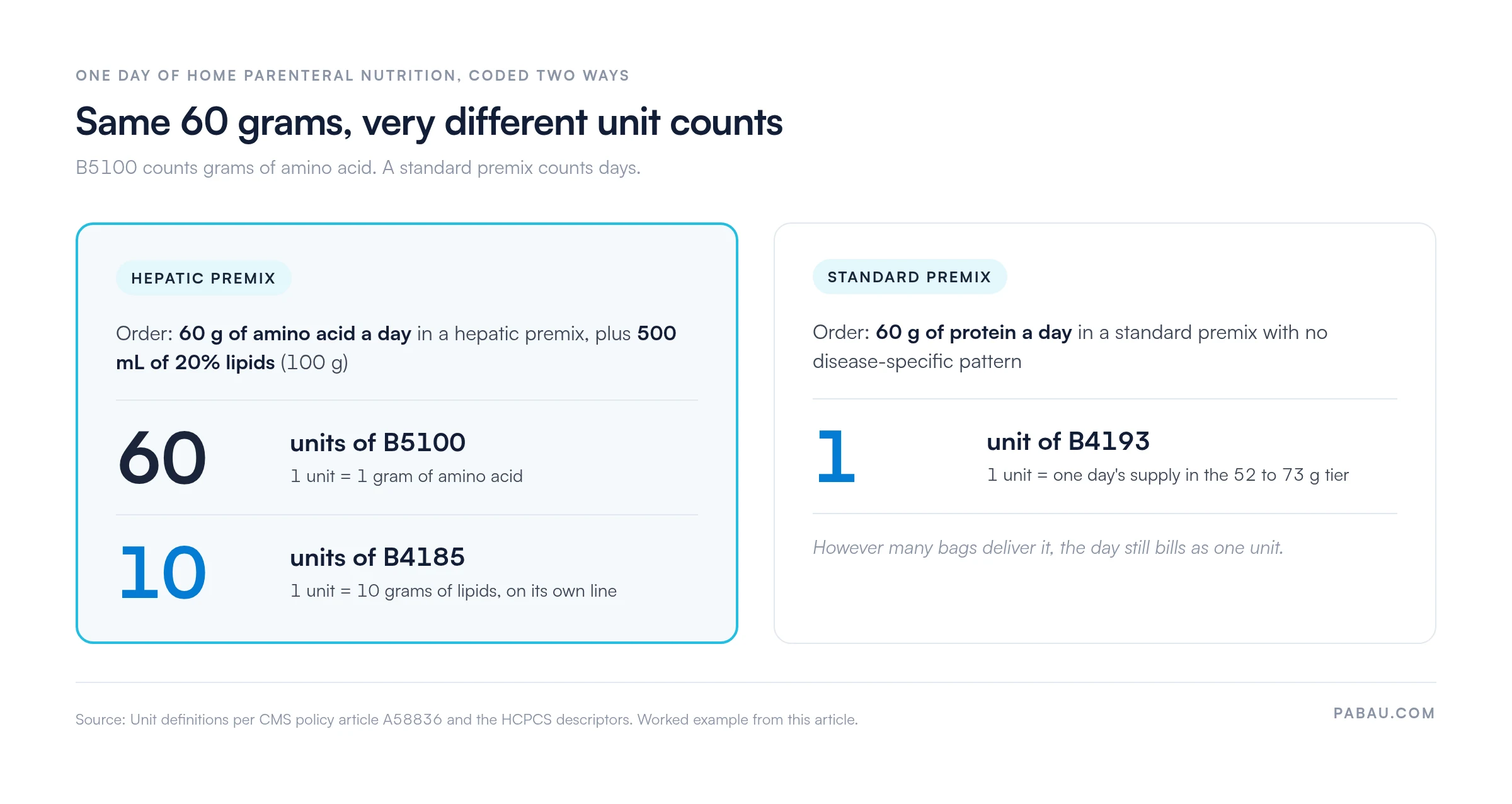
Say the treating practitioner orders a hepatic premix that delivers 60 grams of amino acid a day. Each day of therapy bills as 60 units of B5100.
Add 500 mL of 20% lipids and the patient receives 100 grams of lipids, or 10 units of B4185. Never fold the lipid grams into the B5100 count.
Compare that with a standard premix. Sixty grams of protein a day bills as one unit of B4193, however many bags deliver it. Side by side, the two unit counts land far apart.
The paperwork for B5100 changed in 2023. CMS stopped requiring the CMS-10126 DME Information Form, often called the parenteral nutrition CMN, for dates of service on or after January 1, 2023. Claims sent with a CMN or DIF attached are now rejected and returned.
The medical record does that job now. Keep these on file and ready for a records request:
Keep the full set together on the patient record. A DME MAC records request can then be answered from one place, not pieced together from the pharmacy and the prescriber.
Medicare covers home parenteral nutrition under the Prosthetic Device benefit, so claims route to the DME MAC for the patient’s state. Two contractors run the four jurisdictions: CGS Administrators covers B and C, and Noridian Healthcare Solutions covers A and D.
Coverage is set by LCD L38953 (Parenteral Nutrition) and its policy article A58836. The core requirements are:
L38953 lists no covered ICD-10-CM codes, so no diagnosis code guarantees payment on its own. The medical record has to show the GI mechanism.
The billing supplier must be an enrolled, accredited DMEPOS supplier. A practitioner who only writes the order cannot bill B5100. IV therapy practices running home infusion programs should confirm their accreditation before the first claim.
Nursing visits to give parenteral nutrition at home are not a DME MAC benefit. For coding questions about a specific product, contact the Pricing, Data Analysis and Coding (PDAC) contractor.
Also check the CMS Required Face-to-Face Encounter and Written Order Prior to Delivery List before the first claim date, because CMS updates it periodically.
A B5100 claim usually carries two kinds of diagnosis. One supports the hepatic formula, and the other supports parenteral nutrition itself.
Treat this list as typical, not as a covered list. The chart still has to document the absorption or motility failure and the test of permanence.
Billing B5100 correctly means matching units, modifiers, and claim fields to policy article A58836. Errors in these fields usually lead to a rejection that needs a corrected claim.
Check the CMS DMEPOS fee schedule for the current per-gram allowable in your state. CMS updates it every January and again each quarter, so never reuse a prior-year figure.
Lipids (B4185, B4187) go on the same claim as separate lines when the patient receives both. Our HCPCS code library lists the other B-series codes with their descriptors.
Before each claim, check three things against each other: The compounding record’s gram count, the claim’s units, and the order’s formula. If the pharmacy has switched the patient to a standard or renal formula, the code must change from that date forward.
These are the common causes of B5100 denials, each with its fix. Fixing them before submission is faster than working a denial queue afterward.
A pre-submission check that compares the compounding record, the order, and the claim line catches these mismatches before the DME MAC does.
B5100 claims fail on details that live in different places. The formula sits in the pharmacy record, the gram count drives the units, and the practitioner’s notes carry eligibility. Many billing teams still track all three across spreadsheets and email.
Pabau keeps the order, clinical notes, and forms on one patient record. Its claims management software tracks each claim and its status, so a rejected line is easy to trace back to its documentation.
The result is a billing team that checks units and modifiers against the chart before a claim goes out. Fewer claims come back, and records requests take less time to answer.

Pabau keeps clinical notes, digital forms, and claim tracking on one patient record. Your team can check each B5100 claim against its documentation before it goes out.

Treat the compounding record as the source of truth for every B5100 claim. The formula on it decides the code, and the gram count on it decides the units.
The trade-off is extra checking at the start of each episode. Document the GI impairment alongside the liver disease, and recode from the day the formula changes. That upfront work costs less than a corrected claim or an overpayment found at audit.
Book a demo to see how Pabau keeps clinical records and claim tracking together for your billing team.

Want fewer claims coming back from payers? Pabau’s claims management software tracks each claim, its status, and the denials your team needs to work.
Billing a renal patient instead? HCPCS code B5000 covers the renal amino acid premix and how its per-gram units are counted.
Need the supply kit code too? HCPCS code B4220 explains the parenteral nutrition supply kit that often ships alongside the premix.
New to DME MAC claims? Medicare billing for practices walks through the claiming channels and compliance rules behind every Medicare claim.
Working a denial right now? Denial codes in medical billing lists the top 20 CARC codes and the fix for each one.
HCPCS code B5100 covers the hepatic amino acid premix, the HepatAmine formula, for home parenteral nutrition. It suits patients whose liver disease calls for a modified amino acid pattern. Renal premixes bill under B5000, stress premixes under B5200, and standard premixes under B4189 to B4199.
All three are disease-specific amino acid premixes billed per gram of amino acid. B5000 is the renal formula, B5100 the hepatic formula, and B5200 the stress formula with branched-chain amino acids. The formula on the compounding record decides the code.
Bill one unit per gram of amino acid, per policy article A58836. A daily order of 60 grams of amino acid bills as 60 units for that day. Lipids go on a separate line under B4185 or B4187.
No. CMS stopped requiring the CMS-10126 DME Information Form for dates of service on or after January 1, 2023. Claims sent with one attached are rejected. Keep the Standard Written Order and supporting records on file instead.
No. Liver disease explains the hepatic formula, but parenteral nutrition coverage depends on the gut. LCD L38953 requires a permanent impairment of absorption or GI motility, documented by the treating practitioner.
Common reasons include a formula mismatch, units billed per day instead of per gram, and a missing KX, GA, GY, or GZ modifier. Charts that show liver disease but no GI absorption or motility impairment also fail coverage.
Medicare pays B5100 per gram of amino acid on the CMS DMEPOS fee schedule. Rates vary by state and change each January and quarter. Check the current CMS file before you bill.