HCPCS code P9058: Red blood cells, leukocytes reduced, CMV-negative, irradiated
HCPCS code P9058: Official descriptor and key attributes HCPCS code P9058 report...

Last Updated: Oct 26, 2026
A4737 is the HCPCS Level II code for injectable anesthetic, for dialysis, per 10 ml. It covers the local anesthetic, usually lidocaine, injected at the vascular access site before needle insertion.
Medicare bundles A4737 into the ESRD PPS per-treatment payment, so the dialysis facility reports it but receives no separate payment. Topical anesthetic cream or gel is coded A4736 instead, per gram.
Let Pabau's smart automation suggest the right codes, reduce claim denials, and keep your practice compliant—effortlessly.
Automate repetitive tasks and focus on what matters most—your patients.
Reduce coding errors and ensure compliance with the latest regulations.
Clean claims, fewer denials, and faster reimbursements.
Powerful insights and reporting to help your practice thrive.
HIPAA compliant SOC 2 certified GDPR-compliant Trusted by 4,000+ clinics worldwide

HCPCS code A4737 reports injectable anesthetic for dialysis, counted per 10 ml of solution.
A4737 covers needle-delivered anesthetic and A4736 covers topical anesthetic per gram, so the route of administration decides the code.
Medicare always bundles A4737 into the ESRD PPS per-treatment payment, and CMS lists it on the consolidated billing list as not separately payable.
A separate charge for the bundled supply, a missing ESRD diagnosis (N18.6, Z99.2) and the wrong anesthetic code are the usual causes of A4737 denials.
Pabau’s claims management software tracks each claim through to remittance, so repeat A4737 denials surface after the first one.
HCPCS code A4737 is an A-series Level II supply code maintained by the Centers for Medicare and Medicaid Services (CMS). The official descriptor reads: Injectable anesthetic, for dialysis, per 10 ml. It identifies the local anesthetic injected at the vascular access site before needle insertion during hemodialysis.
For Medicare, A4737 is bundled into the end-stage renal disease (ESRD) prospective payment system (PPS). The dialysis facility reports it, but Medicare never pays it as a separate line.
According to the CMS HCPCS overview, A-series codes are updated annually. Check A4737 against the current HCPCS release file before submitting claims, because descriptor language and coverage notes can change between releases.
Injectable anesthetics in a dialysis setting are given subcutaneously at the cannulation site. The injection comes just before needle insertion into an arteriovenous fistula, graft, or central venous catheter. They reduce pain at the access point. That matters because ESRD patients attend three sessions a week on average, and repeated needle anxiety is a documented barrier to treatment adherence.
The most commonly used agents are lidocaine and buffered lidocaine (lidocaine buffered with sodium bicarbonate). Both are given in small volumes, typically 1-3 ml per cannulation site. Because A4737 is counted per 10 ml, a single session often uses less than one full unit.
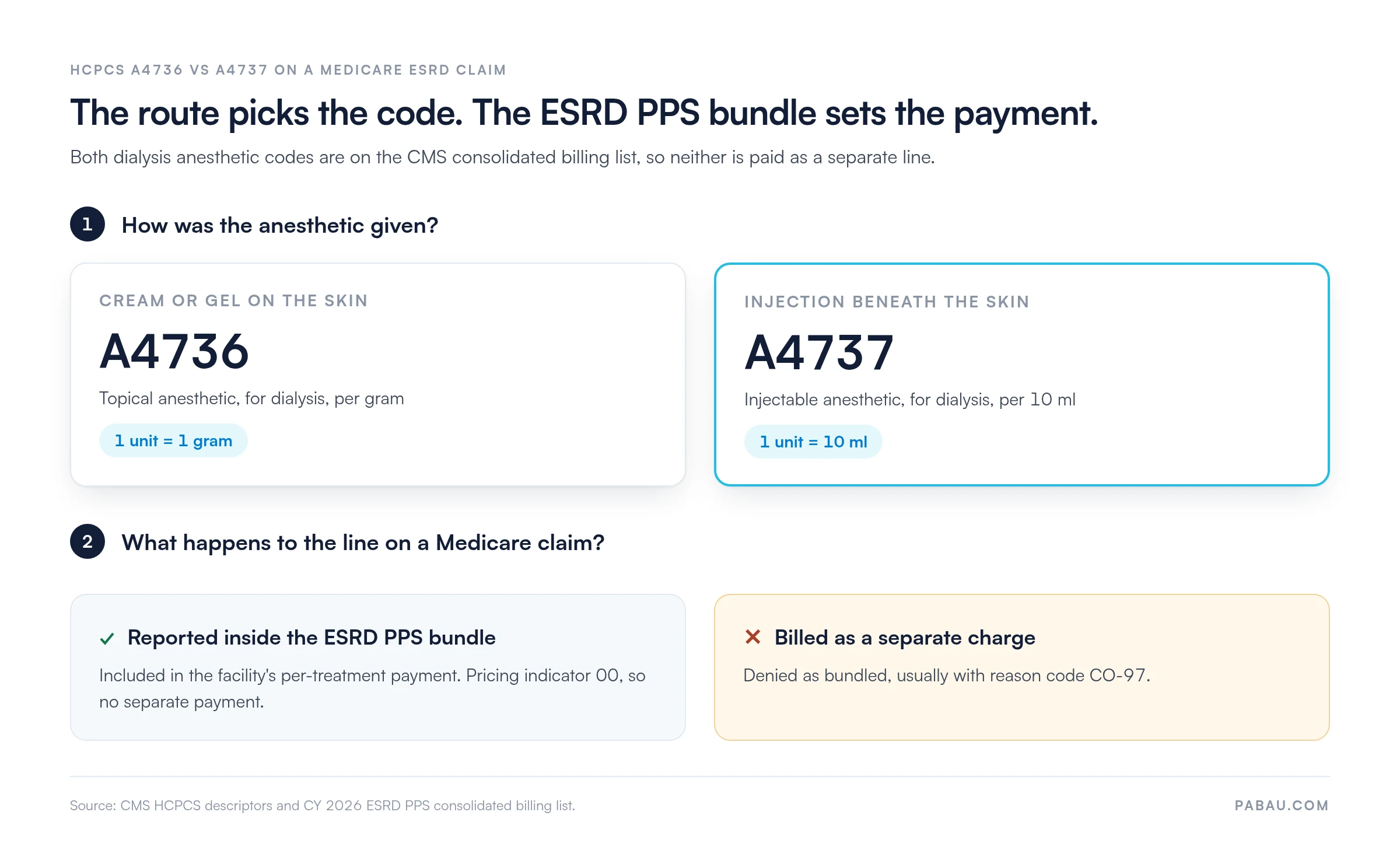
A4736 covers topical anesthetic cream or gel applied to the access site, reported per gram. A4737 covers injectable anesthetic solution, reported per 10 ml. Route of administration is the deciding factor. Cream or gel on the skin surface uses A4736, and needle-delivered solution beneath the skin uses A4737.
Some facilities pre-numb the site with topical cream and then inject lidocaine before cannulation. Document each product, its route and its amount as separate entries in the treatment record. Both codes are ESRD PPS bundled supplies, so Medicare pays for neither one separately. The path below shows how the route picks the code while the payment outcome stays the same.
Billing compliance requirements for A4737 come down to documentation of four elements: medical necessity, the drug given, the volume in ml, and the dialysis encounter. Medicare folds the payment into the bundle, but an auditor still expects all four in the record.
A clean claim submission for A4737 requires the following supporting documentation:
The two primary ICD-10 codes that establish medical necessity for A4737 are N18.6 (end-stage renal disease) and Z99.2 (dependence on renal dialysis). Billers should verify these against the applicable MAC Local Coverage Determination (LCD) for dialysis supply codes, as covered diagnoses can vary by contractor jurisdiction.
N18.6 and Z99.2 are typically submitted together as primary and secondary diagnosis codes. Submitting Z99.2 without N18.6 (or another primary kidney disease code) may trigger a medical necessity denial. Dependence on dialysis does not by itself establish the underlying renal condition.
Medicare pays dialysis facilities for ESRD treatment through the ESRD PPS, in place since 2011. It consolidates most dialysis-related drugs, supplies and services into a single bundled payment per treatment.
A4737 is bundled into that per-treatment payment, and the dialysis facility cannot bill it separately. CMS lists it, with A4736, on the ESRD PPS consolidated billing list. The code also carries pricing indicator 00, so it has no separate Medicare price. The Physician Fee Schedule does not price A4737, which makes it the wrong place to check its status.
A4737 carries no separate Medicare payment. A claim that lists it outside the ESRD PPS bundle is denied as bundled, usually with reason code CO-97. Tracking those denials as part of revenue cycle management shows whether staff still submit the code as a standalone charge.
The HCPCS descriptor defines one unit of A4737 as 10 ml of injectable anesthetic, so divide the total volume given by 10. How a fractional unit is reported follows the payer’s or MAC’s instruction. On Medicare ESRD facility claims the units are informational, because the bundle pays for the anesthetic either way.
The treatment record should show the vial size, the concentration (for example, a 10 ml vial of 1% lidocaine) and the volume given per session. Reporting the full vial when only part of it was used overstates the supply. Document what was given, not what the vial held.
The superbill documentation for each session should capture the ml figure in its own field. Billing staff can then work out units without re-reading clinical notes.
Add a volume-to-unit reference card to your dialysis billing workflow. List common volumes (2 ml, 5 ml, 10 ml, 15 ml, 20 ml) with their A4737 unit values. Note each payer’s rule for partial units beside them, so staff report the same volume the same way every time.
A4737 denials usually trace back to four causes. They are the wrong anesthetic code, a separate charge for a bundled supply, a missing diagnosis code, or a unit error. The denial management strategies that work for HCPCS supply codes apply here. Sort denials by reason code, find the highest-volume cause, and fix the documentation step that feeds it.
Facilities tracking denials across several supply codes can map each one to its denial reason codes and the payer’s Claim Adjustment Reason Code (CARC). That shows which category to fix first. A bundling denial (CO-97) needs a different fix from a medical necessity denial (CO-50).
Payment for A4737 depends on the payer. Medicare’s answer is fixed, while Medicaid programs and commercial plans set their own rules.
A4737 sits within a cluster of dialysis-related A-series supply codes, and dialysis coders meet several of them on the same claims. The AAPC HCPCS code lookup and the NLM HCPCS Level II search API help confirm descriptors and spot newly added codes in the range.
Coders should review the full A4600-A4800 range for any dialysis encounter with multiple supply items. Each supply code carries its own unit definition and ESRD PPS bundling status. Submitting one supply code correctly while misbilling another on the same claim is a common audit finding in dialysis facility reviews.
When auditing dialysis supply claims, pull every A-series code from the same date of service together. If A4736 and A4737 both appear, the treatment record should show the cream and the injection as separate entries. Neither line adds Medicare payment, so the audit is checking the record, not the revenue.
When supply lines are tracked in a spreadsheet beside the claims system, a bundled code like A4737 can slip through as a standalone charge. It comes back weeks later as a CO-97 denial, and someone has to work out why.
Pabau, the practice management platform we build, includes claims management software that submits claims and tracks each one through to remittance. Billing teams see every denial against the patient record, so a repeat A4737 error shows up after the first remittance rather than the tenth.
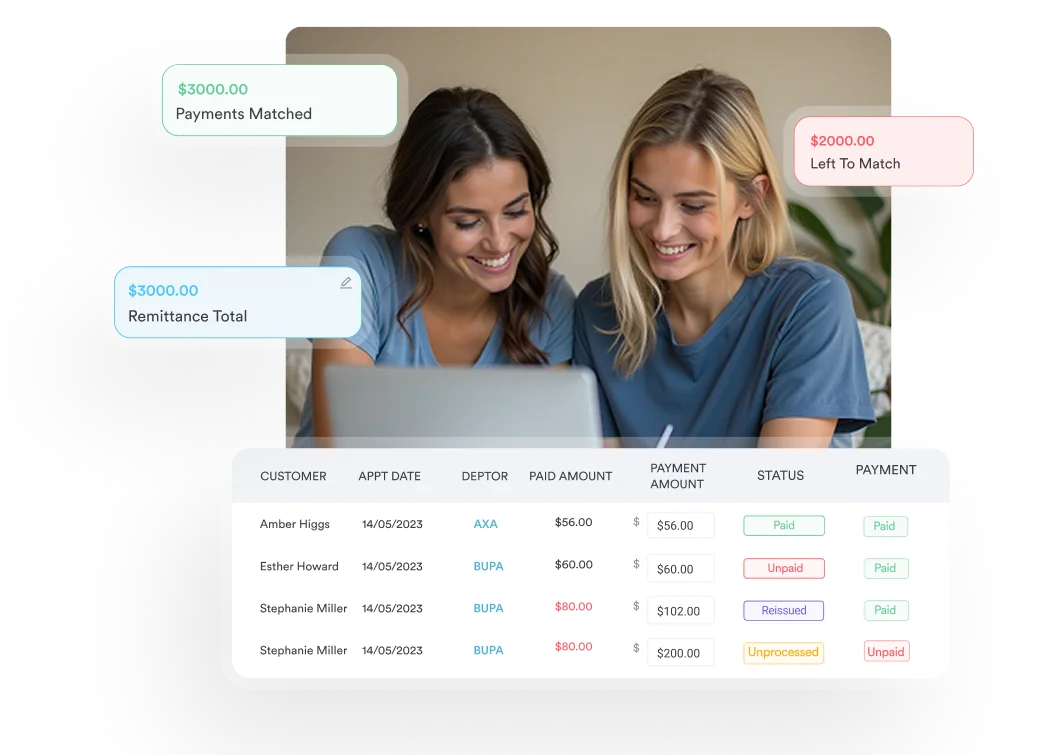
Every Pabau subscription includes every feature, so claims tracking and denial reporting come as standard. Your team gets the supply code workflow without an upgrade or an add-on.

Pabau’s claims management software tracks HCPCS supply lines from submission to remittance, so billing teams spot CO-97 bundling denials early. See how it works in a live demo.

A4737 is easy to pick and easy to mishandle. The route of administration settles the code, and the ESRD PPS settles the payment, because Medicare never pays A4737 as a separate line.
So put the effort into the treatment record, not the charge. Capture the route, the product and the ml given at every session, and keep A4737 off claims as a standalone charge. Your team stops chasing CO-97 denials, and the record is ready when an auditor asks.
If you’d like to see how Pabau tracks supply lines and bundling denials on dialysis claims, book a demo with our team.

Coding the topical version instead? HCPCS code A4736 covers topical anesthetic for dialysis, reported per gram.
Need a framework for reducing claim rejections across billing codes? Denial management in healthcare covers how to categorize, prioritize, and resolve HCPCS and CPT denials systematically.
Want to understand how supply code billing fits into the wider revenue picture? What is revenue cycle management explains the end-to-end process from claim submission through payment posting.
Looking for guidance on building cleaner claims from the start? Clean claim submission outlines the documentation and coding standards that prevent rejections before they happen.
Billing other access-site supplies? HCPCS code A4740 covers shunt accessories for hemodialysis.
HCPCS code A4737 covers injectable anesthetic administered at the dialysis vascular access site, billed per 10 ml of solution used. It applies specifically to subcutaneous injections (typically lidocaine) given before needle insertion into an arteriovenous fistula, graft, or catheter during a hemodialysis session. Topical anesthetic cream is billed under A4736, not A4737.
A4736 covers topical anesthetic (cream or gel) applied to the skin surface before dialysis cannulation, billed per gram. A4737 covers injectable anesthetic delivered by subcutaneous injection at the access site, billed per 10 ml. Route of administration is the deciding factor: surface application uses A4736, needle injection uses A4737.
N18.6 (end-stage renal disease) is the standard primary ICD-10 code paired with A4737. Z99.2 (dependence on renal dialysis) is typically added as a secondary code to confirm active dialysis status. Submit both together on most ESRD dialysis claims. Verify covered diagnoses against your MAC’s LCD for dialysis supply codes, as covered code lists can vary by contractor jurisdiction.
Most A4737 denials come from four causes. The first is a separate charge for a supply the ESRD PPS always bundles, which Medicare denies as CO-97. The second is a missing ICD-10 code, usually N18.6 or Z99.2. The others are a unit error from reporting vial size instead of volume given, and the wrong anesthetic code. Check the Claim Adjustment Reason Code (CARC) on the remittance before resubmitting.