

HCPCS Code G0163: Skilled nursing observation and assessment
What is HCPCS Code G0163? HCPCS Code G0163 is a deleted Level II code for skille...

Last Updated: Oct 15, 2026
A4648 is the HCPCS Level II code for a tissue marker, implantable, any type, each. It covers biopsy site clips, fiducial seeds and similar markers that let later imaging or surgery find the same spot. Each marker is one unit.
Physicians and non-facility practices report A4648, usually in a physician office (POS 11). Hospital outpatient departments bill C1879 for the same device, and Medicare packages the marker into ASC payments.
Let Pabau's smart automation suggest the right codes, reduce claim denials, and keep your practice compliant—effortlessly.
Automate repetitive tasks and focus on what matters most—your patients.
Reduce coding errors and ensure compliance with the latest regulations.
Clean claims, fewer denials, and faster reimbursements.
Powerful insights and reporting to help your practice thrive.
HIPAA compliant SOC 2 certified GDPR-compliant Trusted by 4,000+ clinics worldwide

HCPCS Code A4648 covers implantable tissue markers of any type, billed per marker. Only physicians and non-facility practices bill it, typically in a physician office (POS 11).
Hospital outpatient departments bill C1879 for the same device, and Medicare packages the marker into ASC payments. Billing A4648 in a facility setting is a common cause of denial.
Documentation must include the procedure note naming the marker placed, the ICD-10 diagnosis supporting medical necessity, and the quantity of units.
A4648 is carrier-priced, so your Medicare Administrative Contractor (MAC) sets the allowance rather than a national fee schedule.
Pabau, our practice management platform, supports billing by keeping the procedure note, the patient record and the invoice in one place.
HCPCS Code A4648 is the supply code for an implantable tissue marker. The official CMS descriptor reads: Tissue marker, implantable, any type, each. Physicians and non-facility practices bill it once for every marker placed. The phrase “any type” is deliberate, so the code covers the full range of devices placed to mark tissue for later imaging or surgical localization.
Devices that qualify under A4648 include biopsy site clips, fiducial markers and other implantable markers used in image-guided procedures.
A biopsy site clip is a small metal clip left after a core-needle biopsy, so follow-up mammography can find the sampled site. Fiducial markers are gold seeds or coils that guide radiation therapy targeting. Each one leaves a durable landmark that shows up on later imaging.
Some coders read “any type” as covering any implant that shows up on imaging. The code is narrower than that. It applies to devices placed to mark tissue for localization, not to every radiographically visible implant. Like other A-codes in the HCPCS supply series, it describes the device rather than the procedure that placed it.
Devices and scenarios that qualify:
Devices and scenarios that do not qualify:
A4648 applies whenever a clinician places an implantable marker during an image-guided or surgical procedure in a physician office or other non-facility setting. The most common clinical triggers are:
The clinical rationale in every case is the same. The marker is placed so future imaging or surgery can locate the treated site precisely. That purpose, documented in the procedure note, is what ties the supply code to medical necessity.
A4648 is a supply code, so it always travels with a CPT code for the procedure that placed the marker. CMS lists four physician codes billed with A4648: 19499, 32553, 49411 and 55876.
Breast biopsy codes 19081–19086 are not on that list. They already include imaging guidance and clip placement, so guidance codes such as 76942 and 77021 are not reported with them either.
Diagnosis codes that support medical necessity include C50.x (malignant neoplasm of breast) and D05.x (carcinoma in situ of breast). R92.x (abnormal findings on breast imaging) and N63.x (unspecified lump in breast) also qualify. A screening encounter code does not establish the need for a marker. The operative note must link the diagnosis to the clinical reason for placing the marker.
The most consequential distinction is between A4648 and C1879. Both describe implantable tissue markers, and the setting of service decides which one goes on a claim. The chart below follows the marker from where it was placed to the claim that carries it.
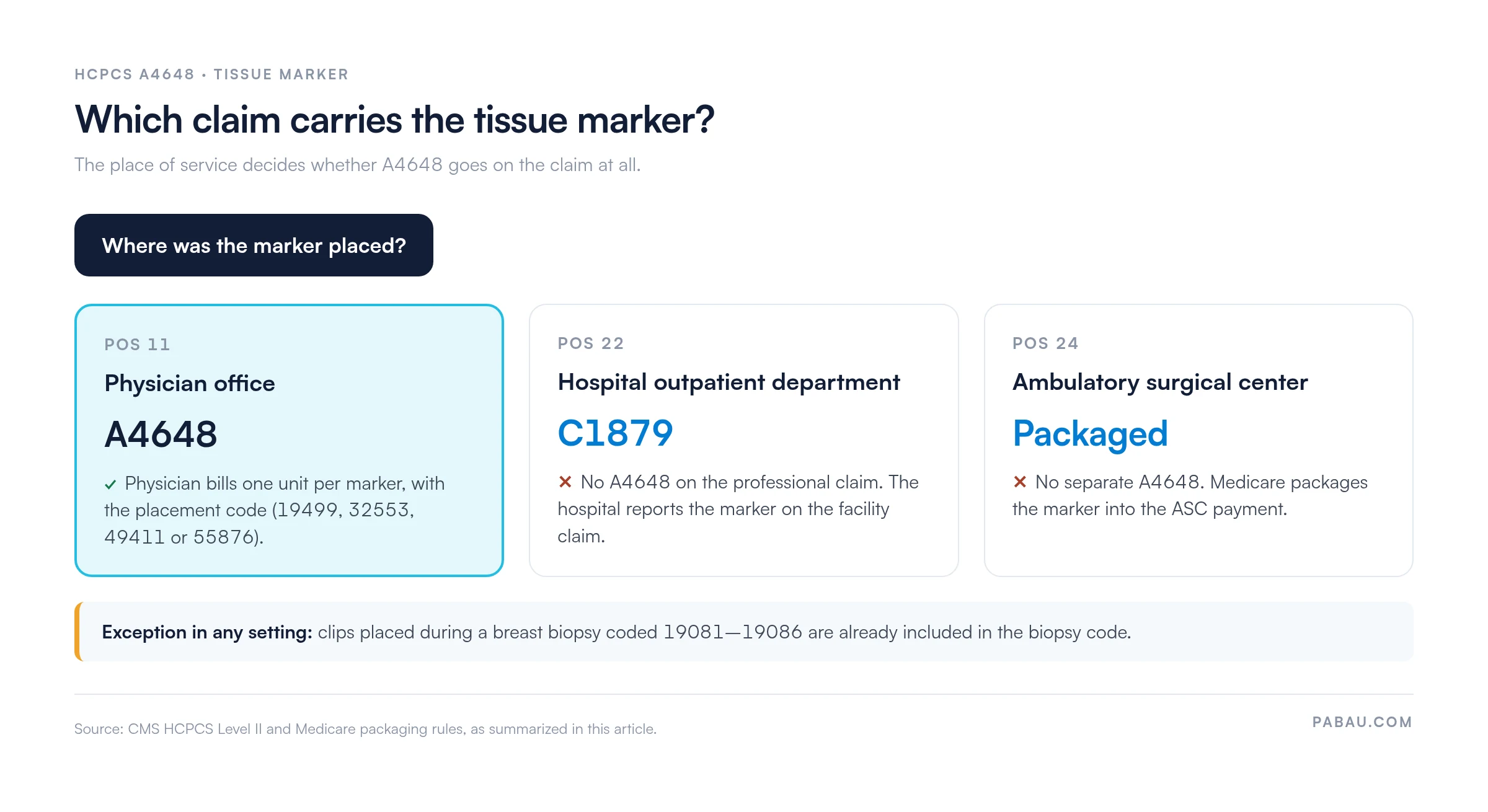
The table sets A4648 beside the two codes it is most often confused with.
A common compliance error starts with a radiology group that places markers in a hospital outpatient department under a professional services agreement. The hospital already reports the marker under C1879, so A4648 on the professional claim bills the same device twice.
Reaching for A4649 is the other slip. It is a miscellaneous code, and a tissue marker already has a specific one.
Before billing A4648, confirm the place-of-service code on the claim. POS 11 (physician office) supports A4648. POS 22 (outpatient hospital) and POS 24 (ambulatory surgical center) do not, because the facility payment already covers the marker. A4648 billed with either code will almost certainly deny.
Medicare Part B covers HCPCS Code A4648 when the marker is medically necessary and the documentation supports it. There is no National Coverage Determination (NCD) for tissue markers. Coverage is left to each MAC’s discretion (carrier judgment, coverage code C), so policy can differ between jurisdictions.
A4648 carries pricing indicator 57, which means it is carrier-priced. Your MAC sets the allowance, and the code has no national amount on the Medicare Physician Fee Schedule. Ask your MAC for the carrier-priced allowance before building charge amounts. CMS reviews HCPCS Level II codes every year, so confirm the code is still active each year.
Medicare does not generally require prior authorization for A4648. Because coverage rests on contractor judgment, a claim that paid can still be recouped on post-payment review if the note doesn’t support medical necessity. Check your MAC’s published guidance before billing a high volume of A4648 claims.
Weak documentation is the underlying cause of most A4648 denials that survive the setting-of-service check. A complete, billable record for HCPCS Code A4648 includes all of the following:
A documentation checklist built into the procedure workflow catches these problems before the chart reaches a coder. That is where medical billing compliance starts, at the point of care rather than the billing desk.
Structured procedure templates prompt the clinician for marker type, anatomical site and unit count. Those three fields prevent most avoidable A4648 rejections, and they sit at the core of submitting a clean claim.
Most A4648 denials trace to one of a small number of recurring errors. Good denial management strategies for supply codes start with knowing which error type generated the denial.
When an A4648 claim denies with a CO-4 (inconsistent with modifier) or CO-97 (procedure included in another procedure) remark code, start with the NCCI edit. Pull the edit for the companion CPT code billed on the same date. The denial is almost always a bundling edit, not a coverage issue.
Medicare policy sets the baseline for A4648, but commercial payers and Medicaid programs diverge in ways that change reimbursement. Knowing these revenue cycle management differences stops you from billing A4648 to plans that will deny it outright.
UnitedHealthcare, Aetna, Cigna, and Blue Cross Blue Shield plans each maintain their own medical policies for tissue marker supplies. Several large commercial payers include the marker in the global fee for image-guided biopsy CPT codes, mirroring Medicare’s packaging logic. Pull the payer’s medical policy from its portal before billing A4648 to any commercial plan for the first time.
Where prior authorization is required, it is almost always tied to the procedure CPT code rather than the supply code. The marker supply follows the authorization for the procedure. If the authorization is missing or excludes the supply, A4648 will deny even if the procedure itself pays.
Medicaid coverage for A4648 varies by state program and cannot be generalized. Some state Medicaid programs follow Medicare guidance, while others limit coverage to specific diagnoses or exclude tissue markers as a separately billable supply. Check the state Medicaid fee schedule and policy bulletin for the jurisdiction before billing.
Tools like the PGM Billing HCPCS lookup confirm whether the code is active in the relevant program.
Practices billing A4648 juggle three moving parts on every claim. The supply code has to match the procedure code, and the note has to name the marker. The place of service also has to fit the setting. When charges are keyed by hand, one of those slips.
Pabau keeps the patient record, the treatment note and the invoice in one system. You add the insurer to the patient record, and each invoice routes to the right payer. In the US, Pabau connects to Claim.MD, so your team can submit, track and record payments from one claims management dashboard.
Before a claim goes out, Pabau checks that details such as membership numbers and authorization codes are in place. The Send button stays disabled until they are. Your team still enters the A4648 unit count and place of service on the invoice, so check both before you send.

Pabau keeps patient records, treatment notes and invoices in one system, and checks claim details before your team sends them.

Treat A4648 as a setting question first. If the marker went in at a physician office, bill it per unit alongside the placement code. If it went in at a hospital outpatient department or an ASC, leave it off the professional claim.
The trade-off is a little effort up front. A structured procedure note takes the clinician a minute per case, and it saves the back-and-forth when a payer asks for proof. Practices that place fiducials or clips every week should build that note into the workflow now.
Book a demo to see how Pabau keeps your patient records, invoices and claims in one system.

Want to reduce claim denials across your billing team? Denial management strategies for healthcare practices covers the systematic approaches that reduce rework.
Need a cleaner submission process from charge capture to payer? What makes a clean claim explains the documentation and coding standards that prevent rejections at the first touch.
Looking to strengthen your overall billing compliance posture? Medical billing compliance essentials outlines the regulatory framework and audit risk areas that radiology and oncology practices face.
HCPCS Code A4648 covers implantable tissue markers of any type, billed per marker placed. Physicians and non-facility practices bill it, typically in a physician office (POS 11). Qualifying devices include metallic biopsy site clips and fiducial markers for radiation therapy targeting. Surgical tissue clips that mark a lesion for later imaging also count.
Medicare Part B covers A4648 when medical necessity is documented. There is no National Coverage Determination for tissue markers, so coverage is left to MAC discretion (carrier judgment, coverage code C). Prior authorization is not generally required, but a note that doesn’t support necessity can lead to recoupment on post-payment review.
A4648 is billed by physicians and non-facility practices, typically in a physician office (POS 11). C1879 is the C-code hospital outpatient departments use for the same device on the facility claim. Both describe implantable tissue markers, so the place of service decides which one applies. Billing A4648 with a hospital outpatient place-of-service code is a common denial trigger.
A4648 is billed per marker placed, and units should equal the number of markers documented in the operative or procedure note. Most single-biopsy encounters involve one marker, but multiple clips may be placed during vacuum-assisted or multi-site procedures. Payer policies on unit limits vary, so check your MAC’s guidance and the commercial plan policy before billing more than one unit.
The most common denial reasons are a wrong place-of-service code and thin documentation of medical necessity. Pairing A4648 with a code that already includes the marker is another. A4648 billed in a hospital outpatient setting, where C1879 applies, or with breast biopsy codes 19081–19086 will deny. Payer policies that treat the marker as part of the global procedure fee also cause denials.
Medicaid coverage for A4648 varies by state. Some state programs follow Medicare guidance and cover the code when medical necessity is documented. Others exclude tissue markers as a separately billable supply. Check the state Medicaid fee schedule and policy bulletin before billing A4648 to a Medicaid beneficiary.




