HCPCS code J3471: Hyaluronidase ovine injection billing guide
HCPCS code J3471: Descriptor, code type, and quick-reference data HCPCS code J34...

Last Updated: Oct 14, 2026
E0466 is the HCPCS Level II code for home ventilator, any type, used with non-invasive interface, (e.g., mask, chest shell).
Let Pabau's smart automation suggest the right codes, reduce claim denials, and keep your practice compliant—effortlessly.
Automate repetitive tasks and focus on what matters most—your patients.
Reduce coding errors and ensure compliance with the latest regulations.
Clean claims, fewer denials, and faster reimbursements.
Powerful insights and reporting to help your practice thrive.
HIPAA compliant SOC 2 certified GDPR-compliant Trusted by 4,000+ clinics worldwide

HCPCS Code E0466 covers a home ventilator of any type used with a non-invasive interface such as a mask or mouthpiece, billed under Medicare Part B as durable medical equipment.
Medicare reimburses E0466 as a Frequent and Substantial Servicing (FSS) item: a monthly, all-inclusive rental with no 13-month cap and no ownership transfer to the beneficiary, billed with the KX modifier to attest medical necessity.
Coverage requires a face-to-face physician evaluation, a written order, and documented medical necessity, chiefly established under NCD §280.1, with LCD L33800 overlapping for certain qualifying conditions.
Pabau’s claims management software links face-to-face evaluation notes directly to billing workflows, reducing the missing documentation that triggers E0466 claim denials.
HCPCS Code E0466 describes a home ventilator, any type, used with a non-invasive interface such as a mask or mouthpiece. The code sits within the Durable Medical Equipment (DME) category under HCPCS Level II, maintained annually by the Centers for Medicare and Medicaid Services (CMS).
It covers both pressure-cycled and volume-cycled home ventilators, as long as the interface connecting the device to the patient is non-invasive.
The non-invasive qualifier is critical. If the patient is ventilated through an invasive interface, such as a tracheostomy, code E0465 applies instead. E0466 is exclusively for non-invasive delivery, making accurate interface documentation the first line of defense against a wrong-code denial.
CMS updates HCPCS Code E0466 reimbursement rates annually as part of the DMEPOS fee schedule. Rates vary by Durable Medical Equipment MAC jurisdiction: Jurisdiction A (Noridian, covering the northeast), Jurisdiction B (CGS, covering the midwest), Jurisdiction C (CGS, covering the south), and Jurisdiction D (Noridian, covering the west).
Suppliers should confirm current allowed amounts directly against the CMS DMEPOS fee schedule before billing, as rates vary by geographic region and are subject to annual update.
The fee schedule publishes a monthly rental amount. Under FSS, Medicare pays that monthly rate for as long as medical necessity continues, with no lump-sum purchase option and no ownership transfer. The table below shows the general structure of E0466 rate application across jurisdictions.
Rates are approximate and subject to annual CMS revision. Always verify against the official CMS DMEPOS fee schedule before submitting claims for the current fiscal year.
Coverage for home ventilators, including E0466, is chiefly established under NCD §280.1 (Medicare National Coverage Determinations Manual, Chapter 1, Part 4), with related NCD 240.9 addressing noninvasive home mechanical ventilation. LCD L33800, which primarily governs bi-level respiratory assist devices, overlaps only for certain qualifying conditions.
A claim that lacks documentation of every required criterion is a denial waiting to happen. Coverage requires all of the following to be present before billing begins.
Medical necessity under NCD §280.1 is not satisfied by a diagnosis code alone. The underlying clinical documentation must support the ICD-10 code submitted. Billers using patient compliance documentation systems can track whether all required clinical criteria are captured at the point of care, rather than chasing records after a denial.
Suppliers must maintain a file that supports every element of the coverage criteria, most of which originates with the ordering physician’s evaluation. The following documentation.
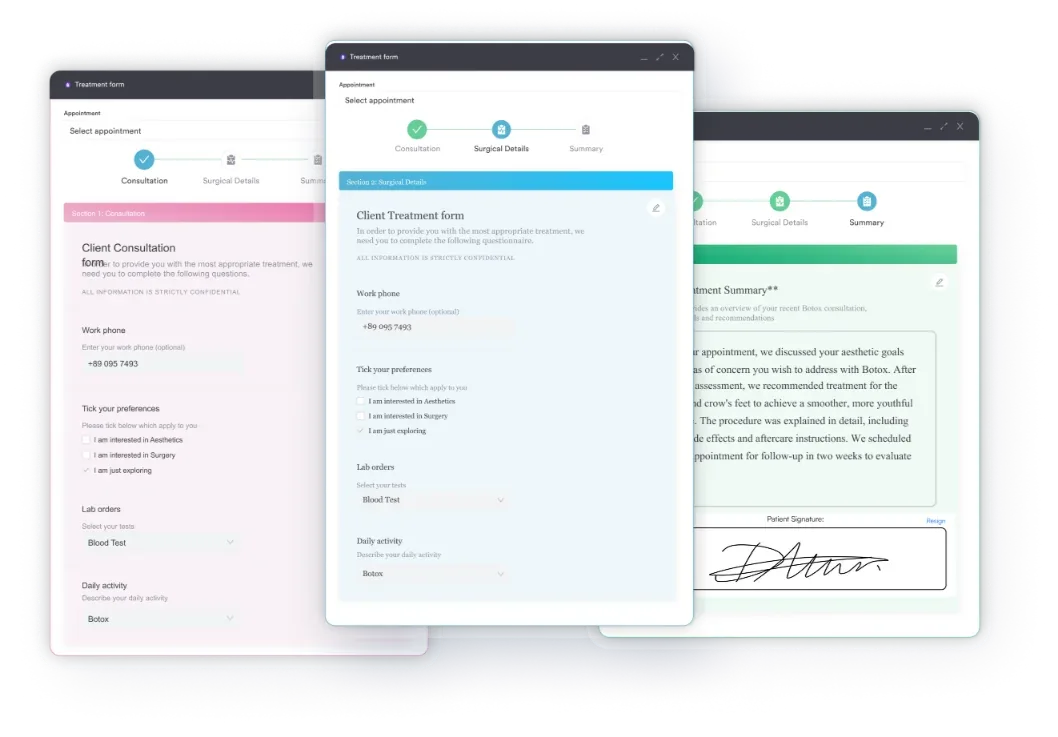
Using digital forms for intake and clinical documentation helps practices capture all required fields at the point of the face-to-face evaluation, reducing the risk of incomplete records at the time of claim submission. Good patient record management ensures the treating provider’s notes are timestamped, retrievable, and audit-ready when DMEMAC requests supporting documentation.
Practices supplying equipment directly rely on inventory management software to know what’s in stock before promising it.
E0466 is billed under Medicare’s Frequent and Substantial Servicing (FSS) payment category, not the capped rental rules that apply to most DME equipment categories. FSS billing has its own mechanics, and submitting a claim under the wrong framework is one of the most consistent denial triggers for this code.
Under FSS, Medicare pays a monthly, all-inclusive rental fee for as long as medical necessity continues. There is no 13-month rental cap, and ownership of the ventilator never transfers to the beneficiary. The supplier retains title to the equipment and keeps billing the monthly rate as long as coverage criteria are met.
Because that monthly fee already covers accessories, suppliers bill A4612 for replacement battery cables only when the patient owns the ventilator.
One restriction applies across the FSS ventilator codes: E0465, E0466, E0467, and E0468 cannot be paid under FSS if the device is actually being used to deliver CPAP or bi-level PAP therapy. When a patient is really on PAP therapy, the claim belongs under the respiratory assist device codes and their capped rental rules, not under a ventilator code.
Because FSS billing continues indefinitely rather than capping at 13 months, suppliers need to keep the KX modifier and its supporting medical-necessity documentation current on every claim, not just at initial setup. Consult your AAPC HCPCS code reference and confirm with your DMEMAC before assuming a home ventilator claim falls under capped rental rules.
Integrating compliance management workflows that flag when a KX attestation needs updating helps practices avoid FSS-specific denials.
Confirm the KX modifier is backed by current medical-necessity documentation before every E0466 claim goes out, not just at initial setup. Because FSS billing continues indefinitely, a documentation file that goes stale mid-rental is a common, avoidable denial trigger. Build a periodic review into your billing workflow to catch this before claims are submitted.
The ICD-10-CM codes submitted with an E0466 claim must document a qualifying diagnosis as defined under NCD §280.1, or under LCD L33800 for certain overlapping conditions. The codes listed below are commonly associated with E0466 claims, but the clinical documentation must support whichever code is submitted.
A listed diagnosis does not guarantee coverage if the underlying records do not substantiate the clinical need. Confirm with your DMEMAC for payer-specific variations before submitting.
Always verify the complete covered diagnosis list against NCD §280.1 via the CGS Medicare coding resource, and check LCD L33800 where a RAD-qualifying condition applies. Related respiratory diagnoses such as J42 may also support medical necessity depending on the clinical picture.
ICD-10 crosswalk tools can help identify which diagnosis codes are accepted by specific DMEMACs, but the governing coverage determination remains the standard.
E0466 and E0465 are both home ventilator codes, distinguished by interface type. Billing the wrong one is a frequent denial reason, and correcting it after the fact requires a claim amendment and delays reimbursement.
E0466 sits within a family of respiratory equipment codes. Billers working with home ventilation cases should be familiar with the adjacent codes to select the correct one and avoid unbundling errors. Using structured billing workflows that reference the full respiratory DME code family helps prevent inadvertent code substitution.
A full HCPCS Level II code reference, including the complete respiratory equipment family, is available through the CMS HCPCS overview. Practices using structured medical forms for clinical intake can include device-type fields that map directly to the correct code selection during billing, reducing downstream correction work.

Pabau connects face-to-face evaluation notes directly to your billing workflows, so the documentation required for HCPCS Code E0466 claims is captured at the point of care, not chased after a denial. See how integrated practice management reduces DME billing errors.

Most E0466 denials are preventable. Auditors and DMEMAC reviewers flag the same categories of error repeatedly, whether the claim originates from a pulmonology group, a home health team.
Understanding where claims fail is more useful than knowing the billing rules alone, because the rules are only as strong as the documentation behind them.
Using practice management software that enforces documentation completion before a claim is submitted provides a structural check against these common errors.
Practices that integrate clinical and billing workflows reduce the lag between evaluation and claim submission, which is where documentation most often falls through. Pabau’s claims management tools let practice teams track which required documents are attached before a claim is released, providing a pre-submission checklist that mirrors NCD §280.1 coverage requirements.
For practices that want deeper visibility into why claims fail, Insights Plus, our specialist reporting and analytics add-on, offers billing analytics that can flag whether a specific denial type, such as missing face-to-face documentation, an unsupported KX modifier, or wrong code selection, is recurring, so teams can target training and fix the workflow causing it.
Flag every E0466 claim for a pre-submission documentation check before it leaves your billing system. Confirm the face-to-face evaluation note is dated before delivery, the modifier matches the rental month, and the ICD-10 code is supported by objective clinical findings in the file. This three-point check catches the majority of E0466 denials before they happen.
HCPCS Code E0466 claims fail most often because of documentation issues that could have been caught before submission: a missing face-to-face evaluation, a KX modifier applied without supporting documentation, or a diagnosis that does not hold up to NCD §280.1 scrutiny. The code itself is straightforward. The billing discipline around it is where practices gain or lose reimbursement. A paper claim is scanned before it is read, so alignment and legibility affect whether it processes.
Pabau’s claims management software connects clinical documentation directly to billing workflows, so the records required for E0466 coverage are captured at the point of care and retrievable at audit. To see how integrated documentation and billing reduces DME denial rates, book a demo.

Coding an open wound at the first visit? Thorax open bite coding guide covers the details a claim needs for an open bite on the left back thorax wall.
Coding a sequela-stage vascular injury? Intercostal vessel injury coding guide explains when this sequela code applies to an unspecified intercostal blood vessel injury.
Coding a healing abdominal wound instead? Abdominal wound follow-up coding guide covers billing a subsequent-encounter open wound on the right flank abdominal wall.
HCPCS Code E0466 covers a home ventilator of any type used with a non-invasive interface such as a mask or mouthpiece. It is a Durable Medical Equipment code billed to Medicare Part B through a DMEMAC. The code applies when the ventilator interface is exclusively non-invasive; devices with invasive interface capability require E0465 instead.
E0466 is billed under Medicare Part B’s Frequent and Substantial Servicing (FSS) payment category, as a monthly, all-inclusive rental. There is no 13-month cap and ownership never transfers to the beneficiary; the supplier keeps billing the monthly rate for as long as medical necessity continues, using the KX modifier to attest that supporting documentation is on file. Claims are submitted to the DMEMAC covering the beneficiary’s state.
Required documentation includes a written physician order predating delivery, face-to-face evaluation notes from a qualified treating provider, an ICD-10-CM code supported by objective clinical findings (such as arterial blood gas results or sleep study data), and a supplier-maintained file with proof of ongoing medical necessity for the duration of the rental period.
E0466 covers home ventilators used with a non-invasive interface, such as a mask or mouthpiece. E0465 covers home ventilators used with an invasive interface, such as a tracheostomy tube. Billing E0466 for a patient ventilated through a tracheostomy is a common denial trigger and may result in a claim amendment request.
Commonly used ICD-10 codes include J96.10 (chronic respiratory failure, unspecified), J96.11 (chronic respiratory failure with hypoxia), J96.12 (chronic respiratory failure with hypercapnia), and G47.33 (obstructive sleep apnea). These are commonly cited in coverage contexts, but the clinical documentation must substantiate whichever code is submitted. Consult NCD §280.1 for the full covered diagnosis list, and LCD L33800 for overlapping RAD-qualifying conditions.
Coverage for E0466 is chiefly established under NCD §280.1 (Medicare National Coverage Determinations Manual, Chapter 1, Part 4), with related NCD 240.9 addressing noninvasive home mechanical ventilation. LCD L33800, which primarily governs bi-level respiratory assist devices, overlaps only where a qualifying condition such as obstructive sleep apnea applies. Suppliers should review the current version of both determinations with their DMEMAC to confirm coverage criteria have not been revised.