

HCPCS code E0198: Water pressure pad billing guide
HCPCS code E0198 is a water pad for a standard mattress HCPCS code E0198 is the ...

Last Updated: Oct 13, 2026
A4434 is the HCPCS code for ostomy pouch, urinary; for use on barrier with locking flange, with faucet-type tap with valve (2 piece), each. It covers one drainable urostomy pouch that snaps onto a separate locking-flange skin barrier.
Coders most often confuse it with A4433, the closed-end pouch for the same barrier type. That distinction is a common source of A4434 claim denials. Medicare covers A4434 under Part B as a DMEPOS supply, so the billing supplier must hold DMEPOS accreditation.
Let Pabau's smart automation suggest the right codes, reduce claim denials, and keep your practice compliant—effortlessly.
Automate repetitive tasks and focus on what matters most—your patients.
Reduce coding errors and ensure compliance with the latest regulations.
Clean claims, fewer denials, and faster reimbursements.
Powerful insights and reporting to help your practice thrive.
HIPAA compliant SOC 2 certified GDPR-compliant Trusted by 4,000+ clinics worldwide

HCPCS code A4434 covers a drainable urinary ostomy pouch for a two-piece locking-flange barrier system, not a closed-end or colostomy pouch.
Medicare Part B covers A4434 as a DMEPOS supply; the billing supplier must hold CMS DMEPOS accreditation.
The NU modifier (new equipment purchase) is required for disposable ostomy pouches; omitting it triggers automatic claim rejection.
Pabau’s claims management software keeps written orders, diagnoses, and claim status in one place, with real-time eligibility checks.
HCPCS code A4434’s official CMS descriptor reads: Ostomy pouch, urinary; for use on barrier with locking flange, with faucet-type tap with valve (2 piece), each. In plain terms, it is one drainable urostomy pouch that snaps onto a separate locking-flange skin barrier.
A4434 sits in the HCPCS Level II codes A-series, which the Centers for Medicare and Medicaid Services (CMS) updates for supplies and equipment outside CPT.
The 2026 Medicare DMEPOS fee schedule amount for A4434 varies by locality. CMS publishes locality-specific rates in its annual DMEPOS fee schedule file, so there is no single national allowed amount. Look up the rate for your jurisdiction in the CMS DMEPOS fee schedule files.
A4434 covers one drainable urinary ostomy pouch with a faucet-type tap, made for a two-piece system where the pouch locks onto the barrier flange. The code applies per pouch and to urinary (urostomy) use only.
Several adjacent product types fall outside A4434’s scope and require different codes:
The clinical setting driving A4434 use is primarily urostomy following bladder removal (cystectomy), congenital urinary diversion, or trauma-related urinary diversion. Patients on a two-piece system typically receive a separate skin barrier code alongside A4434 for the pouch. The two are billed separately, not bundled.
The ostomy HCPCS code family clusters tightly around product type, drainage style, and stoma type. Selecting the wrong code is one of the most preventable denial reasons for urinary ostomy claims. The table below maps the four urinary pouch codes side by side.
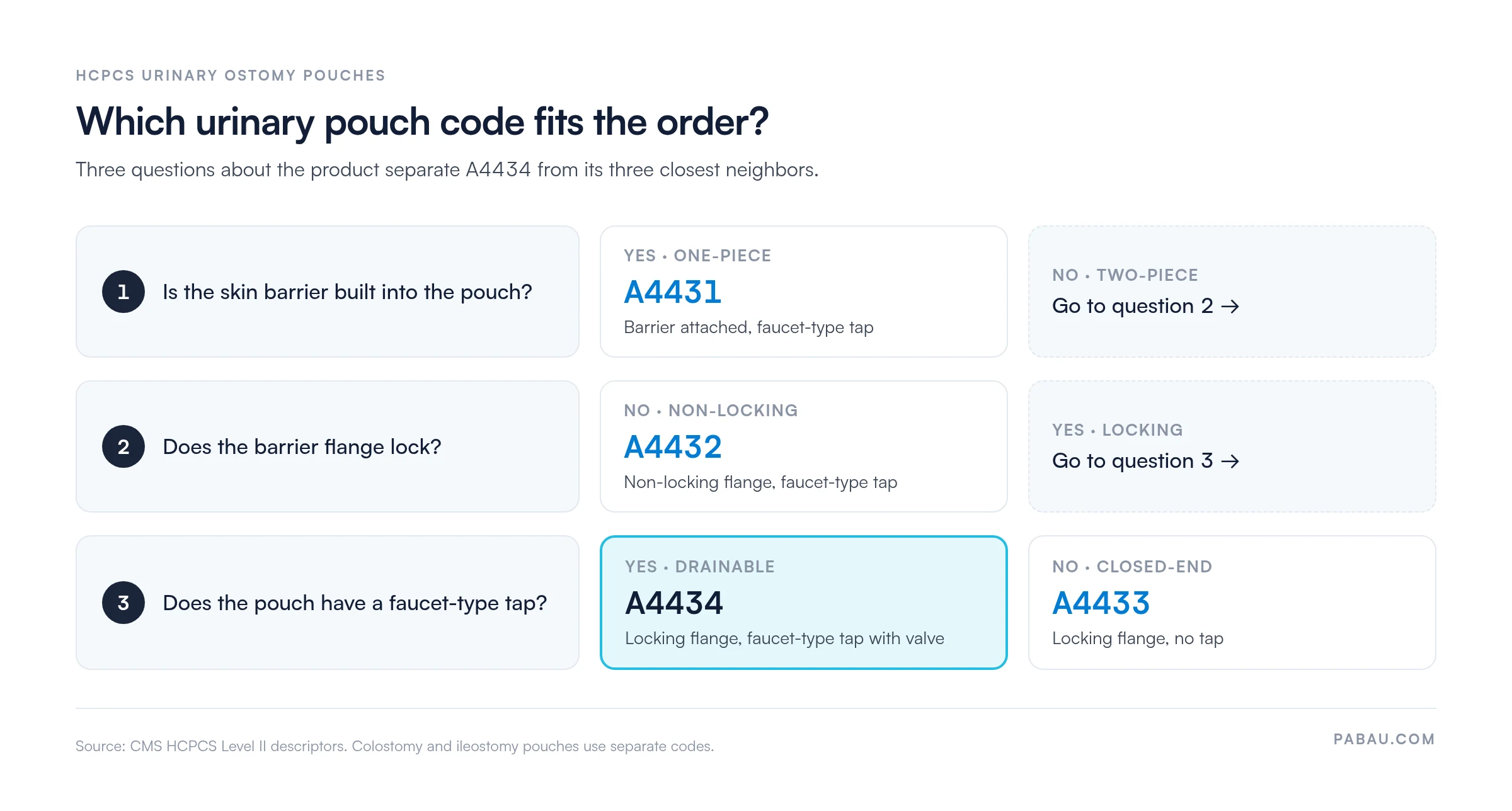
A4433 and A4434 fit the same two-piece locking-flange barrier, so the two pouches read almost identically on an order. The faucet-type tap is the one feature that separates them.
A4433 is the closed-end locking-flange pouch, with no tap. A4434 is the drainable version, with a faucet-type tap and valve that lets the patient empty urine without removing the pouch. CGS announced service-specific post-pay reviews of ostomy supplies including A4434 (Jurisdiction C), so the distinction gets checked after payment too.
Decision rule: If the product is a drainable pouch with a faucet-type tap for a two-piece locking-flange barrier, use A4434. If the same pouch is closed-end with no tap, use A4433. If the pouch is for a colostomy or ileostomy (fecal diversion), use the drainable colostomy/ileostomy pouch codes instead. The chart below runs the same logic as three questions.
Medicare Part B covers A4434 as a DMEPOS supply when the patient meets the ostomy LCD’s medical necessity criteria. Coverage requires three elements to be in place before the supplier ships product.
Prior authorization requirements for DMEPOS supplies shift periodically as CMS updates its prior authorization list. Check A4434’s current prior auth status against the CMS DMEPOS prior authorization program list before submission. The status can vary by MAC jurisdiction and claim value.
The ICD-10 codes that establish medical necessity for A4434 are determined by each MAC’s local coverage determination (LCD). Commonly accepted codes across MAC jurisdictions include the following, though coders must verify against their specific MAC’s current LCD before billing:
Verify covered diagnoses against your MAC’s current LCD for ostomy supplies before billing. Diagnoses not on the LCD-covered list will result in automatic medical necessity denial.
Solid medical billing compliance for A4434 depends on documentation being in place before the supplier delivers product. CMS requires specific written order elements for all DMEPOS ostomy supplies.
The written order must contain all of the following at the time of the initial supply:
No Certificate of Medical Necessity (CMN) applies to ostomy supplies. The standard written order covers the prescription side. The patient’s medical record must also support the LCD’s medical necessity criteria, including the type of urinary diversion and the quantity used.
Proof of delivery documentation must also be retained. CMS requires suppliers to keep delivery records showing the beneficiary’s signature (or an authorized representative’s) and the date of receipt. These records must be available for audit for a minimum of seven years.
Build a pre-ship documentation checklist for every A4434 order: written order, ICD-10 confirmed against the MAC LCD, quantity within monthly limit, proof of delivery prepared. Running this check before dispatch catches missing elements before a claim is submitted, not after a denial arrives.
The usual maximum under the Ostomy Supplies LCD (L33828) is 20 pouches per month for A4433 and A4434. Verify the allowance against your DME MAC’s current LCD before billing, because policy revisions can change it.
Exceeding the monthly quantity limit without a signed Advance Beneficiary Notice (ABN) results in automatic non-payment. The ABN must be issued to the beneficiary before the excess supply is delivered. Without it, the supplier absorbs the cost for quantities above the cap.
DMEPOS claims require a purchase or rental modifier appended to the code to indicate how the item is being supplied. For disposable ostomy pouches like A4434, the applicable modifier is almost always NU.
Omitting the NU modifier from an A4434 claim typically results in claim rejection at the MAC level. CMS DMEPOS modifier rules require this modifier on all supply codes for purchased items. Verify current modifier requirements against CMS guidance before submission, as modifier rules for DMEPOS have been updated periodically.
Most A4434 denials trace back to one of six root causes. Effective denial management workflows address each cause before it reaches the payer.
Billing HCPCS code A4434 correctly requires a defined pre-submission workflow. Running these steps in order catches the denial causes above before the claim goes out. Start with insurance eligibility verification, so active Part B coverage is confirmed before any product ships.
Two Medicare Administrative Contractors (MACs) publish specific guidance relevant to A4434 billing. Coders in their jurisdictions should review this guidance alongside national CMS policy.
CGS Medicare (Jurisdiction C): CGS announced service-specific post-pay reviews of ostomy supplies including A4434 (Jurisdiction C). The review also took in A4431, A5081, and A5122. Suppliers in that region should expect record requests on these claims and keep orders and delivery proof ready.
Noridian Medicare (Jurisdiction D DME): Noridian JD DME maintains a dedicated ostomy DMEPOS policy page that governs ostomy supply coverage in the western US jurisdiction. Coverage criteria, quantity limits, and LCD-covered diagnoses can differ from CGS policy. Suppliers billing under Noridian should verify current LCD requirements before processing A4434 claims under that jurisdiction.
When MAC policy differs from national CMS guidance, MAC policy governs claims in that jurisdiction. The AAPC’s HCPCS code reference and the PGM Billing HCPCS lookup tool help confirm current code descriptors. Cross-check them against the MAC’s own LCD for definitive policy.
Organizations building automated claim validation can pull current code data from the NLM HCPCS Level II API.
Bookmark your MAC’s ostomy LCD directly. CGS and Noridian both update LCDs when policy changes. Checking the MAC’s published LCD quarterly, rather than relying on third-party tools alone, keeps you billing against the current covered-diagnosis list and quantity limits.
Without one system, an A4434 order gets tracked across a spreadsheet, a paper order file, and a clearinghouse portal. Each handoff is a chance to ship before the written order is signed, or to key A4433 when the order says drainable.
Pabau, the practice management platform we build, keeps the order, the diagnosis, and the claim in one patient record. Its claims management software connects to Claim.MD in the US, so you can run real-time eligibility checks and submit claims electronically from one dashboard.
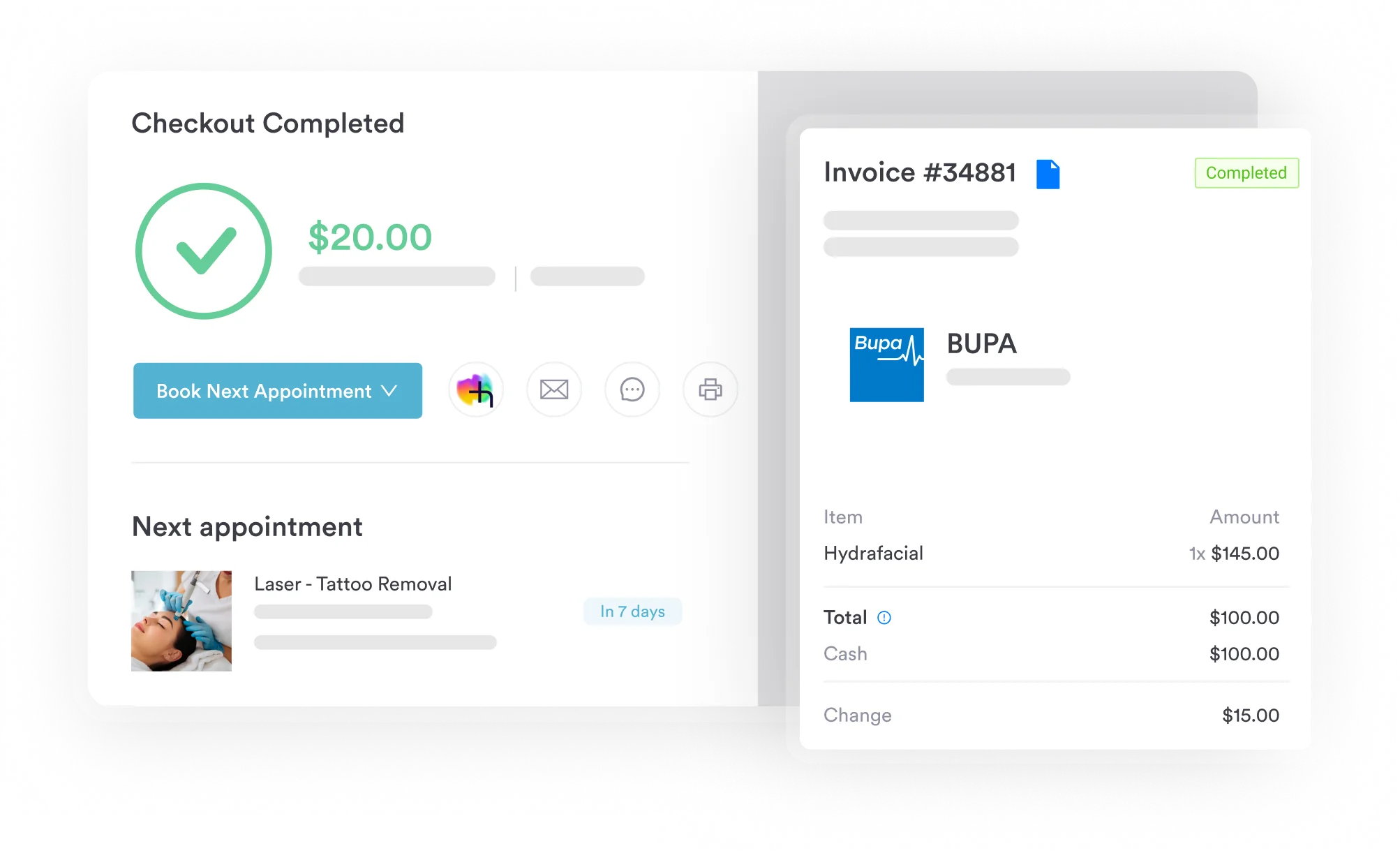
ERA remittances post back to the same dashboard. A denied line shows up next to the order behind it, so your team can correct the code or the paperwork before the next shipment.

Pabau keeps written orders, diagnoses, and claim status in one patient record, with electronic claim submission and real-time eligibility checks built in.

Treat the faucet-type tap as the deciding feature when you assign HCPCS code A4434. If the order describes a closed-end pouch, the claim belongs under A4433, and no modifier or diagnosis will rescue the wrong code.
Build your pre-ship check around the errors that recur in this code family. Those are A4433 (closed-end) or A4431/A4432 billed instead of A4434, a missing written order, and units above the 20-per-month allowance without an ABN. Catching them at order entry costs far less than answering a post-pay review.
Pabau’s clean claim workflows keep the order, the diagnosis, and the claim status in one record. Book a demo to see how your team can get urinary ostomy claims paid on the first submission.

Need to understand how clearinghouse submissions work for DMEPOS claims? Medical claims clearinghouse guide explains how EDI 837P claims route from supplier to payer and where validation errors occur.
Want to reduce ostomy claim denial rates systematically? Denial codes in medical billing maps CARC denial reason codes to the documentation errors behind them.
Billing the closed-end version instead? HCPCS code A4433 covers the locking-flange urinary pouch with no tap.
Working with a non-locking flange? HCPCS code A4432 covers the drainable urinary pouch for non-locking two-piece barriers.
Looking for guidance on the revenue cycle around DMEPOS supplies? Revenue cycle management overview covers the end-to-end process from patient encounter through claim payment for supplier organizations.
HCPCS code A4434 covers a urinary ostomy pouch, drainable, for use on a barrier with locking flange in a two-piece system, billed per pouch. It applies to urostomy patients using a drainable pouch with a faucet-type tap. Closed-end pouches, colostomy pouches, and one-piece systems bill under other codes.
A4433 is the closed-end urinary pouch for a two-piece locking-flange barrier, with no tap. A4434 is the drainable version of the same pouch, with a faucet-type tap and valve. Check the order for the tap before selecting A4434 over A4433.
The usual maximum under the Ostomy Supplies LCD (L33828) is 20 urinary pouches per month for A4433 and A4434. Verify the allowance against your DME MAC’s current LCD before billing. Quantities above the limit without a signed ABN result in automatic non-payment.
Commonly accepted ICD-10 codes include Z43.6 (encounter for attention to artificial openings of urinary tract) and Z93.6 (other artificial openings of urinary tract status). N99.518 (complication of other stoma of urinary tract) is also widely accepted. Exact covered diagnoses vary by MAC LCD, so always confirm against your jurisdiction’s current policy before submission.
The NU modifier (new equipment, purchased) is required for disposable ostomy pouches like A4434. RR (rental) and UE (used equipment) do not apply to single-use disposable supplies. Add GA when the quantity exceeds the monthly limit and an ABN has been issued to the beneficiary.
Prior authorization requirements for DMEPOS supplies are updated periodically by CMS and vary by MAC jurisdiction. Check A4434’s current status against the CMS DMEPOS prior authorization program list and your MAC’s LCD before submitting claims. Requirements can change within a coverage year.



