

HCPCS code E0198: Water pressure pad billing guide
HCPCS code E0198 is a water pad for a standard mattress HCPCS code E0198 is the ...

Last Updated: Oct 13, 2026
A4280 is the HCPCS Level II code for adhesive skin support attachment for use with external breast prosthesis, each. It covers only the adhesive that holds the breast form to the chest wall, not the form itself.
The prosthesis bills separately under L8030, L8031, or L8035, and L8031 already has the adhesive built in. Medicare coverage requires a prior mastectomy, a qualifying ICD-10-CM diagnosis, and a written order from the treating physician.
Let Pabau's smart automation suggest the right codes, reduce claim denials, and keep your practice compliant—effortlessly.
Automate repetitive tasks and focus on what matters most—your patients.
Reduce coding errors and ensure compliance with the latest regulations.
Clean claims, fewer denials, and faster reimbursements.
Powerful insights and reporting to help your practice thrive.
HIPAA compliant SOC 2 certified GDPR-compliant Trusted by 4,000+ clinics worldwide

A4280 covers the adhesive skin support attachment for an external breast prosthesis only, never the prosthesis itself.
Medicare coverage requires a post-mastectomy diagnosis (Z90.10–Z90.13 or a relevant C50.x code) and a written physician order.
The code is billed per attachment, with one unit typically allowed per prosthesis-wearing side per benefit period.
A4280 pairs with L8030 or L8035, but not with L8031, which already has the adhesive built in.
Most A4280 denials trace back to a missing order, an unsupported diagnosis code, or a unit count over the limit.
HCPCS Code A4280 is the Level II supply code for an adhesive skin support attachment for use with external breast prosthesis, each.
It sits in the A-series of medical and surgical supplies, and it pays for the adhesive that holds a breast form to the chest wall. CMS maintains the HCPCS Level II code set and publishes updates every quarter.
The table below summarizes the classification details to confirm before you submit an A4280 claim.
Only Medicare-enrolled DMEPOS suppliers may bill A4280. Physicians, hospitals, and non-enrolled suppliers can’t submit A4280 claims to Medicare, however complete the documentation is.
A4280 covers the adhesive skin support attachment designed to secure an external breast prosthesis against the chest wall. That can be a tape, an adhesive pad, or a skin-safe bonding agent. It doesn’t cover the breast form, a mastectomy bra, or any other post-mastectomy supply.
The most common coding error is billing A4280 when the item dispensed was the prosthesis. The descriptor draws the line like this:
The quickest way to choose the line item is to start from what you handed the patient, as the diagram below shows.
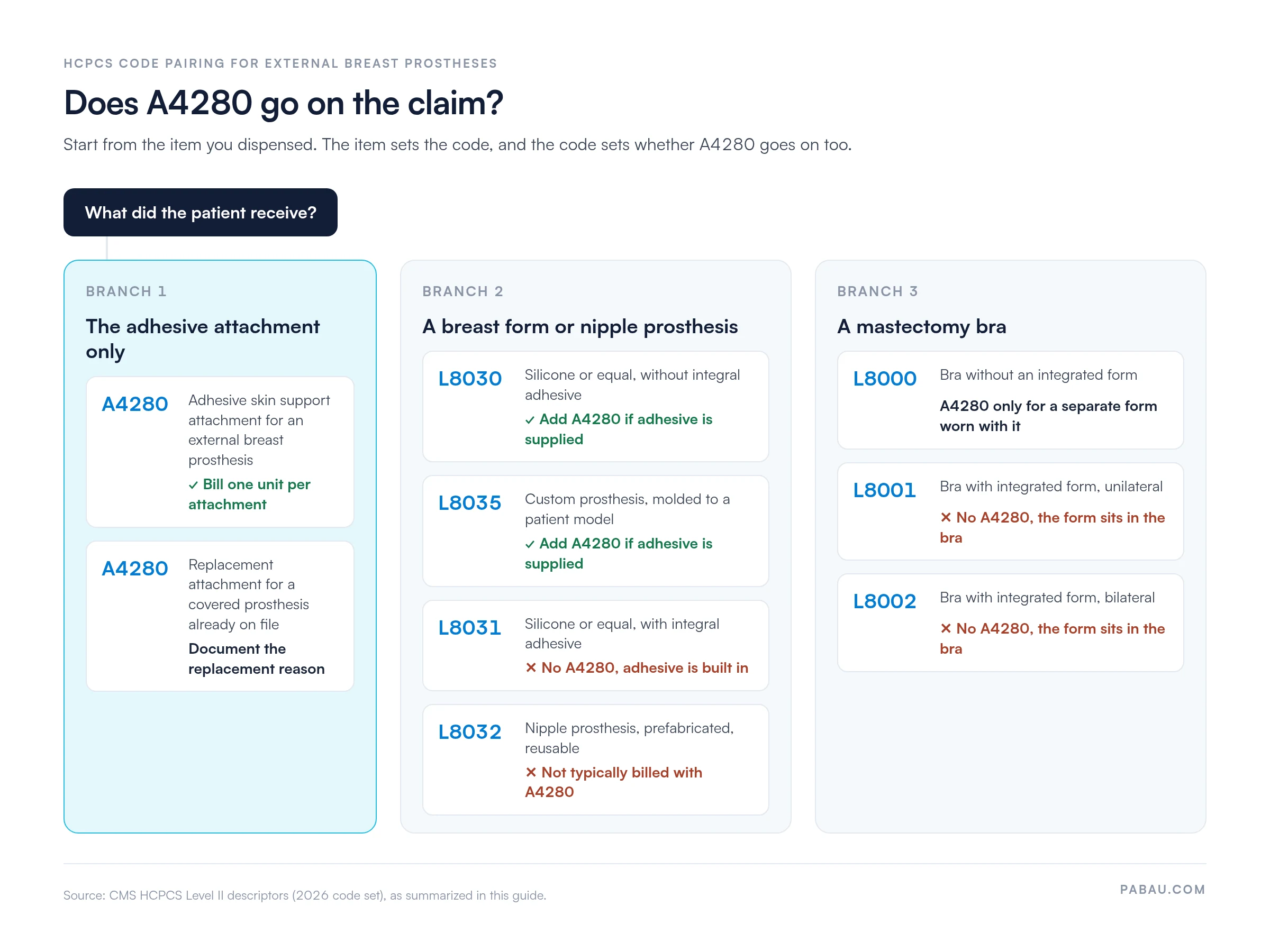
The word “each” in the descriptor matters. Every adhesive attachment billed needs its own unit on the claim, so a bilateral mastectomy patient who needs two attachments gets two units of A4280.
Medicare covers external breast prostheses and related supplies, including A4280, under the prosthetic device benefit. The rules sit in the External Breast Prostheses policy article (A52478). Coverage applies to Medicare Part B beneficiaries who have had a mastectomy and meet every clinical and documentation requirement.
The core coverage conditions are:
Two Durable Medical Equipment Medicare Administrative Contractors (DME MACs, often shortened to DMACs) process these claims. They are CGS Administrators (Jurisdictions B and C) and Noridian Healthcare Solutions (Jurisdictions A and D). Check the LCD for the jurisdiction where the beneficiary lives, not where the supplier is based.
The claim must carry a qualifying ICD-10-CM diagnosis code that confirms mastectomy status. Accepted codes generally include the Z90.1x series and relevant active malignancy codes, though the LCD may expand or narrow this list.
Check the current LCD before billing with a C50.x active malignancy code. Some claims are accepted only when it’s paired with a Z90.1x code.
Documentation is the part of an A4280 claim the supplier controls most. Sound medical billing compliance means the full set is on file before the item is dispensed, not pieced together after a denial.
Pull the operative or pathology report at intake, before the adhesive attachment is dispensed. Suppliers who wait for the physician’s office to send records often ship first and face a denial when the record never arrives. Build the documentation request into your intake workflow, not your appeals process.
The most frequent coding error with A4280 is billing it instead of, or wrongly alongside, a breast prosthesis or mastectomy bra code. The comparison below, checked against the AAPC HCPCS code reference, shows when each code applies.
A4280 and L8030 are distinct items and can go on the same claim when both the breast form and the adhesive are dispensed. Never use A4280 as a stand-in for L8030 or as a bundled “prosthesis with adhesive” code.
Mastectomy bras are a separate line again. A bra without a form bills under L8000. The breast form worn with it carries its own code, plus its own A4280 unit where adhesive is supplied.
One A4280 billing unit equals one adhesive attachment. Quantity allowances come from the LCD, so treat the limits below as typical Medicare policy and confirm them for the beneficiary’s jurisdiction.
The 2026 allowed amount for A4280 varies by state, because DMEPOS fees are set per state. CMS publishes the files every year, so check the current figure in the DMEPOS fee schedule rather than relying on last year’s rate.
As a general reference, the Medicare allowed amount for A4280 has historically sat under $10 per attachment. Confirm the 2026 figure before quoting reimbursement to patients or facilities.
Medicare doesn’t currently require prior authorization (PA) for A4280 as a stand-alone supply. CMS updates its DMEPOS prior authorization list from time to time, so check it before assuming the rule still holds.
Commercial payers are a different matter. A PA request is strongest when it arrives with the physician order, the diagnosis codes, and the patient’s prosthesis history in one packet.
When PA is required, submit the physician’s written order, the operative or pathology report, and the specific adhesive product and quantity requested. A denial for missing PA can’t be overturned on medical necessity grounds alone.
Effective denial management in healthcare starts with knowing the patterns. A4280 rejections are predictable, and most trace back to missing paperwork, wrong units, or confusion with L8030.
Run a monthly audit of A4280 claims. Pull every claim where A4280 was billed without an L8030 or L8035 on the same or a recent claim. Add any A4280 billed next to L8031. Both patterns invite DMAC medical review and post-payment audits.
An A4280 claim follows the standard DMEPOS workflow through the DME MAC. Tracking each step in denial-reducing claims management software catches the missing documents behind most A4280 denials.
Commercial and Medicaid plans set their own rules for A4280, so a claim that clears Medicare can still bounce elsewhere. Checking each payer’s terms before dispensing is part of submitting a clean claim.
Women’s Health and Cancer Rights Act (WHCRA): The WHCRA (Pub. L. 105-277) requires group health plans that cover mastectomies to also cover prostheses and reconstructive surgery. It applies to employer-sponsored group plans, not to Medicare, Medicaid, or individual market plans. Bill these plans with the same supporting documents as Medicare, then check each plan’s PA rules and quantity allowances.
Medicaid: State Medicaid programs set their own policies for breast prosthesis supplies. Oregon, for example, regulates A4280 under the Oregon Health Authority’s OAR rules. Other states may use a different code, ask for their own documentation forms, or set different quantity limits. Check the state Medicaid fee schedule before billing A4280 to a Medicaid plan.
Commercial payers: Most commercial plans that cover mastectomy supplies will pay for A4280, but limits, PA rules, and rates vary a lot. Some pay at Medicare rates, and others use contracted fee schedules that differ by region. Confirm coverage, PA, and network status before dispensing.
Most A4280 denials start before the claim exists. The order arrives after dispensing, the operative report sits in someone’s inbox, or nobody counts how many attachments went out this year.
Pabau, the practice management and billing platform we build, keeps those pieces on the patient record. The physician order, mastectomy report, and signed delivery form live next to each appointment and invoice. Digital forms capture signatures at dispensing, so the proof of delivery exists before the claim is built.
When the claim goes out, it draws on that record, and the claim history shows what each patient has already received. Your team can check units against the limit before billing, so fewer A4280 lines come back denied.

Pabau stores the order, mastectomy report, and signed delivery form on the patient record, so each supply claim goes out complete. See how it fits your billing workflow.

A4280 is a low-value code, so the cost of getting it wrong is mostly time. A denied attachment worth a few dollars can take longer to appeal than it pays.
The fix is to decide the claim at dispensing, not at billing. Pick the code from the item you handed over, and skip A4280 entirely next to L8031 or a bra with a built-in form. Have the order and mastectomy report on file before the patient leaves.
Suppliers who work this way trade a slower intake for claims that rarely come back. Book a demo to see how Pabau keeps supply-code documentation in one place for your billing team.

Billing the breast form too? HCPCS code L8030 covers the silicone prosthesis that A4280 is billed alongside.
Dispensing a mastectomy bra? HCPCS code L8000 explains how to bill a bra without an integrated form.
Working to reduce claim rejection rates? Submitting a clean claim outlines the data elements and documentation standards that prevent first-pass denials.
Managing post-denial workflows? Denial management in healthcare explains how to categorize, track, and appeal denied DME claims systematically.
Need the full billing picture? What is medical billing covers the revenue cycle from claim creation through payment posting.
HCPCS Code A4280 covers the adhesive skin support attachment that secures an external breast prosthesis to the chest wall, billed per unit. It doesn’t cover the prosthesis itself (billed under L8030, L8031, or L8035), mastectomy bras, or other post-mastectomy supplies.
Yes. Medicare Part B covers A4280 for post-mastectomy patients with a written physician order and a qualifying ICD-10 diagnosis code (Z90.10–Z90.13). The supplier must be enrolled as a Medicare DMEPOS supplier, and the claim must meet the external breast prostheses LCD.
Typically one unit per side per benefit period, which is generally the calendar year. That means one unit for a unilateral mastectomy patient and two units for a bilateral mastectomy patient. Early replacement needs documented medical necessity, so check the exact limit in the LCD for the beneficiary’s jurisdiction.
The top denial reasons are a missing or unsigned physician order, an uncovered diagnosis code, and more units than the LCD allows. A supplier NPI not enrolled for DMEPOS and a missing proof of delivery also cause denials. So does coding A4280 in place of L8030, the prosthesis itself.
A4280 covers the adhesive attachment that holds the prosthesis in place, while L8030 covers the silicone breast prosthesis without integral adhesive. Both can go on the same claim when both items are dispensed. Never substitute A4280 for L8030, because they’re separate covered items with separate allowed amounts.
Medicare doesn’t generally require prior authorization for A4280, though suppliers should check the current DMEPOS prior authorization list. Commercial payers often require PA for any breast prosthesis supply, adhesive attachments included. Medicaid PA rules vary by state.



