

CCSD code G5100: Bypass of duodenum billing guide
CCSD code G5100 bills a bypass that leaves the duodenum in place CCSD code G5100...

Last Updated: Oct 16, 2026
Billable Code
99458 is the CPT add-on code for each additional 20 minutes of remote physiologic monitoring treatment management in a calendar month. Clinical staff, a physician or another qualified health care professional can furnish the time. The month must include one real-time interactive communication with the patient or caregiver.
The code is never billed alone. Every 99458 unit is reported with CPT 99457, which covers the first 20 minutes of the same month. In 2026, Medicare pays $41.42 per unit nationally in a non-facility setting.
Let Pabau's smart automation suggest the right codes, reduce claim denials, and keep your practice compliant—effortlessly.
Automate repetitive tasks and focus on what matters most—your patients.
Reduce coding errors and ensure compliance with the latest regulations.
Clean claims, fewer denials, and faster reimbursements.
Powerful insights and reporting to help your practice thrive.
HIPAA compliant SOC 2 certified GDPR-compliant Trusted by 4,000+ clinics worldwide

CPT code 99458 covers each additional 20 minutes of RPM treatment management beyond the first 20 billed as 99457 in the same calendar month.
99458 is an add-on code, so it is never billed without CPT 99457 for the same patient and month.
The 2026 national Medicare non-facility rate is $41.42 per unit, and practices can stack units for patients with longer monthly management time.
Clinical staff under general supervision can furnish the time, and the 16-day transmission rule applies to 99454, not 99458.
Pabau, the practice management platform we build, tracks cumulative monthly time against CPT thresholds and flags incomplete documentation before claims go out.
CPT code 99458 bills each additional 20 minutes of remote physiologic monitoring treatment management in a calendar month. It sits on top of the first 20 minutes, which are billed as 99457.
The American Medical Association (AMA) publishes the official descriptor. The 2026 wording reads as one clause, shown here in its four parts:
Three facts determine whether 99458 applies to a given month:
The “interactive communication” requirement means at least one real-time exchange with the patient or caregiver during the month. Asynchronous review of device data does not satisfy it on its own. The communication must be two-way and synchronous.
Only treatment management activities count toward each 20-minute block. Device setup, patient education and in-person visit time belong to other codes.
Remote patient monitoring (RPM) is billed with six CPT codes in 2026, each covering a distinct part of the program. Device supply sits under 99454 or 99445, while management time sits under 99470, 99457 and 99458.
The distinction between 99457 and CPT code 99458 comes down to billing hierarchy and time thresholds.
CPT code 99458 carries prerequisites that go back to program enrollment, not just the billing month. Each condition below must be met before a claim goes out.
Run a monthly eligibility sweep before billing RPM codes. For every patient in the program, confirm three points. Consent is documented in the chart. The device code matches the transmission days (16 or more for 99454, 2 to 15 for 99445). A real-time interactive communication is recorded for the month. Checking these before submission prevents the most common 99458 denials.
Billing CPT code 99458 is straightforward when the workflow is systematic. A clean claim submission for 99458 follows these steps in sequence:
CMS documentation requirements for CPT code 99458 are time-specific and provider-specific. A chart note that satisfies 99457 does not automatically cover additional 99458 units.
Each 99458 unit requires the record to show:
HIPAA-compliant documentation for RPM programs needs particular attention to how device-generated data is stored and linked to clinical notes. The record must connect the transmitted readings to the clinical review. A note that says “reviewed RPM data” without the readings attached is a weakness auditors flag often.
The 2026 national Medicare rate for CPT code 99458 is $41.42 per unit in a non-facility setting. That is 1.24 total relative value units (RVUs), including 0.61 work RVUs, multiplied by the $33.4009 conversion factor. The facility rate is $26.39, because the facility receives its own payment.
In 2025, the same unit paid $38.49 non-facility, from 1.19 RVUs at a $32.3465 conversion factor. Geographic adjustments change both figures by locality, so check the CMS Physician Fee Schedule lookup for your area.
These 2026 figures come from the final rule, not projections. CMS publishes the proposed fee schedule around July and the final rule in the fall, with rates effective January 1. The CMS relative value files carry each year’s RVUs, so recheck them before you update expected payments.
CPT code 99458 can be billed multiple times per month for the same patient, and the AMA sets no cap on the number of units. Each additional full 20-minute increment of qualifying management time generates one billable unit. The chart below shows how monthly minutes map to codes and 2026 national payments.
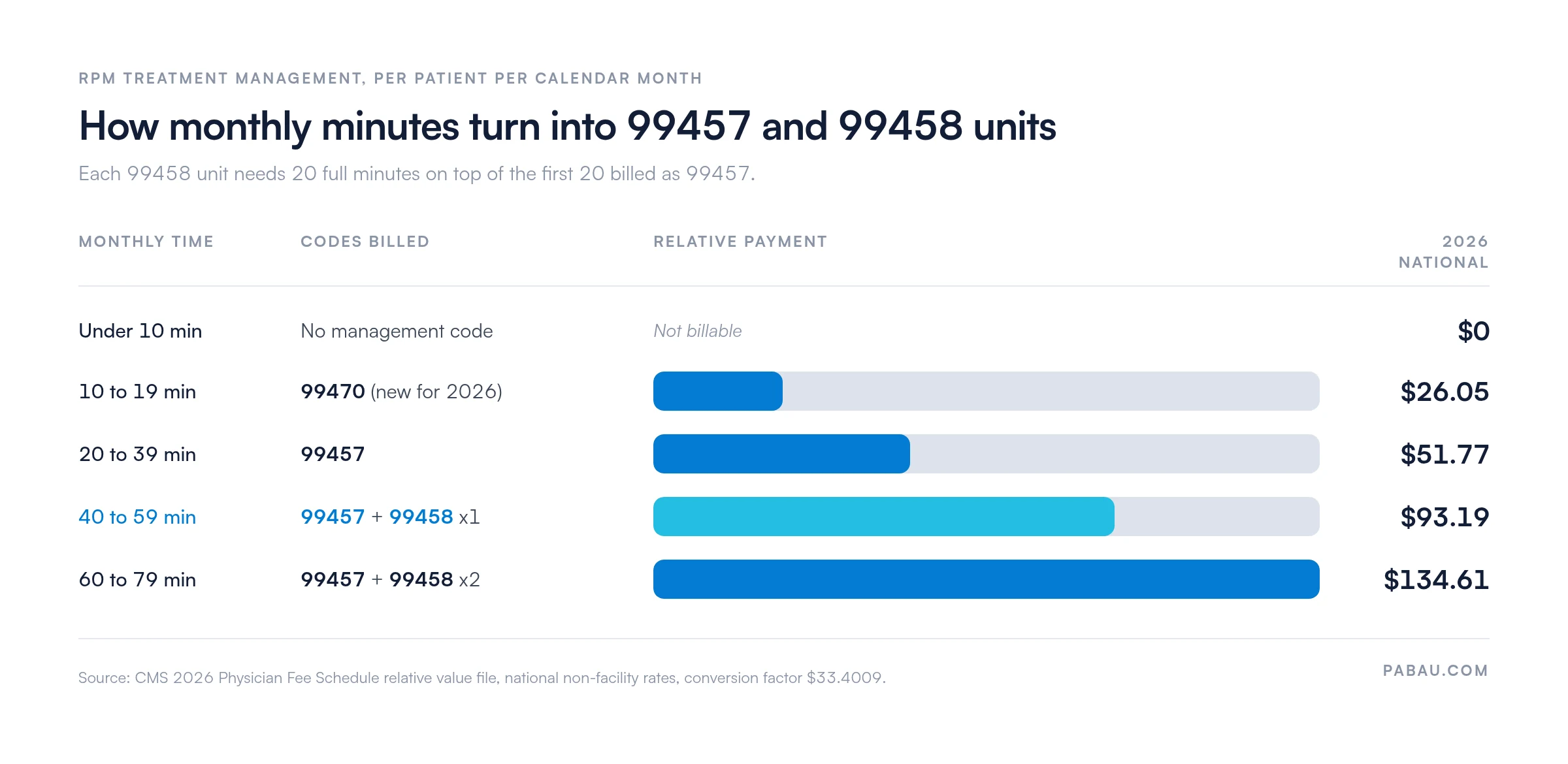
In practice, clinical need sets the stacking ceiling rather than coding rules. A patient with hypertension, diabetes and congestive heart failure (CHF) under active monitoring could generate 60 to 80 minutes of management time a month. That means one 99457 unit and two or three 99458 units for the month.
Two important limits apply in practice:
Medicare Part B covers CPT code 99458 under the Physician Fee Schedule, with no prior authorization under traditional Medicare. The patient must be an established patient with an acute or chronic condition, and consent must be documented. Report the ICD-10-CM diagnosis codes for the monitored condition to support medical necessity.
Medicaid coverage varies significantly by state. Some state Medicaid programs mirror Medicare’s RPM billing policy, while others have no formal guidance or require prior authorization for each billing month. Contact the state Medicaid agency before billing 99458 to a Medicaid patient.
Commercial payers are the most variable category. Before billing, check these points with each plan:
Record each payer’s rules in the patient’s billing profile, so staff see them at the point of service rather than during claims processing.
CPT code 99458 denials cluster around a handful of root causes. Effective denial management workflows start with knowing which patterns to watch.
CMS allows RPM and chronic care management (CCM) codes such as 99490 to be billed for the same patient in the same month. The rules need careful attention to avoid bundling denials.
RPM time and CCM time must not overlap. Take a 30-minute call that covers both CCM care planning and RPM data review. That time cannot count toward both code sets. CMS guidance requires time to be distinct and non-duplicative between care management programs billed concurrently.
Practices billing both RPM and CCM for the same patient should:
CMS guidance on concurrent billing has evolved over time. Until a national coverage determination settles the edge cases, apply conservative documentation standards and check your MAC’s current transmittals. Solid RPM billing compliance practices protect the practice during any payer review.
The 2026 CPT code set reworked the RPM family, and 99458 kept its role as the 20-minute add-on to 99457. Four changes matter for billers:
Subscribe to CMS Medicare Learning Network (MLN) Matters updates to hear when RPM-related transmittals are issued. The MLN is the authoritative source for mid-year policy changes between annual fee schedule releases.
Without a shared log, RPM minutes sit in device portals, call notes and spreadsheets until someone totals them at month end. Pabau’s claims software for practices logs cumulative monthly management time per patient. It prompts staff when 99457 is met and each 99458 unit becomes billable, and it flags missing documentation before submission.
For practices using the Claim.MD clearinghouse integration, Pabau submits CMS-1500 and 837P claims electronically. Built-in CPT and ICD-10 catalogs validate code pairing at submission. The integration also runs real-time eligibility checks and posts 835 electronic remittance advice, so common 99458 errors are caught before the denial cycle starts.

Pabau tracks cumulative monthly RPM time per patient, flags when 99457 and 99458 thresholds are reached, and prompts documentation before claims go out. Your RPM revenue is captured and defensible.

CPT code 99458 pays reliably once the workflow behind it is solid. Bill 99457 first, record consent in the chart, and log time per unit as it happens. Keep the 16-day rule where it belongs, on the device code.
The revenue is usually lost when time is reconstructed after the month closes. Logging minutes at each interaction makes documentation the trigger for the next billable unit, and that habit decides whether the add-on pays.
Book a demo to see how Pabau tracks RPM minutes and flags each billable 99458 unit before the claim goes out.

Need a framework for managing RPM denials at scale? Denial codes in medical billing covers the CARC and RARC codes that appear on rejected RPM claims and how to action each one.
Want to understand how clearinghouse submission works end to end? Medical claims clearinghouse guide explains the 837P transaction lifecycle and how electronic validation catches errors before payer adjudication.
Looking to verify patient eligibility before billing RPM codes? Insurance eligibility verification outlines the eligibility check workflow that confirms RPM coverage before each billing cycle.
Want to see where RPM billing fits in the wider revenue cycle? What is revenue cycle management walks through each stage from patient registration to final payment.
New to the claims side of the practice? What is medical billing explains how a claim moves from coded encounter to payment.
CPT code 99458 bills each additional 20 minutes of remote patient monitoring treatment management time in a calendar month. It sits on top of the first 20 minutes billed under CPT 99457. Clinical staff under general supervision, physicians and other qualified health care professionals can all furnish the time.
CPT 99457 covers the first 20 minutes of RPM management per calendar month and is the required parent code. CPT 99458 covers each additional 20-minute increment beyond that. It cannot be billed without 99457 for the same patient in the same billing period.
There is no AMA-imposed monthly unit cap on CPT 99458. Each full 20-minute block of qualifying management time generates one unit. A patient with 60 total minutes in a month generates one 99457 and two 99458 units. Some commercial payers set their own monthly limits, so verify the plan’s policy before billing multiple units.
Yes. Medicare Part B covers CPT code 99458 under the Physician Fee Schedule, with no prior authorization under traditional Medicare. The patient must be an established patient with an acute or chronic condition, and verbal or written consent must be documented. The 16-day transmission rule applies to the device code 99454, not to 99458.
Each 99458 unit needs time entries showing when the work happened and who performed it. The record also needs a summary of the physiologic data reviewed and the clinical decision made. It must confirm an interactive communication with the patient or caregiver during the month.
Yes, provided the time is kept separate. CMS permits RPM and CCM billing in the same month when the time for each is non-overlapping and documented separately. Some MACs have local policies that may restrict this, so check your MAC’s current transmittals first.



