

HCPCS code E0198: Water pressure pad billing guide
HCPCS code E0198 is a water pad for a standard mattress HCPCS code E0198 is the ...

Last Updated: Oct 13, 2026
99456 is the CPT code for a work related or medical disability examination by other than the treating physician. The exam covers a medical history, a physical examination, a diagnosis with an impairment calculation, a future treatment plan, and the completed documentation and report.
It sits in the Evaluation and Management section with 99455, which the treating physician bills for the same exam. Workers compensation carriers and liability insurers pay for most 99456 claims, and each one needs a signed written report.
Let Pabau's smart automation suggest the right codes, reduce claim denials, and keep your practice compliant—effortlessly.
Automate repetitive tasks and focus on what matters most—your patients.
Reduce coding errors and ensure compliance with the latest regulations.
Clean claims, fewer denials, and faster reimbursements.
Powerful insights and reporting to help your practice thrive.
HIPAA compliant SOC 2 certified GDPR-compliant Trusted by 4,000+ clinics worldwide

CPT 99456 applies only to non-treating physicians conducting work-related or disability evaluations. Treating physicians must use 99455.
A signed written report summarizing history, examination, record review, and impairment rating methodology is required for every valid claim.
Workers compensation is the primary payer. Medicare rarely covers this code and has no broad national coverage policy for it.
Pabau, the practice management platform we build, lets occupational medicine practices submit and track 99456 claims through Claim.MD and monitor denials.
CPT code 99456 is defined by the American Medical Association as: Work related or medical disability examination by other than the treating physician that includes:
The phrase “other than the treating physician” is the code’s defining constraint. The physician who takes the history, examines the patient, rates impairment and writes the report must have no ongoing treatment relationship with the patient.
The code sits in the Evaluation and Management section of the CPT code set, alongside CPT 99455, its treating-physician twin. Both codes describe the same examination type. The only difference is who performs it.
CPT 99455 is used by the treating physician, and CPT code 99456 is used by a non-treating physician. A treating physician who bills 99456 claims a service defined by its independence from the patient relationship. That misstatement can lead to a compliance review on top of the denial.
Three questions settle the code for any disability exam, and the order you ask them in matters.
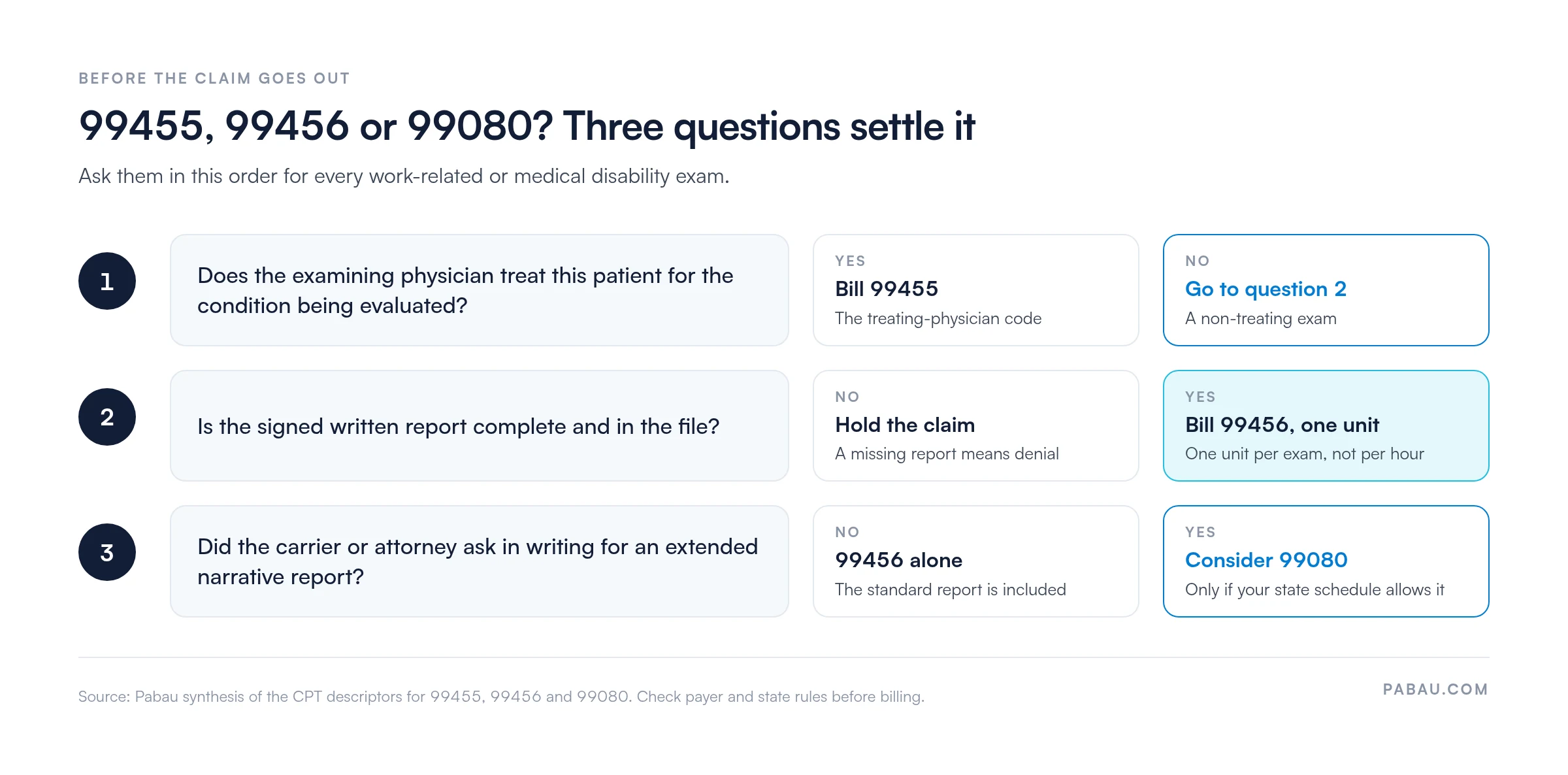
Only a physician with no treating relationship to the patient may bill CPT code 99456. Once a provider has delivered ongoing clinical care for the condition being evaluated, they must use 99455 instead.
Eligible billers typically include:
Occupational medicine is the specialty most frequently billing this code. Any physician type can use it, provided the non-treating requirement is met and documented. Some payers and state schedules allow qualified non-physician practitioners to perform it; confirm payer policy before billing.
CPT code 99456 covers the full range of services required to complete a work-related or medical disability examination as a non-treating physician. None of these components is separately billable on the same date by the same provider:
Diagnostic testing ordered during the examination is not included. X-rays, nerve conduction studies, or laboratory work ordered to support the evaluation are billed separately using the appropriate CPT codes. The same applies to any injection or procedure performed at the same visit.
Every CPT 99456 claim must be supported by a formal written report. Payers, particularly workers compensation carriers, treat the absence of a signed written report as grounds for automatic denial. Document the following elements to satisfy both AMA CPT requirements and payer audit standards.
Using digital documentation forms to capture structured disability evaluation data reduces transcription errors. It also makes it easier to retrieve the record components payers most commonly audit. The written report itself must still be a narrative document signed by the physician.

CPT code 99456 is a service-based code, not a time-based code. You bill one unit per examination encounter regardless of how long the evaluation takes. Billing multiple units for a single encounter is a common trigger for payer audits.
Place of Service 11 (Office) is the most common setting. Use POS 22 (Outpatient Hospital) or other appropriate codes when the examination is conducted in a facility setting. The POS code affects the applicable fee schedule rate in some workers comp jurisdictions.
Standard professional service modifiers apply. Modifier 32 (mandated services) may be appropriate when the examination is court-ordered or required by a government agency. Use modifier 52 (reduced services) only where the payer’s policy allows it for an incomplete exam. Always verify modifier requirements with the specific workers comp carrier before submission.
Most payers treat a separate E/M on the same date by the same physician as duplicative, so bill 99456 alone for that encounter. Check the current NCCI procedure-to-procedure tables and the carrier’s policy before adding another E/M code. Diagnostic testing ordered during the visit is the exception, and those codes are separately billable.
CPT 99080 covers special reports, such as insurance forms, that carry more than the usual medical communications or standard reporting forms. Some workers compensation jurisdictions pay it on top of CPT code 99456. They do so only when the requested narrative report goes materially beyond the standard examination report.
The practical test is the scope of the request. If the payer or referring attorney asks for a longer narrative on causation, apportionment, life care planning or similar elements, 99080 may be separately payable. If the written report is simply the standard exam documentation, 99080 is not separately billable.
Before billing 99080 alongside CPT 99456, obtain written confirmation from the requesting carrier or attorney that an extended narrative report was specifically required. File this with the patient record. Without documented justification, 99080 claims alongside 99456 are routinely denied as unbundled. They can also attract audit attention.
The CMS Physician Fee Schedule shows how Medicare treats CPT code 99456, including whether it carries a national payment rate. Workers compensation rates are set by individual state fee schedules and typically exceed Medicare rates, though they vary considerably by jurisdiction. The FastRVU 2026 RVU lookup tool also draws on the CMS Physician Fee Schedule data.
For practical billing purposes, check the CMS Physician Fee Schedule lookup for RVU data. Then consult your state workers comp fee schedule directly for jurisdiction-specific reimbursement. Review electronic remittance advice patterns after submission to see whether the carrier is applying your contracted rate correctly.
Medicare rarely covers CPT 99456 in practice. Workers compensation carriers, liability insurers, or state-mandated programs order and pay for most disability examinations. Medicare’s program structure is designed around medically necessary treatment, and third-party disability determinations fall outside it.
When a Medicare beneficiary requires a disability evaluation for workers comp or legal purposes, the requesting party pays for it. That is the carrier or attorney, not Medicare. There is no current broad National Coverage Determination (NCD) establishing Medicare coverage for routine disability evaluations under this code. Always verify with individual Medicare Administrative Contractors for any jurisdiction-specific Local Coverage Determinations.
Denials on CPT code 99456 cluster around a small set of predictable errors. A solid denial management workflow identifies these patterns quickly. The table below maps the most common denial reasons to their corrective actions.
Tracking denials by reason code across your 99456 claims shows whether errors are systemic or isolated. Repeated wrong-code denials, for example, usually mean the billing team needs a refresher on 99455 vs 99456. For a full reference on reason codes, see the guide to medical billing denial codes.
Flag every 99456 claim for a two-step billing check. First confirm the examining physician has no treating history with this patient (use 99455 if they do). Then confirm the signed written report is in the file before submitting. These two checks prevent the majority of 99456 denials.
Denials on 99456 claims usually trace back to paperwork. The report is still unsigned, a treating physician’s exam went out as 99456, or a short payment sat unnoticed for weeks.
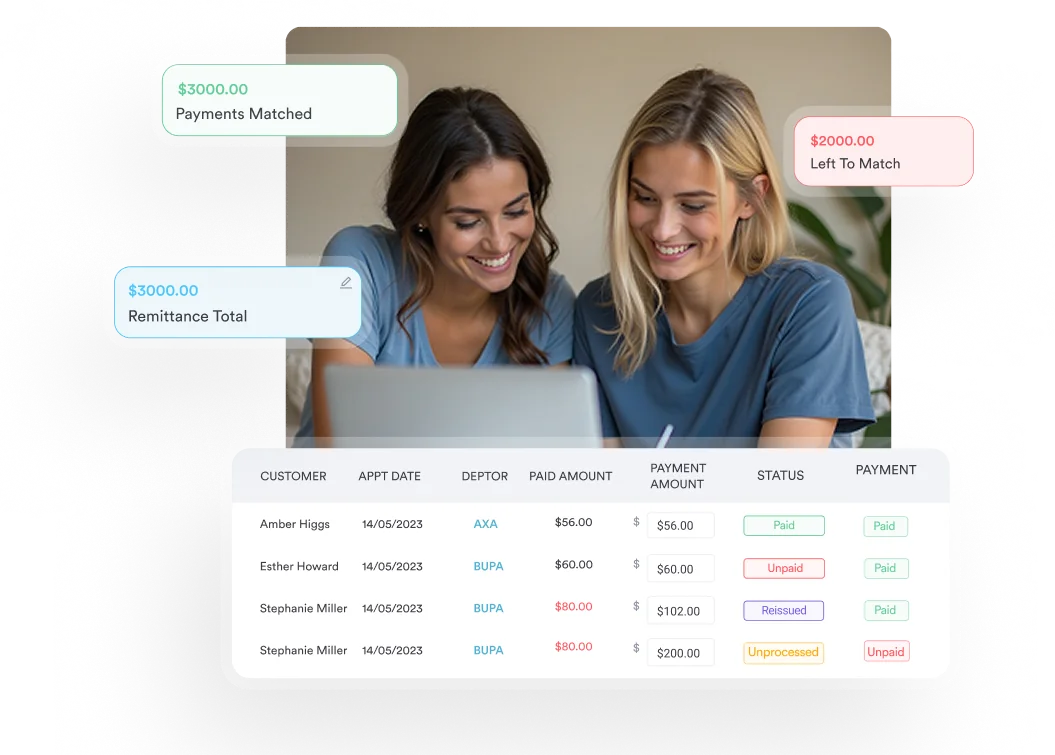
With Pabau’s denial-tracking claims management software, your team can submit and track claims through Claim.MD and monitor denials. The signed report and intake forms sit on the same patient file, so an appeal starts with the evidence already attached.
Denial reports then show which errors keep recurring, so the fix goes into the workflow once. Getting each clean claim out the first time matters most for practices that bill workers comp carriers every week.

Pabau helps occupational medicine practices submit and track disability exam claims through Claim.MD and monitor denials, with the signed report on the same patient record.

Settle the treating relationship before anyone codes the exam. That one question decides between 99455 and 99456, and it is the error most likely to turn a denial into a compliance review.
Then make the signed report a hard stop in your billing workflow. A claim that waits a day for a signature gets paid. A claim that goes out without one comes back denied, and the appeal costs more than the wait.
Pabau lets you submit and track claims through Claim.MD and monitor denials, with the exam record in the same system. Book a demo to see how it fits your disability exam billing.

Need to understand how clearinghouse submissions work for workers comp claims? Medical claims clearinghouse guide explains how electronic claims route from practice to payer.
Want the full billing workflow from encounter to payment? Revenue cycle management overview covers each stage between the exam and the payment.
Want to see how Pabau sends claims to US payers? Claim.MD clearinghouse integration explains how Pabau submits and tracks claims through Claim.MD.
Is the examining physician also the treating physician? CPT code 99455 covers the same disability exam when the treating physician performs it.
Does the carrier require authorization before the exam? Prior authorization process walks through requesting and tracking approvals before the visit.
CPT code 99456 is used to bill a work-related or medical disability examination performed by a physician who is not the patient’s treating physician. The service includes a written report. It is most commonly billed by occupational medicine physicians, independent medical examiners, and insurer-designated evaluators under workers compensation or liability insurance programs.
No, Medicare does not broadly cover CPT 99456. Disability examinations are third-party services ordered by workers compensation carriers, liability insurers, or state agencies. When a Medicare beneficiary undergoes a disability evaluation for a workers comp claim, the workers comp carrier is the responsible payer.
In some workers compensation jurisdictions, yes. CPT 99080 (special reports beyond routine) can be billed alongside 99456 when the carrier or attorney specifically requested an extended narrative report. Most commercial payers and Medicare treat the written report as bundled into 99456 and deny 99080 separately. Always obtain written confirmation from the carrier before billing both codes.
The most common denial reasons are a treating physician billing 99456 instead of 99455, and a signed report missing on audit. Others include an incorrect place of service code, a same-day E/M visit that the payer treats as duplicative, and missing prior authorization. Each of these has a straightforward corrective action on appeal.
Medicare publishes the payment status for CPT 99456 in the CMS Physician Fee Schedule. Check the CMS PFS lookup, and if no national RVUs are listed, the code is carrier-priced. Workers compensation rates vary by state and typically exceed Medicare benchmarks. Liability and no-fault rates are carrier-negotiated or set by state mandate.



