



CCSD code G5100: Bypass of duodenum billing guide
CCSD code G5100 bills a bypass that leaves the duodenum in place CCSD code G5100...

Last Updated: Oct 16, 2026

CPT code 99080 covers special reports such as insurance forms, disability evaluations, and workers’ compensation narratives that go beyond standard medical communication.
Medicare assigns CPT 99080 a status indicator of B, meaning bundled and non-payable, so Medicare claims for this code are routinely denied.
Billing 99080 on the same date of service as an E/M code is the most common denial trigger. Some workers’ compensation and commercial payers do reimburse it separately.
New York is the exception worth knowing. There, 99080 is not a report fee but a flat $1 charge that offsets the cost of electronic billing.
Pabau’s claims management software helps practices attach supporting documentation to claims and track 99080 denials before they age into write-offs.
CPT code 99080 bills for a special report, such as an insurance form, a disability evaluation, or a workers’ compensation narrative. The report has to carry more than the usual medical communication. Medicare treats the code as bundled and pays nothing for it. Workers’ compensation and liability carriers reimburse it most consistently.
This guide covers the official descriptor, the scenarios that qualify, and the documentation that holds up. It then works through payer-by-payer reimbursement, denial prevention, and the related codes worth knowing. One state treats 99080 as something else entirely, and that gets its own section.
CPT code 99080 is classified under Miscellaneous Medicine Services in the AMA’s CPT code set. The official descriptor reads: Special reports such as insurance forms, more than the information conveyed in the usual medical communication or standard reporting form.
The phrase “more than the information conveyed in the usual medical communication” is the qualifier that decides whether the code applies. Completing a standard referral note or a routine encounter summary does not meet the threshold.
The CMS Physician Fee Schedule confirms the status indicator B designation. The code is treated as bundled into other services and carries no separate payment amount under Medicare. Use the fee schedule lookup to confirm the current status indicator before each billing cycle, since CMS updates these annually.
CPT code 99080 applies when a physician or qualified provider completes administrative documentation beyond a standard encounter note. The work has to call for original medical judgment, extra review of records, or new narrative. The most common misapplication is billing it for routine communication that payers treat as part of the E/M service.
Here is the test that settles most cases. Would completing this report take meaningful additional work beyond what the chart already documents? If yes, 99080 applies. If the report restates the encounter note in a different format, it likely does not qualify.
Payer denials for 99080 frequently cite insufficient documentation, which means the claim carried no evidence that the work went beyond standard reporting. Capture that evidence at the moment the report is completed, rather than reconstructing it from the chart weeks later.
Attaching the completed report to the claim, where payer systems support it, cuts the odds of a documentation-based denial sharply. The supporting material has to travel with the claim rather than sit in the chart waiting for someone to ask for it.
Billing CPT code 99080 correctly comes down to a few submission mechanics that differ from standard E/M codes. The form fields and the date logic decide most outcomes.
Four questions decide the outcome before the claim leaves your practice, and they run in a fixed order. The first one that fails tells you what to do instead of submitting.
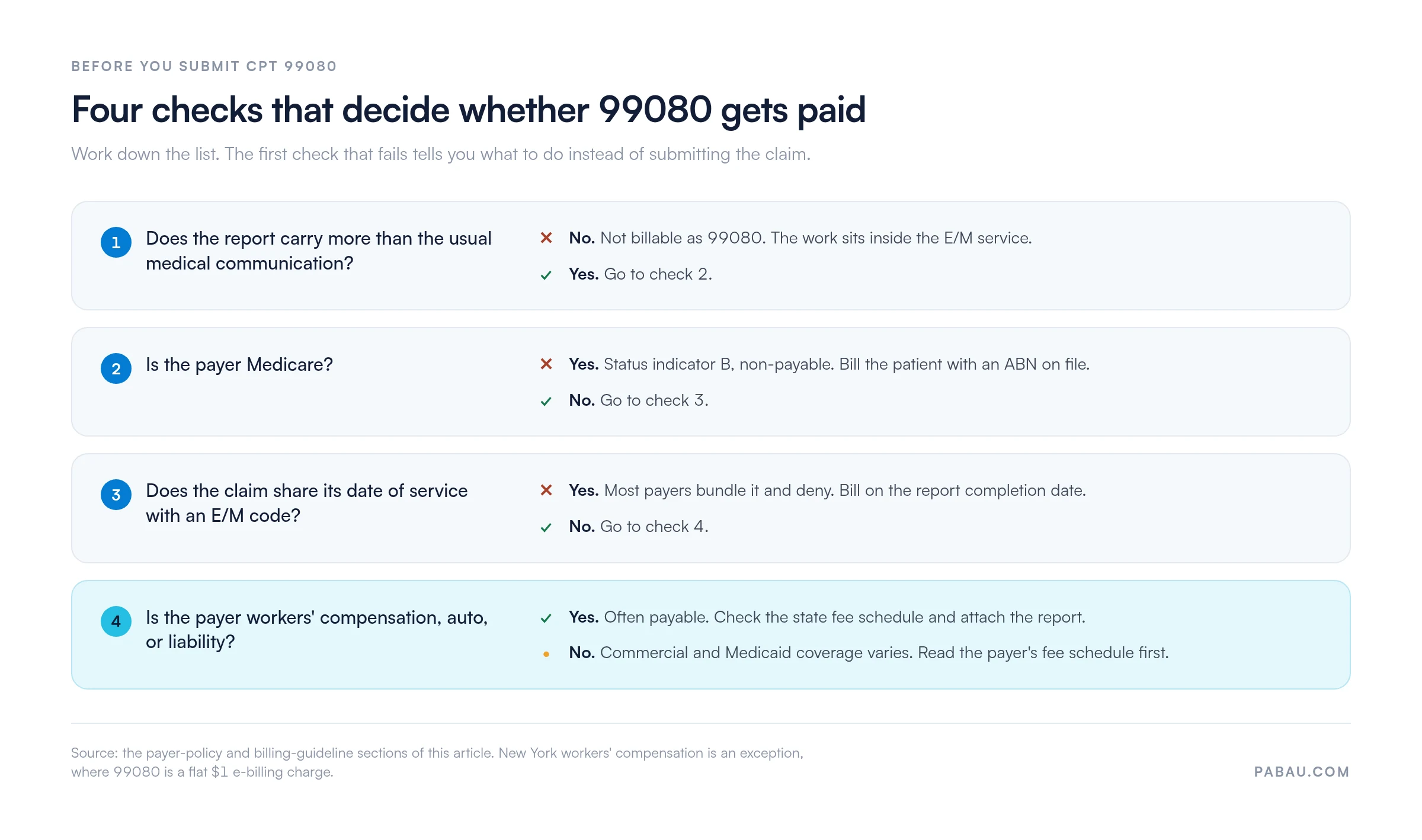
Bill CPT 99080 on the date the report was completed rather than the date of the patient encounter. Separate dates keep you clear of the automatic bundling trigger that most payers apply when 99080 and an E/M code share a date of service.
Reimbursement for CPT 99080 varies more sharply by payer type than almost any other miscellaneous code. Confirm the payer’s current policy through their provider portal or fee schedule before you bill. Watching how submitted 99080 claims get adjudicated is the fastest way to build a payer-specific picture of what pays and what gets denied.
Checking the patient’s benefits before the report is written tells you whether the plan is likely to cover it. That answer decides whether you collect upfront, bill the payer, or bill the patient afterward.
CPT 99080 is denied most often because Medicare assigns it status indicator B, which makes it bundled and non-payable. The AAPC CPT code reference confirms that designation under the Medicare Physician Fee Schedule.
CMS treats the code as folded into the global services provided to that patient, so no separate payment exists regardless of the documentation submitted.
Beyond Medicare, these are the most common denial triggers across all payer types:
Tracking denials by reason code and payer makes the pattern visible, which is where denial management earns its keep on this code. A payer that consistently denies 99080 despite valid documentation is applying a coverage policy. The response then shifts from appealing to renegotiating or billing the patient.
The bundling problem shows up most often when the physician completes a special report during or straight after an office visit. If the 99080 claim shares its date of service with an E/M code (99202-99215), most payers deny it. They fold the administrative service into the encounter.
Three practical approaches exist:
The medical billing denial codes reference lists the CARC and RARC reason codes that usually accompany a 99080 bundling denial. Front-desk and billing staff can then read the cause straight off the electronic remittance advice, known as the ERA, instead of guessing.
Workers’ compensation payers are among the most consistent payers for CPT 99080, but the rules vary substantially by state. Before assuming the code is payable, know your state’s fee schedule, its submission requirements, and any electronic billing mandate that applies.
New York shows how far a state can diverge. In the New York workers’ compensation system, 99080 is not a payment for a special report at all. The Workers’ Compensation Board allows it as a By Report line worth up to $1. That dollar offsets the cost of using a Board-approved electronic submission partner.
The mechanics follow from that. The charge has to appear on the same CMS-1500 as the treatment codes for that visit. It is never billed on its own, and no narrative report supports it. Reimbursement matches the cost the provider incurred, capped at that dollar.
So the general advice about separate dates of service does not apply in New York. Read your own state’s fee schedule and board bulletins before you assume 99080 behaves the same way there as it does elsewhere.
Several codes address adjacent scenarios where 99080 does not apply, or where a more specific code exists. Using the right code the first time reduces the risk of denial and improves coding accuracy.
Verify each code’s current AMA descriptor before using it. 99455 and 99456 in particular often carry better coverage than 99080 with workers’ compensation and commercial payers. Both are specific to the disability evaluation context. Compare work RVU values and Medicare fee schedule rates across these codes before you choose one.
When completing a disability evaluation, check whether 99455 (treating physician) or 99456 (other physician) applies before defaulting to 99080. Both are specific to the work disability context and often carry broader payer coverage, particularly with commercial insurers and workers’ compensation carriers.
Most 99080 write-offs start with a handoff. The provider finishes the report, the documentation lands in the chart, and the billing team submits the claim without the attachment. The denial that follows costs more in appeal and resubmission time than the payment was ever worth.
Practice management software like Pabau closes that handoff by keeping documentation, billing, and denial tracking in one system. Pabau’s claims management software holds the special report in the same place the claim is generated and submitted. Nobody has to go looking for it twice.
The Claim.MD clearinghouse integration then submits claims electronically to thousands of US payers, and it supports both CMS-1500 and 837P formats. Remittance advice comes back into the same system, so the billing team can see exactly how each 99080 claim was adjudicated.
For practices with heavy workers’ compensation or disability reporting, the same setup flags codes with known non-coverage before submission. Instead of learning about a status indicator B denial weeks after the fact, the team sees the problem during claim review.
Tracking 99080 denial rates by payer over time also builds the evidence for a decision. You end up knowing which carriers pay the code, which need a different billing strategy, and where direct patient billing is the better answer.

Pabau’s claims management tools let you attach supporting documentation directly to 99080 claims. Track denials by payer and flag non-covered codes before submission, so your team spends less time on rework.

CPT code 99080 is payable for the right payers and the right scenarios. What decides the outcome is documentation discipline and payer-specific knowledge, rather than the code itself. Medicare will not pay it. Many commercial plans will not either. Workers’ compensation and liability carriers often will, provided the documentation shows work beyond a routine encounter note.
So treat 99080 as a process rather than a coding question. Complete the report, attach it at submission, bill on the correct date, and track denials by payer so the approach adjusts over time. And check your own state’s rules first, because New York proves the code does not behave the same way everywhere.
Pabau’s billing tools support that workflow from documentation through to payment. Book a demo to see how attachment, clearinghouse submission, and denial tracking work on a 99080 claim.

Need to understand how claims get submitted electronically? Our Claim.MD clearinghouse guide explains how electronic claim submission works and what to expect from remittance advice.
Dealing with recurring denials across multiple codes? Medical claims clearinghouse overview covers how clearinghouses scrub claims before they reach payers, and why that matters for codes like 99080.
Want to reduce administrative billing errors? Revenue cycle management explained connects documentation, coding, and payment into one operational framework.
CPT code 99080 bills for special reports such as insurance forms, disability evaluations, and workers’ compensation reports. These carry more information than standard medical communication. It applies when a physician or qualified provider performs additional administrative documentation work beyond what a routine encounter note or referral letter captures.
Most payers bundle 99080 into the E/M service when both codes share a date of service. They treat the report as part of the office visit. To avoid this denial, bill 99080 on the date the report was completed, which may differ from the visit date. Some workers’ compensation payers accept a modifier that separates the two services on the same date, but this is payer-specific.
No. Medicare assigns CPT 99080 a status indicator of B, meaning bundled and non-payable. It is not separately reimbursable under the Medicare Physician Fee Schedule. Submitting 99080 to Medicare will result in a denial. Practices may bill the patient directly for non-covered administrative services when an appropriate Advance Beneficiary Notice is on file.
Yes, workers’ compensation payers are among the most consistent payers for CPT 99080. Coverage and allowed amounts vary by state fee schedule, so verify the rules for your state before billing. New York is a notable exception. There, 99080 is a flat charge of up to one dollar that offsets the cost of electronic billing.
Documentation must identify the type of report completed, the requesting party, and the additional work performed beyond standard encounter documentation. Record the time spent on the report separately from any face-to-face encounter time. Attach a copy of the completed report where the payer’s system supports attachments. Payer-specific requirements may add steps such as prior authorization or attestation forms.
CPT 99455 covers a work disability evaluation by the treating physician, and CPT 99456 covers one by a non-treating physician. Both are more specific alternatives for formal disability determinations. They often carry better payer coverage than 99080 in this context, particularly with commercial insurers and workers’ compensation carriers. Always verify current AMA descriptors and payer fee schedule listings before substituting codes.



