

CCSD code G5100: Bypass of duodenum billing guide
CCSD code G5100 bills a bypass that leaves the duodenum in place CCSD code G5100...

Last Updated: Oct 16, 2026
99225 is a deleted CPT code for subsequent observation care, per day, for a patient responding inadequately to therapy or with a minor complication. It required two of three key components: an expanded problem focused interval history, an expanded problem focused examination, and moderate-complexity medical decision making. Physicians typically spent 25 minutes at the bedside and on the patient's floor or unit.
The AMA deleted 99225 effective January 1, 2023, when observation and inpatient visits merged into one code family. Subsequent observation visits on or after that date are billed with 99231, 99232 or 99233, and 99232 is the moderate-complexity equivalent.
Let Pabau's smart automation suggest the right codes, reduce claim denials, and keep your practice compliant—effortlessly.
Automate repetitive tasks and focus on what matters most—your patients.
Reduce coding errors and ensure compliance with the latest regulations.
Clean claims, fewer denials, and faster reimbursements.
Powerful insights and reporting to help your practice thrive.
HIPAA compliant SOC 2 certified GDPR-compliant Trusted by 4,000+ clinics worldwide

CPT Code 99225 is a deleted subsequent observation care code. The AMA removed it from the CPT code set effective January 1, 2023.
The code applied to observation patients responding inadequately to therapy or with a minor complication, typically with about 25 minutes of physician time.
Since 2023, subsequent observation care is billed with the unified inpatient/observation codes: 99231 (low), 99232 (moderate) or 99233 (high complexity).
Time-based 99232 starts at 35 minutes, so a visit that once met 99225 at about 25 minutes needs moderate MDM documented instead.
Pabau’s claims management software sends claims through Claim.MD, where clearinghouse checks can stop a deleted code like 99225 before it reaches the payer.
CPT Code 99225 is a deleted evaluation and management code for subsequent observation care, per day. It sat in the Hospital Observation Services range (99217-99226) of the AMA’s CPT code set until January 1, 2023.
The official descriptor required at least two of these three key components:
Counseling or care coordination was provided as the patient’s problems and the family’s needs required. Usually, the patient was responding inadequately to therapy or had developed a minor complication. Typically, 25 minutes were spent at the bedside and on the patient’s hospital floor or unit.
Coders applied 99225 on the middle days of an observation stay. Those fell after initial observation care (99218-99220) and before the discharge day (99217). It was the middle tier of the series, above 99224 (stable, low complexity) and below 99226 (unstable, high complexity).
No, CPT Code 99225 is not active. The AMA deleted it effective January 1, 2023, in an E/M restructuring that retired the separate observation code series. That series ran from 99217-99220 for initial care to 99224-99226 for subsequent care. Any claim with 99225 for a date of service on or after that date will be rejected.
Claims for dates of service before January 1, 2023, remain valid under standard CMS policy for deleted codes. If a Medicare Administrative Contractor (MAC) or commercial payer audits 2022 or earlier, 99225 is still the right code for those dates. Check late-claim rules with your MAC, because policies vary by contractor.
The AMA retired the initial observation codes (99218, 99219, 99220) and the observation discharge code (99217) at the same time.
The same-day admission and discharge codes (99234-99236) stayed, revised to cover inpatient and observation stays alike. The aim was to stop tracking a patient’s status purely for coding when the clinical work matched inpatient care.
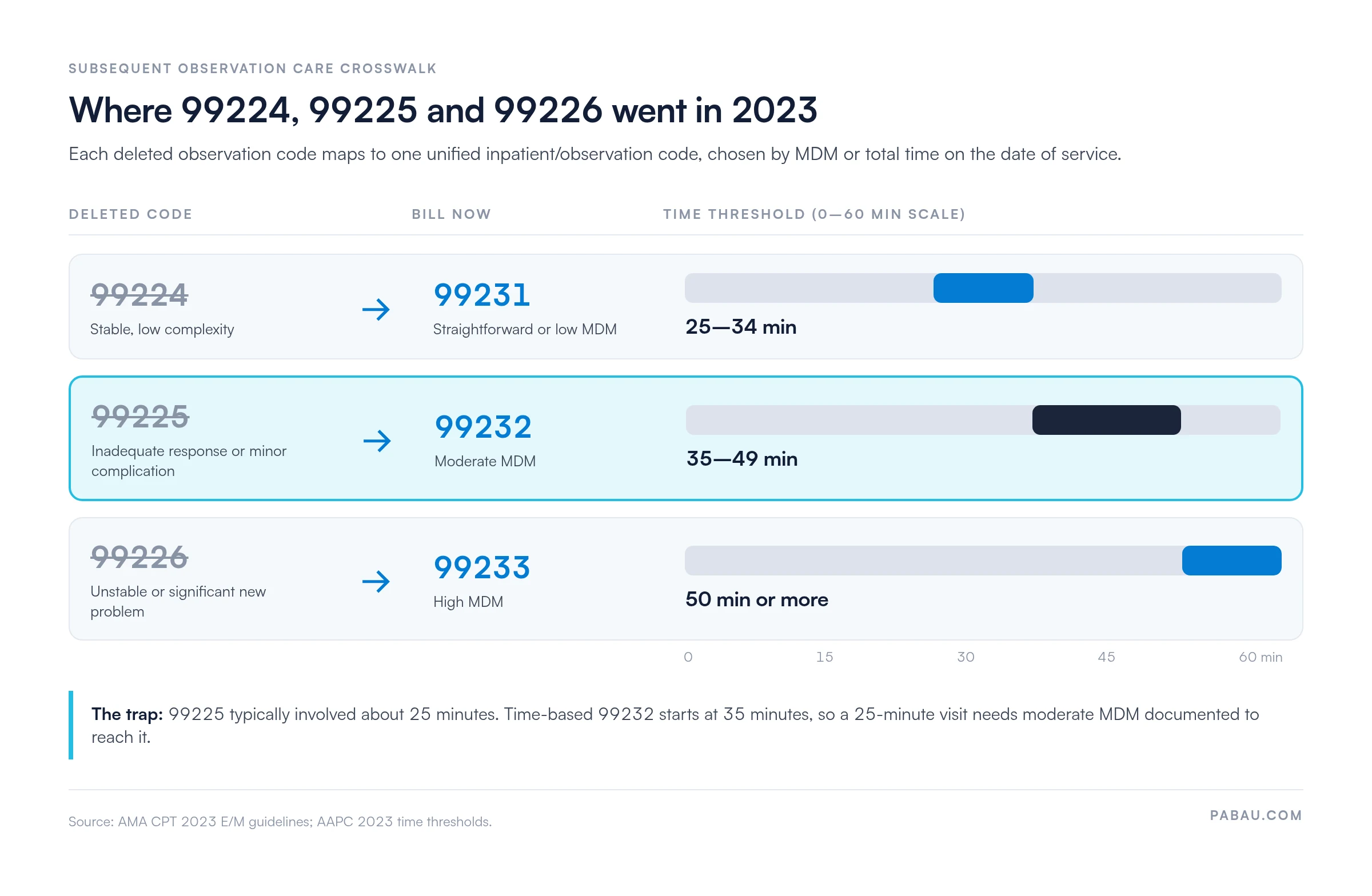
The 2023 AMA E/M restructuring replaced the 99224-99226 subsequent observation series with the unified subsequent care codes 99231, 99232 and 99233.
These apply whether the patient is formally admitted as an inpatient or placed in observation status. The level depends on medical decision making (MDM) complexity or total time spent.
The biggest operational change is that coders no longer pick codes by observation or inpatient status. The clinical work and MDM complexity drive code selection. A hospitalist seeing a patient on day two of observation who is responding inadequately to IV antibiotics now bills 99232, not 99225.
The crosswalk below shows where each deleted code went, and why the new time thresholds catch out coders used to 99225.
Observation status and inpatient admission are distinct administrative classifications, and the distinction carries significant financial consequences for patients under Medicare. Under Medicare Part B, a patient in observation is treated as an outpatient. They pay 20% coinsurance on each covered service and the full cost of any self-administered drugs.
An inpatient admission falls under Medicare Part A, which applies a single deductible and covers approved medications as part of the stay.
Before 2023, this distinction also drove code selection. Observation patients used the 99218-99226 series, and inpatients used the 99221-99233 series. That split is gone.
Post-2023, the unified 99221-99223 (initial) and 99231-99233 (subsequent) codes apply regardless of status. The status still matters for the patient’s bill; it no longer drives which E/M code the physician selects.
For pre-2023 claims, CPT Code 99225 required two of three key components. Those were an expanded problem focused interval history, an expanded problem focused examination, and moderate-complexity medical decision making. Alternatively, coders could bill on time, with about 25 minutes at the bedside and on the patient’s floor or unit.
A complete 99225 note had to include these elements to withstand audit under standard AMA CPT guidelines:
Ensuring medical billing compliance on observation notes requires building these elements into the EHR template so they are not omitted under time pressure. A missing medical necessity statement gets the claim denied, however thorough the rest of the note is.
For current claims (January 1, 2023, onward), billing subsequent observation care follows the unified inpatient/observation framework. The steps below apply directly and replace the old 99224-99226 workflow.
Check that every day between the initial care date and the discharge date carries a subsequent care claim. A middle day where the physician saw the patient but billed no code is both a compliance risk and lost revenue. Build a daily rounding charge capture audit into the hospitalist team’s end-of-shift workflow.
Upcoding and downcoding errors in the subsequent observation series were common before 2023 and remain a risk in the unified series.
The table below maps the full pre- and post-2023 code families side by side, making the complexity thresholds explicit. A clean claim needs the level that matches both the documented MDM and the note’s clinical narrative.
Time is where coders moving from the old system trip up. The post-2023 99232 starts at 35 minutes, while the old 99225 typically involved about 25. A physician used to reaching 99225 with a shorter visit must document more time or meet moderate MDM explicitly to justify 99232.
Refer to the CMS Physician Fee Schedule lookup tool for current reimbursement values by code and locality.
CPT Code 99225 is deleted, so no current Medicare Physician Fee Schedule (MPFS) rates apply. Historical rates for pre-2023 service dates varied by locality through the Geographic Practice Cost Index (GPCI) adjustments CMS applies to all E/M codes.
Facility and non-facility rates also differed. A patient in a hospital observation unit triggered the facility rate, and the non-facility rate applied elsewhere.
For historical rate lookups covering 2022 and earlier, use the FastRVU lookup tool filtered to the applicable fee schedule year. For current reimbursement on 99232, the functional replacement for 99225-level work, the CMS fee schedule search gives national rates. Your MAC then adjusts them using your locality’s GPCI values.
The work RVU for 99232 is 1.59 under the 2024 MPFS, up from 1.39 before the 2023 revaluation. Rates update annually, so verify against the applicable year’s published values.
Denial patterns for CPT Code 99225 followed consistent themes across payers. Understanding them remains relevant for retroactive audits and informs denial prevention on the current 99232 equivalent. Robust denial management workflows start with knowing which failure mode triggered each rejection.
Reviewing common denial codes in medical billing can help revenue cycle teams identify patterns across observation claims before they accumulate into write-offs. The medical claims clearinghouse layer catches many of these errors before the claim leaves the practice management system.
CMS sets the federal framework for observation billing, but Medicare Administrative Contractors issue Local Coverage Determinations that add jurisdiction-specific requirements.
MACs have differed on acceptable observation duration, required supporting diagnosis codes, and documentation detail for extended stays. A patient in a Noridian jurisdiction may face different audit triggers than one in a CGS jurisdiction for the same clinical presentation.
Commercial payers operate entirely outside the CMS framework. Many impose their own observation billing policies, prior authorization requirements, and time limits.
Some commercial contracts require notification within hours of a patient being placed in observation status; others require clinical review on day two. Check individual payer contracts and policy bulletins rather than assuming CMS rules apply.
Systematic monitoring of these policies is an underappreciated part of revenue cycle management that prevents observation-specific denials before they reach the claims stage.
The AAPC Codify CPT lookup indexes MAC and commercial payer policy articles alongside code descriptors. It’s a practical starting point when researching LCD requirements for a specific observation scenario.
Without a check at submission, a deleted code shows up only as a denial. An old charge capture template still lists 99225, the claim goes out, and the rejection arrives weeks later.
Pabau’s claims management software builds the claim from the invoice, with the patient, treatment and insurer details already attached. Validation checks keep the Send button disabled until required details are in place. Claims then go to payers through Claim.MD, with real-time eligibility checks and status tracking.
Your billing team spends less time on resubmissions and more on the documentation queries that decide the 99231-99233 level.

Pabau’s claims management software, connected to Claim.MD, checks claim details before they go out and tracks every claim to payment. See how it works for hospital-based and multi-specialty practices.

If your charge capture templates still list 99224-99226, retire them now and map each one to its unified replacement. That single update removes the denial that 99225 triggers automatically on any current-date claim.
The harder change is time. A visit that once reached 99225 at about 25 minutes won’t reach 99232 on time alone. Document moderate MDM in the observation note, or bill 99231 when the note supports only low complexity.
For pre-2023 audits, defend 99225 notes on the old key components, not the new MDM rules. Either way, the note has to show why the patient is still there and what the physician did about it.
Book a demo to see how Pabau checks observation claims before they reach the payer.

Coding a low-complexity follow-up day? CPT code 99231 covers the straightforward or low-MDM tier that replaced 99224.
Managing an unstable observation patient? CPT code 99233 explains the high-MDM tier that replaced 99226.
CPT Code 99225 is a deleted evaluation and management code for subsequent observation care. It covered a patient responding inadequately to therapy or with a minor complication, typically with about 25 minutes of physician time. It was valid for service dates before January 1, 2023.
Yes, CPT Code 99225 is deleted effective January 1, 2023. The AMA eliminated the entire separate observation care code series as part of the E/M restructuring that year. Claims submitted with 99225 for current dates of service are automatically denied.
The unified inpatient/observation subsequent care codes 99231, 99232, and 99233 replaced the deleted observation series. 99231 maps to low complexity (was 99224), 99232 to moderate complexity (was 99225), and 99233 to high complexity (was 99226). These codes now apply regardless of whether the patient is in observation or formal inpatient status.
No current Medicare rate exists for CPT 99225 because the code is deleted. For historical rates covering 2022 and earlier service dates, use FastRVU or the archived CMS Physician Fee Schedule files for the applicable year. For equivalent current-date services, look up 99232 in the current MPFS, noting that rates vary by locality and are updated annually.
Both represent moderate-complexity subsequent care, but they differ in time threshold and scope. The deleted 99225 typically involved about 25 minutes and applied only to observation patients. The current 99232 requires 35-49 minutes (or moderate MDM documentation) and applies to observation and inpatient stays alike.
Claims using CPT 99225 for service dates on or after January 1, 2023, are denied because the code is deleted. Payers reject deleted codes automatically during claims adjudication. The fix is to update charge capture templates and coding workflows to use 99231, 99232, or 99233 based on complexity.



