HCPCS code E0198: Water pressure pad billing guide
HCPCS code E0198 is a water pad for a standard mattress HCPCS code E0198 is the ...

Last Updated: Oct 13, 2026
Q4182 is the HCPCS Level II code for transcyte, per square centimeter (add-on, list separately in addition to primary procedure).
Let Pabau's smart automation suggest the right codes, reduce claim denials, and keep your practice compliant—effortlessly.
Automate repetitive tasks and focus on what matters most—your patients.
Reduce coding errors and ensure compliance with the latest regulations.
Clean claims, fewer denials, and faster reimbursements.
Powerful insights and reporting to help your practice thrive.
HIPAA compliant SOC 2 certified GDPR-compliant Trusted by 4,000+ clinics worldwide

HCPCS code Q4182 describes Transcyte, a biosynthetic skin substitute, reported per square centimeter to Medicare and most commercial payers.
Q4182 has to be paired with a CPT application code from the 15271-15278 series, because the supply code alone is denied.
The anatomic site and the total wound surface area decide which of the eight application codes applies.
Wound measurements in square centimeters belong in the clinical record before every Q4182 claim is submitted.
Pabau’s claims management software keeps per-unit quantities with the encounter that produced them, so clean claims go out first time.
Q4182 is a Level II HCPCS supply code for Transcyte skin substitute, billed per square centimeter. The Centers for Medicare and Medicaid Services (CMS) maintains it as part of the Q4100 series, which covers skin substitute graft products. Payment runs through the Outpatient Prospective Payment System (OPPS) or the Medicare Physician Fee Schedule (MPFS), depending on the setting. CMS publishes the full HCPCS Level II code set annually, and the CMS HCPCS overview is the authoritative source for code structure and maintenance.
The supply code reports the product. A separate application procedure code reports the work of applying it, and sequencing the two correctly is what keeps the claim payable.
Wound care billing sits alongside scheduling and clinical documentation, so a practice running all three in one system spends less time reconciling them. Claims management software keeps each per-unit quantity attached to the encounter it came from.
Transcyte is a biosynthetic wound dressing that works as a temporary skin substitute. It lays a biologically active matrix over partial-thickness burns and chronic wounds while the patient’s own skin regenerates. Advanced Tissue Sciences developed the product and obtained FDA premarket approval for it in March 1997.
Clinically, Transcyte is indicated for partial-thickness burns, donor sites, and selected chronic wound types where a temporary barrier is needed. Key product characteristics relevant to billing and coverage decisions include:
Confirm current availability with the product’s present distributor, and check that the treating facility used Transcyte itself, before assigning HCPCS code Q4182. Applying Q4182 to a different skin substitute is a misrepresentation that payers will recoup on audit.
Medicare reimburses Q4182 per square centimeter of Transcyte applied. Allowable amounts vary by setting, by geographic locality, and by Medicare Administrative Contractor (MAC) jurisdiction. CMS publishes updated rates annually, and the current figures are available through the CMS Physician Fee Schedule lookup.
Because allowables are per square centimeter, the units billed have to equal the wound area treated. Rounding up, or billing a stock package quantity instead of the measured area, is a common audit trigger. Verify your MAC’s current allowable for Q4182 before setting internal fee schedules.
HCPCS code Q4182 reports the Transcyte product itself. A separate CPT application code from the 15271-15278 series reports the work of applying the skin substitute. Both codes belong on the same claim, and Q4182 submitted on its own is usually denied. Getting that pairing right on the first submission is most of what a clean claim takes here.
Two questions settle the choice. The first is which anatomic group the wound sits in, and the second is whether total wound surface area reaches 100 sq cm.
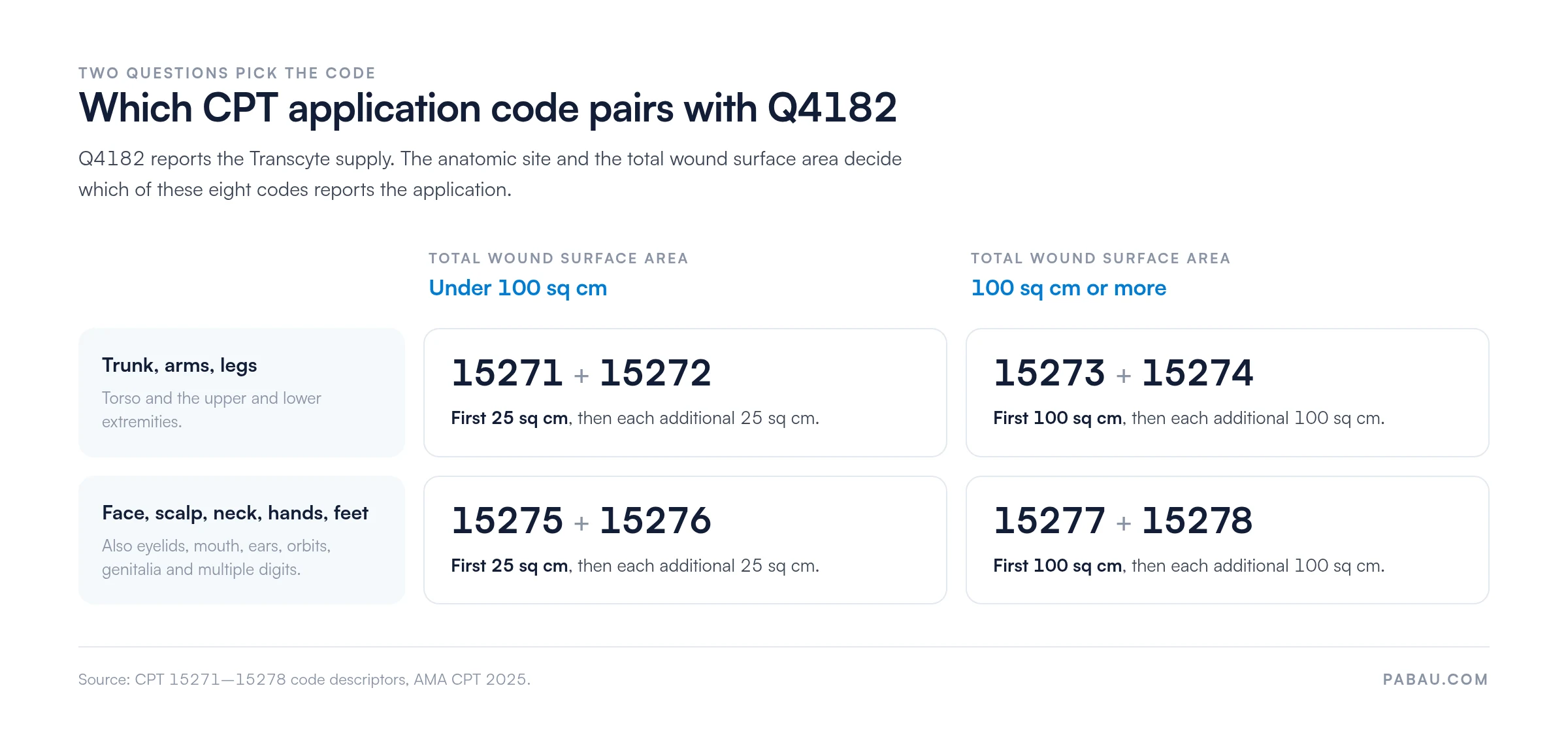
For infants and children, the descriptors on 15273, 15274, 15277 and 15278 express the same thresholds as a percentage of body area. No descriptor in this family distinguishes an acellular dermal replacement from any other skin substitute.
Report Q4182 units as the total wound area in whole square centimeters. A wound measuring 12.4 sq cm is billed as 12 units, because rounding up inflates the quantity and creates a billing error. The AAPC HCPCS code lookup and the NLM HCPCS Level II API are useful for verifying code descriptors and attributes.
Common modifiers and claim-level fields used with Q4182 include:
Verify modifier applicability against your MAC’s current LCD for skin substitute grafts. Requirements differ by region, and they are revised more often than the code set is.
Medicare coverage for Q4182 depends on the applicable MAC Local Coverage Determination (LCD) for skin substitute grafts. No national coverage determination (NCD) exists for Q4182 specifically. Prior authorization (PA) requirements vary:
Check eligibility and prior authorization before the procedure, not after it. A benefits check confirms active coverage and surfaces any approval the plan expects on a high-cost skin substitute. Applying Transcyte first and asking later leaves the practice holding the cost when the payer refuses.
Post-payment audits on Q4182 usually turn on the medical record rather than the code itself. The table below maps each documentation element to the billing purpose it serves. It also names where in the chart an auditor expects to find it.
Many MAC LCDs for skin substitutes require evidence that standard wound care was tried for four weeks first. A missing treatment history is the most common reason an otherwise valid Q4182 claim fails on audit. Pull the prior visit notes into the record before the claim goes out, rather than after a recoupment letter arrives.
Audit your wound measurement documentation before submitting any Q4182 claim. Pull the procedure note and confirm the wound area in square centimeters matches the units billed on the claim. Correct the record before submission when the measurement is missing or imprecise. Running the same check across the last 90 days of Q4182 claims shows whether the problem is one claim or the whole workflow.
The Q4100 series covers the skin substitute graft supply codes. When the product applied is not Transcyte, the correct code is the Q4-series code specific to that product, and billing Q4182 instead is a misrepresentation. Use the table below to identify the adjacent codes for commonly applied skin substitutes.
Q4182 claims require a supporting ICD-10-CM diagnosis code on the same claim. The diagnosis has to reflect the wound type that justifies applying Transcyte. The codes below are the ones most consistently paired with Q4182 in wound care settings. When the wound type falls outside this list, our ICD-10-CM codes library covers the wider set.
Select the most specific ICD-10-CM code available for the wound type, site, and severity. Reaching for an unspecified code when a more specific one exists is a red flag on claim review. Confirm each code is active for the date of service, since ICD-10-CM updates take effect on October 1.
In most wound care practices the measurement and the claim live in different places. A clinician writes the wound area into the procedure note, and a biller keys the unit count onto the claim. Nobody compares the two until a payer asks for the record.
Practice management software like Pabau keeps the encounter and the claim on one patient record. The wound measurement captured in the clinical note stays attached to the charge. That makes the Q4182 unit count traceable to the note that justifies it. The application CPT code and the supporting diagnosis sit on the same encounter.
That means a documentation request is answered from one place instead of three. Claim status is visible as it moves, so a rejected Q4182 line is corrected while the filing window is still open.

Pabau’s claims management tools help wound care practices keep per-unit quantities with the encounter they came from. They pair supply and procedure codes so clean claims go out the first time. See how it works with a short demo.

Q4182 is a simple code with an unforgiving paper trail. The descriptor, the units, and the application code are quick to get right. What decides whether the payment survives a look back two years later is the record behind them.
So the work worth doing sits upstream of the claim. Fix how the wound measurement reaches the note, and the unit count on the claim stops being a judgment call. The rest is transcription.
Pabau keeps the wound measurement, the application code, and the claim on one patient record. Book a demo to see how Pabau tracks per-unit supply codes alongside the clinical notes that justify them.

Need to understand how denial codes affect wound care claims? Denial codes in medical billing explains the most common remittance advice codes and how to respond to them.
Want to build a cleaner claims submission workflow? Electronic remittance advice covers how ERAs streamline payment posting and denial tracking for billing teams.
Looking for a broader guide to wound care billing compliance? Revenue cycle management fundamentals walks through the full claims process from coding to payment reconciliation.
New to the claims lifecycle behind a supply code? What is medical billing follows a claim from the encounter through to payment posting.
Worried about audit exposure on high-cost supplies? Medical billing compliance sets out the documentation standards that hold up under post-payment review.
HCPCS code Q4182 is the Level II code for Transcyte, a biosynthetic skin substitute, billed per square centimeter to Medicare and commercial payers. It falls within the Q4100 series of skin substitute graft supply codes maintained by CMS.
Q4182 is billed per square centimeter of Transcyte applied. Units reported on the claim must equal the wound area measured in whole square centimeters on the date of application. Billing a stock package quantity instead of the measured area is a billing error.
Prior authorization requirements vary by payer. Traditional Medicare generally does not require PA for Q4182, though some MACs and most Medicare Advantage plans do. Commercial payers commonly require prior authorization for high-cost skin substitutes, so confirm requirements before performing the procedure rather than after.
Q4182 is paired with a CPT code from the 15271-15278 series for skin substitute application. The anatomic site group and the total wound surface area decide which code applies, with 100 sq cm as the threshold. Both the supply code and the application code belong on the same claim, because Q4182 submitted alone is denied.
Q4182 was an active HCPCS Level II code as of the 2025 CMS HCPCS update. Verify the code’s status each year against the annual CMS HCPCS Level II code file. Q-series skin substitute codes are reviewed and occasionally revised each October. Never bill a code without confirming it is active for the date of service.
Required documentation starts with the wound measurement in square centimeters, matching the units billed. Add the wound type and ICD-10-CM diagnosis code, the product name and lot number confirming Transcyte was used, and a medical necessity statement. The record also needs treating provider credentials, evidence of prior conservative wound care, and the place of service. Missing wound measurements and absent prior treatment records are the two most common audit failures.