HCPCS code P9058: Red blood cells, leukocytes reduced, CMV-negative, irradiated
HCPCS code P9058: Official descriptor and key attributes HCPCS code P9058 report...

Last Updated: Oct 26, 2026
99220 was the CPT code for initial observation care, high complexity (comprehensive history and exam, high-complexity MDM, typically 70 minutes at the bedside). It covered the first day a physician managed a patient placed in hospital observation status.
The American Medical Association (AMA) deleted CPT 99220 effective January 1, 2023, when it merged observation and inpatient hospital E/M codes. Payers reject or deny 99220 on any date of service from that day on. Bill 99234-99236 when admission and discharge fall on the same date, or 99223 for a high-complexity first day when the stay crosses calendar dates.
Let Pabau's smart automation suggest the right codes, reduce claim denials, and keep your practice compliant—effortlessly.
Automate repetitive tasks and focus on what matters most—your patients.
Reduce coding errors and ensure compliance with the latest regulations.
Clean claims, fewer denials, and faster reimbursements.
Powerful insights and reporting to help your practice thrive.
HIPAA compliant SOC 2 certified GDPR-compliant Trusted by 4,000+ clinics worldwide

CPT Code 99220 was deleted January 1, 2023, along with six other standalone observation-only E/M codes (seven in all: 99217-99220 and 99224-99226).
High-complexity initial observation care now bills under 99236 for same-day admission and discharge, or 99223 when the stay spans separate calendar days.
The 2023 replacement codes are selected by medical decision making (MDM) or total time, not by the three key components 99220 required.
Payers reject or deny CPT 99220 on any date of service after December 31, 2022, because the code no longer exists.
Pabau’s claims management software submits claims through Claim.MD and routes remittance advice back into Pabau, so denials are tracked in one place.
CPT Code 99220 was the high-complexity code in the initial observation care series (99218, 99219, 99220). The American Medical Association (AMA) deleted it on January 1, 2023. The series covered the first day a physician managed a patient placed in hospital observation status. Today the same encounter is billed with 99236 or 99223, depending on the calendar dates.
Each 2022 code required three key components: a level of history, a level of examination and a level of medical decision making. The table shows how the three codes differed.
The 2022 AMA CPT codebook described 99220 as initial observation care, per day, requiring all three key components. Those were a comprehensive history, a comprehensive examination and medical decision making of high complexity. Physicians typically spent 70 minutes at the bedside and on the patient’s unit. The code is not valid for any date of service from January 1, 2023 onward.
The AMA eliminated CPT Code 99220 and six companion codes (seven deleted observation codes in all) in its 2023 evaluation and management (E/M) restructuring. Observation status is a billing designation rather than a clinical one. Keeping separate code sets for observation and inpatient care added complexity without a clinical reason.
The deleted observation codes are:
The AMA’s rationale was to align coding with the patient encounter rather than the administrative designation of observation or inpatient. Under the restructured system, the complexity of care drives code selection. Hospitalists and attending physicians code the same encounter the same way, whether the patient is in observation or formal inpatient status.
The replacement for CPT 99220 depends on two factors. The first is whether the patient was admitted and discharged on the same calendar day. The second is whether the encounter was an initial or subsequent visit. The table maps the most common 99220 scenarios to their current equivalents.
Take the most common case. A hospitalist evaluates a new observation patient with a high-severity problem, reviews extensive outside records and manages a complex treatment plan. That encounter is now billed as 99236 with a same-day discharge, or 99223 when the stay crosses calendar days. Place of service still goes on the professional claim, but it does not change which E/M code you select.
The whole choice comes down to one question about dates, as the decision diagram below shows.
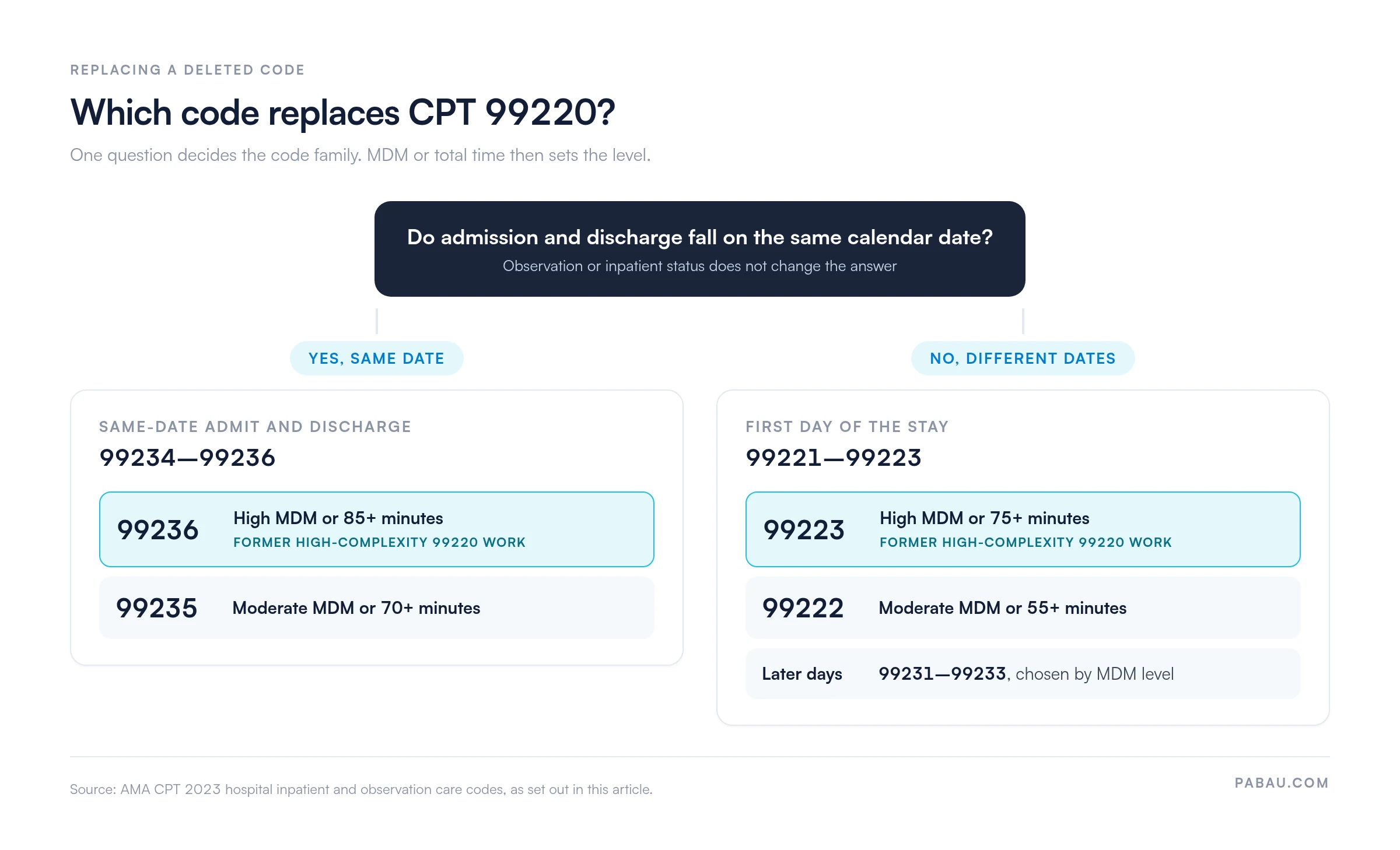
Check the calendar-day boundary before choosing between 99236 and 99223. If the initial encounter and the discharge fall on the same date, use 99236. If the patient stays past midnight, use 99223 for the admission day. Bill 99231-99233 for each day after that, and discharge day management codes 99238-99239 for the final day.
Documentation for 99236 and 99223, the main replacements for CPT Code 99220, follows the MDM table the AMA extended to hospital codes in 2023. High-complexity MDM requires meeting at least two of the three elements below.
The physician can also qualify on time alone, with at least 85 minutes for 99236 or 75 minutes for 99223. Total time covers face-to-face and non-face-to-face work on the date of the encounter. That includes reviewing records, ordering tests, coordinating care and documenting. State the time explicitly in the record.
Auditors often downcode from high to moderate complexity when physicians document clinical findings but leave out the MDM reasoning. Three patterns commonly lead to a downcode.
CMS governs observation billing through its two-midnight rule, which determines whether a patient qualifies for inpatient admission or remains in observation status. Under this rule, a physician must expect the patient to need hospital care spanning at least two midnights to support formal inpatient admission. Stays expected to be shorter generally stay in observation, which affects patient cost-sharing but not professional E/M code selection.
For professional billing, the replacement codes (99221-99223, 99231-99233, 99234-99236) apply whether the patient is in observation or inpatient status. The CMS Physician Fee Schedule reimburses the professional component at the same rate for the same code regardless of observation versus inpatient designation. Understanding medical billing fundamentals remains essential because facility billing and professional billing follow different rules here.
Medicare Administrative Contractors (MACs) such as CGS and Novitas issue jurisdiction-specific guidance on observation documentation requirements. MAC policies may add documentation standards beyond the AMA’s MDM framework. Check your MAC’s local coverage articles before you finalize an internal policy. Commercial payers often follow CMS guidelines for observation billing, but some set their own authorization rules for longer observation stays.
Several active E/M codes are frequently mistaken for 99220 or for its replacement codes, particularly by coders who trained before 2023. The comparison below clarifies which setting, timing, and complexity level each code requires.
Coders who remember the old observation series sometimes reach for 99223 when they mean 99236, or the reverse. The calendar-day rule is the primary test. If admission and discharge fall on the same calendar date, 99234-99236 are the correct family. If discharge falls on a later date, the first day is billed with 99221-99223.
When CPT Code 99220 appears on a date of service from January 1, 2023 onward, payers will reject or deny the claim. The denial reason varies by MAC and commercial payer. The table pairs the common reasons with the fix for each.
Proactive denial management strategies catch deleted-code submissions before they leave the practice. A claim scrubber with an up-to-date code set stops 99220 from reaching a payer on a 2023 or later date of service. Understanding common denial codes in medical billing helps billing staff respond quickly when a remittance returns with a deleted-code adjustment.
For claims with a pre-2023 date of service, CPT 99220 remains valid. A claim for an observation encounter dated December 30, 2022 is correctly coded with 99220 and should not be recoded to the 2023 replacement series.
For legacy billing research, internal audits, or retrospective chart reviews, the 2022 Medicare Physician Fee Schedule values for CPT Code 99220 are recorded below. The current values for 99223 and 99236 sit alongside them for comparison. All figures come from the CMS relative value files (CY2022 October release and CY2026 July release).
CMS revalued the hospital inpatient and observation codes for 2023, so the replacements do not carry 99220’s values. A 99236 now carries more total RVUs than 99220 did, and a 99223 carries fewer. For exact 2022 dollar amounts by locality, the AAPC Codify CPT lookup and the CMS fee schedule archive are the recommended references.
When conducting a retrospective audit of 2022 claims, verify the date of service before recoding. Claims dated on or before December 31, 2022 should retain CPT 99220 as originally coded. Recoding a valid pre-2023 claim to the 2023 replacement series creates a corrected-claim submission that may trigger a medical record request from the payer.
A 99220 rejection on a 2023 date of service is quick to fix once someone spots it. The slow part is matching each denial back to its encounter when claims, remittances and patient records live in separate tools.
Pabau, the practice management platform we build, connects its claims management software to the Claim.MD clearinghouse. Pabau’s Claim.MD integration submits claims and routes remittance advice back into Pabau, so denials are tracked in one place. Each denial reason code sits next to the claim and the patient record it came from.
Your coder still chooses the replacement code, whether that is 99236 or 99223. What changes is the follow-up. The corrected claim goes back out from Pabau and is tracked the same way, without reconciling remittance files by hand.
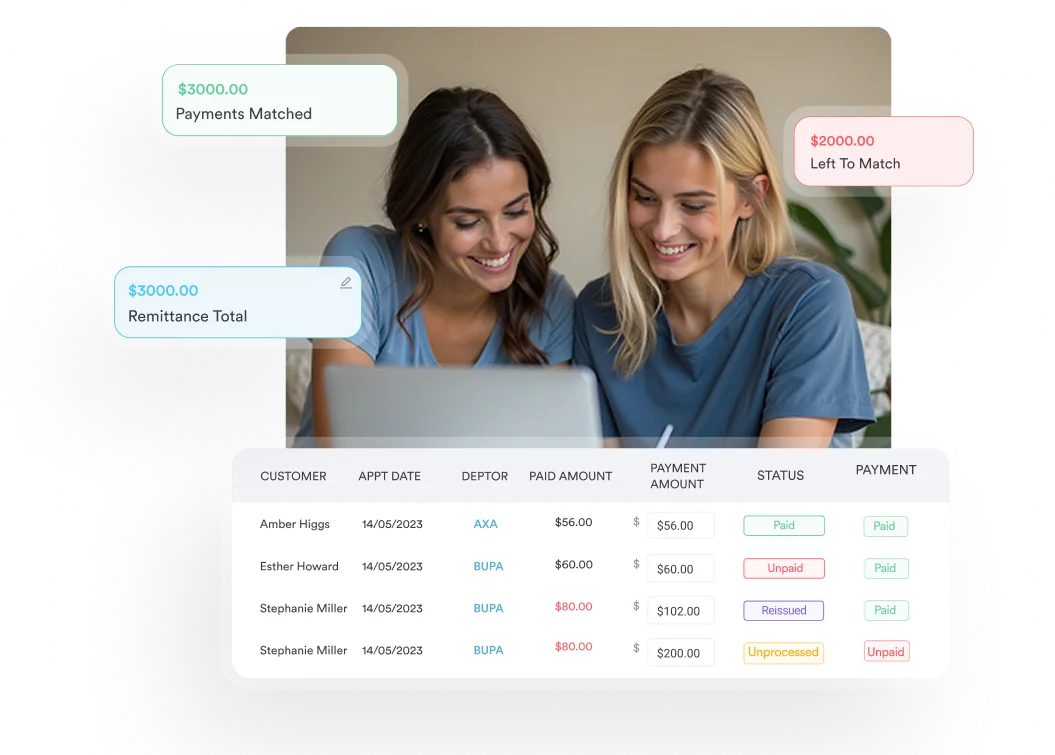

Pabau’s Claim.MD integration submits claims and routes remittance advice back into Pabau, so denials are tracked in one place. Your billing team sees each denial reason next to the claim it belongs to.

Treat 99220 as a historical code. Keep it on claims dated on or before December 31, 2022, and never recode those claims to the 2023 series.
For every current encounter, settle the calendar dates first. Same-date admission and discharge points to 99234-99236, and a later discharge points to 99221-99223 for the first day. Then document the two MDM elements, or the total time, that support the level you bill.
The date check and the MDM reasoning are where these claims most often fail. Get both right in the note, and the replacement code defends itself in an audit.
Book a demo to see how Pabau keeps observation claim denials and remittance advice in one place for your billing team.

Need to understand how claim denials are classified? Denial codes in medical billing explains the CARC and RARC code sets that appear on remittance advice when a claim is adjusted or denied.
Looking for a structured approach to working denied claims? Denial management in healthcare covers the end-to-end process from identifying root causes to tracking appeal outcomes.
Want to understand how observation billing fits into the broader revenue cycle? Revenue cycle management fundamentals explains how claim submission, adjudication and payment posting connect across the patient encounter.
Billing a low or moderate same-day stay? CPT code 99234 covers the same-date admission and discharge code at the lower end of the 99234-99236 family.
Coding the days after a high-complexity admission? CPT code 99233 explains high-complexity subsequent hospital care, which replaced the deleted 99226.
CPT Code 99220 was the high-complexity initial observation care code, used for first encounters with observation-status patients. It required a comprehensive history, a comprehensive examination and high-complexity medical decision making. The AMA deleted this code effective January 1, 2023, as part of the E/M restructuring that eliminated all standalone observation-only codes.
CPT 99236 replaced 99220 for same-day observation/inpatient admission and discharge at high complexity. CPT 99223 replaces it when the patient is admitted and the encounter spans separate calendar days. Both require high MDM or equivalent time documentation.
Yes, but only for dates of service on or before December 31, 2022. For any date of service from January 1, 2023 onward, CPT 99220 is a deleted code and payers will reject or deny the claim. Use the 99234-99236 or 99221-99223 series for all current encounters.
CPT 99220 was a standalone observation-only code deleted in 2023. CPT 99236 is its current replacement for same-day observation or inpatient encounters at high complexity, requiring high MDM or 85+ minutes of total time. Unlike 99220, code 99236 applies whether the patient was technically in observation or formal inpatient status.
Subsequent hospital care codes 99231 (low), 99232 (moderate), and 99233 (high) replaced the deleted subsequent observation care codes 99224, 99225, and 99226. Select the complexity level based on the MDM documented for each subsequent visit. The same AMA MDM framework applies to initial and same-day codes.