CCSD Code M7590: Suburethral tape sling billing guide
CCSD Code M7590: Official descriptor and what it covers CCSD Code M7590 has one ...

Last Updated: Nov 10, 2026
99172 is the CPT code for automated or semi-automated visual function screening of both eyes. It quantitatively measures visual acuity, ocular alignment, color vision by pseudoisochromatic plates, and field of vision. It may also include contrast sensitivity and vision under glare.
The code was created for occupational medicine, where pilots, drivers, and other workers need vision clearance for their jobs. A pediatric acuity screen with a chart is CPT 99173, and instrument-based photoscreening is 99174 or 99177. Medicare lists 99172 as non-covered, so employers, private payers, or patients usually pay.
Let Pabau's smart automation suggest the right codes, reduce claim denials, and keep your practice compliant—effortlessly.
Automate repetitive tasks and focus on what matters most—your patients.
Reduce coding errors and ensure compliance with the latest regulations.
Clean claims, fewer denials, and faster reimbursements.
Powerful insights and reporting to help your practice thrive.
HIPAA compliant SOC 2 certified GDPR-compliant Trusted by 4,000+ clinics worldwide

CPT 99172 is an automated or semi-automated visual function screen that measures acuity, ocular alignment, color vision, and field of vision in both eyes.
The code was created for occupational medicine, such as screening pilots and drivers, not for pediatric well-child visits.
A quantitative acuity screen with a Snellen-type chart is 99173, and instrument-based photoscreening is 99174 or 99177.
CCI bundles 99172 into eye exam codes 92002-92014 with modifier indicator 0, so no modifier unbundles the pair.
Medicare lists 99172 as non-covered with 0.00 RVUs in the CY2026 fee schedule, so employers, private payers, or patients usually pay.
CPT code 99172 reports automated or semi-automated visual function screening of both eyes. Also, one session gives quantitative results for visual acuity, ocular alignment, color vision, and field of vision. Moreover, the code sits in the Medicine section of CPT, in the 99170-99199 range of other services and procedures.
The American Medical Association added 99172 in CPT 2001 at the request of occupational medicine. As a result, it was built for screening pilots and other professionals whose vision is essential to the job.
CPT code 99172 covers one screening session that tests several visual functions in both eyes on an automated or semi-automated device. The results are quantitative, so each function produces a measured value.
However, the descriptor has no age band. The patient is usually an adult worker, because the screen depends on reliable responses across several subtests.
Furthermore, CPT code 99172 does not cover an acuity-only screen, instrument-based photoscreening, or a diagnostic eye examination. Instead, each of those has its own code.
In short, the line between screening and diagnosis decides the code. A screen identifies people who need a full exam, while a diagnostic exam evaluates a complaint or a known condition.
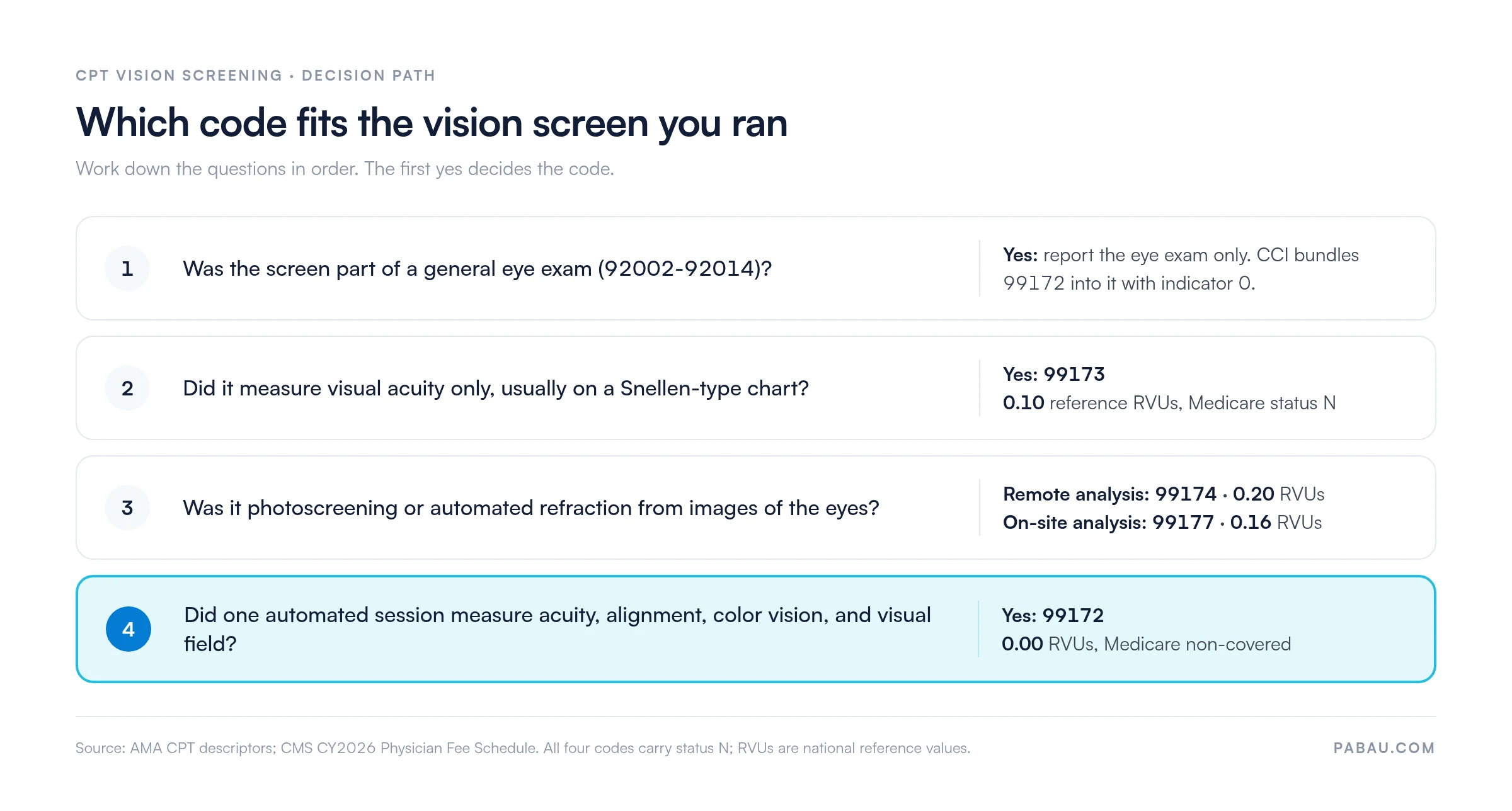
CPT 99173 is a quantitative, bilateral screening test of visual acuity alone. In contrast, CPT 99172 screens acuity plus alignment, color vision, and visual field on an automated or semi-automated device. So what was tested, and on which device, decides the code.
For example, if the screen measured acuity only, report 99173. If one automated session measured acuity, alignment, color vision, and visual field, report 99172.
Code from the device printout. A vision tester report with acuity, alignment, color, and field results supports 99172. A wall chart reading of 20/30 in each eye supports 99173 only.
CPT 99174 and 99177 report instrument-based ocular screening of both eyes, such as photoscreening or automated refraction. 99174 applies when the images go for remote analysis and report, and 99177 when analysis happens on site. In addition, neither needs the patient to read a chart.
However, all three codes involve a device, which is where the confusion with 99172 starts. For example, a photoscreener flags risk factors in a child who cannot cooperate with a chart. By contrast, a 99172 device measures several visual functions against the vision standard a job requires. The decision path below sorts a screen into its code from what was tested and how.
Occupational medicine physicians and the practices that run employer screening programs report 99172 most often. Also, AAPC coding guidance notes the code was not designed for ophthalmologists, whose eye exams usually include these functions already.
By contrast, optometrists rarely use it. When they do, the patient usually needs vision clearance for a job, a recertification, or a license to operate vehicles or machinery.
Trained staff commonly run the screening device, while the billing provider reviews the results. However, who may perform and supervise the test depends on the payer contract and on state scope-of-practice rules.
Consequently, CPT 99172 is not reported with a general ophthalmological service or an E/M service. The code’s CPT instruction says so, and CCI edits also enforce the eye exam pairing.
Therefore, check the current quarterly CCI tables before you build a claim. Edits change each quarter, and a commercial payer may also apply its own bundling policy on top.
The record, however, has to show that an automated or semi-automated screen measured the functions in the descriptor, in both eyes. Otherwise, a note that reads “vision screen passed” supports neither 99172 nor 99173.
Finally, attach the device printout or result export to the visit. It also shows that each function was measured, and a payer reviewing the claim may ask for it. Submitting a clean claim starts with documentation that supports every element of the code.
Build a structured 99172 note with one field per subtest and a required pass, fail, or refer outcome. A note with acuity filled in and the other fields empty tells the provider the visit supports 99173, not 99172.
First, Medicare does not pay for CPT 99172. The CY2026 Physician Fee Schedule also assigns it status indicator N, which CMS defines as a non-covered service, with 0.00 RVUs. Run insurance eligibility verification before the screen, so the patient or employer knows who pays.
Meanwhile, Medicaid rules are set state by state. Pediatric vision screens are usually reported with 99173, 99174, or 99177, so do not assume a state Medicaid program pays for 99172. Check your state fee schedule for the code before you bill it.
Instead, most 99172 screens are paid by an employer or by the worker. AAPC guidance notes that the screen is usually mandated by an employer or licensing board, and paid privately or out of pocket. Medical billing fundamentals explains how insurer, employer, and self-pay billing routes differ.
In short, Medicare pays $0.00 for CPT 99172 in 2026. This is because the CY2026 Physician Fee Schedule lists 0.00 work, practice expense, and malpractice RVUs for the code under status N.
Also, CY2026 has two conversion factors: $33.4009 for most clinicians and $33.5675 for qualifying APM participants. Neither changes the result, because any conversion factor times 0.00 RVUs is $0.00.
The 99173, 99174, and 99177 amounts are national reference values before geographic adjustment. CMS publishes RVUs for them, but only status A, R, and T codes are used for Medicare payment. Still, other payers may use these values to set their own rates.
By contrast, 99172 has no reference value at all. Instead, its price comes from your employer contracts, your payer contracts, or your self-pay fee schedule. Then verify the figures in the CMS physician fee schedule relative value files or the CMS Physician Fee Schedule lookup tool.
Overall, most denials on 99172 come from billing the wrong payer or reporting the wrong code. Thus, each item below names the cause and the fix.
Denial management workflows that track 99172 denials by reason code show which of these causes recurs. Claims sent as electronic claims via Claim.MD return payer responses electronically, so your team sees each rejection sooner.
Occupational vision screens create work at both ends of the visit. Specifically, staff need a complete record of every subtest, and someone has to bill the right party. Moreover, that party is often an employer or the worker rather than an insurer.
Pabau, the practice management and billing platform we build, keeps that work on one patient record. Custom forms in Pabau, for example, prompt staff for each documentation field, from the device used to the color vision and visual field results. When an insurer does pay, Pabau’s claims management software submits the claim through Claim.MD and tracks the payer response.
For employer-paid and self-pay screens, Pabau’s checkout invoices the screen and records the payment at the desk. Code selection stays with your coders, while Pabau keeps the record and the billing trail together.

Pabau’s custom forms prompt staff for each screening result, and checkout or Claim.MD submission bills the right party. Book a demo to see the workflow for your practice.

Overall, CPT 99172 is a narrow code. It fits an automated, multi-function vision screen for a worker who needs clearance, but little else. A child’s chart test is 99173, while a photoscreen is 99174 or 99177.
So bill it to the party that asked for the screen. Medicare pays nothing for it, an eye exam absorbs it, and an E/M visit also cannot carry it. Finally, settle the payer and the code before the patient sits down at the device.
Book a demo to see how Pabau keeps occupational screening records and billing on one patient record.

Need to track denial patterns across your 99172 claims? Denial management in healthcare covers how to build a systematic tracking and resolution workflow for recurring billing rejections.
Submitting claims through a clearinghouse? Claim.MD clearinghouse overview explains how Pabau’s US clearinghouse integration handles claim submission, payer responses, and ERA reconciliation.
Want to understand the full 837 claim submission process? 837 claim file guide walks through the electronic claim format, required fields, and common submission errors.
Screening a child’s acuity with a chart? CPT code 99173 covers the quantitative acuity-only screen and its documentation.
Using a photoscreener instead? CPT code 99177 explains instrument-based ocular screening with on-site analysis.
CPT code 99172 covers automated or semi-automated visual function screening of both eyes. Also, it quantitatively measures visual acuity, ocular alignment, color vision by pseudoisochromatic plates, and field of vision. It may also include contrast sensitivity and vision under glare.
CPT 99173 is a quantitative screening test of visual acuity only, usually done with a Snellen-type chart. CPT 99172 is an automated or semi-automated screen of acuity, alignment, color vision, and visual field. Pediatric well-visit screens are usually 99173, while 99172 serves occupational screening.
No. The CY2026 Physician Fee Schedule lists 99172 with status indicator N, meaning non-covered, and 0.00 RVUs. Instead, employers, licensing programs, private payers, or patients usually pay. Medicaid coverage varies by state, so check your state fee schedule before you bill it.
No. CPT instructs against reporting 99172 with a general ophthalmological service or an E/M service. In addition, CCI bundles it into eye exam codes 92002-92014 with modifier indicator 0, and modifier 25 does not override the E/M instruction.
The most common causes are billing Medicare, which does not cover the code, and billing it with an eye exam or E/M visit. Others are, for example, using 99172 for a chart-only acuity screen or a photoscreen, and records missing a subtest result.
Medicare pays $0.00 for 99172 in 2026, because the code carries 0.00 RVUs and status indicator N, meaning non-covered. Therefore, the result is the same at both conversion factors, $33.4009 and $33.5675. Instead, employer contracts, payer contracts, or your self-pay fee schedule set the price.