

HCPCS code E0198: Water pressure pad billing guide
HCPCS code E0198 is a water pad for a standard mattress HCPCS code E0198 is the ...

Last Updated: Oct 13, 2026
99177 is the CPT code for instrument-based ocular screening (eg, photoscreening, automated-refraction), bilateral; with on-site analysis. It applies when a photoscreener or automated refractor screens both eyes and the result is read before the patient leaves.
When the images go to a remote reading service instead, the screening belongs under 99174. Chart-based visual acuity screening uses 99173, and well-child visits are the most common setting for 99177.
Let Pabau's smart automation suggest the right codes, reduce claim denials, and keep your practice compliant—effortlessly.
Automate repetitive tasks and focus on what matters most—your patients.
Reduce coding errors and ensure compliance with the latest regulations.
Clean claims, fewer denials, and faster reimbursements.
Powerful insights and reporting to help your practice thrive.
HIPAA compliant SOC 2 certified GDPR-compliant Trusted by 4,000+ clinics worldwide

CPT code 99177 covers bilateral instrument-based ocular screening when the result is analyzed on-site, in the same clinical session.
On-site analysis is what separates 99177 from 99174, and choosing the wrong one of the two is the leading denial reason.
Medicare generally does not cover 99177 as a standalone preventive benefit for adults, and Medicaid coverage varies by state.
Under the 2026 Medicare fee schedule, 99177 pays about $5.34 nationally, slightly less than the $6.68 paid for 99174.
Documentation must name the instrument, confirm both eyes were screened, and state that the analysis was performed on-site.
CPT code 99177 is defined by the American Medical Association (AMA) as: Instrument-based ocular screening (eg, photoscreening, automated-refraction), bilateral; with on-site analysis. Each word in that descriptor carries billing weight.
This code applies across pediatrics, optometry, ophthalmology, and primary care settings wherever instrument-based screening is performed and interpreted at the point of care. It is most commonly used for pediatric vision screening during well-child visits. The code sits in the Medicine section of the CPT code set, within the 99170-99199 range for other services and procedures.
Not every device that produces an image of the eye qualifies. The instrument must be FDA-cleared for vision screening and must produce output that the clinician interprets on-site in the same visit.
Payers judge 99177 on timing, whatever the device brand. The clinician has to read the output during the encounter. Check each payer’s local coverage determination (LCD) before billing, because some commercial plans keep their own approved-device lists.
CPT 99174 covers the same procedure, instrument-based ocular screening of both eyes, with one difference. The analysis happens off-site. That single distinction drives the code selection and explains most billing errors on these two codes.
Decision rule: Ask one question before selecting the code. Does the clinician or staff member read the device output and form an impression during the encounter, before the patient leaves? If yes, bill 99177. If the images go to an external service for an overnight or remote read, bill 99174.
The diagram below adds chart-based screening, billed as 99173, and the 2026 Medicare rate for each code.
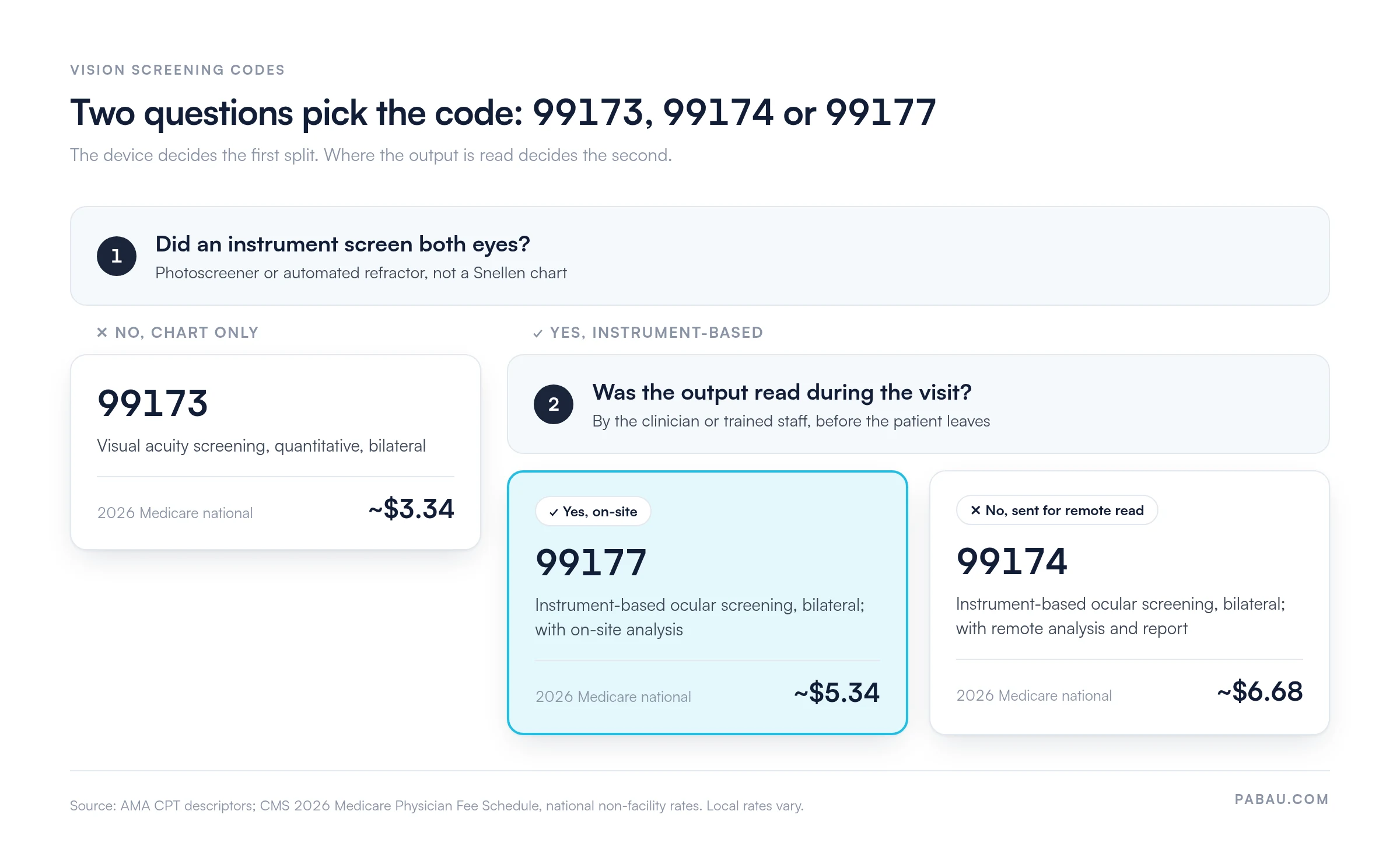
The reimbursement difference is small, and it favors the remote code. Under the 2026 Medicare fee schedule, 99174 pays about $6.68 nationally and 99177 about $5.34. Billing 99177 when the workflow is remote analysis is still a coding error that exposes the practice to overpayment recovery.
The medical record must support every element of the 99177 descriptor, because an auditor checks each one against the note. Build the seven items below into your note template so staff capture them at every screening.
Modifiers are not routinely required for 99177 billed alone. You may bill 99177 with an evaluation and management (E&M) service on the same date. Modifier 25 on the E&M code then signals a separately identifiable service. Without modifier 25, the screening may be bundled and denied.
Audit your EHR template for 99177 visits. If the note has no field capturing ‘on-site analysis performed,’ staff will leave it out. Add a single checkbox or auto-populated phrase so the statement appears on every 99177 note.
Coverage for CPT code 99177 varies significantly by payer type. Confirming coverage before the encounter through insurance eligibility verification prevents most of the preventable denials in this category.
Medicare generally does not cover CPT 99177 as a standalone preventive vision screening benefit for adult beneficiaries. Traditional Medicare covers vision care only when there is a diagnosable condition (e.g., diabetic retinopathy monitoring under a diabetic care code), not for routine photoscreening.
Practices billing Medicare for adult patients should issue an Advance Beneficiary Notice (ABN) when coverage is uncertain. The patient can then decide whether to proceed with self-pay.
Medicaid coverage is more favorable. Under the federal EPSDT (Early and Periodic Screening, Diagnostic, and Treatment) mandate, state Medicaid programs must cover medically necessary vision screening for children under 21. CPT 99177 is commonly covered under EPSDT in states that have added instrument-based screening to their covered services list. Coverage and rates vary by state.
North Carolina Medicaid, for example, issued a policy update in September 2025 clarifying its billing requirements for CPT 99177. Check your state Medicaid agency’s current coverage bulletin before billing.
Commercial coverage depends on the plan’s medical policy bulletin. Aetna’s Clinical Policy Bulletin (CPB 689) addresses ocular photoscreening and outlines covered indications. UnitedHealthcare Community Plan and similar Medicaid managed care organizations often follow state EPSDT rules but may apply their own prior authorization requirements.
Always verify coverage and prior authorization status per patient and per payer before scheduling instrument-based screening.
The 2026 Medicare Physician Fee Schedule rate for CPT 99177 is about $5.34 nationally in a non-facility setting. That figure comes from 0.16 total RVUs at a $33.40 conversion factor, and it varies by locality. Medicare adjusts it with each locality’s geographic practice cost index (GPCI). A practice in Manhattan sees a different rate than one in rural Mississippi.
Submit electronic CMS-1500 claims through the Claim.MD clearinghouse integration and check eligibility in real time before the visit.
Use the CMS Physician Fee Schedule lookup tool to verify the exact rate for your locality before billing.
Rates shown are approximate Medicare national averages for 2026, taken from the CMS MPFS non-facility figures, and they vary by locality. Verify using the FastRVU 2026 RVU lookup tool or the CMS MPFS search. Commercial payer rates are negotiated separately and may be significantly higher or lower.
Most CPT code 99177 denials are preventable. Track the reason code on each returned claim with a denial management workflow, and the pattern hitting your practice hardest shows up fast. Claims management software that checks eligibility before the visit and tracks claim status catches coverage problems early.
Yes, CPT 99177 can be billed on the same date of service as a preventive visit, but bundling edits apply depending on the payer. The screening is a separately identifiable service from the evaluation and management component of the well-child visit.
Modifier 25 on the E&M code is the standard approach. A physician may perform a well-child visit (CPT 99381-99395) and also perform and interpret instrument-based ocular screening on the same date.
Append modifier 25 to the E&M code to signal a distinct service. Without it, many payers will automatically bundle 99177 into the preventive visit payment and deny it as a duplicate.
Pair the well-child E&M with its routine exam diagnosis, such as Z00.129 for a child with no abnormal findings.
When a claim is denied as bundled, include the note with the appeal. It should show that the screening took a separate clinical effort outside the routine physical examination.
CPT 99177 can be billed by a range of provider types, but payer policies vary. Check the payer’s provider rules before the screening, because recoding can’t fix a provider-eligibility denial.
Check your payer contracts before assuming all mid-level providers can bill 99177 under their own NPI. Some commercial plans require physician supervision for vision screening codes even when state law permits independent NP/PA practice. A 30-minute contract review prevents months of denied claims.
Many pediatric and primary care teams still check coverage by phone, key each claim into a payer portal and chase its status by hand. On a fee of about $5 per screening, every manual step eats into what the code pays.
Pabau, the practice management platform we build, connects to the Claim.MD clearinghouse. It turns the visit’s invoice into an electronic CMS-1500 claim and checks the patient’s eligibility in real time before the screening.
Once the claim is out, Pabau tracks its status and brings the electronic remittance advice (ERA) back into the account. Your team sees a denied 99177 as soon as the payer returns it. You can then fix the code or the note while the visit is fresh.

Pabau turns screening invoices into electronic CMS-1500 claims, checks eligibility before the visit, and tracks each claim until the remittance comes back.

CPT code 99177 pays a few dollars, so its value lies in getting paid on the first pass. Once your note template records the instrument, both eyes and on-site analysis, coding comes down to one question about where the output was read.
Remember that 99174 pays slightly more under Medicare, and pick the code from the workflow anyway. If your images go to a remote reader, the claim is 99174, and an audit will judge it on that basis.
Book a demo to see how Pabau checks eligibility and tracks your vision screening claims from invoice to payment.

Need to understand how clearinghouse submission works for CPT claims? Claim.MD clearinghouse guide walks through how electronic claims are validated, routed, and reconciled with Pabau.
Seeing repeated denials across multiple CPT codes? Denial codes in medical billing explains CARC codes and how to respond to the most common payer rejection reasons.
Want to verify 837 claim file submission for your payer? 837 file guide covers the standard electronic claim format and how Pabau submits it through Claim.MD.
Billing a chart-based acuity check instead? CPT code 99173 covers quantitative visual acuity screening and how it differs from instrument-based codes.
CPT code 99177 covers instrument-based ocular screening, bilateral, with on-site analysis. It applies when a clinician uses an FDA-cleared device, such as a photoscreener or automated refractor, to screen both eyes. The clinician interprets the results during the same encounter. It does not cover chart-based visual acuity screening (CPT 99173) or instrument-based screening where images are sent for remote analysis (CPT 99174).
The only difference is where the analysis occurs. CPT 99177 requires on-site analysis, meaning the clinician interprets results during the same session. CPT 99174 applies when images are transmitted to a remote reading service for off-site interpretation. Under the 2026 Medicare fee schedule, 99174 also pays slightly more.
FDA-cleared instruments commonly accepted for CPT 99177 include the Welch Allyn Spot Vision Screener, Plusoptix, and Retinomax autorefractor. Smartphone-based apps such as GoCheck Kids may qualify but require individual payer LCD verification. Chart-based methods and remote photoscreening services do not qualify for 99177 under any payer policy.
Medicare generally does not cover CPT 99177 as a standalone preventive vision screening benefit for adult beneficiaries. Practices should issue an ABN before providing the service to Medicare patients. Medicaid coverage is more favorable, because EPSDT requires states to cover medically necessary vision screening for children under 21. Many states include 99177 in covered services, and state Medicaid rates and policies vary.
The leading denial reason is wrong code selection, specifically billing 99177 when the workflow used remote analysis, which requires 99174. Other frequent causes include missing on-site analysis language in the note and failure to document bilateral screening. A missing prior authorization, or no modifier 25 on a same-day preventive visit, also triggers denials.
Yes, CPT 99177 can be billed on the same date as a well-child visit (CPT 99381-99395) when it represents a separately identifiable service. Append modifier 25 to the E&M code to prevent bundling edits. Some commercial payers include vision screening in the preventive visit fee regardless of modifier usage. Verify the specific payer’s bundling rules before billing.
The 2026 Medicare Physician Fee Schedule rate for CPT 99177 is about $5.34 nationally in a non-facility setting. That comes from 0.16 total RVUs at a $33.40 conversion factor. The rate varies by locality, so verify yours with the CMS MPFS lookup tool. Medicare coverage for adult patients is limited, so most 99177 reimbursement comes from Medicaid and commercial plans covering children.
Ocular photoscreening uses a camera-based device to capture images of the eyes and analyze them for risk factors such as refractive error and media opacity. It bills under CPT 99177 when analysis is on-site, or CPT 99174 when images are transmitted for remote interpretation. The screening technology is the same; the code depends entirely on where and when the analysis occurs.



