



HCPCS code E0198: Water pressure pad billing guide
HCPCS code E0198 is a water pad for a standard mattress HCPCS code E0198 is the ...

Last Updated: Oct 13, 2026

CPT Code 99173 describes a screening test of visual acuity, quantitative, bilateral, using a standardized chart such as a Snellen chart.
Bilateral testing is mandatory, because a unilateral screening does not satisfy the code definition and will be denied.
Medicare does not pay for 99173. The code carries fee schedule status indicator N, so routine screening vision testing stays statutorily excluded.
Medicaid through EPSDT, CHIP, and commercial plans are the realistic payers, with reported commercial allowances near $4 to $6.
Practice management software like Pabau embeds CPT 99173 into encounter templates, which reduces manual entry errors and supports clean claim submission.
CPT Code 99173 is the billing code for a screening test of visual acuity, quantitative, bilateral.
It covers a standardized chart test of both eyes in one encounter, usually a Snellen chart. Medicare never pays for it, so Medicaid, CHIP, and commercial plans are the payers that matter.
The code sits in the Medicine section of the CPT codebook and is not restricted to ophthalmologists. Family physicians, pediatricians, and other qualified providers may bill it. This guide covers the descriptor, the documentation payers check, 2026 reimbursement, and the errors behind most denials.
The official AMA CPT descriptor reads: Screening test of visual acuity, quantitative, bilateral. Three words in it carry billing weight. Screening rules out a diagnostic evaluation, quantitative means a chart with measurable acuity lines, and bilateral means both eyes in one encounter.
The work RVU of 0.00 reflects that 99173 captures the test itself rather than physician cognitive work. Practice expense and malpractice RVUs carry the small remaining value.
Publishing a relative value is not the same as paying a claim. The CMS Physician Fee Schedule lookup tool returns status indicator N for 99173 and no payment amount in any locality. Medicaid, CHIP, and commercial payers price against the published RVUs instead.
CPT 99173 is appropriate when a provider uses a recognized, standardized quantitative chart to screen both eyes in a single encounter. Well-child visits and preventive care appointments are the most common settings, but the code is not age-restricted. Adults can receive the screening too.
The screening must use a recognized quantitative tool. A Snellen chart is the most common, but any age-appropriate standardized chart with measurable acuity lines qualifies. Informal assessments such as finger counting or confrontation field testing do not support the code.
A screening and an examination are separate services. When a failed screen brings the patient back for evaluation, ophthalmological service codes such as 92012 replace 99173 on the claim.
Missing documentation is the leading cause of 99173 denials. Payers look for four elements in the medical record, and the absence of any one of them is enough to trigger a rejection.
Retain records of any referral the screening triggers. If a child screens below threshold and a referral follows, document both the result and the referral action in the same encounter note.
Build a visual acuity screening template in your EHR with mandatory fields for chart type, bilateral results (OD and OS separately), and provider name. When those fields are required before the note closes, an incomplete 99173 note cannot be filed.
Whether 99173 can be billed separately alongside a preventive medicine code depends on the payer. NCCI (National Correct Coding Initiative) edits do not bundle 99173 with preventive medicine codes as a hard edit, so separate billing is technically supported.
In practice, payers apply their own policies, and some commercial plans fold vision screening into the preventive visit allowance. Medicare sits outside that analysis entirely, because the code is noncovered there before any bundling question arises.
Check the patient’s plan before the appointment to confirm whether it covers 99173 as a separately billable service. That single check resolves most “not covered” denials before they happen.
Medicare pays nothing for CPT Code 99173. The Physician Fee Schedule assigns the code status indicator N, which means noncovered. Routine screening vision testing is statutorily excluded from Part B, and medical necessity cannot override a statutory exclusion.
There is no locality-adjusted Medicare rate to quote, and there never has been one. The acuity check Medicare does pay for is bundled into the Initial Preventive Physical Examination and billed as G0402.
Reimbursement for 99173 comes from Medicaid, CHIP, and commercial plans instead. CMS has published relative values for the code since 2018, with a work RVU of 0.00 and a total RVU around 0.10. Reported commercial allowances run roughly $4 to $6 per screening.
State Medicaid programs publish their own fee schedules, and the amounts differ widely between states. Pull the figure for the state you bill in rather than assuming a national average.
Medicare does not cover CPT 99173 in any setting or at any frequency. A local coverage determination cannot create payment where a statutory exclusion already applies, and no Medicare Administrative Contractor policy will change that.
If a Medicare patient receives a standalone acuity screening, bill the patient directly. Issue a voluntary ABN so the cost is clear before the test. Screening performed inside the IPPE is already paid through G0402 and is never billed separately.
Medicaid is state-dependent. The Early and Periodic Screening, Diagnostic, and Treatment mandate requires participating states to cover vision screening for enrolled children. That makes 99173 broadly reimbursable in pediatric contexts, and CHIP coverage generally mirrors those requirements.
Rates still vary from state to state. Pull your own state schedule before quoting a figure to a parent or a practice manager.
Most 99173 denials are preventable. Five documentation and coding errors generate the bulk of rejections for this code.
Meeting the documentation requirements before the note closes is what produces a clean first-time claim. Correcting the record after a denial arrives costs far more staff time than it saves.
CPT 99173 sits in a cluster of vision and hearing screening codes. Choosing the wrong one is a common audit trigger, particularly the confusion between 99173 and 92551. The AAPC CPT code lookup confirms descriptors across adjacent codes.
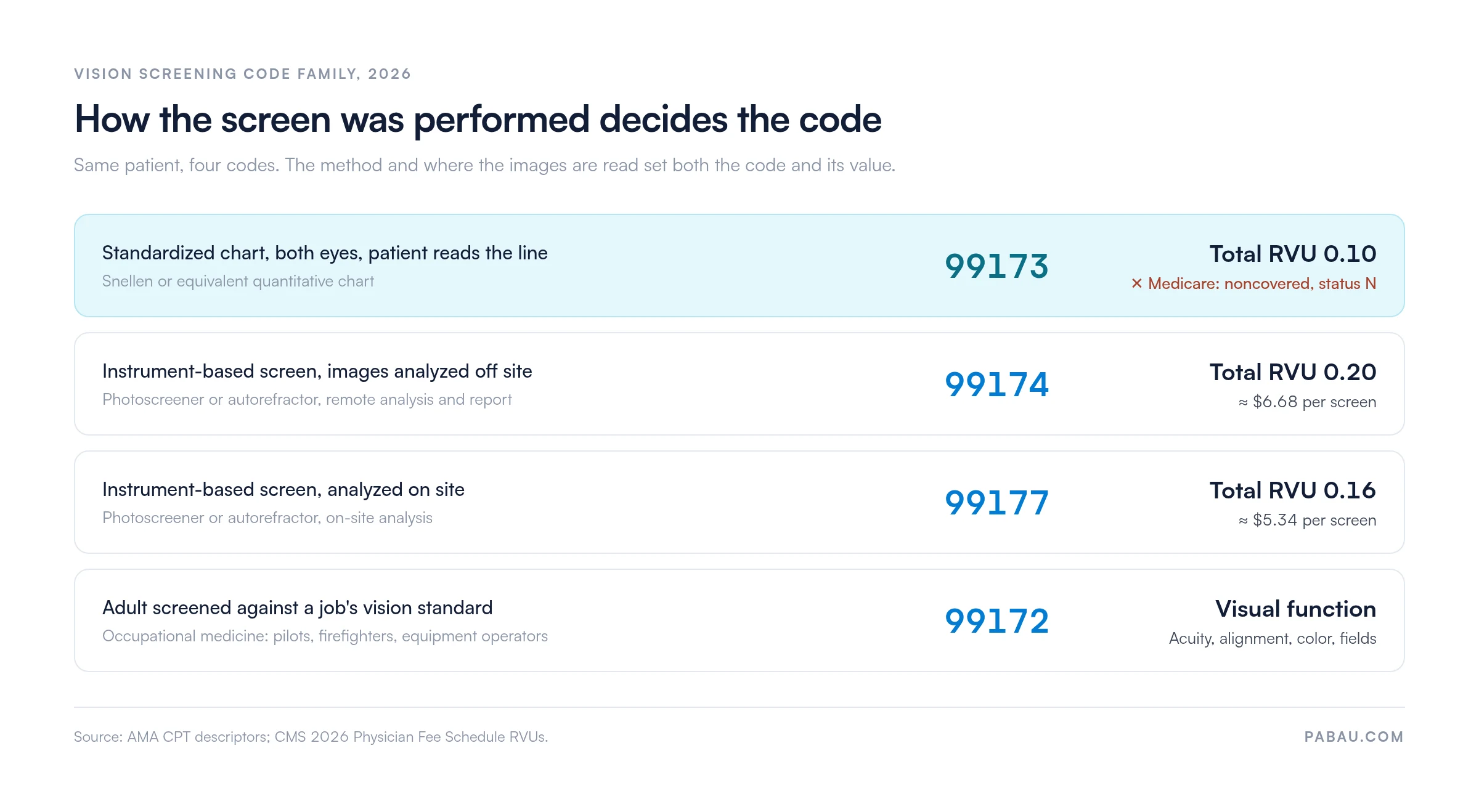
The 99173 versus 99172 distinction is about setting, not age. 99172 belongs to occupational medicine, where pilots, firefighters, and equipment operators are screened against a job’s vision standard. It measures alignment, color vision, and visual fields alongside acuity, and it needs no chart. 99173 is the chart-based acuity screen used in general preventive care.
The 99174 and 99177 pair catches people out for a different reason. Both use the same photoscreener, and the on-site read pays less than the remote one. Descriptors for the neighboring codes sit in our CPT code library, and the chart below sets all four against the method each requires.
Pediatric practices account for the majority of CPT 99173 volume, and Medicaid pays for most of it. Because Medicare never covers the code, the pediatric EPSDT pathway is where 99173 reliably turns into revenue. Two details carry the weight there: the chart you choose, and the schedule you document against.
Most 99173 billing problems are structural rather than clinical. The provider performed the test, used the chart, and checked both eyes. The documentation workflow never captured the required fields, and by the time anyone reviewed the claim the note was closed.
Practice management software like Pabau moves that check earlier. Encounter templates can require the chart name and both acuity results before a note closes. That removes the omission behind most 99173 denials before the claim is built, so there is no reopening of closed notes and no addendum.
Pabau’s connected claims management software ties encounter documentation directly to claim submission. CPT 99173 sits on the visual acuity screening template with its required fields attached. Claims then route to Claim.MD, our US clearinghouse partner. It reaches more than 4,000 US payers and validates CPT codes before anything is sent.

Pabau connects your clinical documentation to claim submission. Encounter templates with mandatory fields for chart type and bilateral acuity results mean 99173 claims go out complete, every time.

The money on 99173 is small, which is exactly why the workflow around it has to be cheap. A $5 screening cannot absorb the staff time an appeal costs. The only version of this code that pays is the one that goes out clean the first time.
Settle the payer question before the visit rather than after the denial. Medicare is already decided and needs no further checking. Medicaid, CHIP, and commercial contracts are where the answer changes, and each is worth confirming once and recording in the template.
Then make the note carry its own proof. Required fields for chart type and both acuity results turn a coding rule into something the software enforces. Book a demo to see how Pabau keeps preventive screening claims complete before they reach a payer.

Need to understand how clearinghouse submission works? Our medical claims clearinghouse guide explains how claims route from EHR to payer and where they get rejected.
Concerned about billing compliance across your preventive care codes? Medical billing compliance best practices covers documentation standards, audit triggers, and payer policy alignment.
Dealing with a high denial rate on vision screenings? Denial codes in medical billing breaks down the most common rejection codes and how to respond to each.
CPT Code 99173 covers a screening test of visual acuity, quantitative, bilateral. It applies when a provider uses a recognized standardized chart, such as a Snellen chart, to measure acuity in both eyes during one encounter. It does not cover diagnostic eye exams or instrument-based photoscreenings, which use different codes.
There is none. Medicare assigns CPT 99173 status indicator N on the Physician Fee Schedule, which means the code is noncovered. Routine screening vision testing is statutorily excluded from Part B, so no locality has a payable rate. The acuity check Medicare does pay for is bundled into the Initial Preventive Physical Examination under G0402. Medicaid, CHIP, and commercial plans are where 99173 gets reimbursed, typically around $4 to $6 depending on the plan.
In most cases, yes. NCCI edits do not include a hard bundle between 99173 and preventive medicine codes (99381-99397). However, commercial payers may apply their own bundling policies. Check your payer contract and run eligibility verification before billing 99173 separately alongside a preventive visit code.
CPT 99173 is the chart-based acuity screen used in general preventive care. CPT 99172 is a visual function screening used in occupational medicine. It checks adults such as pilots, firefighters, and equipment operators against job-related vision standards. 99172 also covers ocular alignment, color vision, and visual fields, and it does not require a chart.
CPT 99173 is a visual acuity screening of both eyes using a standardized chart. CPT 92551 is a pure tone audiological screening, air only. The two codes describe different sensory screening modalities and are not interchangeable. Both may appear on the same claim when both screenings were performed during the same encounter.
Medicaid coverage for CPT 99173 varies by state. The EPSDT mandate requires states to cover vision screening for enrolled children, making 99173 broadly reimbursable in pediatric Medicaid contexts. Adult coverage and rates vary significantly by state Medicaid program and individual managed care organization policies.
Yes. CPT 99173 is not restricted to ophthalmologists. Any qualified provider performing a standardized quantitative bilateral visual acuity screening may bill the code. That includes family physicians, pediatricians, internists, and nurse practitioners, subject to payer credentialing requirements.



