CPT Code 52352: Ureteroscopic stone removal billing guide
CPT Code 52352: Official descriptor and procedure overview CPT Code 52352 descri...

Last Updated: Oct 30, 2026
98928 is the CPT code for osteopathic manipulative treatment (OMT); 7-8 body regions involved. A physician trained in OMT bills it after treating somatic dysfunction in seven or eight of the 10 CPT body regions in one encounter.
Common denial causes include region counts that don't match the documentation and E/M services billed the same day without modifier 25 on the office visit.
Let Pabau's smart automation suggest the right codes, reduce claim denials, and keep your practice compliant—effortlessly.
Automate repetitive tasks and focus on what matters most—your patients.
Reduce coding errors and ensure compliance with the latest regulations.
Clean claims, fewer denials, and faster reimbursements.
Powerful insights and reporting to help your practice thrive.
HIPAA compliant SOC 2 certified GDPR-compliant Trusted by 4,000+ clinics worldwide

CPT code 98928 covers OMT of seven or eight body regions, the second-highest tier of the 98925-98929 family.
Physicians trained and credentialed in OMT, mainly DOs, bill this code, while chiropractors use 98940-98942 and physical therapists use 97140.
Sacral and pelvic work count as two regions, but both knees or every rib level each count as one region.
Modifier 25 goes on any E/M code billed the same day, never on 98928, and leaving it off is the leading denial reason.
Pabau’s practice software keeps SOAP notes, documented regions and diagnoses on the patient record and pulls them into a pre-filled claim sent via Claim.MD.
The American Medical Association defines CPT code 98928 as osteopathic manipulative treatment (OMT) of seven or eight body regions in one encounter. The physician diagnoses and treats somatic dysfunction by hand, using techniques such as high-velocity low-amplitude (HVLA) thrust, myofascial release, muscle energy, counterstrain and cranial osteopathy. The code applies when that work covers seven or eight distinct regions in one session.
The code is billed by physicians trained and credentialed in OMT, mainly DOs. An MD trained in OMT can bill the 98925-98929 family too, and Medicare requires a physician competent in OMT. Chiropractors use 98940-98942 for chiropractic manipulative treatment, and physical therapists use manual therapy code 97140.
The table below summarizes the key billing data for CPT code 98928 at a glance.
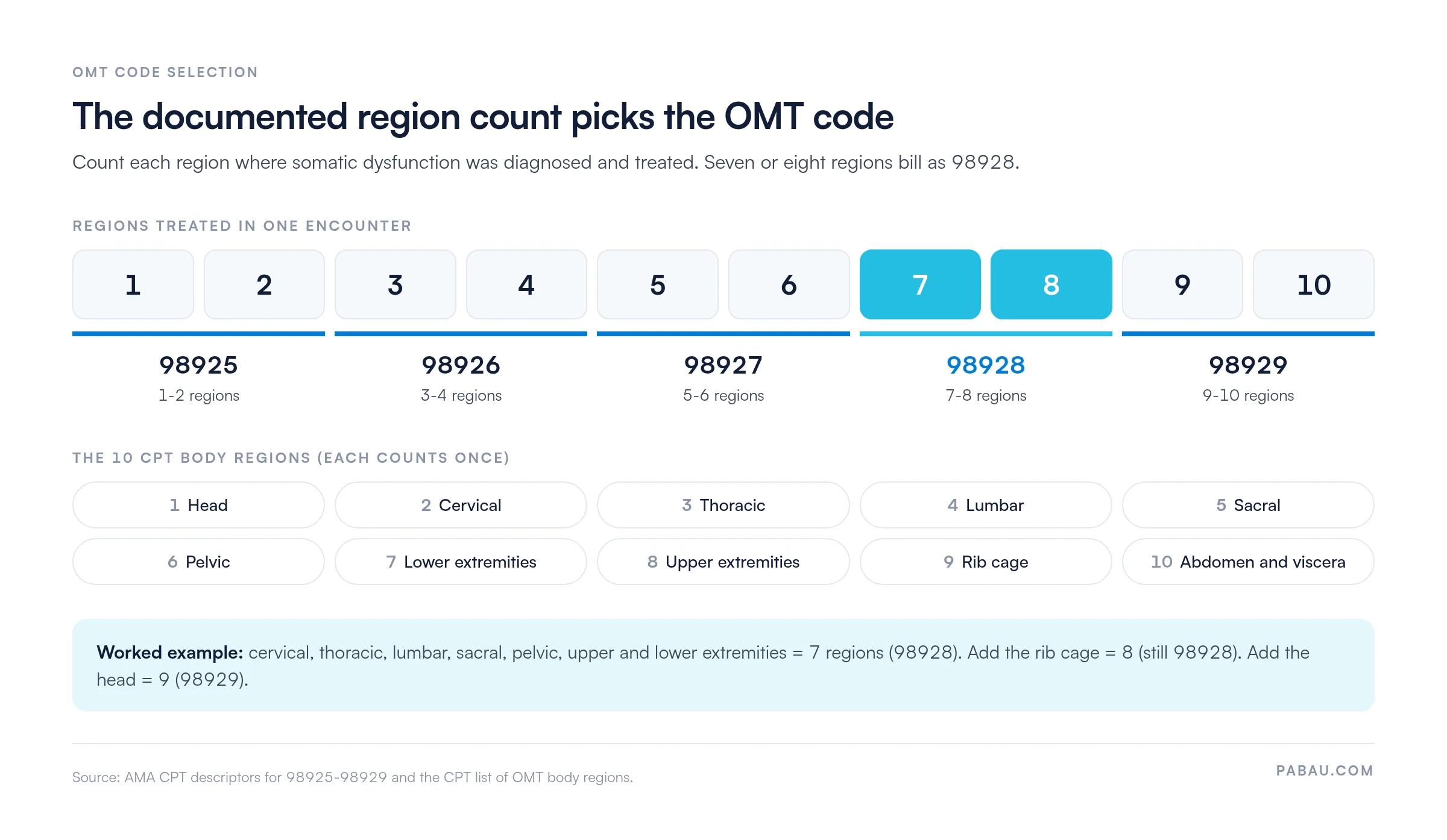
The five OMT codes are differentiated solely by the number of body regions treated. Selecting the wrong code is the most common upcoding or downcoding scenario on OMT claims. It is also the easiest audit flag to trigger, because the chart note must document the region count explicitly.
Each step down the ladder is one pair of regions. A note that names only three or four regions belongs under 98926, however long the session ran.
AMA guidelines recognize exactly 10 osteopathic body regions for the purpose of counting under the 98925-98929 family. To bill CPT code 98928, the chart note must document somatic dysfunction and hands-on treatment in seven or eight of the 10 below.
Common miscounting error: Treating both knees does not equal two regions. The lower extremities region is a single unit. Each rib level is not a separate region either, because all rib work counts as one rib cage region. Treating the right shoulder and the left shoulder still counts as one upper-extremity region. Coders who miscount bilateral work inflate the region tally and generate upcoding exposure.
Count the distinct regions where somatic dysfunction was both diagnosed and treated, then select the code whose range includes that count. A session treating the cervical, thoracic, lumbar, sacral, pelvic, upper extremity and lower extremity regions covers seven regions, which lands in 98928. Add the rib cage and the count moves to eight, still within 98928. Document the head as a ninth region and the claim crosses into 98929, as the ladder below shows.
The chart note must list each region explicitly. A note that says “global OMT performed” without naming the individual regions does not support 98928 or any other OMT code.
Medicare Part B covers OMT when a physician trained in OMT provides it and the service is medically necessary. Under the CMS Physician Fee Schedule, payment is the RVU total multiplied by the annual conversion factor. A geographic practice cost index (GPCI) then adjusts it for your locality.
The figures below are illustrative estimates based on national averages. Actual allowed amounts vary by geographic locality, payer contract, and the CMS conversion factor in effect for the year of service. Always verify current rates using the FastRVU 2026 RVU lookup tool or the CMS MPFS search.
OMT billing requires a supporting diagnosis that establishes medical necessity. Medicare and commercial payers most commonly accept three groups of ICD-10-CM codes with CPT code 98928. They are somatic dysfunction codes (M99.0x), spinal pain codes and structural pathology codes. The diagnosis must reflect the documented clinical condition, not a generic placeholder. Lumbar somatic dysfunction, coded M99.03, is the pairing billed most often with 98928.
When treating multiple regions, list every relevant somatic dysfunction code. M99.00-M99.09 cover the head, cervical, thoracic, lumbar, sacral, pelvic, lower and upper extremity, rib cage and abdomen regions. Payers expect a diagnosis code for each anatomical region documented in the OMT note. A claim with seven treated regions and only one M99 code is a medical necessity red flag.
Adequate documentation is the single biggest lever for protecting CPT code 98928 claims from audit recoupment. CMS Local Coverage Determinations for OMT specify the minimum elements that must appear in the medical record for each date of service.
A complete OMT note that supports submitting a clean claim must include all of the following:
Review every CPT 98928 claim before submission by checking the chart note against this seven-point list. If any element is missing, return the note to the treating physician for a dated addendum before billing.
The treating physician may bill CPT code 98928 and an E/M code (such as 99213 or 99214) on the same date of service. The E/M must represent a separately identifiable service beyond the OMT itself. Modifier 25 must be appended to the E/M code, not to 98928.
What “separately identifiable” requires: The E/M must address a problem or concern that is distinct from the somatic dysfunction being treated with OMT. Take a patient who comes in for scheduled OMT and also mentions new chest pain. The OMT is billed under 98928, and the chest pain evaluation supports a separate E/M with modifier 25. Simply performing a brief re-evaluation before starting OMT does not constitute a separately identifiable E/M service.
The documentation must support both services independently. Auditors routinely look for chart notes where the “E/M” is just the OMT examination. They check for a separately documented complaint, history or decision-making outside the OMT encounter.
Most CPT code 98928 denials fall into five categories. Fix the root cause before you resubmit, or the same claim comes back with the same reason. Match the CARC on the remittance against our list of denial codes, then log the fix in your denial management workflow.
Medicare does not require prior authorization for OMT under CPT code 98928 in most MAC jurisdictions, though frequency limitations may apply under local coverage policies. Commercial payers vary significantly. Many managed-care plans cap OMT visits at 12-20 per plan year, and some require prior auth after the third or fifth visit.
What to verify before billing: Confirm whether the plan requires prior auth for OMT and whether a referral or diagnosis code limitation applies. Then check that the treating physician is in-network. Plans that cover chiropractic manipulation sometimes exclude OMT under a separate benefit structure, even when the ICD-10 diagnosis codes overlap.
Always source prior-auth requirements from the current payer policy document rather than relying on prior-year experience. Payer policies for OMT change at plan renewal, and verbal confirmations from call centers are not binding.
CPT code 98928 and the chiropractic manipulative treatment codes are often confused because both involve spinal manipulation. Chiropractic codes start at 98940 and run to 98942, and payers govern the two families with separate rules.
Most 98928 errors start in the handoff between chart and claim. Someone reads the SOAP note, counts the regions and retypes them into a billing screen or a paper superbill. That retyping step is where region counts and modifiers most often get lost.
Pabau keeps the SOAP note, the documented regions and the diagnoses on the patient record. Its claims management software pulls that data into a pre-filled claim, which your team reviews and sends via Claim.MD, our US clearinghouse partner. You can then track the claim’s status from the same record.
Your coder still chooses the code and checks the region count against the note. The difference is that the claim starts from the note the physician signed, which makes a clean claim easier to send the first time.
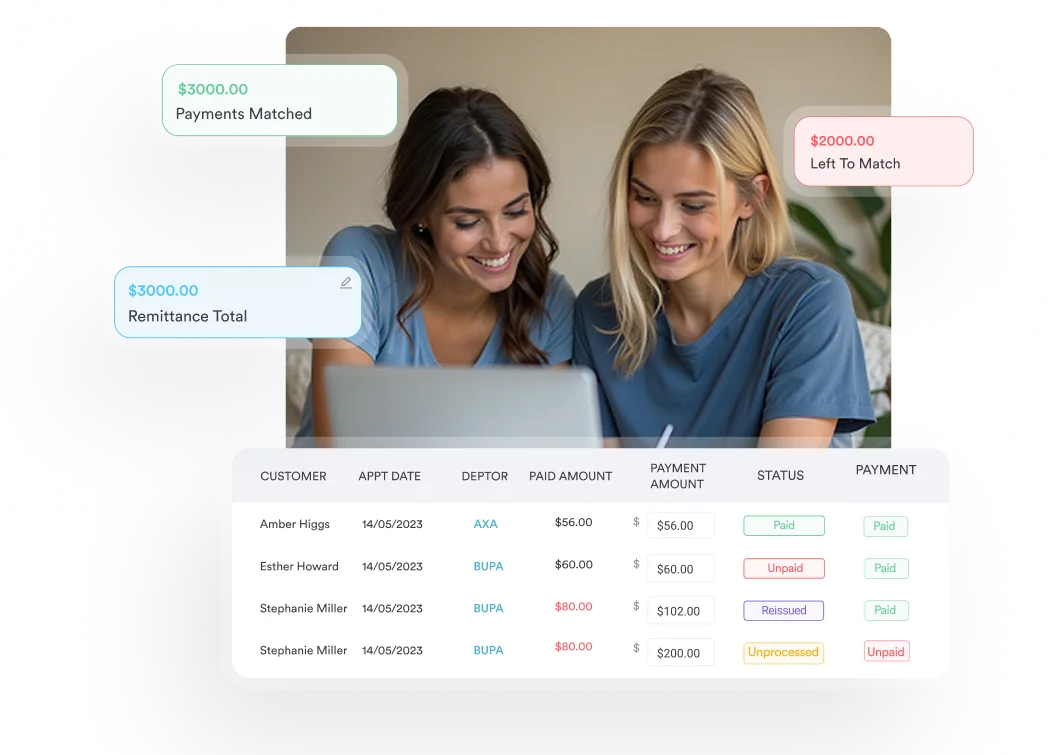

Pabau keeps SOAP notes, documented regions and diagnoses on the patient record, then pulls them into a pre-filled claim sent via Claim.MD. Your team reviews the claim instead of retyping the chart.

With CPT code 98928, the chart note decides the code. Before you bill, recount the named regions against the 10 CPT regions, listing sacral and pelvic work separately and each extremity pair once.
If an E/M visit happened the same day, put modifier 25 on the E/M and make sure the note shows a separate problem. Get those two checks right, and the remaining risks are diagnosis coverage and enrollment, which you can confirm before the visit.
Book a demo to see how Pabau turns a signed OMT note into a pre-filled claim your team only has to review.

Need to verify current RVU values for OMT codes? Revenue cycle management fundamentals explains how RVU-based payment works across the Medicare Physician Fee Schedule.
Getting denials on credentialing grounds? Credentialing with insurance companies covers the physician enrollment process with commercial payers and Medicare MACs.
Want to understand CARC denial codes on your OMT claims? Denial codes in medical billing maps the most common CARC and RARC codes to corrective actions for procedure code claims.
CPT code 98928 covers osteopathic manipulative treatment (OMT) applied to seven or eight body regions in a single visit. A physician trained in OMT, usually a DO, performs it. Techniques include HVLA thrust, myofascial release, muscle energy and counterstrain, applied across seven or eight of the 10 recognized body regions.
CPT 98927 covers OMT of five or six body regions, while 98928 covers seven or eight. The treating physician must document somatic dysfunction findings and treatment for each region. A note naming seven or eight regions bills as 98928, and one naming five or six bills as 98927. Counting bilateral extremity work as two regions is a common audit trigger.
Yes, Medicare Part B covers CPT 98928 when a physician trained in OMT performs it and a covered diagnosis supports it. That is typically an M99.0x somatic dysfunction code or an appropriate spinal pathology code. Coverage depends on medical necessity and the Local Coverage Determination for your MAC jurisdiction. Frequency limits vary by MAC, so check the relevant LCD before assuming unlimited visits.
CPT 98928 carries approximately 1.18 work RVU in 2026, with a non-facility total of about 2.20 RVUs. Values are updated annually, and payment varies by locality through the GPCI adjustment. Verify the current-year figures in the CMS MPFS lookup before projecting reimbursement.