CPT code 63081: Vertebral corpectomy, cervical spine
CPT code 63081: official descriptor and procedure overview CPT code 63081 descri...

Last Updated: Oct 6, 2026
98926 is the CPT code for osteopathic manipulative treatment (OMT); 3-4 body regions involved. It is billed by doctors of osteopathic medicine (DOs) or MDs trained in OMT when they treat three or four distinct regions in one visit.
The code sits between 98925 (1-2 regions) and 98927 (5-6 regions) in the OMT series. Assignment turns on how many regions the note names, each with the technique used and the somatic dysfunction found.
Let Pabau's smart automation suggest the right codes, reduce claim denials, and keep your practice compliant—effortlessly.
Automate repetitive tasks and focus on what matters most—your patients.
Reduce coding errors and ensure compliance with the latest regulations.
Clean claims, fewer denials, and faster reimbursements.
Powerful insights and reporting to help your practice thrive.
HIPAA compliant SOC 2 certified GDPR-compliant Trusted by 4,000+ clinics worldwide

CPT code 98926 covers osteopathic manipulative treatment (OMT) of three or four of the 10 recognized body regions in one encounter.
DOs, and MDs trained in OMT, can bill it, while chiropractors and physical therapists cannot, per CMS LCD L33616.
Each treated region must be named in the note with its own technique, or the note cannot support the code level.
Modifier AT is a chiropractic Medicare requirement and does not belong on an OMT claim.
RVUs and Medicare rates for 98926 change every year and by locality, so check the CMS fee schedule before quoting a figure.
CPT code 98926 is the American Medical Association procedure code for osteopathic manipulative treatment (OMT) of three or four body regions in one encounter. The official descriptor reads: Osteopathic manipulative treatment (OMT); 3-4 body regions involved.
It is billed by doctors of osteopathic medicine (DOs), or by MDs trained in OMT. Chiropractors and physical therapists are still excluded, per CMS LCD L33616.
OMT is a hands-on approach in which the physician diagnoses somatic dysfunction and treats it with manipulative techniques. Common ones include high-velocity low-amplitude (HVLA) thrust, myofascial release (MFR), counterstrain, and muscle energy technique.
The five OMT codes differ only by the number of body regions treated. All five sit in the 98925-98929 OMT subsection of the medicine section of the CPT codes set. Picking the wrong tier is a common trigger for OMT upcoding audits, so the region count in the note must match the code billed.
The region count reflects the regions treated and documented, not the number examined or assessed. Auditors look for a technique recorded against each region, not a count ticked in a checkbox field.
CPT recognizes 10 body regions for OMT coding. To bill 98926, the physician must treat and document three or four of them in a single encounter.
The upcoding trap: sub-areas within one region do not count as separate regions. Treating the right and left lower extremities is one region, not two. Treating L1-L3 and L4-L5 is still the lumbar region. Count the distinct regions first, then read the code off the grid below.
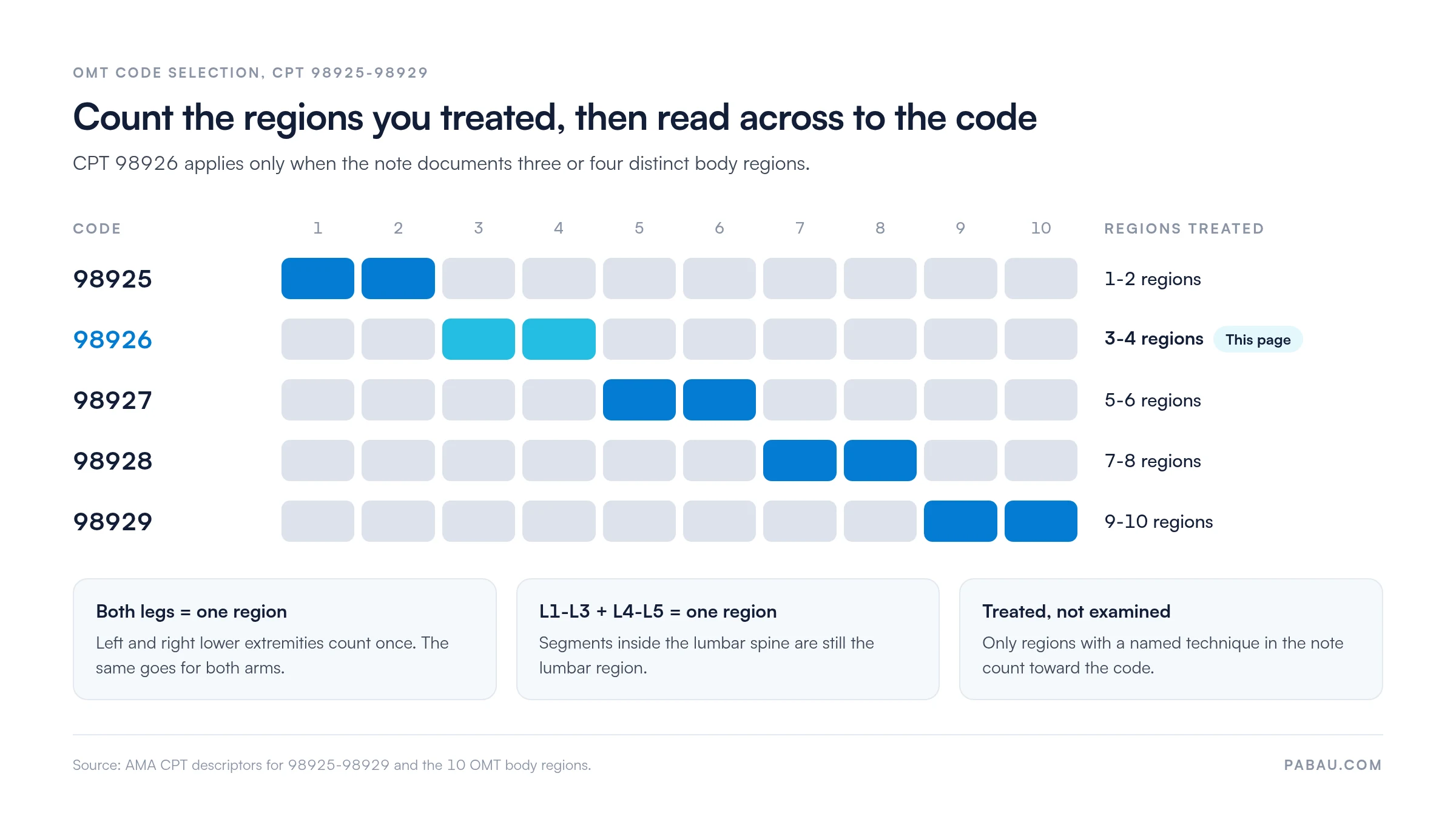
Medical necessity must support treating that many regions. Picture a patient with isolated low back pain whose visit is billed at 98926. That claim will draw scrutiny unless the note explains why three or four regions needed treatment that day.
The paired diagnosis code must support medical necessity for OMT. Payers cross-reference the ICD-10 code against the CPT code to confirm the treatment is clinically appropriate. These are the diagnoses most often used with CPT code 98926.
M99 somatic dysfunction codes are the strongest medical necessity support for OMT. Spinal cases often lead with M99.01 for the cervical region or M99.03 for the lumbar region. Some payers reject OMT claims where the only diagnosis is a non-specific pain code with no matching M99 code. Listing both improves claim acceptance.
Insufficient documentation is a leading cause of CPT 98926 denials. Each of the three or four treated regions must appear by name in the note, with the technique used on it. A checkbox form that records a region count without naming each region is not enough.
A compliant OMT note for 98926 includes these elements, in line with CMS LCD L33616 and AOA coding guidance:
Run each note against a clean claim submission checklist before the claim leaves the practice. Auditors look specifically for region-technique pairings. A note that says “OMT performed to 3-4 regions” without naming them is one of the most frequent deficiencies in OMT post-payment reviews.
Run a monthly internal audit on five randomly selected 98926 claims. Pull the notes and check three points. Are three or four regions named individually? Is a technique listed for each? Does the diagnosis code support treating that many regions? Fixing a weak note template in-house costs far less than defending it in a payer audit.
A DO or MD may bill an evaluation and management (E/M) visit on the same date as CPT code 98926. The E/M has to be a separately identifiable service.
When you bill an E/M and 98926 on the same date, append Modifier 25 to the E/M code, not the OMT code. Modifier 25 marks a significant, separately identifiable E/M service by the same physician on the same day.
Document the E/M separately from the OMT note, addressing a problem beyond what the OMT itself required. A common pairing is an established-patient visit billed as 99213 with Modifier 25.
The Modifier AT trap: Medicare requires Modifier AT (active/acute treatment) on chiropractic manipulation codes 98940-98942. It does not apply to physicians billing OMT. An AT on a 98926 claim signals a billing system configured for chiropractic rules. That can invite audits and damage your standing with your Medicare Administrative Contractor.
Confirm your billing software never auto-appends AT to OMT codes, and recheck the mapping whenever your code rules change.
Medicare Part B covers OMT when it is medically necessary, per CMS coverage article 56954. It must be performed by a DO, or by an MD trained in OMT. Coverage applies in office and outpatient settings where the physician can provide E/M services.
Submitting CPT 98926 claims electronically through a clearinghouse speeds up payer adjudication. Pabau, the practice management platform we build, connects to Claim.MD, its US clearinghouse partner. Claim.MD sends 837P claims to 4,000+ payers, including Medicare Administrative Contractors. It returns 835 remittances for automated payment posting.
Medicare pays CPT 98926 from three relative value units (RVUs): work, practice expense, and malpractice. CMS updates those RVUs and the conversion factor every year under the Physician Fee Schedule (PFS). A figure quoted from a past year is likely out of date.
Payment also varies by locality. Each Medicare payment locality adjusts the RVUs through its geographic practice cost index (GPCI), so the same claim pays differently across the country. Non-facility (office) rates run higher than facility rates.
Look up the current values for your locality in the CMS Physician Fee Schedule Look-Up Tool before quoting rates to patients or forecasting reimbursement. Our guide to OMT reimbursement rates explains how payment shifts across the whole 98925-98929 series.
OMT denials tend to repeat the same few patterns, and each one is preventable. A structured denial management workflow catches them before they compound.
Check your CPT 98926 denial rate by payer in your billing reports. A rate well above your other codes for one payer usually points to a documentation pattern. It can also mean a payer policy your workflow has not caught yet.
Many osteopathic practices chart OMT in one system and rebuild the claim in another. Region-by-region notes get re-keyed by hand, which is where a dropped region or a stray modifier slips in. Pabau’s claims management software carries the note straight into the claim instead.
Modifier rules are enforced at the practice management layer, before a claim is transmitted. Your team spends less time on rework and appeals, and more OMT claims are paid on first submission.

Pabau’s claims management software maps CPT codes 98925-98929, scrubs claims before submission, and integrates with Claim.MD to send 837P files to 4,000+ payers. See how it works for osteopathic practices.

Bill 98926 from the note, never from habit. If the note names three or four regions, each with its own technique and a supporting M99 finding, the claim holds up under review. If it records only a count, fix the note before the claim goes out.
The trade-off is a few more minutes of charting per visit. That costs far less than defending a batch of OMT claims in a post-payment review. Book a demo to see how Pabau carries region-by-region OMT notes straight into a scrubbed, ready-to-submit claim.

Need to understand how denials are categorized and appealed? Denial codes in medical billing covers CARC reason codes, appeal workflows, and how to read remittance advice.
Want a primer on what the ERA/835 file tells you after a claim is adjudicated? Electronic remittance advice explains how to interpret payment, adjustment, and denial information from payers.
Looking for guidance on insurance eligibility checks before the patient arrives? Insurance eligibility verification covers eligibility workflows that reduce claim rejections at the front desk.
Treating the sacrum as one of the regions? ICD-10 code M99.04 covers segmental and somatic dysfunction of the sacral region.
CPT code 98926 is the AMA procedure code for osteopathic manipulative treatment applied to 3-4 body regions in a single clinical encounter. It is billed by DOs, or by MDs trained in OMT, while chiropractors and physical therapists are excluded under CMS LCD L33616. It covers hands-on techniques such as high-velocity low-amplitude thrust, myofascial release, and muscle energy technique.
The three codes differ only by the number of body regions treated: 98925 covers 1-2 regions, 98926 covers 3-4 regions, and 98927 covers 5-6 regions. The clinical note must name each treated region individually, and the billed code must match the documented region count exactly.
Yes. Medicare Part B covers CPT code 98926 when it is medically necessary and performed by a DO, or by an MD trained in OMT. There is no statutory annual frequency limit, but medical necessity must be re-established at each visit. Prior authorization is generally not required by Medicare, though MAC-specific local coverage determinations may apply.
The note must name each of the 3-4 treated regions individually and document TART findings per region. It must also specify the technique used in each region and the patient’s response to treatment. A region count in a checkbox field without naming the regions is not sufficient documentation for audit purposes.
Yes, when the E/M is a separately identifiable service. Modifier 25 must be appended to the E/M code (not the OMT code), and the E/M must be documented separately from the OMT note. Without Modifier 25, payers will bundle the two services and pay only one.
M99 somatic dysfunction codes (M99.01 through M99.09) are the strongest medical necessity support for OMT claims. M99.01 (cervical), M99.02 (thoracic), M99.03 (lumbar), and M99.04 (sacral) are the most frequently paired diagnoses. Pairing a non-specific pain code with a corresponding M99 code improves claim acceptance rates with most payers.