CPT code 21011: Excision of soft tissue tumor of the face
CPT code 21011: Official descriptor and procedure overview CPT code 21011, as pu...

Last Updated: Oct 8, 2026
K0745 is the HCPCS Level II code for absorptive wound dressing for use with suction pump, home model, portable, pad size more than 16 square inches but less than or equal to 48 square inches.
That descriptor is the easy part. Coverage is the hard part, because Medicare's Suction Pumps policy directs a denial wherever a non-covered disposable device would do the same job.
Let Pabau's smart automation suggest the right codes, reduce claim denials, and keep your practice compliant—effortlessly.
Automate repetitive tasks and focus on what matters most—your patients.
Reduce coding errors and ensure compliance with the latest regulations.
Clean claims, fewer denials, and faster reimbursements.
Powerful insights and reporting to help your practice thrive.
HIPAA compliant SOC 2 certified GDPR-compliant Trusted by 4,000+ clinics worldwide

HCPCS code K0745 is one absorptive wound dressing for a portable, home-model suction pump, with a pad above 16 and up to 48 square inches.
One unit buys one complete dressing change, including the porous dressing, the drainage tubing, and the occlusive seal.
The Suction Pumps LCD (L33612) directs a denial wherever the non-covered A9272 device would serve the same purpose.
Pad size is the only difference between K0744, K0745, and K0746, so measure the wound before you pick the code.
Only an accredited, Medicare-enrolled DMEPOS supplier can bill K0745, and the claim routes by the patient’s permanent address.
K0745 is a Level II HCPCS K-code for a wound care supply. CMS published the descriptor with the code, and the wording has not changed since it took effect.
Long descriptor: Absorptive wound dressing for use with suction pump, home model, portable. Pad size more than 16 square inches but less than or equal to 48 square inches.
Short descriptor: Absorp drg >16<=48 suc pump.
The code arrived as part of a four-code set, effective July 1, 2011, in Transmittal 2236. K0743 is the pump. K0744, K0745, and K0746 are the dressing sets that go with it, separated only by pad size.
Policy article A52519 sets out what a single unit buys. Each K0744, K0745, or K0746 unit covers one complete dressing change. The set holds the components that change needs: the non-adherent porous dressing, the drainage tubing, and the occlusive dressing that seals the wound.
One detail separates this family from negative pressure wound therapy. The K0743 system runs without a collection canister, so exudate stays in the dressing material.
NPWT instead pairs an electrical pump (E2402) with a dressing set (A6550) and a disposable canister (A7000), all under a different policy.
One more point before the coverage rules. Only a Medicare-enrolled, accredited DMEPOS supplier can bill K0745, and a physician practice needs its own supplier number to submit the claim.
Claims go to a DME MAC rather than the Part A/B MAC that processes office visits.
The table below holds the fields a biller checks before a K0745 claim goes out.
Coverage for K0745 comes from the Suction Pumps LCD (L33612), and the dressing is payable only for use with the pump it serves. So the pump’s coverage test decides the dressing’s outcome.
The LCD sets a narrow clinical test first. Suction on wounds is appropriate only where the quantity of exudate exceeds what conservative measures can contain, such as surgical dressings and wound fillers.
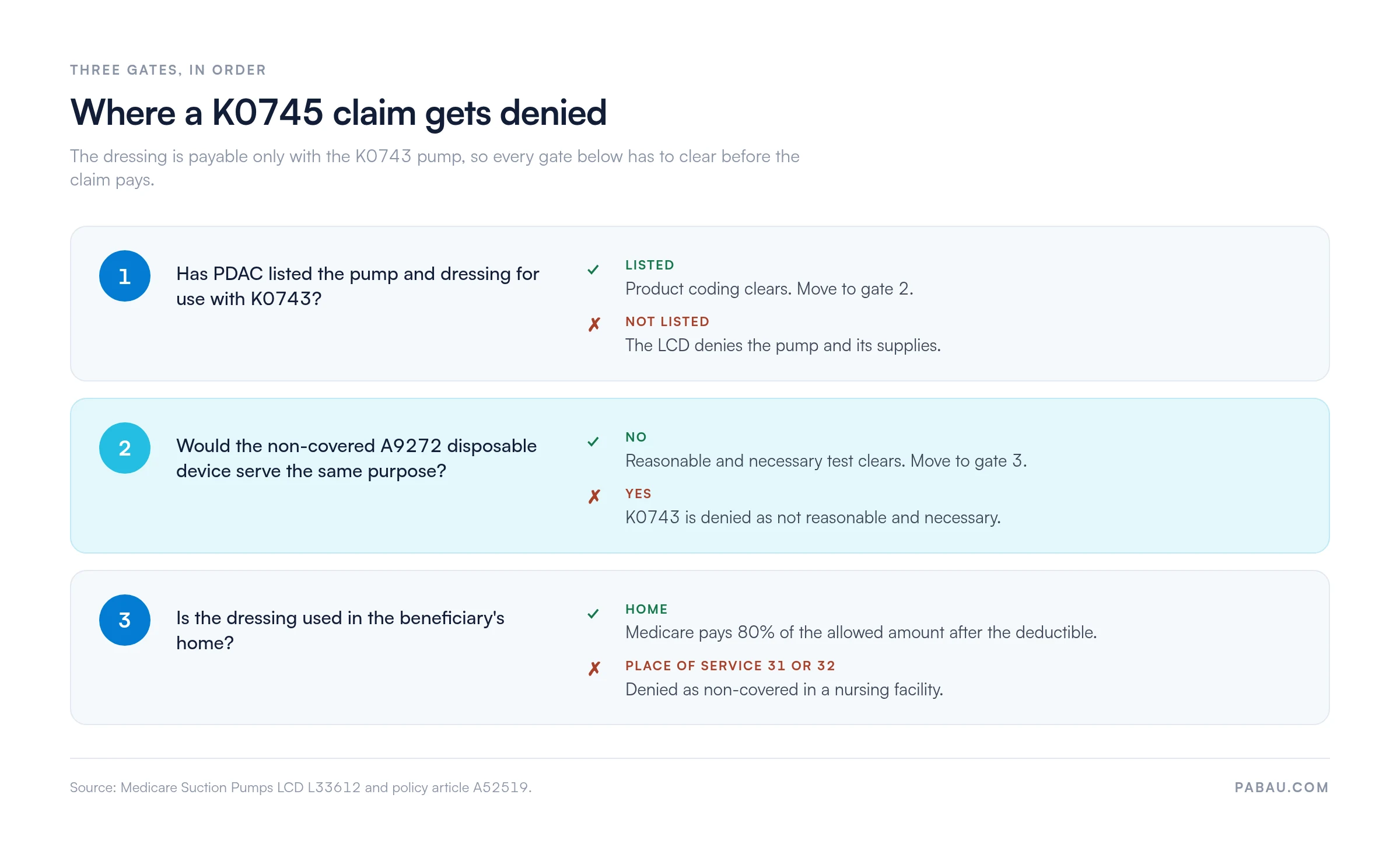
Then comes the rule that decides most of these claims. Where a non-covered alternative exists (A9272), the LCD says a covered DME item (K0743) is not reasonable or necessary. It adds that K0743 will be denied as not reasonable and necessary when it is billed.
A9272 is the disposable wound suction device, and Medicare does not cover it. The code is all-inclusive, so supplies used with it are not separately billable. A supplier who bills K0743 and its dressings anyway should plan for beneficiary liability before delivery.
Product coding is the second gate. The LCD denies wound suction pumps and their supplies that PDAC has not designated as qualified for K0743. CGS publishes a coding verification lookup tool that shows whether a HCPCS code needs PDAC verification at all.
Place of service is the third gate. Items used with a suction pump are denied as non-covered in a nursing facility, which covers place of service 31 and 32. DME is statutorily excluded from payment in those settings. Read the three gates in order, because a claim that fails the first never reaches the second.
K0745 documentation follows the DMEPOS standard requirements, with one difference worth planning for. K0745 is a repeat supply, so the refill records carry as much weight as the original order.
A Standard Written Order must reach the supplier before the claim is submitted. The SWO replaced the detailed written order in 2020, so an intake template that still asks for a DWO is out of date.
K0745 also does not appear on the CMS list of items needing a face-to-face encounter and a written order before delivery. No documented face-to-face visit is a condition of payment for the dressing itself.
A complete K0745 record holds the following:
Gather all of it before the claim goes out rather than after a denial arrives. Retention matters as well, since a reviewer can ask for the refill history months after the wound has healed.
Neither the Suction Pumps LCD nor policy article A52519 sets a KX requirement for K0743 through K0746. There is no medical policy checkbox for KX to attest to here, so adding it by habit tells the payer nothing.
The modifiers that carry weight are the liability modifiers. Because the LCD expects a denial where A9272 is the reasonable alternative, the ABN decision drives which one belongs on the line.
GA and GZ look alike and carry opposite consequences. GA means an ABN is on file, so the beneficiary can be billed. GZ means no ABN, so the balance is yours. Check that pairing before a claim is released.
Measure the wound before you pick the code, not after the denial. A pad of 16 square inches or less is K0744. More than 16 and up to 48 square inches is K0745. Larger than 48 square inches is K0746. Policy article A52519 also tells you to use the smallest dressing that covers the wound. For several wounds close together, use one larger dressing set rather than several small ones.
K0745 is paid under the Medicare DMEPOS fee schedule as a supply used with covered DME. Allowed amounts vary by state and DME MAC jurisdiction, so there is no single national rate to quote.
Units drive the total. One unit is one complete dressing change, so two changes in a week bill as two units. Pull the current year’s allowed amount from the CMS DMEPOS fee schedule file before you bill, because CMS reissues that file every January.
Put that January review on the calendar for every code you bill, K0745 included. A rate that moved quietly in the new year is an easy source of underpayment.
K0745 does not appear on the CMS required prior authorization list. That list covers power mobility devices, pressure reducing support surfaces, lower limb prosthetics, spinal and knee orthoses, and pneumatic compression devices.
So there is no CMS prior authorization step for the dressing, and no authorization number to append to the claim. The gates for K0745 sit elsewhere. PDAC product coding, the LCD’s reasonable and necessary test, and the refill rules decide whether the claim pays.
Other payers write their own rules, though. Medicare Advantage plans, state Medicaid programs, and commercial payers can all require prior authorization for wound suction supplies where traditional Medicare does not. Verify each plan’s policy before the first dressing ships.
CMS updates the required list by Federal Register notice, so recheck it each year instead of trusting a saved copy.
DMEPOS claims go to one of four DME MACs rather than the Part A/B MAC that handles physician claims. Jurisdiction follows the beneficiary’s permanent address, not the supplier’s location.
So a supplier in California shipping K0745 dressings to a beneficiary who lives in Florida bills Jurisdiction C, which CGS administers.
Cross-border deliveries and beneficiaries who winter in another state are where this gets missed. CMS keeps the current contractor assignments on file if you need to confirm one.
Supplier requirements for billing K0745:
K0745 sits in a four-code family for portable wound suction. Choosing between the three dressing codes is a measurement decision, because pad size is the only variable that separates them.
Two codes get grouped with K0745 by mistake, usually because the numbers sit nearby. K0740 covers repair or nonroutine service for oxygen equipment, billed as a labor component per 15 minutes.
K0835 is a group 2 standard power wheelchair with a single power option. Neither belongs on a wound care claim.
The pump side of the same claim runs on K0743. Verify every descriptor against the current year’s CMS HCPCS file before you bill into a new year.
The Suction Pumps policy publishes no covered diagnosis list for K0745. The ICD-10-CM lists inside policy article A52519 apply to the airway suction codes instead, including E0600, A4605, A4624, A7002, and A7047.
Diagnosis selection here is therefore a documentation exercise rather than a lookup. Report the code that names the wound under treatment, and make sure the record supports the exudate burden the LCD asks about.
That evidence has to come from the treating practitioner’s notes, since a supplier’s own file cannot establish medical necessity by itself. Documentation rules for HCPCS code J7644 treat a diagnosis code on the claim as insufficient without the physician’s supporting clinical findings.
Wound diagnoses reported alongside portable wound suction usually come from a short set of families:
Code to the highest level of specificity the record supports. A wound code missing its site or laterality trips a MAC edit before a reviewer ever reads the claim.
K0745 denials cluster around a handful of causes, and most of them are set in motion before the claim is built.
Track denials by code and reason rather than one claim at a time. When K0745 denials pile up on a single reason code, the fix belongs upstream in intake or product coding. Our guide to denial codes maps the common CARC and RARC entries back to their root causes.
Run a monthly K0745 denial review grouped by reason code. Documentation denials point back to the order, the wound notes, or the refill contact. Coverage denials point to the LCD test and the PDAC listing. Administrative denials point to enrollment, jurisdiction routing, or units. Each group has a different owner, so route them separately instead of reworking claims one by one.
K0745 claims fail for administrative reasons far more often than clinical ones. Six checks catch most of it, and none of them take long:
Two of those six sit outside billing. The measurement and the PDAC listing belong to whoever picks the product. That makes them a standing conversation with the clinical side, not a rework queue.
Most K0745 denials start as a small mismatch between the record and the claim. The wound notes describe three dressing changes and the claim carries one unit.
The order sits in a shared drive, the delivery note sits in somebody’s inbox, and the biller rebuilds both from memory.
Practice management software like Pabau closes that distance by building the claim from the record itself. Pabau offers claims management that pre-fills the CMS-1500 from the clinical record, so the dressing changes you documented become the units on the line.
HCPCS and ICD-10 lookup libraries sit behind a search icon, and required claim fields have to be complete before submission unlocks.
On the US pipeline, Pabau also runs eligibility checks, posts electronic remittances, and tracks claim status. So when a K0745 line comes back denied, the reason code sits next to the record it came from. That shortens the loop between a denial and its fix, which is where DMEPOS revenue usually leaks.
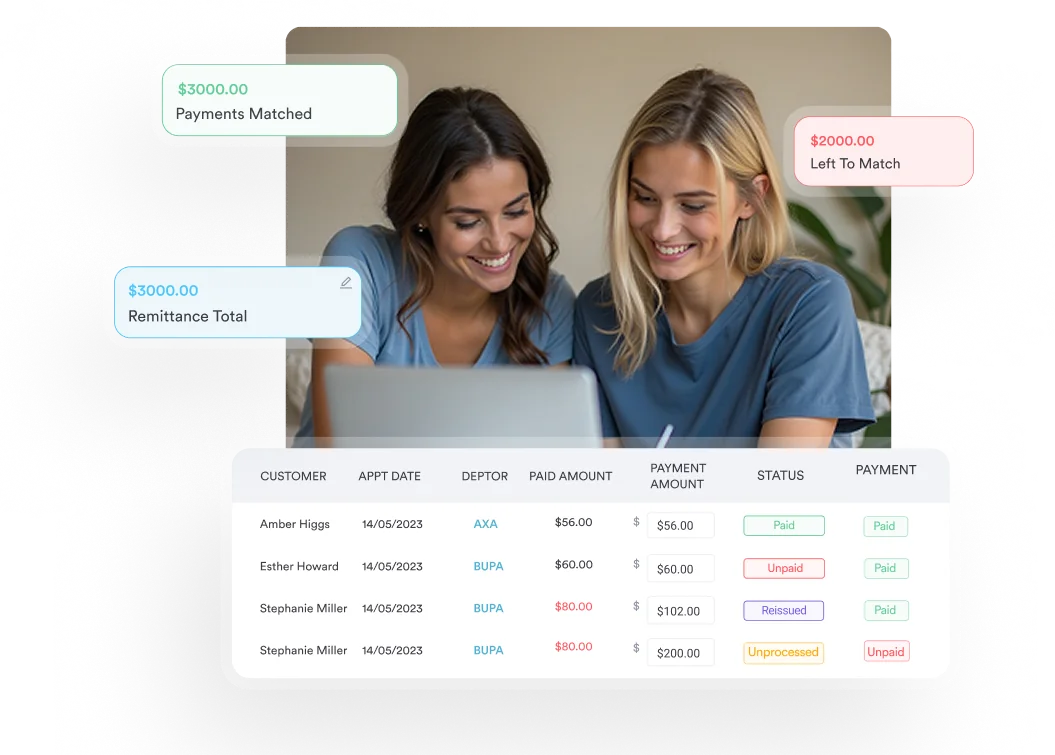

Pabau pre-fills the CMS-1500 from the clinical record, carries HCPCS and ICD-10 lookup libraries, and checks required claim fields before submission unlocks.

K0745 is a wound care supply code, and every billing decision on it follows from that. Pad size picks the code. The K0743 pump’s coverage decides whether the dressing pays at all. The refill record is what keeps it payable month after month.
The Suction Pumps LCD is blunt about the odds. Where the non-covered A9272 device would serve the same purpose, K0743 and its dressings get denied. Read that before delivery rather than after a denial, and you can set expectations with an ABN and code the line correctly first time.
So treat K0745 as a documentation problem with a coding label on it. Book a demo to see how Pabau turns a wound record into a DMEPOS claim without a second round of data entry.

Need to understand how clearinghouse submissions work for DMEPOS? Medical claims clearinghouse guide explains how claims flow from supplier to payer and what happens when they get rejected.
Want a clean-claim checklist for billing teams? Submitting a clean claim outlines the core elements every DMEPOS claim must have before it hits the MAC.
Looking to understand the 837P format used to submit K0745 claims electronically? EDI 837 file guide breaks down how electronic claim files are structured and what errors cause rejections at the clearinghouse level.
No. CMS discontinued certificates of medical necessity and DME information forms for claims with service dates on or after January 1, 2023. A Standard Written Order is what the supplier needs on file.
Usually yes. An assisted living facility counts as the beneficiary’s home when it provides mainly non-skilled care. A skilled nursing facility does not, which is why place of service 31 and 32 are denied.
Code each dressing change by the pad you used that day. A wound that shrinks past 16 square inches moves to K0744. One that grows past 48 square inches moves to K0746.
The supply codes have to match the pump you delivered. A6550 belongs with the E2402 NPWT pump, and K0744 through K0746 belong with K0743. Mixing them signals the wrong system.
File a redetermination with the DME MAC within 120 days of the remittance advice. If that fails, a qualified independent contractor handles the reconsideration, and you have 180 days to request it.
The Suction Pumps policy sets no fixed cap. Billing continues while the record shows continued medical need and the pump stays in use.