



CCSD code G5100: Bypass of duodenum billing guide
CCSD code G5100 bills a bypass that leaves the duodenum in place CCSD code G5100...

Last Updated: Oct 16, 2026

CPT Code 97533 describes sensory integration techniques billed per 15-minute unit, requiring direct patient contact throughout each session.
Medicare has historically treated 97533 as investigational, so coverage depends on your MAC jurisdiction and each payer’s policy.
Missing the plan-of-care modifier and failing to document medical necessity are the two most common denial triggers for this code.
Session notes need start and stop times, because unit counts under the 8-minute rule cannot be defended without them.
Pabau tracks timed billing units and stores session documentation in the same workflow, reducing manual errors on 97533 claims.
CPT Code 97533 is the timed billing code for sensory integration therapy, charged in 15-minute units of direct patient contact. Occupational therapists use it when a session applies sensory integrative techniques to improve sensory processing and adaptive responses to environmental demands. Medicare has historically treated the service as investigational, so coverage depends on your MAC jurisdiction and each payer’s policy.
Where it is covered, reported Medicare payment sits at roughly $21 to $24 per unit, and private payers typically pay 110% to 140% of that. Most denials trace back to three things. Those are the wrong plan-of-care modifier, a session note without clock times, and a diagnosis that fails to document a sensory deficit.
This reference covers the official code description, 2026 fee schedule data, and documentation requirements. It also covers modifier rules, ICD-10 pairings, and the billing errors that trigger audits.
CPT Code 97533 describes sensory integration techniques used to enhance sensory processing and promote adaptive responses to environmental demands. The American Medical Association (AMA) classifies it under Physical Medicine and Rehabilitation. Each unit represents 15 minutes of direct one-on-one contact between a qualified therapist and the patient.
The full AMA description reads: Sensory integrative techniques to enhance sensory processing and promote adaptive responses to environmental demands, each 15 minutes; direct patient contact. Three elements decide whether a session qualifies. The techniques must be sensory integrative in nature, direct patient contact must be maintained throughout, and the session must be documented in 15-minute increments.
The clinical framework most commonly associated with CPT 97533 is Ayres Sensory Integration (ASI), developed by occupational therapist A. Jean Ayres. ASI uses structured sensory-rich environments, specialized equipment such as swings and climbing walls, and therapist-guided activities to address sensory processing differences.
The peer-reviewed literature links 97533 to ASI methodology, but payer policies often define sensory integration more broadly. Document the specific techniques used in every session note rather than naming the framework alone.
Occupational therapists (OTs) and occupational therapy assistants (OTAs) are the primary providers billing CPT 97533. Physical therapists (PTs) and physical therapist assistants (PTAs) may also bill it, depending on state licensure scope and payer credentialing. Speech-language pathologists do not typically bill this code, because it falls outside standard SLP reimbursement structures for most payers.
Provider eligibility for 97533 varies by state licensure and payer contract. Confirm with each payer before credentialing a PT to bill this code.
Supervision requirements also vary by setting and payer. For Medicare, services must be provided under a plan of care established by a physician, nurse practitioner, or clinical nurse specialist. Document the supervising provider in the plan of care and in the session note.
Third-party aggregators put the 2026 Medicare national average for CPT 97533 at roughly $21 to $24 per 15-minute unit. Those figures are estimates from non-CMS sources. Verify them against the CMS Physician Fee Schedule lookup tool for your own geographic locality before you submit claims.
Rates vary by MAC jurisdiction, so a practice in a high-cost urban area may receive noticeably more per unit than one in a rural region. Private payer rates typically exceed Medicare rates by 10% to 40%, though this depends on the contract. Medicaid reimbursement is state-dependent and can fall below Medicare rates in some jurisdictions.
Run an eligibility check before the first session to confirm that 97533 is a covered service under that patient’s specific plan. Reconciling payer remittances against your expected per-unit rate is also how systematic underpayments surface.
Medicare’s coverage position on CPT 97533 is the single most important policy detail for any practice billing this code. The Centers for Medicare and Medicaid Services (CMS) has historically classified sensory integration therapy as investigational for most adult diagnoses. That usually makes it non-covered, or subject to strict medical necessity review at the MAC level.
Coverage varies by Medicare Administrative Contractor (MAC) jurisdiction, so check the relevant Local Coverage Determination (LCD) for your region before billing Medicare patients. The BCBS medical policy on Auditory and Sensory Integration Therapy is another common coverage hurdle. Many BCBS plans exclude 97533 for adults, or limit it to specific pediatric diagnoses with supporting evaluation documentation.
Obtain a pre-authorization or an eligibility check before the first session whenever you are working with commercial payers.
Documentation for CPT 97533 must establish medical necessity and show that the services delivered match what was billed. Vague session notes are the primary driver of post-payment audits and recoupment demands. Every record needs the following elements to support a clean claim.
Meeting billing compliance standards for timed therapeutic codes takes more than a brief narrative. Digital clinical forms configured to capture each required field keep the note complete at the point of care.

Start and stop times are non-negotiable for timed codes. A note that says “60-minute session” without clock times will not survive audit scrutiny under the 8-minute rule calculation.
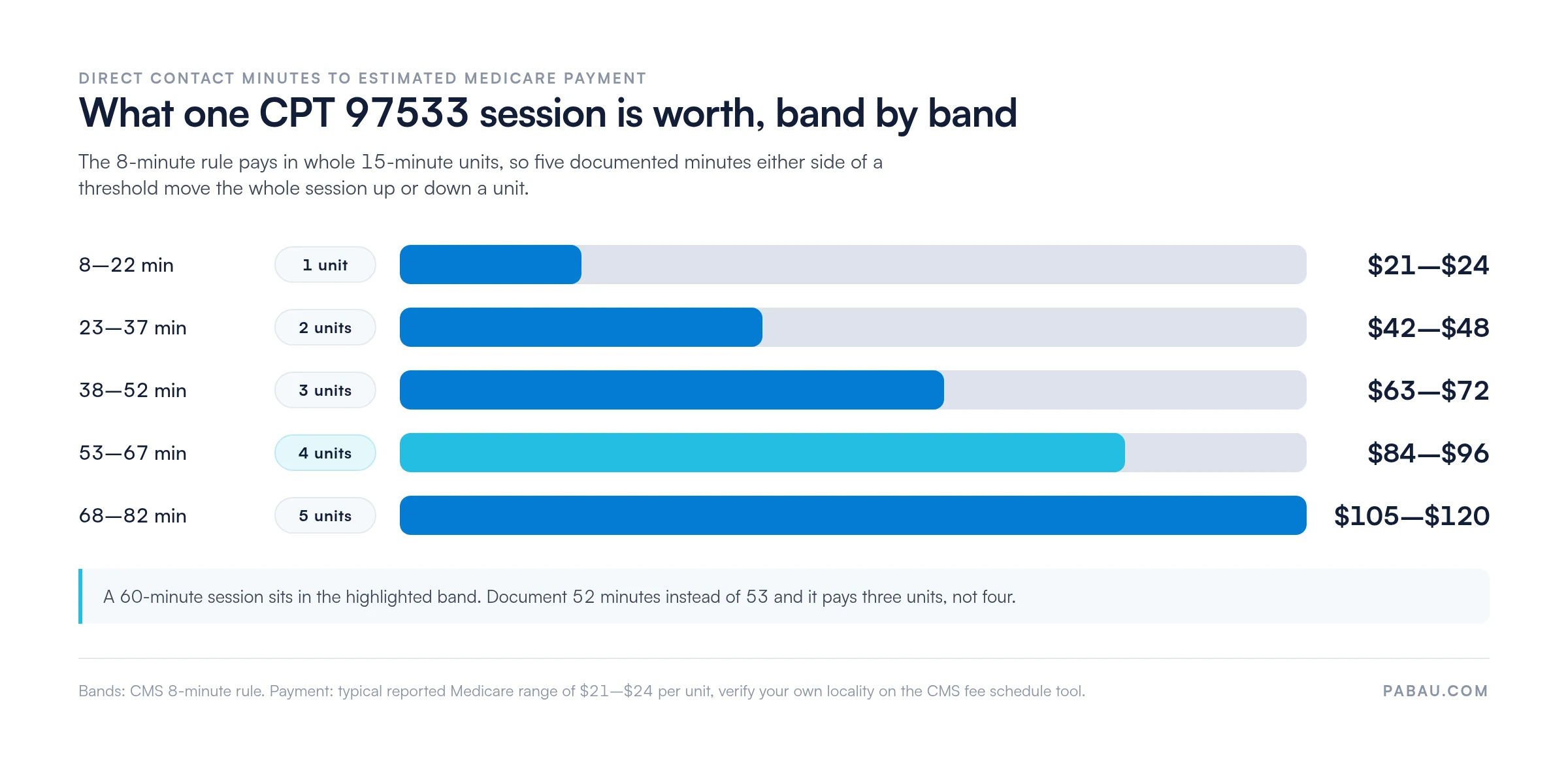
CPT 97533 uses the CMS 8-minute rule for Medicare claims. A unit may be billed only once at least 8 minutes of direct contact time have elapsed. The table below converts total direct contact minutes into billable units.
Private payers may apply different unit calculation rules. Some count only the midpoint of each 15-minute block rather than using the 8-minute floor. Confirm the methodology with each payer and document accordingly.
Converted at the reported Medicare rate, the bands are worth much more than the minute differences between them suggest.
Document start and stop times for every CPT 97533 session, even when the session is exactly 60 minutes. Auditors look for exact clock times in the note. A session note that says ’45 minutes of sensory integration therapy’ without specific times is a soft target for recoupment requests. Build start and stop time fields directly into your SOAP note template.
The correct modifier on a 97533 claim is not optional for Medicare. A missing or incorrect modifier turns a clean claim into a denial before a payer even reviews the clinical documentation.
The KX modifier tells Medicare that the patient has exceeded the annual therapy threshold but that continued treatment is medically necessary. The clinical record has to support that with objective evidence of continued functional progress. Billing KX without adequate documentation is a significant audit risk under the Office of Inspector General (OIG) work plan.
Every CPT 97533 claim needs a supporting ICD-10 diagnosis code that establishes medical necessity. The diagnosis must reflect a documented sensory processing deficit that functionally limits the patient’s daily activities. Pairing 97533 with a non-supporting diagnosis is a common audit trigger.
Symptom codes from the R41 block do not belong on a 97533 claim. R41.3 is “Other amnesia” and the broader cognitive-symptom descriptors sit under R41.8-, and neither documents a sensory processing deficit. A payer reviewing medical necessity wants the diagnosis that names the deficit being treated, not a cognitive symptom recorded alongside it.
The AAPC Codify CPT lookup carries CPT-to-ICD-10 crosswalk references you can use to confirm which diagnosis codes support medical necessity for a given therapeutic procedure. The CMS Physician Fee Schedule tool returns payment and RVU data only, so use it for rates rather than diagnosis pairings. Re-check coverage annually, because LCD policies update with each fiscal year.
The 97530 vs 97533 distinction catches billers every year. Both are 15-minute timed codes under Physical Medicine and Rehabilitation, both require direct patient contact, and both are billed by OTs and PTs. The difference is clinical. 97530 (therapeutic activities) targets functional task performance, while 97533 (sensory integration) targets the underlying sensory processing system.
Billing 97530 when the treatment record describes sensory integration activities, or the reverse, is upcoding regardless of intent.
Same-day billing of 97533 and 97530 works when the services are genuinely distinct and separately documented. Check the current National Correct Coding Initiative (NCCI) edit table via CMS before billing both on one date. Edit status can change with annual updates. Where Modifier 59 is required, the session note must describe how each 15-minute block served a different clinical purpose.
Knowing which codes commonly appear alongside or instead of 97533 helps billers avoid both missed charges and upcoding errors. The table below covers the codes most frequently billed in sensory integration and occupational therapy settings.
The OIG’s ongoing focus on therapy billing means 97533 claims face above-average scrutiny. Most audit triggers come from thin documentation and unit calculation errors rather than intentional fraud. Fixing them starts with identifying which of the errors below is happening in your own billing cycle.
Review your claim denial codes regularly to spot patterns in 97533 rejections. A cluster of CO-4 denials (incorrect procedure code) usually signals a modifier problem. CO-97 denials (bundled service) point to a same-day coding conflict that Modifier 59 could resolve with the right documentation.
Practices that document in one system and bill in another retype the same session data twice. That hand-off is where unit miscounts and missing modifiers start. Practice management software like Pabau keeps the session note and the claim in one workflow. The billed units come from the contact time the clinician recorded.
Pabau’s claims software for therapists connects the clinical record to the claim line. Configurable SOAP note templates can require start and stop times, a medical necessity statement, and therapy goal progress before a clinician signs off. The record is then audit-ready before the next patient arrives.
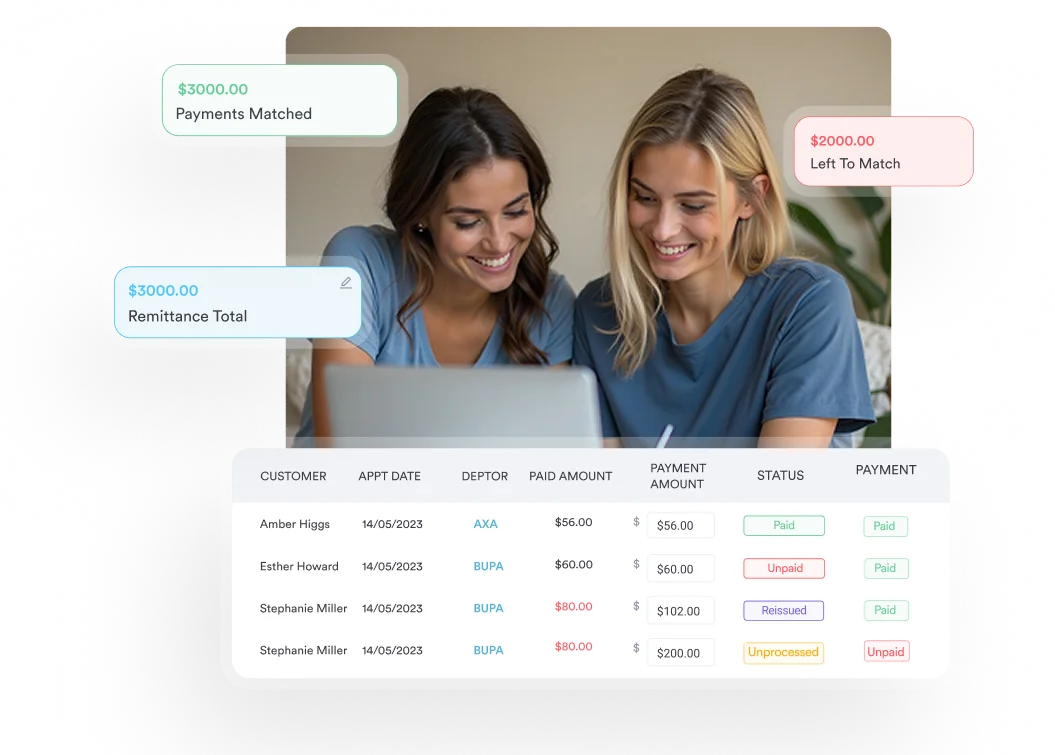
Superbill generation then pulls time-based units directly from the documented contact time. That removes the manual calculation step where OT practices most often overbill or underbill 97533. For US practices submitting electronically, Pabau integrates with Claim.MD for real-time eligibility checks and 835 remittance processing. Teams can confirm before a session whether 97533 is covered under that patient’s plan.
Run a quarterly audit of your 97533 claims. Pull the last 90 days of submissions and check the billed unit counts against the documented start and stop times in the session notes. If the units and the minutes do not align, that is a repayment liability. Fix the documentation workflow before a payer audit finds it first.

Pabau records start and stop times in the session note and carries the unit count through to the claim. Every 97533 submission matches the documentation behind it.

CPT 97533 denials are almost always preventable, and the fix is procedural rather than clinical. Accurate unit counts, the right plan-of-care modifier, a diagnosis that documents a sensory deficit, and session notes with clock times carry nearly every claim through.
The trade-off worth remembering is that this code rewards the practice treating documentation as part of the treatment. Front-load the requirements into the note template and the claim looks after itself. Leave them to the biller and every session becomes a reconstruction from memory, which is exactly what an auditor is looking for.
Book a demo to see how Pabau keeps timed code documentation and claim submission on the same record for occupational therapy practices.

New to the mechanics behind the claim? What is medical billing walks through the full cycle from encounter to payment, which is the context every timed code sits in.
Want fewer 97533 rejections at first submission? Clean claim submission sets out the checks that keep a claim from bouncing back on data entry alone.
Need to work through denials you already have? Denial management in healthcare explains how to find and fix recurring denial patterns across a practice.
Billing therapy sessions to self-pay patients? Superbill guide covers what the document must show so a patient can claim reimbursement themselves.
CPT Code 97533 is used for sensory integration therapy. The treatment applies structured sensory techniques to improve sensory processing and promote adaptive responses to environmental demands. It is billed per 15-minute unit, with direct patient contact required throughout the session. Occupational therapists use it primarily for autism spectrum disorder, sensory processing disorder, and related developmental conditions.
The number of billable units for CPT 97533 depends on the total minutes of direct patient contact. Under the CMS 8-minute rule for Medicare, 8 to 22 minutes supports 1 unit and 23 to 37 minutes supports 2 units. From there, 38 to 52 minutes supports 3 units and 53 to 67 minutes supports 4 units. Private payers may use different calculation methods, so confirm the unit rules with each payer.
The GP modifier is required on Medicare claims when 97533 is billed under a physical therapy plan of care. Use GO instead when the service falls under an occupational therapy plan. The KX modifier applies when therapy exceeds the annual Medicare threshold but continued treatment is medically necessary. Modifier 59 may be required when billing 97533 alongside another therapeutic code on the same date, to show the services are distinct.
Physical therapists may bill CPT 97533 depending on state licensure scope and payer credentialing rules. Not all payers recognize PTs as eligible providers for sensory integration therapy. Confirm with each payer individually before billing, and apply the GP modifier for Medicare claims under a PT plan of care.



