



HCPCS code E0198: Water pressure pad billing guide
HCPCS code E0198 is a water pad for a standard mattress HCPCS code E0198 is the ...

Last Updated: Oct 13, 2026

CPT code 97139 covers unlisted therapeutic procedures in physical medicine and rehabilitation when no specific code exists.
A special report describing the procedure, time, and medical necessity must accompany every 97139 claim.
97139 differs from 97039 (unlisted modality) and 97799 (catch-all unlisted PM&R procedure) by service category.
Practice management software like Pabau helps physical medicine practices document, submit, and track unlisted code claims in one workflow.
CPT code 97139 is the unlisted therapeutic procedure code for physical medicine and rehabilitation.
It applies when a service in a PM&R setting has no named CPT descriptor that captures it. Physical therapists, occupational therapists, and physiatrists use it for a novel or highly individualized technique that falls outside the 97xxx series.
Unlisted codes carry a documentation duty that named codes do not. Every 97139 claim needs a special report describing the procedure, the time spent, and the clinical rationale. Payers deny the claim outright when that narrative is missing.
CPT code 97139 is defined by the American Medical Association’s CPT code set as “unlisted therapeutic procedure (specify).” It sits in the Physical Medicine and Rehabilitation section of the CPT manual. Its neighbours there cover therapeutic exercises (97110), neuromuscular reeducation (97112), manual therapy (97140), and therapeutic activities (97530).
The parenthetical “(specify)” in the descriptor is the operative word. Every claim carrying 97139 must include a written description of the exact procedure performed. The AMA designed the code this way deliberately. Unlisted codes act as a safety valve for medically necessary services that have no dedicated descriptor yet. They are not a default when a named code would apply.
Use CPT 97139 only when two conditions hold at once. First, the service is a therapeutic procedure within the PM&R scope. Second, no existing code in the 97xxx series describes it accurately. If a named code exists, use it. Reaching for 97139 as a workaround is a billing error that invites audits and payer scrutiny.
Common legitimate scenarios where 97139 may be appropriate include:
Medical necessity is central to every 97139 submission. The treating provider, not the biller, determines whether the procedure meets the payer’s medical necessity standard. A well-supported clinical rationale in the special report is the first line of defense against denial.
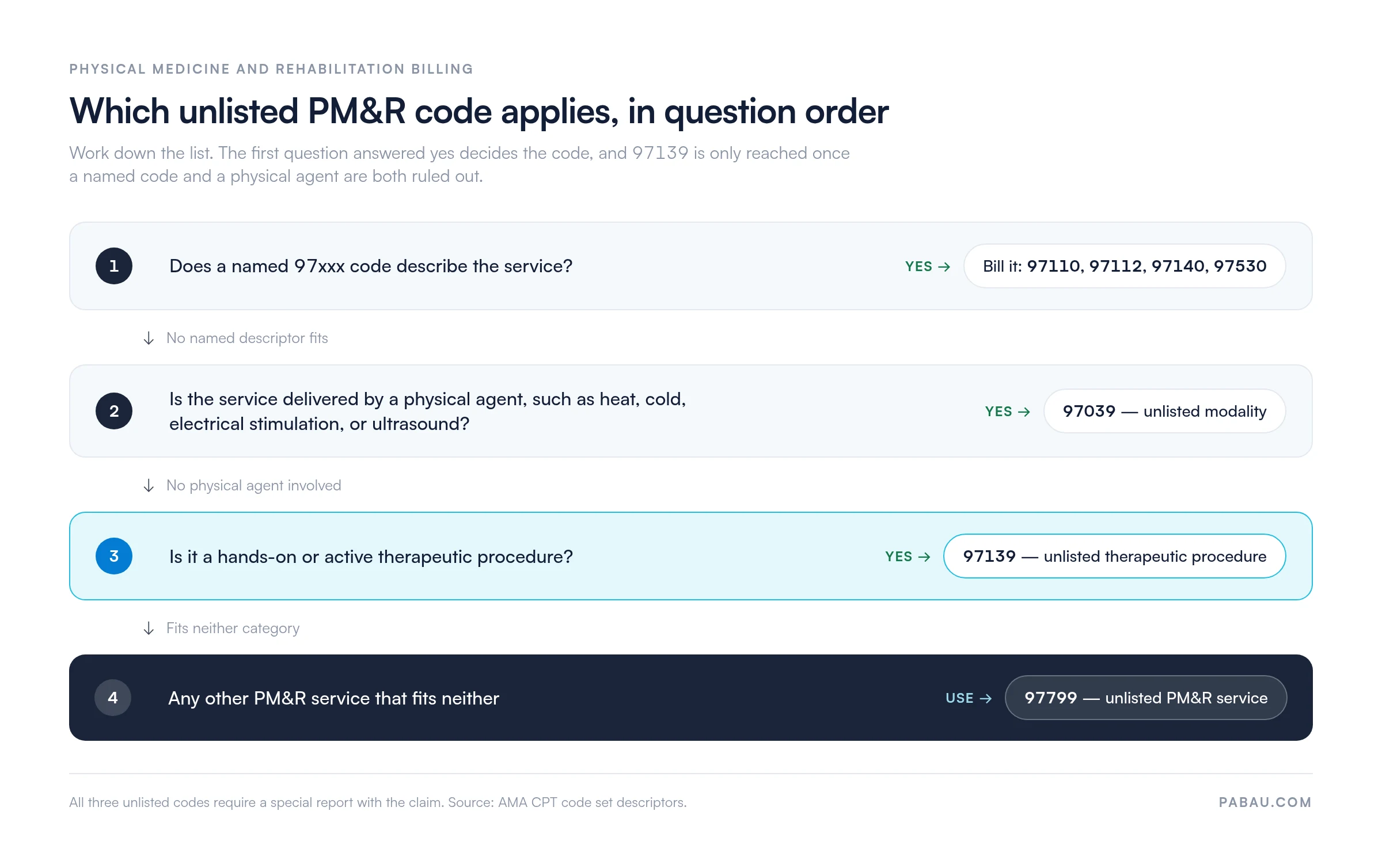
Three unlisted codes cover physical medicine and rehabilitation, and selecting the wrong one is a common cause of claim rejection. Each applies to a distinct service category. That distinction is the most important decision a PM&R biller makes when a named code is unavailable.
How to choose: Ask whether the service involves a physical agent, such as heat, cold, electrical stimulation, or ultrasound. If yes, 97039. If the service is a hands-on or active therapeutic procedure, 97139. If it fits neither, 97799 applies as the broader catch-all. The questions run in a fixed order, and the flow below follows that order.
Documentation for CPT code 97139 is more demanding than for any named PM&R code. Every claim must be accompanied by a special report, sometimes called a narrative report. Without it, the claim gives the payer nothing to review and is denied on submission.
The special report must address each of the following elements. Omitting any one of them gives the payer grounds to deny without requesting an appeal:
A special report follows a predictable order, and writing it in that order keeps the reviewer’s questions answered as they arise. These five steps produce a report that satisfies both CMS and commercial payer reviewers.
Aim for a clean claim on the first attempt. A complete special report attached at first submission avoids the administrative burden of appeals and resubmissions.
Billing CPT code 97139 follows a different workflow than billing a standard PM&R code. The claim cannot clear standard electronic submission without supporting documentation, and many clearinghouses flag it for manual review. Physical medicine practices working in streamlined claims management software can attach the special report at the point of claim creation. The report then travels with the claim instead of following it later.

Key billing considerations for 97139:
Read the remittance advice carefully on 97139 claims. Payers often include denial reason codes that name exactly what the special report lacked. Those codes tell the billing team what to correct before the appeal goes out.
Medicare may reimburse CPT code 97139 when medical necessity is established through a complete special report, but coverage is not guaranteed. CMS’s Medicare Claims Processing Manual (Pub 100-04) governs unlisted code handling for physical medicine claims. Medicare contractors review 97139 claims individually and may request more documentation before issuing a coverage determination.
Verify the patient’s plan before scheduling a service you intend to bill under 97139. Some Medicare Advantage plans follow different prior authorization rules than traditional Medicare. Confirm the plan’s unlisted code policy before the appointment, not after.
AAPC’s code lookup provides additional payer policy notes and local coverage determinations that reference 97139 by contractor jurisdiction. Checking the relevant determination before submission is particularly valuable for high-cost or high-frequency 97139 claims.
Before submitting a CPT 97139 claim, verify the payer’s unlisted code policy directly. Call the provider relations line, document the call reference number, and attach it to the patient record. This creates an audit trail if the payer later disputes coverage or requests additional information.
Unlisted codes generate a disproportionate share of billing errors and claim denials in PM&R practices. Most mistakes fall into five repeating patterns, and each one is straightforward to audit for in a quarterly review.
Treat every 97139 denial as a data point. Track which payers deny most frequently and what reasons they state. That pattern informs both future special report content and prior authorization decisions. For HCPCS code H0044, many Medicaid managed care plans want authorization in place before supported housing services begin, not before the month is billed.
Before reaching for CPT code 97139, review the named PM&R codes below. A charting system that surfaces the full 97xxx code set during documentation helps clinicians catch a matching code before billing defaults to unlisted. Use the FastRVU 2026 RVU lookup for current work RVU values on each code.
Our CPT code library covers each of these codes in its own reference page, with the documentation and modifier rules that apply to it. A superbill that pre-populates the 97xxx codes a PM&R team bills most often also reduces the chance that a coder selects 97139 by default.
In most PM&R practices the special report is written in one place and the claim is raised in another. The narrative sits in the clinical note, and someone has to copy or re-attach it at submission. When that step is skipped, the claim goes out bare and comes back denied.
Pabau holds the clinical note, the supporting documents, and the claim in one patient record. The therapist writes the procedure description and the treatment time into the note as part of charting. The biller then attaches that document to the 97139 claim without leaving the patient’s file.
The result is that a 97139 denial comes down to what the report says, rather than to whether it reached the payer at all. Submission status sits in the same view, so a PM&R team can also see which payers keep asking for more documentation on unlisted codes.

Pabau’s claims management workflow helps physical medicine practices capture special report documentation and attach it to the claim. Submission status is tracked in the same place.

The special report decides a 97139 claim. There is no fee schedule entry for the payer to fall back on, so the narrative carries the whole case for payment on its own. Write it once, properly, and attach it at first submission.
An unlisted code also costs more administrative effort than a named one. That is the reason 97139 should appear only when the 97xxx series genuinely has no match for the service. Check the named codes first, then document as though a reviewer will read every line. Book a demo to see how Pabau keeps that documentation attached to the claim from the start.

Worried about denials on unlisted codes? Denial management in healthcare covers how to track denial reasons and work an appeal that gets paid.
Building the charge sheet your coders work from? Superbill explains what belongs on one and how it reaches the payer.
Auditing your billing process this quarter? Medical billing compliance sets out the rules practices are measured against and the records they must keep.
Want to reduce claim processing time? What is revenue cycle management walks through the end-to-end billing cycle and where automation reduces manual effort.
CPT code 97139 is an unlisted therapeutic procedure code in the physical medicine and rehabilitation category. It is used when a therapeutic service is performed that no existing specific CPT code adequately describes. Every claim must include a special report specifying the procedure.
Use 97139 only when you have confirmed that no named CPT code in the 97xxx series accurately describes the service performed. If 97110, 97112, 97140, or 97530 captures the procedure, bill that specific code instead. 97139 is not a shortcut around documentation requirements for standard services.
Every 97139 claim requires a special report. It names the procedure precisely and ties medical necessity to the diagnosis. It also gives total treatment time in minutes, expected functional outcomes, the provider’s qualifications, and a statement that no specific CPT code exists.
97039 covers unlisted physical agent modalities (heat, cold, electrical stimulation). 97139 covers unlisted therapeutic procedures (hands-on or active interventions). 97799 is the catch-all for any other unlisted physical medicine service that fits neither of those two categories. Selecting the wrong code is a common source of claim denial.
Medicare may reimburse CPT code 97139 when a complete special report establishes medical necessity, but reimbursement is not guaranteed. Medicare contractors review each claim individually, and some require prior authorization. Verify the specific contractor’s policy before delivering the service.
Modifier GP applies to services delivered under a physical therapy plan of care and is required for Medicare PT claims. Modifier 59 (distinct procedural service) applies when 97139 is billed with other same-date procedures to avoid bundling. Confirm payer-specific modifier requirements before submission.



