96920 is the CPT code for laser treatment for inflammatory skin disease (psoriasis); total area less than 250 sq cm. It covers targeted excimer laser sessions, such as 308-nm XTRAC treatment, where the total area treated stays under 250 sq cm.
Common billing errors on 96920 are the wrong body surface area tier, missing prior-authorization documentation, and a diagnosis code the payer's LCD does not support.
Related Information
Section
90281-99607 Medicine
Subsection
96900-96999 Special Dermatological Procedures
Code range
96920-96922 Laser treatment for inflammatory skin disease (psoriasis)
96920Excimer laser therapy billing guideHigh match
Confidence score
98%
Why this code?
Matches patient diagnosis
Supported by clinical notes
Commonly used for this condition
Why practices choose Pabau
Save hours every week
Automate repetitive tasks and focus on what matters most—your patients.
Improve accuracy
Reduce coding errors and ensure compliance with the latest regulations.
Get paid faster
Clean claims, fewer denials, and faster reimbursements.
Grow with confidence
Powerful insights and reporting to help your practice thrive.
HIPAA compliant•SOC 2 certified•GDPR-compliant•Trusted by 4,000+ clinics worldwide
Key takeaways
CPT Code 96920 covers excimer laser treatment of inflammatory skin disease when the total treated area is under 250 sq cm.
Code 96921 covers 250 to 500 sq cm and 96922 covers over 500 sq cm, based on the area measured at each session.
The current descriptors name psoriasis only, so parapsoriasis, vitiligo and atopic dermatitis are covered only where a MAC LCD or payer policy allows.
The AMA has revised the descriptors to cover other inflammatory and autoimmune skin conditions from January 1, 2027.
Commercial and Medicare Advantage payers usually require prior authorization, while traditional Medicare relies on LCD documentation and step-therapy criteria instead.
Pabau’s claims management software checks that authorization details are on the claim before submission, submits through Claim.MD, tracks claim status and posts ERA remittances.
CPT Code 96920: definition, descriptor, and code family
CPT Code 96920 is the code for laser treatment for inflammatory skin disease (psoriasis) when the total treated area is less than 250 sq cm. The American Medical Association places it in the Special Dermatological Procedures range (96900-96999) of the CPT code set. Two companion codes cover larger areas.
Code
Official descriptor
Area treated
96920
Laser treatment for inflammatory skin disease (psoriasis); total area less than 250 sq cm
Less than 250 sq cm
96921
Laser treatment for inflammatory skin disease (psoriasis); total area 250 sq cm to 500 sq cm
250-500 sq cm
96922
Laser treatment for inflammatory skin disease (psoriasis); total area over 500 sq cm
Over 500 sq cm
Each descriptor currently names psoriasis only. Coverage for parapsoriasis and vitiligo comes from MAC LCDs and payer policies, not from the descriptor. In May 2025, the AMA CPT Editorial Panel revised 96920-96922 to cover other inflammatory and autoimmune skin conditions, such as atopic dermatitis. That change takes effect January 1, 2027.
The choice between 96920, 96921, and 96922 rests entirely on the body surface area treated at that session, measured and documented in square centimeters.
Covered indications: psoriasis, parapsoriasis, vitiligo, and the 2027 descriptor change
The covered diagnoses for CPT Code 96920 vary by payer and MAC jurisdiction, but the following ICD-10-CM codes are most commonly accepted. Plaque psoriasis, coded as L40.0, is the primary indication on most MAC LCDs. Attach the most specific code that reflects the documented diagnosis.
ICD-10-CM code
Condition
Coverage notes
L40.0
Psoriasis vulgaris (plaque psoriasis)
Accepted by most MACs and commercial payers; primary indication
L41
Parapsoriasis
Not named in the descriptor; covered under most MAC LCDs
L80
Vitiligo
Payer-dependent; some MACs and commercial payers exclude vitiligo. Verify the applicable LCD before billing.
L20-L30 range
Atopic dermatitis, eczema, and related inflammatory skin diseases
Not covered by current descriptor wording until Jan 2027; coverage only where the MAC LCD or payer policy allows.
STRATA Skin Sciences, which makes the XTRAC excimer laser, announced its own coverage-expansion initiative in March 2024. CMS did not expand the indications that year. The descriptor change came from the AMA CPT Editorial Panel in May 2025, effective January 1, 2027. The CY2026 Medicare Physician Fee Schedule final rule kept the codes covered and payable.
Until 2027, atopic dermatitis and other non-psoriasis diagnoses are billable only where the MAC LCD or payer policy allows them. Pull the applicable Local Coverage Determination before billing one of these diagnoses for the first time.
What CPT Code 96920 does NOT cover
Knowing the exclusions prevents denials before they happen. The following are not billable under CPT Code 96920 or its companion codes.
Cosmetic laser procedures. Laser hair removal, pigment correction, or skin resurfacing for aesthetic purposes have no covered indication under 96920. These use entirely different code ranges.
Broad-band UVB phototherapy. Non-targeted, whole-body ultraviolet light delivered via a light box or full-body cabinet is billed under CPT 96900 (actinotherapy), not 96920. Tar or petrolatum combined with UVB is a separate code, 96910. The excimer laser must deliver targeted ultraviolet light.
PUVA and photochemotherapy. Psoralen plus UVA treatment is billed under CPT 96912-96913. Combining PUVA with excimer laser in the same session does not allow stacking both codes without specific documentation of distinct services.
Diagnoses outside the payer’s covered list. Rosacea, acne, and common warts are not typical covered indications for excimer laser therapy under MAC LCDs. Confirm the applicable LCD before billing.
Non-FDA-cleared devices. Some payer policies specify that coverage applies only when treatment is delivered with an FDA-cleared excimer or excimer-like device. Confirm device status before billing commercial plans with this restriction.
How to bill CPT Code 96920: step-by-step workflow
A clean claim for CPT Code 96920 requires getting seven things right before the claim leaves the practice. Skipping any one step is the fastest route to a denial.
Confirm a covered indication. Document the diagnosis with a specific ICD-10-CM code that your MAC’s LCD lists as covered. Pull the current LCD, not last year’s version.
Obtain prior authorization where the payer requires it. Most commercial and Medicare Advantage payers require PA before the first session. Traditional Medicare does not, but its LCDs set documentation and step-therapy criteria. Many payers also require documented failure of topical steroids or phototherapy first. Get the auth number and attach it to every claim in the series.
Measure and record the treatment area. Measure the area treated in square centimeters at each session and document it in the clinical note. This single step decides whether 96920, 96921, or 96922 is correct. A note that says “small lesions” is not sufficient.
Select the correct code. Less than 250 sq cm: 96920. Between 250 and 500 sq cm: 96921. Over 500 sq cm: 96922. Bill the code that matches the measured area for that session, which may change session to session.
Attach the ICD-10 code. Link the claim line to the appropriate ICD-10-CM diagnosis. Vitiligo (L80) requires extra caution: check the LCD before submitting, as coverage is payer-dependent.
Apply applicable modifiers. See the modifier section below for 25, 76, and bilateral guidance.
Submit with the correct place of service code. POS 11 (office) is standard for most dermatology excimer laser sessions. Facility billing uses a different RVU calculation. Confirm before submitting.
Documentation requirements for CPT Code 96920
Thorough documentation is the difference between a paid claim and a post-payment audit reversal. The clinical note for each CPT Code 96920 session must include all of the following.
Diagnosis with ICD-10-CM code. The specific diagnosis, not a general description.
Body surface area in square centimeters. The measured area treated at that session. This determines the code tier and must match the billed code exactly.
Number of treatment sessions to date. Many payers limit covered sessions per year (commonly 10-30 sessions depending on payer and indication). Document the running total.
Prior treatment failures. Most LCDs require evidence that the patient has failed conventional therapies: topical steroids, calcineurin inhibitors, or conventional phototherapy. Document dates of prior treatment and outcomes.
Fluence (energy dose) and treatment parameters. The laser dose in mJ/cm2 and the number of pulses delivered, as recorded by the device.
Physician attestation. A supervising or treating physician must attest to medical necessity. For incident-to billing, confirm supervision requirements under the applicable LCD.
Clinical photographs. Some payers require photographs at baseline and at intervals documenting response. Check payer-specific policy, as this requirement varies.
Consistent documentation also supports medical billing compliance across payer audits. A documentation template built into your EHR reduces the chance of missing a required field mid-session.
Pro Tip
Build a CPT 96920 documentation checklist into your EHR note template. Check off: diagnosis ICD-10, sq cm measured, session count, prior treatment failures documented, fluence recorded, and physician attestation signed. A structured note that auto-populates device parameters eliminates the most common audit findings before they happen.
Modifiers for CPT Code 96920
Modifiers clarify billing circumstances to payers and are required in specific situations. The table below covers the modifiers most relevant to excimer laser billing.
Modifier
When to use
Common pitfalls
76
Repeat procedure by same physician on the same date of service
Only needed if two distinct sessions occur on the same day. Most practices run one session per visit; applying 76 without cause triggers review.
25 (on the E/M)
Significant, separately identifiable E/M service on the same date as the laser session
Append 25 to the E/M, not to 96920, and document the separate work. Bundling without 25 typically results in the E/M being denied.
50
Bilateral procedure when symmetric lesions on both sides of the body are treated in a single session
Many payers do not apply a 50% reduction to phototherapy codes as they do to surgical codes. Verify payer policy before applying modifier 50 to avoid underpayment.
GY
Statutorily non-covered service, or one that is not a Medicare benefit
No ABN is needed. Do not use GY for a diagnosis that an LCD excludes.
GA
Advance Beneficiary Notice (ABN) on file for an LCD-excluded diagnosis, such as vitiligo where the MAC excludes it
Get the signed ABN before treatment, then bill with GA.
Prior authorization requirements by payer
Prior authorization rules for excimer laser vary by payer type. Commercial and Medicare Advantage plans usually require it, while traditional Medicare does not. Check insurance eligibility verification and PA status before every course of treatment, not just the first session.
Payer type
PA required?
Prior treatment failure required?
Notes
Traditional Medicare (MAC LCDs)
No (traditional Medicare); LCD documentation and step-therapy criteria apply
Yes, typically required
Pull the active LCD from your specific MAC (Noridian, Palmetto, NGS, CGS, WPS, Novitas, or First Coast). Requirements are not uniform nationally.
Horizon Blue Cross Blue Shield
Yes
Yes
Policy requires documented failure of conventional phototherapy or topical treatments before approving laser therapy for psoriasis or parapsoriasis.
Other commercial payers
Usually yes
Usually yes
Most major commercial payers (Cigna, Aetna, UHC) publish medical policies covering excimer laser. Check the current policy version before each treatment course, as step-therapy requirements evolve.
Medicare Advantage plans
Usually yes
Usually yes
Each plan sets its own prior authorization rules. Check the plan’s policy before the first session.
Medicaid
State-dependent
State-dependent
Excimer laser coverage under Medicaid varies widely. Some state programs cover it for psoriasis with PA; others exclude it entirely. Verify before scheduling the patient.
CPT Code 96920 reimbursement rates
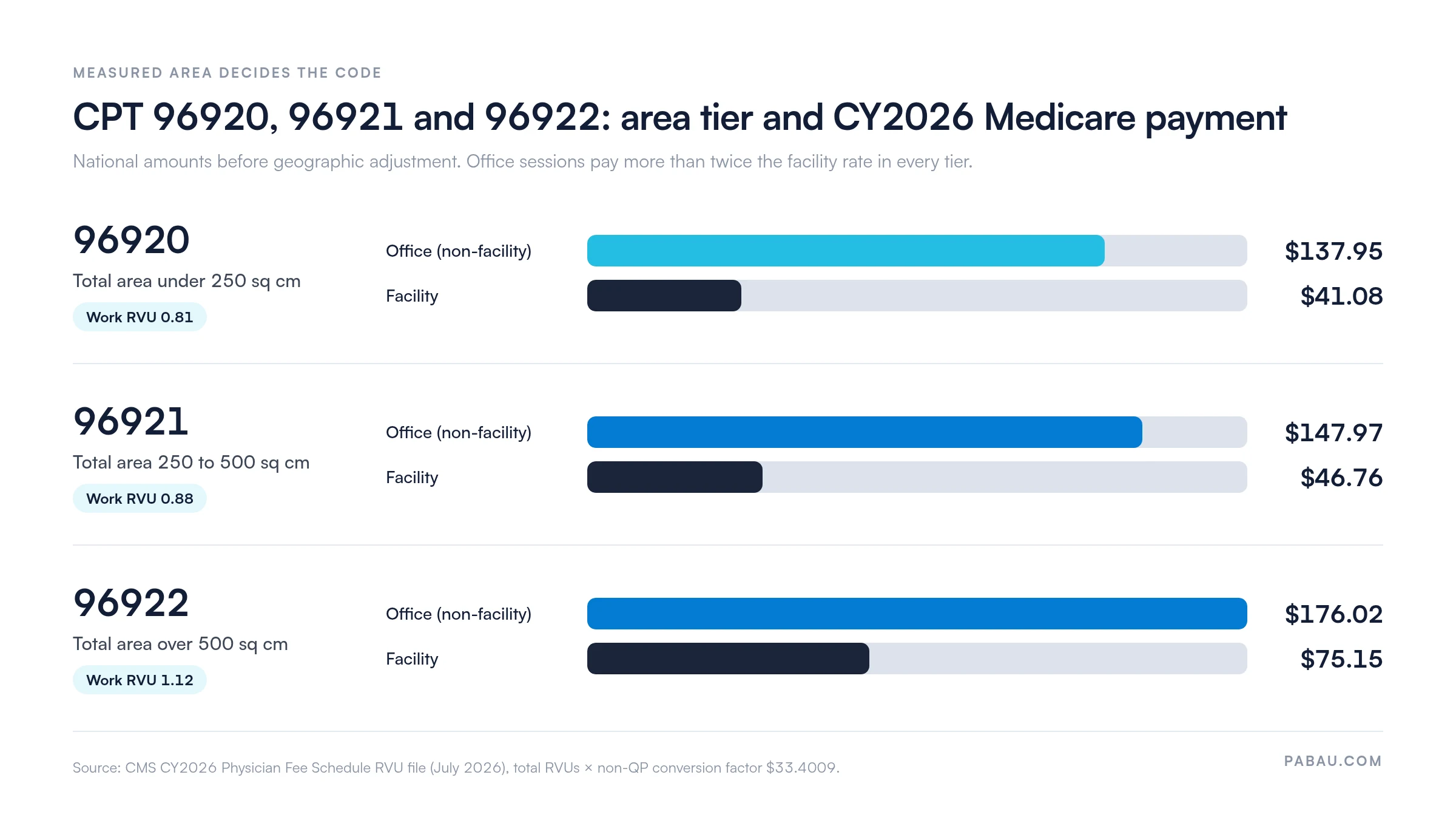
Medicare reimbursement for CPT Code 96920 is calculated from the CMS Physician Fee Schedule and varies by geographic locality and place of service. The figures below are CY2026 national amounts before geographic adjustment, at the non-QP conversion factor of $33.4009. Qualifying APM participants are paid at $33.5675, so their amounts run slightly higher.
The area tier moves the payment less than the setting does, as the chart below shows.
Moving from 96920 to 96922 adds about $38 in the office, while the same session in a facility pays less than half. Figures from the CMS CY2026 RVU file.
The table lists the same CY2026 amounts with the work RVU for each code.
Code
Non-facility rate (approx.)
Facility rate (approx.)
Work RVUs
96920
~$137.95
~$41.08
0.81
96921
~$147.97
~$46.76
0.88
96922
~$176.02
~$75.15
1.12
Commercial payer rates generally exceed Medicare rates. The contracted amount depends on your fee schedule negotiation with each payer, so compare each remittance against that contract.
XTRAC laser and CPT Code 96920: device billing notes
The XTRAC excimer laser, manufactured by STRATA Skin Sciences, is the most widely used 308-nm targeted UVB device in US dermatology practices. CPT Code 96920 is device-agnostic: any FDA-cleared excimer laser delivering targeted ultraviolet light for a covered indication bills under the same code regardless of brand.
Several practical points apply specifically to XTRAC and similar targeted excimer systems:
Device clearance documentation. Some commercial payer policies specify coverage is limited to FDA-cleared excimer or excimer-like devices. Keep your device’s 510(k) clearance documentation on file for audit response.
Session frequency. XTRAC protocols for psoriasis typically deliver sessions two to three times per week. Document each session separately with its own BSA measurement. A single superbill spanning multiple sessions on different dates is not acceptable.
STRATA coverage programs. STRATA has run patient-access programs for uninsured or underinsured patients. These are independent of CPT billing and do not affect how the code is billed for insured patients.
The 2027 descriptor change. STRATA announced a coverage-expansion initiative in March 2024, but CMS did not expand indications that year. The AMA’s revised descriptors take effect January 1, 2027. MAC LCDs and payer policies still decide which diagnoses are covered, so verify the current policy before billing a non-psoriasis diagnosis.
Common denial reasons for CPT Code 96920 and how to appeal
Denials for CPT Code 96920 cluster around a predictable set of causes. A structured denial management workflow that addresses each one at the source is far more efficient than reactive appeals. Here are the most common reasons and the corresponding fix.
Denial reason
Root cause
Fix / appeal approach
Missing prior authorization
PA not obtained before treatment began
For retroactive appeals, submit clinical notes showing medical necessity. Prevention is more effective: build a PA workflow before the first session.
Non-covered indication
ICD-10 code not on the payer’s covered list for excimer laser (e.g., vitiligo on a plan that excludes it)
Review the MAC LCD or commercial policy. If the diagnosis is covered, appeal with the policy language. If not, issue an ABN and bill the patient.
Wrong BSA code selected
96921 or 96922 billed but BSA documentation supports a smaller area
Correct and resubmit with the code that matches the documented measurement. Appeal with the clinical note showing the sq cm treated.
Submit a letter of medical necessity with dates and outcomes of prior topical or phototherapy treatment. Attach the relevant section of the payer’s medical policy to show criteria are met.
Session limit exceeded
Annual session cap reached without a new authorization
Request a session limit extension with documentation of treatment response and ongoing medical necessity. Track session counts in the EHR against each payer’s cap.
Reading the common denial codes alongside the payer’s remittance advice shows which category each denied claim falls into, so appeals go out faster.
Pro Tip
Track CPT 96920 denial reasons by payer in a simple spreadsheet and review them monthly. Denials on this code usually cluster in one or two categories, such as prior authorization or area documentation. Fixing the front-end step behind your top category prevents the repeat denials it causes.
Related dermatology billing codes
Coders frequently confuse CPT Code 96920 with adjacent special dermatological procedure codes. Use the table below to confirm you are billing the correct code for the treatment delivered. Consult the AAPC CPT code lookup for full descriptors.
Code
Description
Key difference from 96920
96900
Actinotherapy (ultraviolet light)
Broad-band, non-targeted UVB; no excimer laser involved
96910
Photochemotherapy; tar and ultraviolet B (Goeckerman), or petrolatum and ultraviolet B
Pairs a topical (coal tar or petrolatum) with UVB; no laser involved
96912
Photochemotherapy; psoralens and ultraviolet A (PUVA)
Psoralen drug plus UVA light, for any condition; not a laser procedure
96913
Photochemotherapy (Goeckerman and/or PUVA) for severe photoresponsive dermatoses requiring at least 4-8 hours of care under direct physician supervision
Extended day-treatment regimen for severe disease; not a laser procedure
96567
Photodynamic therapy (external)
Uses a photosensitizing agent activated by light; separate mechanism from excimer laser
How claims management software reduces denials for CPT 96920
At many dermatology practices, the measured area sits in the clinical note while the authorization number sits in a payer portal. The claim is then built by hand in a separate billing system. Each handoff is a chance to drop the auth number or bill the wrong area tier.
The claims management software in Pabau, the practice platform we build, checks that authorization details are on the claim before it goes out. It then submits the claim through Claim.MD, tracks its status, and posts the ERA remittance when the payer pays.
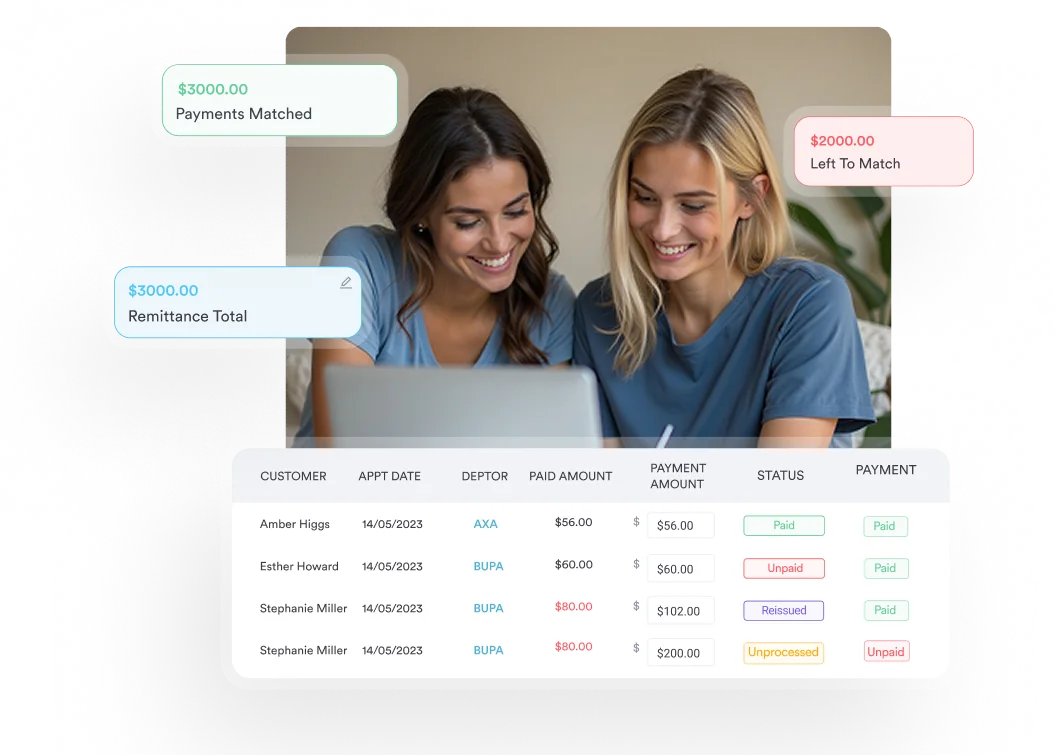
Pabau’s remittance screen lists each claim as paid, unpaid or reissued, so an underpaid excimer laser claim is quick to spot.
Your billers see a missing auth number before submission, not on a denial weeks later. With remittances posted against each claim, an underpaid 96921 or 96922 line is easier to spot.
Catch excimer laser claim errors before submission
Pabau checks that authorization details are on the claim before submission, submits excimer laser claims through Claim.MD, tracks claim status and posts ERA remittances. Your billing team spends less time chasing denials.
Excimer laser claims under CPT Code 96920 fail at two predictable points. One is a missing authorization with commercial or Medicare Advantage payers. The other is an area measurement that doesn’t match the billed tier. Both are process problems, so fix them in the workflow before the first session.
Watch the calendar too. Until January 1, 2027, a non-psoriasis diagnosis is billable only where the LCD or payer policy allows it. Re-check those policies when the revised descriptors take effect.
Clean claim habits protect this code: authorization on file, area measured, and a diagnosis the LCD accepts. They’re easier to keep when the claim is built from one record. Book a demo to see how Pabau checks excimer laser claims before they reach the payer.
Continue your research
Need to understand how your claims reach the payer?Medical claims clearinghouse explained covers how 837P electronic claim files move from practice to payer and what happens when they are rejected.
Dealing with ERA remittances after payment?Electronic remittance advice (ERA) explains how 835 files work, what each adjustment code means, and how to automate posting.
Want to understand the full billing cycle for dermatology?What is revenue cycle management outlines the end-to-end process from patient scheduling through to collected payment.
Billing excimer laser for vitiligo?ICD-10 code L80 covers the vitiligo diagnosis code that payers check against their coverage policy.
CPT Code 96920 covers laser treatment for inflammatory skin disease (psoriasis) over a total area less than 250 sq cm. Treatment uses targeted ultraviolet light, such as a 308-nm excimer laser. Psoriasis (L40.0) is the primary indication. Parapsoriasis (L41) and vitiligo (L80) are covered where the MAC LCD or payer policy allows. Revised descriptors covering other inflammatory skin conditions take effect January 1, 2027.
What is the difference between CPT codes 96920, 96921, and 96922?
The three codes differ only by body surface area treated. Code 96920 covers less than 250 sq cm, 96921 covers 250 to 500 sq cm, and 96922 covers over 500 sq cm. Measure the treated area in square centimeters at each session and bill the code that matches. The area can change session to session, so the correct code may also change.
Can CPT Code 96920 be billed for vitiligo treatment?
Yes, but coverage is payer-dependent and not universal. Some MACs and commercial payers include vitiligo (L80) as a covered indication for excimer laser; others exclude it. Verify the applicable LCD or commercial policy before billing vitiligo under CPT Code 96920. If coverage is excluded, issue an Advance Beneficiary Notice before treatment.
What are the most common reasons CPT 96920 claims are denied?
The most common denial reasons are missing prior authorization and a diagnosis code the payer’s policy does not cover. Others are a billed code that doesn’t match the documented area, thin documentation of prior treatment failures, and an exceeded annual session limit. Most of these are preventable with a front-end PA and documentation checklist.