CCSD code A2720: Proximal gastric vagotomy billing guide
What is CCSD code A2720? CCSD code A2720 is the procedure billing code assigned ...

Last Updated: Oct 8, 2026
93655 is the CPT add-on code for intracardiac catheter ablation of a discrete mechanism of arrhythmia which is distinct from the primary ablated mechanism. The code includes repeat diagnostic maneuvers to treat a spontaneous or induced arrhythmia, and it is reported with primary code 93653, 93654 or 93656.
Most 93655 denials trace back to three mistakes. The add-on is billed without its primary code, the report never documents the distinct second focus, or modifier 51 is appended to an exempt code.
Let Pabau's smart automation suggest the right codes, reduce claim denials, and keep your practice compliant—effortlessly.
Automate repetitive tasks and focus on what matters most—your patients.
Reduce coding errors and ensure compliance with the latest regulations.
Clean claims, fewer denials, and faster reimbursements.
Powerful insights and reporting to help your practice thrive.
HIPAA compliant SOC 2 certified GDPR-compliant Trusted by 4,000+ clinics worldwide

CPT code 93655 is a +add-on code for ablating a second, distinct arrhythmia focus in the same EP session.
It must be reported alongside primary code 93653, 93654 or 93656 and cannot be billed as a standalone charge.
Modifier 51 does not apply to 93655 because add-on codes are modifier-51 exempt by AMA convention.
Documentation must explicitly identify the additional arrhythmia focus as separate from the primary ablation target to avoid medical necessity denials.
Pabau’s claims management software checks required claim details before sending and submits EP ablation claims through the Claim.MD clearinghouse.
CPT code 93655 covers intracardiac catheter ablation of each additional distinct arrhythmia focus. That ablation happens during the same operative session as the primary ablation code. It is always reported with primary code 93653, 93654 or 93656. The American Medical Association designates it with a plus (+) prefix. That prefix marks it as a supplemental procedure code that extends the primary work instead of replacing it.
Procedurally, the electrophysiologist identifies and maps an arrhythmia focus that is distinct from the one already targeted by the primary code. Catheters are advanced to the additional site, mapping confirms its independence from the first focus, and radiofrequency or cryoablation energy is delivered to eliminate it.
The key operative distinction is that the second focus must be demonstrably separate. A continuation of the primary ablation line or an extension of the same anatomical circuit does not count.
The code falls within the CPT electrophysiology section (93600-93662), which governs intracardiac electrophysiological procedures. It does not include diagnostic EP study work, catheter placement, or fluoroscopic guidance, all of which have separate reporting rules.
Because 93655 is a +add-on code, it has no standalone billing status. It must always appear on the same claim as an eligible primary code. The AMA specifies three permitted primaries. Reporting 93655 with any other base code is a coding error that will trigger a denial.
When multiple additional distinct arrhythmia foci are ablated in the same session, 93655 may be reported more than once. Each additional unit must represent a genuinely separate anatomical focus with independent mapping findings. AMA convention supports multiple-unit reporting. Confirm the current CMS Medically Unlikely Edit (MUE) for 93655 before billing more than two units, because payer-specific limits may apply.
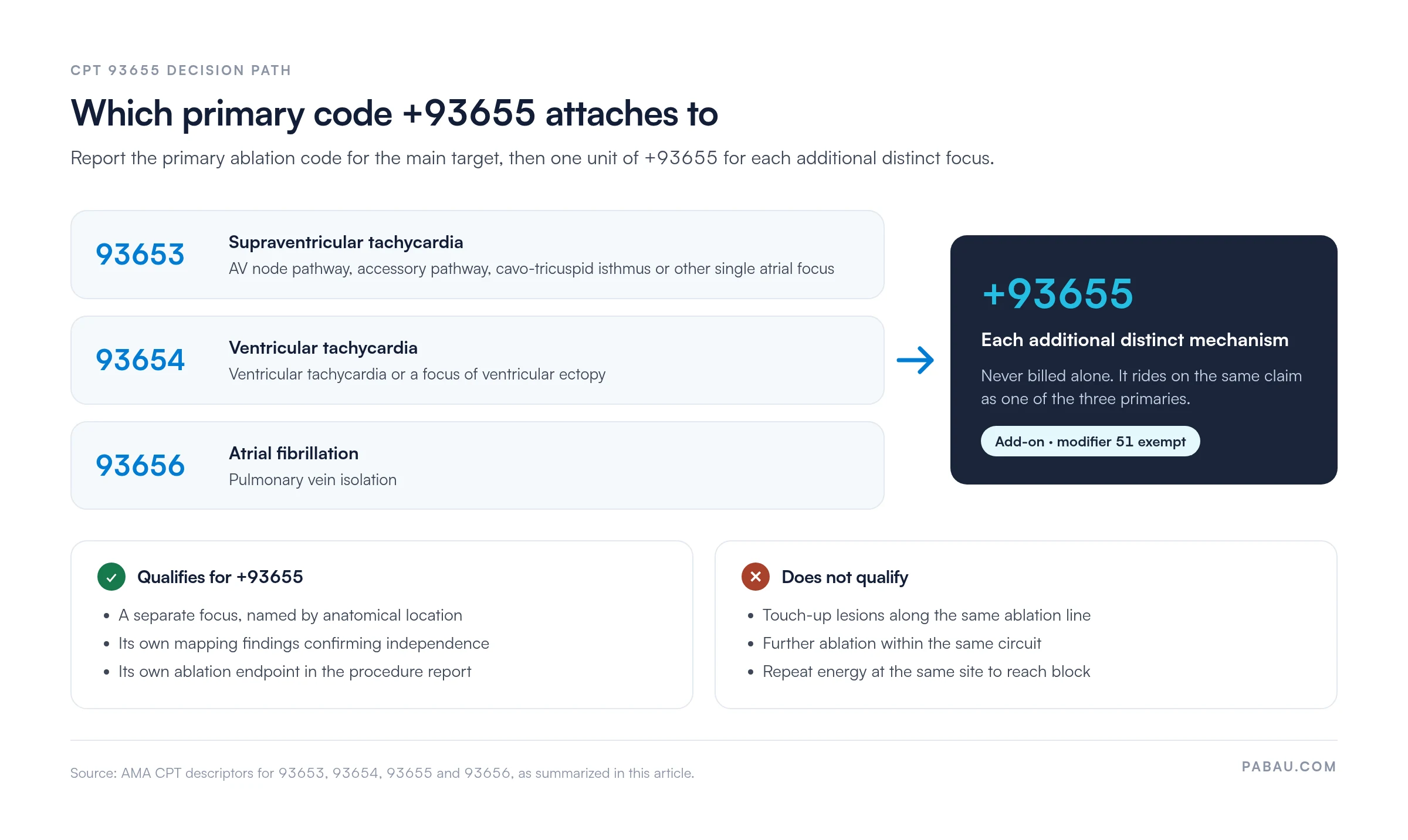
The four core EP ablation codes are frequently confused because they share similar clinical settings. 93653 covers supraventricular tachycardia only, 93654 covers ventricular tachycardia or ectopy, and 93656 covers atrial fibrillation treated with pulmonary vein isolation. 93655 attaches to any of the three when an additional distinct focus is ablated.
Take a common scenario. A patient undergoes PVI for atrial fibrillation (93656), and the electrophysiologist ablates a separate accessory pathway in the same session. Report 93656 as the primary and add 93655 for the accessory pathway ablation. Do not report 93653 alongside 93656 to capture the extra work. 93655 is the correct vehicle for that additional focus.
CPT code 93655 applies whenever the electrophysiologist ablates an arrhythmia focus that is anatomically and electrophysiologically distinct from the focus targeted by the primary code. Clinical qualification depends on documentation, not diagnosis alone.
Arrhythmia types that commonly support 93655 billing:
What does not qualify:
Payer auditors look for documentation that explicitly separates the primary and additional focus by location, electrophysiological characteristics, and independent mapping confirmation. Vague language such as “additional ablation performed” without identifying the distinct focus will not support the add-on. The diagram below puts the primary-code choice and the qualifying tests side by side.
Modifier rules for 93655 are simpler than for most CPT codes because its add-on status resolves several common modifier questions automatically.
The most frequent modifier error on 93655 claims is appending modifier 51. Payers that auto-reduce multiple-procedure payments when modifier 51 is present will improperly reduce the 93655 reimbursement. Remove modifier 51 from all add-on codes before submission.
The Centers for Medicare and Medicaid Services (CMS) National Correct Coding Initiative (NCCI) maintains bundling edit tables updated quarterly. Specific NCCI pairs involving 93655 should be verified against the current NCCI Policy Manual for Medicare Services, as edit tables change with each quarterly release.
General NCCI patterns that affect EP ablation coding including CPT code 93655:
When a payer NCCI edit triggers a denial, review whether a modifier (59 or XU) is permitted for that specific code pair. An NCCI edit pair with a modifier indicator of “1” allows a modifier to override the bundle. A pair with a “0” allows no override at all. Applying a modifier to a “0” indicator pair invites an audit as well as a denial.
The electrophysiology procedure report is the primary documentation vehicle for CPT code 93655. Payers reviewing a 93655 claim will look for explicit language that demonstrates the additional ablation was a separate, distinct service from the primary procedure. Consistent medical billing compliance in EP labs requires a documentation standard applied uniformly across all cases.
Required elements in the EP report to support 93655:
Vague language in the procedure note is the single most common cause of 93655 medical necessity denials. Phrases such as “additional lesions applied” or “ablation of multiple sites” do not satisfy documentation requirements. The report must read as if each ablation target were a separate clinical problem addressed during the same operative encounter.
Most commercial payers require prior authorization for catheter ablation procedures, including those billed with CPT code 93655. Authorization is typically obtained for the primary procedure (93653, 93654 or 93656). The add-on code is covered under that authorization when documentation supports it. However, some payers require the add-on to be listed explicitly during the authorization request.
Payer-specific considerations for EP ablation authorization:
Using claims management software that tracks authorization status linked to specific CPT codes reduces the risk of submitting 93655 claims without valid coverage confirmation. Document the authorization number on the claim form when prior auth was obtained.
Medicare reimburses CPT code 93655 through the Medicare Physician Fee Schedule (MPFS), which is updated annually. Because EP ablation is performed almost exclusively in facility settings (hospital outpatient departments or ambulatory surgery centers), the relevant rate is the facility rate. The CMS Physician Fee Schedule lookup tool provides current year payment amounts and RVU breakdowns by locality.

For reference, the 2026 national unadjusted Medicare payment for 93655 is approximately $260-$270 per unit, before GPCI adjustment. That figure rests on 7.81 total RVUs, and the facility and non-facility amounts are the same for this add-on code. Verify current figures in the MPFS lookup before quoting reimbursement to providers. Rates change with each annual fee schedule release, and locality adjustments apply.
Use the FastRVU 2026 lookup tool to retrieve current work, practice expense, and malpractice RVU values for 93655. From those, calculate the national unadjusted payment, then apply your geographic practice cost index (GPCI) adjustment.
Sound revenue cycle management in an EP practice includes checking the place-of-service code on every ablation claim before submission.
Submit 93655 with the same place-of-service code as its primary procedure, such as 22 for hospital outpatient or 24 for an ambulatory surgery center. A POS code that doesn’t match the primary line invites a payer edit. Run a quarterly audit of POS codes across all EP ablation claims to catch systemic billing errors before they compound.
A solid denial management workflow for EP ablation claims starts with understanding why 93655 is rejected. Most denials fall into five categories, each with a clear prevention strategy. The CARC and RARC codes on the remittance usually show which one applies, and this guide to medical billing denial codes decodes them.
Routing claims through the Claim.MD clearinghouse adds eligibility checks and payer-specific edits before submission. Bundling conflicts and missing authorization data get caught before the claim reaches the payer.
Pair this with the structured documentation checklist above to remove the most frequent causes of 93655 denials. For guidance on error-free submissions, review the criteria for submitting a clean claim in an EP billing workflow.
Without a pre-submission check, a 93655 line that lost its primary code or picked up modifier 51 is only caught when the denial arrives. By then, someone has to pull the procedure note again and rework the claim.
Pabau, the practice management and billing platform we build, checks each claim in the background before it goes out. If a required detail such as an authorization code is missing, the Send button stays disabled until it’s fixed.
Claims then route through the Claim.MD clearinghouse, and electronic remittances come back into the same system. Your EP billing team spends its time on procedure documentation instead of resubmissions.

Pabau checks claim details before submission and routes EP ablation claims through Claim.MD, so your 93655 lines reach payers clean the first time.

Treat 93655 as a documentation code first and a billing code second. When the procedure note names each extra focus with its location, mapping and endpoint, the add-on pays alongside its primary. When the note only says “additional lesions applied,” no modifier or appeal will rescue it.
The trade-off is a few minutes of structured reporting per case against weeks spent overturning a denial. Book a demo to see how Pabau checks your EP ablation claims before they reach the payer.

Need to understand how clearinghouse submissions work for EP claims? Claim.MD clearinghouse guide explains how Pabau routes claims for real-time edit checking before payer submission.
Confused about 837 electronic file requirements for cardiac procedures? 837 file guide covers the EDI transaction format that carries CPT codes including add-on codes to payers.
Looking for a billing denial code reference? Denial codes in medical billing maps common CARC and RARC codes to the denial scenarios most EP practices encounter.
CPT code 93655 is an add-on code for intracardiac catheter ablation of an additional distinct arrhythmia focus. It is reported with primary code 93653, 93654 or 93656 when a second, anatomically separate arrhythmia source is ablated in the same session. It cannot be billed as a standalone code.
Yes. The AMA designates CPT 93655 with a plus (+) prefix confirming add-on status. It must always appear on the same claim as an eligible primary code (93653, 93654 or 93656) and is modifier-51 exempt by AMA convention.
Yes, when the PVC ablation represents a distinct arrhythmia focus beyond the primary ablation already captured by 93653, 93654 or 93656. The procedure note must document the PVC origin site, mapping confirmation, and ablation endpoint separately from the primary focus documentation.
CPT 93655 may be reported more than once in a single session when multiple additional distinct arrhythmia foci are ablated. Each additional unit requires independent mapping documentation. Verify the current CMS Medically Unlikely Edit (MUE) value for 93655 before billing more than two units, as payer-specific limits may apply.
CPT 93653 covers comprehensive EP evaluation and ablation of supraventricular tachycardia only. CPT 93654 covers ablation of ventricular tachycardia or ventricular ectopy. CPT 93656 covers ablation of atrial fibrillation by pulmonary vein isolation. CPT 93655 is the add-on code reported with 93653, 93654 or 93656 when a second, distinct arrhythmia focus is ablated in the same session.
NCCI edits for 93655 primarily target cardiac catheterization codes, intracardiac echocardiography (93662), and diagnostic EP study components. Specific code pairs and modifier indicators change quarterly. Always verify against the current CMS NCCI Policy Manual before applying a modifier to override a bundle.