CPT code 93503: Swan-Ganz catheter billing and modifiers
CPT code 93503: Official descriptor and procedure overview In the AMA CPT code s...

Last Updated: Oct 23, 2026
92626 is the CPT code for the first hour of auditory function evaluation for surgically implanted device candidacy or postoperative device status. Each additional 15 minutes is billed with add-on code 92627.
Audiologists and ENT physicians report it most often for cochlear implant candidacy workups. Denials usually follow notes that record test results but skip the start and end times or the medical necessity narrative.
Let Pabau's smart automation suggest the right codes, reduce claim denials, and keep your practice compliant—effortlessly.
Automate repetitive tasks and focus on what matters most—your patients.
Reduce coding errors and ensure compliance with the latest regulations.
Clean claims, fewer denials, and faster reimbursements.
Powerful insights and reporting to help your practice thrive.
HIPAA compliant SOC 2 certified GDPR-compliant Trusted by 4,000+ clinics worldwide

CPT Code 92626 covers the first 60 minutes of auditory function evaluation, and add-on code 92627 is billed for each additional 15 minutes.
Cochlear implant candidacy is the main clinical context, but the code also covers central auditory processing assessment and post-implant evaluation.
The note must record provider credentials, start and end times, each test performed, and behavioral responses.
A medical necessity statement tied to a specific ICD-10 code is the element payers check most closely.
Claims management software such as Pabau helps practices submit clean 92626 claims, with real-time eligibility verification through Claim.MD.
CPT Code 92626 carries an official descriptor from the American Medical Association. It reads: “Evaluation of auditory function for surgically implanted device(s) candidacy or postoperative status of a surgically implanted device(s); first hour.”
The code belongs to the audiology section of the CPT codebook, covering time-based assessments that exceed the scope of standard pure-tone audiometry.
The procedure requires a structured battery of tests conducted and interpreted by a qualified provider in a single encounter. “First hour” does not mean a full 60 minutes. Under the standard rounding convention for time-based codes, the base code can be billed once 31 minutes of face-to-face evaluation are documented.
Cochlear implant candidacy evaluation is the most frequent clinical context for CPT Code 92626. The code applies when a provider needs to determine whether a patient qualifies for surgical implantation. That decision rests on audiological performance measures that go beyond a standard hearing test.
Beyond candidacy workups, 92626 is appropriate in several other clinical situations. Each must be clearly documented to satisfy payer medical necessity review.
Payers scrutinize medical necessity for every 92626 claim. The clinical indication must appear in the referral documentation, the assessment notes, and the linked ICD-10 code. A mismatch between any of these three elements is the most common reason an otherwise complete claim is denied.
CPT Code 92626 bundles the time-based evaluation session itself but does not include every audiology test a clinician might run during that session. Understanding the bundling rules prevents both undercoding (missing separately billable procedures) and overcoding (billing tests already captured within 92626).
CPT 92627 is the add-on code billed when the auditory function evaluation extends beyond the first 60 minutes. Each unit of 92627 covers an additional 15 minutes, and it cannot be reported without 92626 as the primary code.
Time counting follows standard rules: start the clock when the face-to-face evaluation begins and stop when the provider leaves the room. Documentation must state the start and end times, not just the total duration. Most payers limit 92627 to two or three additional units per session, though this varies by plan.
CPT 92625 covers assessment of tinnitus, a completely different procedure from the auditory function evaluation billed under CPT Code 92626. The two codes are frequently confused because both are performed by audiologists and share overlapping ICD-10 diagnosis codes, but they cannot be used interchangeably.
92625 applies when the clinical question is tinnitus severity and impact: pitch matching, loudness matching, maskability, and tinnitus handicap assessment. 92626 applies when the question is auditory function capacity for device candidacy or post-implant status.
Submitting 92625 when the documentation clearly describes a cochlear implant candidacy evaluation will trigger a medical necessity denial. The reverse also causes problems. Billing 92626 for a session focused entirely on tinnitus assessment is an overcoding error that can surface in a payer audit.
Always select the CPT code based on the primary clinical question documented in the referral and assessment note, not on which code reimburses higher. Mismatching the code to the documented clinical purpose is the fastest route to a sustained audit finding.
CPT Code 92626 sits within a family of audiology codes. Selecting the wrong one usually means either under-reporting the complexity of the evaluation or overbilling for a procedure that standard audiometry adequately captures.
Before submitting two of these codes on the same date of service, check the AAPC Codify CPT lookup for active NCCI edits between them. It also lists the full audiology code range.
Payer auditors reviewing 92626 claims look for six documentation elements. Missing even one can convert a technically correct claim into a sustained denial. Strong medical billing compliance practices treat documentation as a pre-submission checklist, not an afterthought.
A structured encounter template makes a clean claim far more likely on the first submission. The provider cannot sign off until every required element is filled in.
The ICD-10 code on a 92626 claim must precisely reflect the condition driving the evaluation. Nonspecific codes like H91.90 (unspecified hearing loss, unspecified ear) are valid but draw payer scrutiny.
They do not establish medical necessity for an extended evaluation. For bilateral sensorineural loss, the most frequent candidacy diagnosis, H90.3 gives the claim the specificity payers expect.
Medicare covers CPT Code 92626 under the Physician Fee Schedule when medical necessity is established. The documentation must also align with the applicable Local Coverage Determination. Coverage specifics are determined by Medicare Administrative Contractors (MACs), so practices must verify the LCD in effect for their jurisdiction before billing.
Prior authorization requirements for 92626 vary significantly by payer. Commercial insurers covering cochlear implant-related evaluations frequently require pre-authorization, particularly when the claim is linked to device candidacy.
Running insurance eligibility verification before the encounter, and checking authorization requirements separately for 92626, prevents the most common surprise denials.
Key payer coverage considerations to verify per plan:
The Medicare Physician Fee Schedule national average payment for CPT Code 92626 typically falls between $85 and $120 for the base code. Geographic adjustment factors shift the payment by practice location. For 92627, each additional unit reimburses at approximately $20-$35 per 15-minute increment under national rates. These figures reflect non-facility rates and change with each annual MPFS update.
Always confirm current payment amounts using the CMS Physician Fee Schedule lookup tool with your practice’s locality before quoting reimbursement to clinical staff. The FastRVU 2026 lookup provides the RVU component breakdown (work, practice expense, malpractice) and applies the Medicare conversion factor for a more granular view.
Modifier selection for CPT Code 92626 depends on the specific billing scenario. A wrong modifier, or a missing one that a payer’s claim editing system expects, triggers an automatic denial. Resolving it takes a corrected claim.
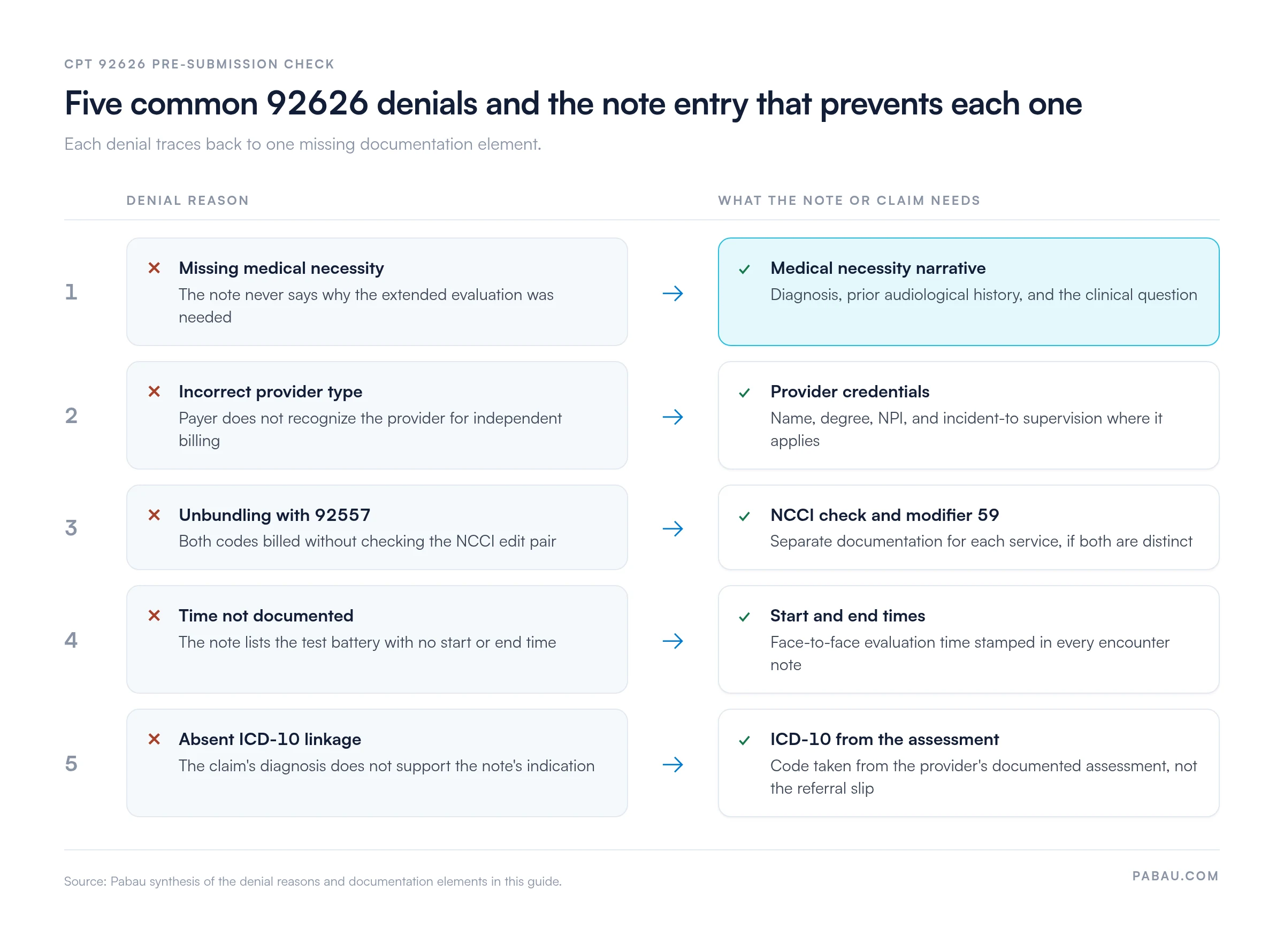
Denial patterns for CPT Code 92626 repeat across payers, so a short prevention checklist catches most of them. Each of the five common reasons below comes with a corrective action.
A claim fixed before submission costs less than one appealed after a denial, which is the core idea behind denial management workflows. Reviewing the common denial codes on audiology claims helps billing staff spot patterns early.
Set side by side, each of these denials maps to one entry in the note or on the claim.
CPT Code 92626 can be billed alongside an E&M visit on the same date of service, but the rules differ by provider type and payer. For physician providers, modifier 25 goes on the E&M code. It signals that the evaluation and management service was a separate, significant encounter beyond the diagnostic audiology test.
The E&M documentation must stand completely on its own. It cannot reference 92626 findings as the basis for the E&M level. Auditors look for a history, examination, and medical decision-making that justify an E&M visit on their own. The note should hold up even if no auditory testing had happened that day.
Audiologists billing without a same-day physician E&M avoid this issue. Under Medicare, audiologists typically cannot bill E&M codes independently. The same-day conflict is therefore limited to ENT and other physicians performing 92626 alongside an office visit.
Always verify payer-specific rules before billing both codes on the same date, as some commercial payers auto-bundle the pair regardless of modifier status. Reviewing medical billing fundamentals for diagnostic audiology can clarify the general principles behind same-day billing edits.
Build a pre-submission checklist for every 92626 claim. Confirm the time is documented, the medical necessity narrative is present, and the ICD-10 code matches the note. Then check that provider credentials are recorded and any same-day E&M carries modifier 25. Those five checks before submission prevent the five most common denials.
Without a connected system, front desk staff check coverage on a payer portal, and billing staff key the 92626 claim after the session. An audiology carve-out or a missing authorization often surfaces only when the denial arrives.
Pabau, the practice management platform we build, keeps simpler claims management in the same system as the appointment and the encounter note. Eligibility is verified in real time through the Claim.MD integration before the patient arrives.
Claims are then submitted, tracked by status, and reconciled against payments without leaving Pabau. Your billing team spends its time on the documentation checks above instead of chasing payer portals.

Pabau’s claims management helps practices submit clean 92626 claims and verify patient eligibility in real time through Claim.MD before the visit. See how it works for your practice.

A 92626 claim gets paid when the note proves the hour. Record the start and end times, each test, and why this patient needed the evaluation at this visit, and most denials never happen.
The trade-off is a few extra minutes of documentation per session. Those minutes cost far less than a corrected claim, an appeal, or an audit finding on an implant candidacy workup.
Pabau’s claims management verifies eligibility in real time before the encounter, so coverage problems surface before the claim does. To see how it works for your audiology or ENT practice, book a demo.

Need a framework for tracking claim errors across your practice? Medical claims clearinghouse guide explains how clearinghouse routing reduces edit failures before claims reach the payer.
Want to understand the 837 electronic transaction your claims travel on? 837 file guide breaks down the EDI format that carries 92626 claims to Medicare and commercial payers.
Exploring how ERA remittances map to denial reason codes? Electronic remittance advice explained covers how to read CARC codes on 92626 denials and build appeal responses.
CPT Code 92626 covers the first 60 minutes of auditory function evaluation for surgically implanted device candidacy or post-surgical device status. The code bundles the full assessment battery, provider interpretation, and written report into a single billable unit. Services like ABR and OAE testing are not bundled and require separate codes.
CPT 92626 covers the first 60 minutes of auditory function evaluation. CPT 92627 is the add-on code billed for each additional 15-minute increment beyond that first hour. 92627 cannot be reported without 92626 as the parent code. Most payers limit 92627 to two or three additional units per session, so verify the specific plan’s unit policy before billing extended sessions.
CPT 92626 evaluates auditory function for device candidacy or post-implant status; CPT 92625 assesses tinnitus severity, including pitch matching, loudness matching, and maskability testing. They cover completely different clinical questions. Billing 92625 when documentation describes a cochlear implant candidacy evaluation is an incorrect code selection that triggers medical necessity denials.
Yes, Medicare covers CPT Code 92626 when medical necessity is established. The documentation must also meet the applicable Local Coverage Determination for the practice’s MAC jurisdiction. Coverage terms, frequency limits, and prior authorization requirements differ by MAC. Verify the specific LCD before billing rather than relying on a general national policy.
The five most common reasons are a missing medical necessity narrative, an unrecognized provider type, and CCI bundling errors with 92557. The other two are missing start and end times, and an ICD-10 code that does not match the condition in the assessment note. Each has a straightforward corrective action described in the denials section above.
Licensed audiologists (Au.D.) are the primary billing providers for CPT Code 92626. Otolaryngologists and other ENT physicians may also bill independently. Speech-language pathologists may perform the evaluation under appropriate physician supervision and bill incident-to, subject to MAC-specific incident-to rules and state licensure scope-of-practice requirements. Provider eligibility varies by payer, so confirm credentialing status before billing.