HCPCS Code A4627: Spacer and valved holding chamber
HCPCS Code A4627: official descriptor and code definition HCPCS Code A4627 is th...

Last Updated: Oct 21, 2026
Billable Code
92537 is the CPT code for a bilateral, bithermal caloric vestibular test with recording. It covers one warm and one cool irrigation in each ear, four irrigations in total. The nystagmus response to each irrigation is recorded with ENG or VNG and interpreted in a signed report.
Coders often confuse it with 92533, the caloric test without recording, which Medicare bundles with no separate payment. A recorded test with one irrigation per ear is reported with 92538 instead.
Let Pabau's smart automation suggest the right codes, reduce claim denials, and keep your practice compliant—effortlessly.
Automate repetitive tasks and focus on what matters most—your patients.
Reduce coding errors and ensure compliance with the latest regulations.
Clean claims, fewer denials, and faster reimbursements.
Powerful insights and reporting to help your practice thrive.
HIPAA compliant SOC 2 certified GDPR-compliant Trusted by 4,000+ clinics worldwide

CPT code 92537 requires bithermal caloric irrigation of both ears with ENG or VNG recording. Missing either element makes the code unbillable.
92537 differs from 92533 in one way that matters: 92533 covers caloric testing without nystagmus recording. Medicare bundles 92533 with no separate payment, though some private payers still pay it.
A recorded test with one irrigation per ear is billed as 92538, and a three-irrigation test is billed as 92537 with modifier 52.
Accepted ICD-10 pairings include H81.x (vestibular disorders), H82 and R42 (dizziness). A diagnosis code that doesn’t support the test is a common cause of medical necessity denials.
Claims management software such as Pabau keeps the signed report, the diagnosis code and the claim in one record, so 92537 claims go out complete.
CPT code 92537 reports a bilateral, bithermal caloric vestibular test with ENG or VNG recording, four irrigations in total. It sits in the vestibular function tests with recording range (92537-92549) maintained by the American Medical Association (AMA). The table below covers the details a coder needs before submitting a claim.
CPT code 92537 covers a full bilateral bithermal caloric vestibular test. Warm and cool water or air is irrigated into each ear canal, four irrigations in total. Electronystagmography (ENG) or videonystagmography (VNG) records the nystagmus response to each one. The slow-phase velocity measurement from each irrigation must be documented in the written report.
What 92537 includes:
What 92537 does not include:
Proper documentation of the procedure is what separates a clean claim from a denial. Payers audit 92537 on two points. They check that a recording exists for each irrigation, and that both ears received bithermal irrigation.
The standard procedure steps are:
A clean claim submission for 92537 must be supported by this written report in the patient record. Practices that store only raw ENG tracing without a signed interpretive summary face consistent denials on audit.
Document the equipment used (ENG or VNG, and water or air as the irrigation medium) in every 92537 report. Some Medicare Administrative Contractors request this detail during pre-payment review. Having it in the note prevents additional development requests that delay payment.
CPT 92533 is the caloric vestibular test without ENG or VNG recording, and that one difference also changes how it is paid. Medicare bundles 92533 (payment status B), so it carries no separate payment. Some private payers may still pay it per irrigation.
The practical rule: If the practice performed and recorded a full four-irrigation bithermal test, bill 92537. A recorded test with one irrigation per ear is 92538, and three recorded irrigations are 92537 with modifier 52. If the recording equipment wasn’t used and only clinical observation was documented, 92533 per irrigation may apply. Medicare won’t pay it separately, so check the payer’s policy. Never upcode to 92537 when the ENG or VNG record doesn’t exist.
The decision comes down to two questions, laid out below.
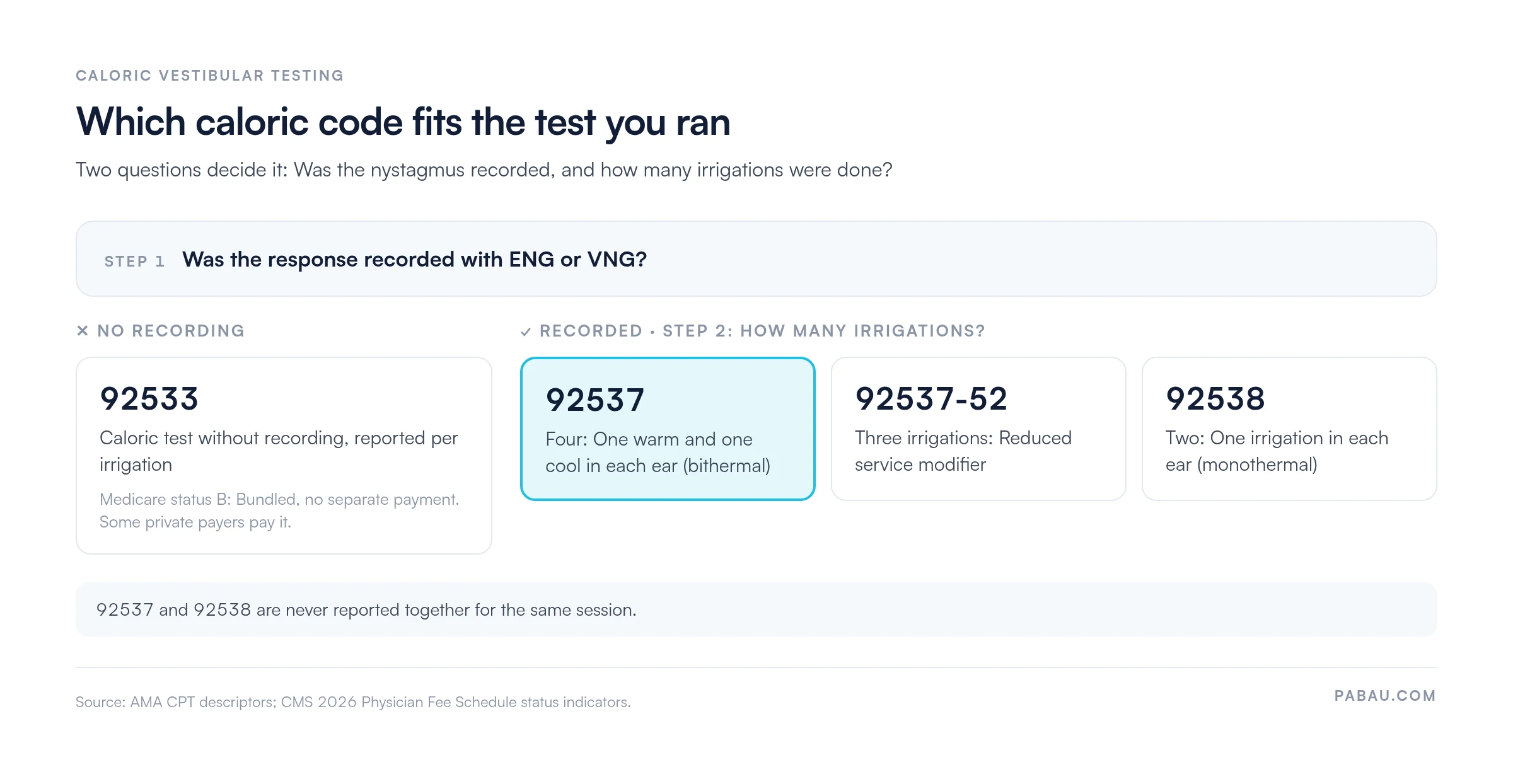
CPT code 92537 sits within a family of vestibular codes. Understanding which can be billed together on the same date of service is essential for avoiding NCCI bundling denials.
Always verify current National Correct Coding Initiative (NCCI) edits before billing any combination. The AAPC Codify CPT lookup provides bundling indicators for each code pair.
Pairing CPT code 92537 with the correct ICD-10-CM diagnosis code is the most direct way to satisfy medical necessity requirements. The codes below are commonly accepted by Medicare and commercial payers. When the workup starts from dizziness alone, R42 is usually the first diagnosis on the claim.
Always consult the local coverage determination (LCD) issued by your Medicare Administrative Contractor (MAC) before billing. LCDs vary by jurisdiction. Some MACs restrict coverage of CPT code 92537 to specific diagnosis codes within the H81 range. They may also require documentation that R42 was investigated rather than defaulted to.
Medicare covers CPT code 92537 under Part B when medical necessity is established and documentation supports the complete bilateral bithermal test with recording. Reimbursement rates are set annually by CMS and vary between facility and non-facility settings. Use the CMS Physician Fee Schedule lookup tool to pull current year rates for your geographic area.
Payment amounts change every January and differ by locality, so this guide doesn’t quote a fixed figure. RVU values can be confirmed with FastRVU’s 2026 RVU lookup. Check the current fee schedule before using any rate in revenue projections.
Incident-to billing for audiologists: Audiologists billing Medicare directly under Part B for 92537 must enroll as Medicare providers. When an audiologist performs and interprets the test in a physician’s office, incident-to rules may apply, depending on whether the physician is present and supervising.
The vestibular codes were restructured in 2016, when 92537 and 92538 replaced the deleted code 92543. Confirm current CMS guidance and your MAC’s LCD rather than relying on billing advice written before that change. The American Speech-Language-Hearing Association (ASHA) publishes Medicare coding guidance for audiologists that is worth reviewing every year.
Medicare fee-for-service does not typically require prior authorization for CPT code 92537. Medicare Advantage plans and commercial insurers, however, vary considerably. Prior authorization is more common when 92537 is ordered alongside a full VNG battery that includes multiple additional vestibular codes.
Before scheduling, verify insurance eligibility and authorization requirements for each payer. These steps reduce prior authorization delays.
Most 92537 denials fall into four categories. Recognizing them in advance prevents the majority of claim rework in audiology and ENT billing departments.
Structured denial management workflows help audiology practices track 92537 denials by reason code, spot patterns and prioritize appeals. Tracking common denial codes such as CO-97 and CO-50 shows whether a pattern is systemic or isolated.
A systemic pattern points to the documentation protocol and calls for a billing process change. An isolated one usually reflects a single payer’s policy and calls for an appeal letter with the supporting documentation attached.
Audiologists, otolaryngologists (ENT physicians), and neurologists are the providers most commonly performing and billing CPT code 92537. Medicare medical billing rules differ depending on how the service is performed and in whose office it takes place.
Audiologists billing Medicare directly must use their own NPI and provider number, not the supervising physician’s. Submitting under the wrong NPI is treated as a billing error and may trigger a refund demand. Verify enrollment status before the first claim goes out.
In many audiology and ENT practices, the ENG or VNG report lives in one system and the claim is built in another. A biller then checks by hand that the signed interpretation, the diagnosis code and the irrigation count all match.
Pabau’s claims management software keeps that documentation and the claim in the same patient record. Through its integration with Claim.MD, Pabau’s US clearinghouse partner, claims go electronically to thousands of US payers. Real-time eligibility checks run before the patient’s appointment, so coverage questions surface before the test.
The result is fewer 92537 claims returned for a missing report or an unsupported diagnosis code. Your billing team spends that time on new claims instead of appeals.

Pabau helps audiology and ENT practices capture ENG/VNG documentation, verify eligibility before appointments, and submit 92537 claims with the right ICD-10 pairings attached. That cuts the back-and-forth that delays payment.

CPT code 92537 is a well-defined procedure code, but its billing turns on three details. The recording requirement separates it from 92533, the bilateral mandate rules out unilateral tests, and ICD-10 pairing rules vary by MAC. Getting all three right on the first submission is what separates a clean audit trail from a denial backlog.
If your denials cluster on CO-97, start with the signed report. If they cluster on CO-50, start with the diagnosis code. Fixing the one step that fails most often recovers more revenue than reworking claims one at a time.
Book a demo to see how Pabau keeps vestibular test reports, diagnosis codes and claims together for audiology and ENT practices.

Need to understand how claims move through a clearinghouse? Medical claims clearinghouse explained covers how electronic claims are validated, routed, and acknowledged before reaching the payer.
Want to reduce rework on denied vestibular claims? Electronic remittance advice (ERA) guide explains how to read 835 remittance files and identify denial patterns by CARC code.
Building your revenue cycle from scratch? Revenue cycle management overview explains the end-to-end process from eligibility verification through payment posting.
CPT code 92537 covers a caloric vestibular test, bithermal (four irrigations: Warm and cool for each ear), with electronystagmography (ENG) or videonystagmography (VNG) recording. Both ears must be tested and the nystagmus response must be recorded and interpreted for the code to be valid.
CPT 92537 requires ENG or VNG nystagmus recording and covers a full bilateral bithermal test. CPT 92533 covers caloric irrigation without recording, billed per irrigation, and Medicare bundles it with no separate payment. Use 92537 when the complete four-irrigation test is performed with a recorded nystagmus response. Use 92533 per irrigation when no recording was made.
Yes, Medicare covers CPT code 92537 under Part B when an appropriate ICD-10 code establishes medical necessity. The documentation must also support the complete bilateral bithermal test with ENG or VNG recording. Coverage criteria are defined by local coverage determinations (LCDs) that vary by Medicare Administrative Contractor jurisdiction.
The most commonly accepted ICD-10 codes with CPT 92537 include H81.10-H81.13 (benign paroxysmal vertigo), H81.0x (Meniere’s disease) and H81.391-H81.392 (peripheral vertigo). Others are H82 (vertiginous syndromes) and R42 (dizziness). Always verify against your MAC’s LCD before submitting, as some payers restrict coverage to specific codes within the H81 range.
The most common denial reasons are: Missing ENG or VNG recording documentation (CO-97) and submitting 92537 when only one ear was tested. Others are an ICD-10 pairing that fails medical necessity review (CO-50), unbundling errors with 92533, and incident-to violations.
Medicare fee-for-service does not typically require prior authorization for CPT 92537. Medicare Advantage plans and commercial insurers vary, and some require prior authorization when 92537 is ordered alongside a full VNG battery. Verify authorization requirements with each payer before scheduling to avoid authorization-related denials.