HCPCS Code V2213: Billing, coverage and denial resolution
HCPCS code V2213: Official descriptor and code definition HCPCS code V2213 is th...

Last Updated: Nov 4, 2026
92548 is the CPT code for a computerized dynamic posturography sensory organization test (CDP-SOT), including interpretation and report. The test runs six conditions: eyes open, eyes closed, visual sway, platform sway, eyes closed with platform sway, and combined platform and visual sway.
Audiologists, ENTs, and neurologists report it for balance testing in balance centers and hospital outpatient departments. The code is global, so it covers the technical and professional components unless modifier 26 or TC splits them. Coverage criteria vary by Medicare Administrative Contractor, and Medicare Advantage plans often require prior authorization.
Let Pabau's smart automation suggest the right codes, reduce claim denials, and keep your practice compliant—effortlessly.
Automate repetitive tasks and focus on what matters most—your patients.
Reduce coding errors and ensure compliance with the latest regulations.
Clean claims, fewer denials, and faster reimbursements.
Powerful insights and reporting to help your practice thrive.
HIPAA compliant SOC 2 certified GDPR-compliant Trusted by 4,000+ clinics worldwide

CPT code 92548 reports a full six-condition CDP-SOT, including interpretation and report, as one global service.
Medical necessity documentation needs a qualifying diagnosis, symptom duration, prior conservative treatment, and a physician order.
Modifier 26 or TC splits the service when one party owns the equipment and another reads the results.
Modifier 50 never applies, because the test already measures whole-body balance.
Claims management software such as Pabau validates each 92548 claim for missing or invalid details before it reaches the payer.
CPT code 92548 is defined by the American Medical Association’s CPT code set as a computerized dynamic posturography sensory organization test (CDP-SOT). It includes interpretation and report. The descriptor lists six conditions: eyes open, eyes closed, visual sway, platform sway, eyes closed platform sway, and platform and visual sway.
Each of the six conditions isolates a different sensory input. The test removes or distorts vision and platform feedback step by step. That shows whether a patient’s balance problem starts in the visual, vestibular, or somatosensory system. All six must be completed for the code to apply, and partial testing does not support 92548.
The 92548 bundle covers the technical performance of all six SOT conditions and the written interpretation and report. It does not cover separately billable vestibular subtests performed on the same day.
Included: All six CDP-SOT conditions, equipment use, patient preparation, data recording, and the clinician’s written interpretation with diagnostic conclusions.
Not included: Separately billed fall risk assessment tools, motor control testing, and adaptation testing (other CDP protocol subtests). Electronystagmography and videonystagmography are also excluded, because they have their own code series.
Each code in the vestibular function test series covers a distinct procedure. Billing the wrong one, or pairing 92548 with a code it already includes, triggers automatic edits at most clearinghouses. The broadest code in the series is 92540, the basic vestibular evaluation, which already contains several of the tests listed below it.
Modifier selection is where many 92548 claims go wrong. The code is global, so it pays the professional and technical components together unless a modifier splits them. Which modifier applies depends on who owns the equipment and who reads the results.
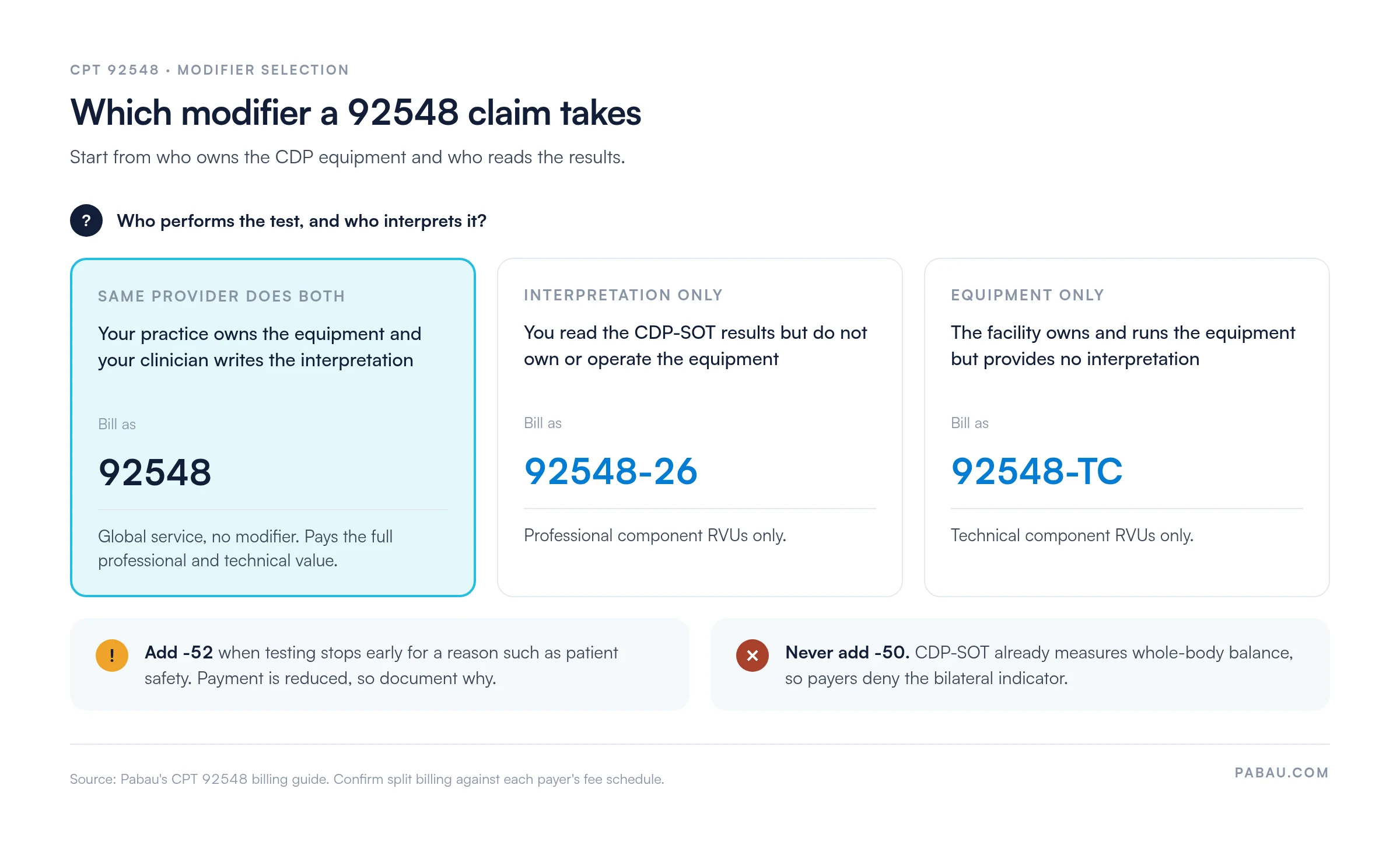
Bilateral modifier 50: CDP-SOT is an inherently bilateral procedure. The test measures the patient’s whole-body balance system, so modifier 50 does not apply. Payers that receive 92548 with modifier 50 typically deny the bilateral indicator as inappropriate for this service.
Check your payer’s fee schedule indicator for 92548 before splitting with modifier 26 or TC. Not every payer assigns separate professional and technical component values to this code. Submit 92548 without a modifier first if the payer pays globally, and add the modifier only when split billing is confirmed payable.
An unsupported diagnosis code is the fastest route to a 92548 denial. The ICD-10 code on the claim must name a condition where CDP-SOT tells the clinician something useful about vestibular or balance function.
Always cross-reference the ICD-10 code against your MAC’s Local Coverage Determination (LCD) for computerized dynamic posturography. Some MACs publish approved diagnosis code lists for this service. A code outside that list triggers an automatic denial, however strong the clinical documentation is. If a first workup was coded to R42, repeat testing should carry the more specific diagnosis that workup produced.
Medicare covers CPT code 92548 when medical necessity criteria are met and the patient’s diagnosis appears on the applicable MAC LCD. Each Medicare Administrative Contractor (Novitas, CGS, NGS, WPS, and others) issues its own LCD for vestibular testing. Coverage criteria therefore differ by geography.
The CMS Physician Fee Schedule publishes annual RVU-based reimbursement for 92548. The 2025 national payment is about $45 ($45.29), and the 2026 figure is about $47. CMS lists the same amount for facility and non-facility settings, before geographic practice cost index (GPCI) adjustments. Always verify current-year amounts in the PFS lookup before quoting patients or setting fee schedule expectations.
Traditional Medicare does not currently require prior authorization for CPT 92548, though payment model updates can change that. Medicare Advantage plans, commercial insurers, and Medicaid managed care organizations are different. Many of them require prior authorization for balance and vestibular testing.
Confirm authorization requirements for each payer and plan before scheduling the test. Insurance eligibility verification at scheduling shows whether prior authorization (PA) is required and what clinical information must go with the request. A typical PA package holds the referring physician’s order, the qualifying diagnosis with symptom duration, and notes on prior conservative management.
Payers reviewing 92548 claims look for a complete clinical picture in the record. A diagnosis code alone is not sufficient. The documentation must justify why CDP-SOT is the appropriate test for this patient at this point in their care.
Reviewing your billing compliance requirements against the applicable MAC LCD before billing reduces documentation-related denials. Templated balance evaluation forms often meet some MAC-required elements but not all of them. Audit those templates once a year against current LCD criteria.
Denials on 92548 cluster around a predictable set of causes. Each one has a corrective action that belongs in the pre-submission workflow, before an appeal is ever needed. The remittance advice names each rejection with a reason code, and our guide to denial codes explains how to read them.
Structured denial management workflows catch these patterns across payers and time periods. Track 92548 denials by payer, diagnosis code, and modifier to see which combination keeps failing. You can then fix the upstream step once instead of appealing each claim.
CPT code 92548 may be billed by any qualified provider who performs and documents the complete CDP-SOT service. Provider eligibility is straightforward for the most common settings, but Medicare supervision requirements add complexity in certain scenarios.
In a manual workflow, the coder picks the 92548 modifier from memory at charge entry. The diagnosis list drifts out of step with the MAC’s LCD, and a payer’s new prior authorization rule never reaches the scheduling notes. Each slip surfaces weeks later as a denial.
Pabau, the practice management platform we build, connects the clinical record to the claim. Its claims management software runs claim validation that scrubs each claim for missing or invalid details before submission. Eligibility checks through Claim.MD show the patient’s coverage before the test is booked. CMS-1500 claims then go out through the same clearinghouse.
The outcome is a 92548 claim that leaves the practice complete, with coverage already confirmed. What a payer expects from a clean claim on first submission is the standard that validation works toward. Your billing staff spend their time on the few claims that need judgment, not on resubmissions.

Pabau validates every claim for missing or invalid details and checks eligibility through Claim.MD before the visit. Audiology and ENT practices spend less time on resubmissions and more on patients.

Treat 92548 as a scheduling and documentation task first and a coding task second. Confirm the LCD diagnosis list and any prior authorization before the patient steps onto the platform. Then make sure the report names all six conditions and their results.
That moves the effort to the front desk, where a missing order costs a phone call rather than an appeal. Settle the modifier from who owns the equipment, and leave modifier 50 off for good. Book a demo to see how Pabau validates 92548 claims and checks eligibility before they go out.

Need to track denial patterns across CPT codes? Denial management in healthcare covers how to build a structured workflow that identifies root causes rather than appealing claims one by one.
Want to understand how the 837P claim file transmits to your clearinghouse? 837 electronic claim file explains the transaction set structure and what each segment means for a vestibular billing workflow.
Looking to verify eligibility before scheduling CDP-SOT? Claim.MD clearinghouse outlines how real-time eligibility checks surface prior authorization requirements and benefit details before the patient arrives.
CPT code 92548 covers computerized dynamic posturography sensory organization testing (CDP-SOT), including all six standardized balance conditions and a written interpretation and report. The six conditions systematically remove or distort sensory inputs to identify whether a balance disorder originates in the visual, vestibular, or somatosensory system. All six must be completed; partial testing does not support this code.
Valid modifiers for CPT code 92548 include 26, TC, 52, and 59. Modifier 26 is the professional component, used when the provider interprets results but does not own the equipment. TC is the technical component, used when the facility owns the equipment but provides no interpretation. Modifier 52 marks a reduced service, and 59 marks a distinct procedural service, used sparingly. Modifier 50 (bilateral) is not appropriate for posturography, as CDP-SOT is an inherently bilateral procedure by design.
Yes, Medicare covers CPT code 92548 when the patient’s diagnosis appears on the applicable MAC Local Coverage Determination (LCD) and documentation supports medical necessity. Coverage criteria vary by region: Each MAC (Novitas, CGS, NGS, WPS) issues its own LCD for vestibular testing with its own approved ICD-10 code list. Confirm your MAC’s current LCD before billing, and verify that the patient’s diagnosis is on the covered list.
Commonly accepted ICD-10 codes include H81.10, H81.391, H81.90, H82, and R42. Between them they cover benign paroxysmal vertigo, other peripheral vertigo, unspecified vestibular disorders, vertiginous syndromes in other diseases, and dizziness. Always verify against your MAC’s LCD approved list, as some contractors require more specificity than others and may reject R42 for repeat testing episodes.
The most common denial reasons are missing medical necessity documentation, a diagnosis code not on the MAC LCD approved list, and incorrect or missing modifiers. Missing documentation usually means no physician order, symptom duration, or record of prior conservative treatment. Prior authorization denials also occur frequently with Medicare Advantage and commercial plans. Building a pre-submission checklist that covers all six documentation elements prevents the majority of these denials at source.
No. Modifier 50 (bilateral) is not applicable to CPT code 92548 because CDP-SOT is inherently a bilateral procedure. The test measures whole-body postural control using both sides of the sensory system simultaneously. Payers that receive 92548 with modifier 50 will typically deny the bilateral indicator. Do not add modifier 50 to this code regardless of the patient’s lateralized diagnosis.