HCPCS code V5259: Digital binaural ITC hearing aid billing
HCPCS code V5259 reports a digital ITC hearing aid pair HCPCS code V5259 reports...

Last Updated: Oct 22, 2026
92700 is the CPT code for unlisted otorhinolaryngological service or procedure. Coders report it for an ENT or audiology service that no specific code in the 92502-92699 range, and no Category III code, describes.
Medicare assigns it status indicator C, so the contractor prices each claim case by case. Every claim needs a procedure note and a cover letter naming a comparable code, and many payers also require prior authorization.
Let Pabau's smart automation suggest the right codes, reduce claim denials, and keep your practice compliant—effortlessly.
Automate repetitive tasks and focus on what matters most—your patients.
Reduce coding errors and ensure compliance with the latest regulations.
Clean claims, fewer denials, and faster reimbursements.
Powerful insights and reporting to help your practice thrive.
HIPAA compliant SOC 2 certified GDPR-compliant Trusted by 4,000+ clinics worldwide

CPT Code 92700 is the catch-all unlisted code for ENT and audiology services that no specific code in the 92502-92700 range describes.
Each claim needs a procedure note and a cover letter explaining why no specific CPT code applies. Missing documentation is the top denial trigger.
Medicare gives 92700 status indicator C, so the contractor prices each claim case by case instead of paying a fixed fee schedule amount.
Pabau’s claims management software scrubs each claim for missing details and tracks it from Pending to Paid, so fewer 92700 claims bounce back.
The American Medical Association’s CPT code set places CPT Code 92700 at the end of the Special Otorhinolaryngologic Services subsection.
Its official descriptor is Unlisted otorhinolaryngological service or procedure. Coders report it only when no specific code in that subsection describes the ENT or audiology service performed.
Understanding medical billing fundamentals helps show where the code fits. The range begins at 92502 and covers procedures such as tympanometry, auditory evoked potentials, cochlear implant programming, and central auditory function evaluation. 92700 is the last code in it.
The table below maps 92700 against the key codes in its family. Check what is already described before reaching for the unlisted option.
When a service falls within this range but no descriptor matches what was performed, 92700 is the correct choice. Tympanometry, for instance, already has its own code, 92550. Verify against the AAPC’s CPT code lookup before defaulting to the unlisted option.
CPT Code 92700 covers any otorhinolaryngological service that has no specific CPT descriptor. That is its only qualifying condition.
Legitimate uses include novel ENT procedures and highly customized vestibular assessments that combine elements of several existing codes. Newly adopted techniques also qualify until the AMA assigns them a Category I or Category III code.
If a specific code exists for the service, that code must be used. Billing 92700 in its place is a coding error and an audit red flag.
The path below shows the order of those checks, and what has to go with the claim once 92700 is the answer.
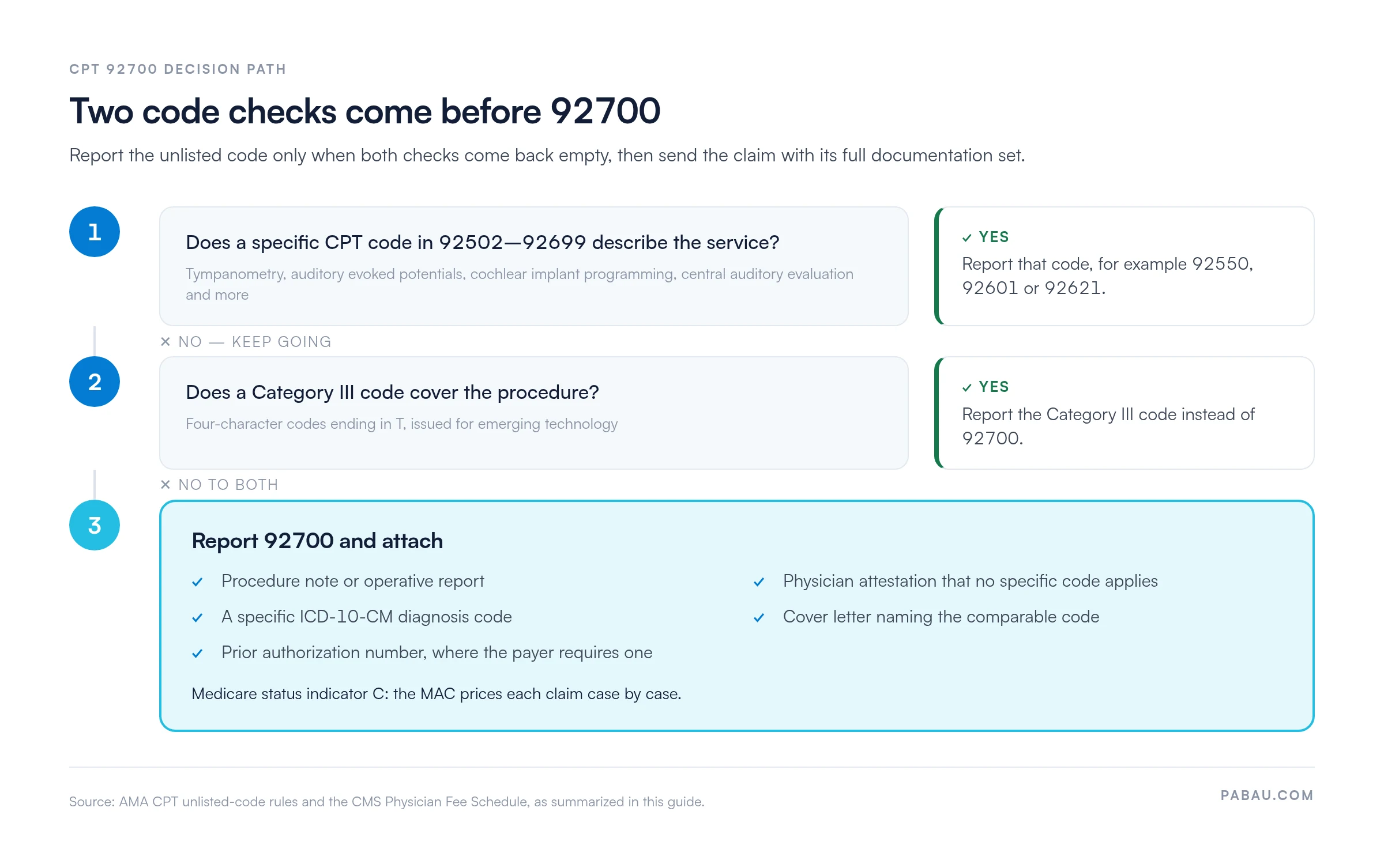
The codes most commonly confused with CPT Code 92700 are 92601 and 92621. Each has a defined descriptor that rules out 92700 when that service is being performed.
NCCI bundling edits for unlisted codes are updated quarterly. Before billing 92700 with a specific code on the same date of service, check the current CMS NCCI edit table for triggered edit pairs.
Before selecting 92700, work through the AMA’s complete 92502-92699 range systematically. Coders often miss 92640, diagnostic analysis with programming of an auditory brainstem implant, per hour. They also miss 92626, the evaluation of auditory function for implanted device candidacy or postoperative status. A payer can reclassify an unlisted code submitted when a specific code exists, and that can trigger a recoupment request.
Documentation for CPT Code 92700 must do more work than documentation for a specific code. The payer has no defined descriptor to match, so the clinical record has to build the whole justification.
Every 92700 claim requires these four elements:
Missing any one of these four elements is the most common reason CPT Code 92700 claims are denied on first submission.
Many payers require prior authorization for unlisted procedure codes, though requirements vary by contract and plan. Check with the payer’s provider relations line or online portal before performing the service, not after. For CPT Code 92700, the request typically needs to include:
Timelines vary. Some payers respond within 5 business days, while others take up to 14. Build prior authorization into your scheduling workflow so services aren’t performed before approval is in place.
A 92700 denial for missing prior authorization is rarely overturned on appeal. You’d need documented proof that authorization was obtained before the date of service.
Medicare assigns CPT Code 92700 status indicator C on the Medicare Physician Fee Schedule, which means the code is contractor-priced. No fixed relative value unit is published for it. The MAC sets the allowed amount case by case, usually by comparing the service to the closest specific code in the 92502-92699 range.
Coverage isn’t guaranteed. The MAC reviews the supporting documentation and applies any Local Coverage Determination for audiology or ENT services. Where no LCD applies, the MAC uses the reasonable and necessary standard under Section 1862(a)(1)(A) of the Social Security Act.
Tracking reimbursement through revenue cycle management workflows matters more for 92700 than for coded services. Payment takes longer, and amounts vary across MACs for the same procedure. Record the comparable code cited in each submission, so your billing team can benchmark payments against expected amounts over time.
Diagnosis coding for CPT Code 92700 must establish medical necessity for a service that has no standard descriptor. Specific (non-unspecified) ICD-10-CM codes are essential. The table below shows commonly paired diagnosis codes across ENT and audiology contexts.
Always select the most specific ICD-10-CM code available for the patient’s condition. Unspecified codes are acceptable only when documentation doesn’t support greater specificity, never as a shortcut. Payers already scrutinize 92700 claims closely, and a vague diagnosis code gives them one more reason to deny.
CPT Code 92700 claims are denied more often than claims for specific codes, because the payer has to review each one by hand. The reasons are predictable, and most can be prevented before submission. Good denial management workflows catch them before claims leave the practice.
Review CARC denial codes alongside each remittance advice to categorize denials systematically. A practice billing 92700 regularly should track denial rates by reason code and review them quarterly, so patterns surface before they become audit triggers.
CPT Code 92700 has no fixed RVU on the Medicare Physician Fee Schedule. Status indicator C means the reviewing MAC prices every claim individually, using the closest specific procedure code as a benchmark.
Commercial payers work in a similar way. Some reference the fee schedule for the comparable code, and others negotiate a rate during prior authorization.
So reimbursement for the same procedure can differ between MACs, between plan types, and even between claims for the same patient if documentation varies.
Use FastRVU’s RVU lookup to find the work RVU of the comparable code you cite in your cover letter. That figure anchors your pricing expectation and can support an appeal if the allowed amount falls well below it.
Don’t append modifier 22 to 92700. Modifiers adjust the defined descriptor of a specific code, and an unlisted code has no descriptor to adjust. When the service took substantially more work than the comparable code describes, explain the extra work in the cover letter and procedure note instead.
Submitting CPT Code 92700 correctly takes more pre-submission work than most specific codes. A consistent workflow reduces first-pass denials and shortens the time to payment. Claims management software that checks each claim for missing details keeps this process reliable across your billing team.
Unlisted procedure codes attract more scrutiny than specific codes in comparative billing reviews. A practice that bills 92700 far more often than its peers can draw attention. MACs and the OIG may flag the pattern for utilization review. A flagged pattern can prompt an Additional Documentation Request (ADR) or a probe audit.
The core compliance risk is using 92700 when a specific code exists. Each such claim is a billing error, and a pattern of them can amount to improper billing under the False Claims Act. Maintaining medical billing compliance for unlisted codes means building an internal audit checkpoint into your billing workflow.
When submitting 92700, always name the comparable specific code in your cover letter and explain how the service differs from that code’s descriptor. This gives the MAC a pricing anchor and shows your coding rationale is sound. Claims that omit the comparable code tend to draw lower payments and more documentation requests.
Many billing teams still handle 92700 claims by hand. Someone checks the claim fields, tracks down the authorization number, and follows the claim through the payer’s portal. Each manual step is a chance for a missing detail to cause a denial.
Pabau, the practice management platform we build, raises the claim straight from the patient’s invoice. Its claim validation scrubs each claim for missing or invalid details before it leaves the system. Prior authorization codes follow the appointment, and Pabau flags any claim that’s still missing one.
In the US, claims go out through Claim.MD, and electronic remittance advice files settle payments against the invoice. The claims dashboard tracks each 92700 claim from Pending to Paid, so your team sees which ones need action and why.

Pabau checks each claim for missing or invalid details and keeps prior authorization codes attached to the appointment. Your unlisted-code claims reach the payer complete.

Treat CPT Code 92700 as the last answer, never the first. Run both code checks, write the procedure note and cover letter, and secure authorization before the appointment. A claim built that way gives the MAC what it needs to price the service.
The trade-off is time. A 92700 claim takes longer to prepare and longer to pay than a typical coded service, and that won’t change. What you control is whether it comes back for a missing document.
Book a demo to see how Pabau’s claim checks and authorization tracking keep your unlisted ENT and audiology claims moving.

Want to build cleaner claims before they leave your practice? Submitting a clean claim covers the elements that determine whether a claim processes on first pass or triggers an ADR.
Looking for a broader overview of the billing process? Superbill documentation explains how to capture the procedure and diagnosis codes needed to support unlisted code submissions from the point of care.
Billing implant candidacy or follow-up testing? CPT Code 92626 covers the evaluation of auditory function for surgically implanted devices, the code coders most often miss before reaching for 92700.
CPT Code 92700 is the code for an unlisted otorhinolaryngological service or procedure. Use it when no specific code in the 92502-92699 Special Otorhinolaryngologic Services range describes the ENT or audiology service performed. It’s a code of last resort, chosen only after confirming that no specific CPT or Category III code fits.
Use CPT 92700 only when no active CPT code in the 92502-92699 range, and no Category III code, accurately describes the service. If a specific code exists, you must use it, even if the service was performed slightly differently. Billing 92700 when a specific code applies is a coding error.
Medicare can cover CPT Code 92700, but it has no fixed fee schedule amount. The code carries status indicator C, so the Medicare Administrative Contractor (MAC) prices each claim case by case. The MAC uses the closest specific code as a pricing reference and applies any relevant Local Coverage Determination. Coverage isn’t guaranteed for every service billed under this code.
You need a detailed procedure note and a physician attestation cover letter explaining why no specific code applies. Add a specific ICD-10-CM diagnosis code that establishes medical necessity, plus the prior authorization number where the payer requires one. Missing any of these is the most common cause of first-pass denial for this code.
CPT 92601 covers cochlear implant programming for patients under age 7, and 92621 covers each additional 15 minutes of central auditory function evaluation. When the service matches either descriptor, you must use that code instead of 92700. CPT 92700 applies only when no specific code in the range describes what was done.
Yes, CPT 92700 can usually be billed with a same-day evaluation and management (E/M) service when the E/M is separately identifiable. Append modifier 25 to the E/M code, not to 92700. Check the payer’s modifier policy and confirm no NCCI edit pairs the two codes for the current quarter.